Well Drilling in Franklin County, NC
Well drilling typically runs $3,000–$16,000 nationally, per our cost guide. Independent local pros serving Louisburg, Youngsville, Franklinton and nearby communities. Describe the problem and we'll route your request — free, no obligation.
- Mark no-water pump problems as emergencies on the form
- County pages on local well depths, aquifers, and permits
- Well inspections, water testing, and treatment
- Free to use — no obligation, no markup
Fast response from independent local providers. No obligation.
Typical national cost$3,000 – $16,000Cost guide →Local Help in Franklin County, NC
Franklin County Environmental Health, based in Louisburg, evaluates sites for wells in the county, issues the permits, inspects the work and handles repair permits for damaged wells. Its FY27 fee schedule, effective July 1, 2026, keeps the new well permit at $400 and lists a repair permit for an existing well and a well abandonment permit at no charge. The department's well page says every new well in North Carolina must be sampled for bacteriological quality and 17 inorganic parameters, and that the initial new-well sampling is free.
Most of the rulebook is statewide. G.S. 87-97, in the North Carolina Well Construction Act (Article 7 of G.S. Chapter 87), makes each county operate a program, run by the local health department serving it, that handles permits, inspections and water testing for private drinking water wells, and has that department enforce the state's minimum requirements, among them the 15A NCAC 02C construction standards. Wells that G.S. 87-88 leaves to the Environmental Management Commission to permit fall outside the county permit. This site forwards requests to independent well contractors and does not drill wells itself.
Franklin County Service Details
What providers in this area actually see: coverage, common jobs, local pricing factors, and rules worth knowing.
Service Area Notes
- Places: in the 2020 place-to-county list the Census Bureau publishes for North Carolina, Franklin County rows cover the towns of Bunn, Franklinton, Louisburg, Youngsville and Wake Forest (Wake Forest also has a Wake County row) and the Centerville and Lake Royale census-designated places, all still listed on the bureau's current TIGERweb layer.
- Applying: new well applications are completed in the county's Viewpoint portal, and only the property owner, or the owner's authorized agent using the county's Authorized Agent Form, may complete one. A site plan is required; the county says site plans must show setbacks from property lines and other structures and the dimensions of the proposed dwelling or structure, and commercial site plans must be prepared by an engineer and go through commercial review. The county says the application is valid for one year from the date of issuance and that fees are due at the time of application, with the payment prompt coming when the application is approved.
- Getting the lot ready (Lot Preparation sheet, FCHD/DEH Form 153, revised 1/15): before the evaluation the applicant must submit a site plan showing property dimensions, the location and size of proposed structures including decks, storage buildings, sheds and pools, driveways, and jurisdictional wetlands if applicable; clearly mark all property lines and corners within 250 feet of the proposed house site, and proposed lines if subdividing; clear obstacles that prevent free movement across the lot while minimizing soil disturbance; mark the house or structure location; and then contact Environmental Health to be scheduled. Each proposed septic system/lot needs its own application and site plan, and one evaluation may cover up to 3 acres. If a specialist arrives and the site has not been prepared, the applicant is notified and the application goes to Inactive status; once the site has been properly prepared, the applicant may contact Environmental Health to have the application made active again.
- Other North Carolina county pages on this site: Wake County, Johnston County and Union County.
Common Jobs in Franklin County
- New private drinking water wells, permitted after a specialist evaluates the prepared lot
- Irrigation-only wells: G.S. 87-97.1 allows an irrigation water well permit whether or not the property is connected to or served by public water, if the application states that the well will not be interconnected to plumbing connected to a public water system and will be used only for irrigation or other nonpotable purposes; the section does not apply where the property is connected to, or may be served by, a public water system whose operating authority or government unit receives Local Government Commission assistance
- Repairs to the well itself under the county's no-charge repair permit (pump and tank work is covered in the FAQ)
- Hydrofracturing a weak well, which the DHHS certification chart places at Level B
- Permanent closure of unused wells under the no-charge abandonment permit
- Bacteria, inorganic, uranium, radon and gross alpha/beta tests on existing wells
What Drives Pricing Here
- Estimate: this site's calculator prices the bore by applying a national per-foot range, keyed to the rock type you choose, to the depth you type in, then adds a general permit line and pump and pressure tank allowances; its code credits those figures to Angi, HomeGuide and HomeAdvisor. It holds no Franklin County data, so use it as a starting budget and substitute the county's $400 permit.
- Depth: no publication cited on this page gives a typical well depth for Franklin County. Under G.S. 87-97(k) the health department keeps an address-searchable registry of the wells it permits, with every water test result, and each GW-1 record filed under 02C .0114 reports a well's diameter, depth and yield.
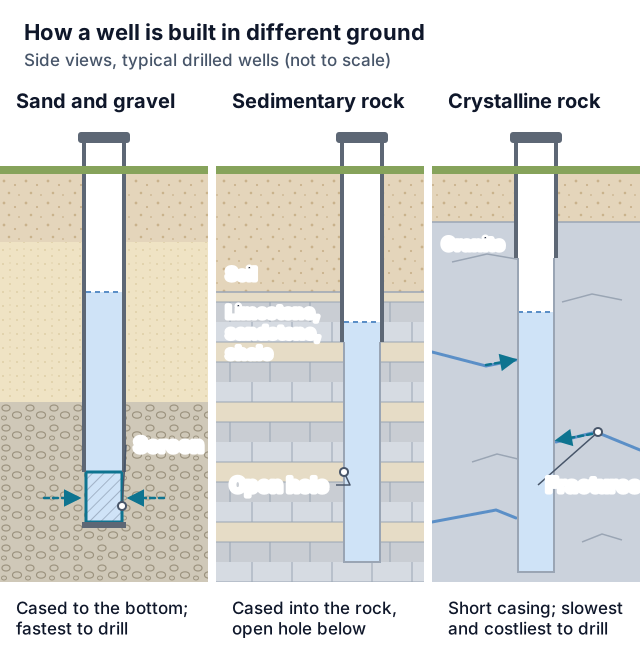
- Casing: Franklin is not among the areas listed in 02C .0116(a) or .0117, so the general .0107(d)(4) minimum is casing to 20 feet below land surface, or 43 feet for a well built at reduced separation distances, subject to the shallower-source provisions of .0116(b)-(c). In a well drawing water from consolidated rock the casing must be set firmly into the rock by at least five feet, and its top must stand 12 inches or more above land surface.
Permits & Local Rules
- Certification (G.S. 87-98.4): Article 7A forbids performing, managing or supervising any well contractor activity, meaning a well's construction, installation, repair, alteration or abandonment, without being certified. Exempt are a worker employed by, or performing labor or services for, a certified well contractor in connection with activity done under that contractor's personal supervision; anyone building, repairing or abandoning a well on a tract that the individual owns or leases; and a government agency employee doing the activity solely within the scope of that government employment. The licensed plumbing contractor exemption in 87-98.4(b)(13) and the other exemptions in (b) and (c) have their own conditions. None of them excuses the separate G.S. 87-97 permit.
- Selling well work (87-98.4(a)): if you are not a certified well contractor, or you are not an employee of one, you may offer well contractor activity only when a certified well contractor will perform it and, before work begins, you give the landowner a written disclosure naming that contractor, giving the contractor's certification number, and naming the company employing the contractor.
- Levels: under Article 7B, the Well Contractors Certification Commission sits in NC DHHS's Division of Public Health. On the DHHS chart, breaking the well seal for pump installation or repair, chlorination or disinfection is Level D work; grouting, abandonment, packers and liners are Level C; hydrofracturing, cable tool rigs and direct push are Level B; and air or mud rotary rigs, sonic drilling and geothermal loops are Level A, each level covering the ones below it.
- Permit decision (G.S. 87-97(d)-(f)): a field evaluation of the site comes first, and an abandoned well found there makes its proper closure a condition of the construction permit. The department has 30 days from receipt of the application to grant or deny it; the permit issues automatically only when the department lets those 30 days pass without acting, and the department may then contest that permit under Chapter 150B. A compliant well cannot be denied because of a local government policy against new wells. Permits last five years and may be revoked if a fact or circumstance underlying the permit materially changes.
- Changes after the permit: 02C .0306(a) lists the changes the owner or agent must report to the health department before construction, among them separation distances that cannot be met and a house or septic system that has to move from its permitted spot; check the full list in the rule or with Environmental Health.
- Setbacks (02C .0107(a)): a water supply well may not sit where surface water or runoff collects around it, and the rule's table sets minimum distances to contamination sources existing when it is built, among them 50 feet from a single-family dwelling's septic tank and drainfield, repair area included (100 feet for a saprolite system under 15A NCAC 18A .1956); 100 feet from septic tanks and drainfields serving all other facilities; 25 feet from building perimeters, counting attached structures needing a building permit such as garages, patios or decks; 50 feet from a surface water body that recharges groundwater (the rule's examples are ponds, lakes and reservoirs), but 25 feet from other surface waters, such as creeks and rivers; and 50 feet from gravesites.
- Tight lots (02C .0107(a)(3)): when a single-family dwelling's lot is too small, or other fixed conditions keep its domestic well from meeting the table, the well keeps the greatest separation possible, with floors of 25 feet to an industrial or municipal sewage or liquid-waste collection line or sewer main built to AWWA C600 and/or C900 water main standards and 50 feet to animal barns. Such a well must then be cased to 43 feet or more and draw its water from deeper than 43 feet below land surface.
- Grout (02C .0107(f)): outside the Rule .0116 areas, grout around the casing goes at least 20 feet down, and deeper wherever a zone holding water that is contaminated, saline or otherwise non-potable has to be sealed off. It must be placed no later than seven days after the casing is set, shortened to one day when a saline water-bearing zone has been penetrated. Paragraphs (e) and (f) set the allowed grouts and placement methods, each with its own limits.
- Inspection calls: Franklin makes contractors responsible for notifying Environmental Health that a well grout or wellhead inspection is needed and asks drillers and plumbers to call the day before, and no later than 9 am the day of, the inspection. 02C .0305 and G.S. 87-97(e2)-(e3) describe when a contractor may grout without an inspector and certify the grout instead, with their own notice, timing, holiday and certification conditions, and under 87-97(e4) a well with a grout-depth variance needs a scheduled inspection, with only the health department able to certify it. Ask Environmental Health before grouting day.
- Certificate of completion (02C .0306(b)-(c), G.S. 87-97(g)): while the work goes on, the well contractor keeps at the site a copy of whichever permit covers the job, whether construction, repair or abandonment, meets all of its conditions and sends the health department a copy of the GW-1. The department then verifies the well was built in the permitted area and to the permit, inspects the grout around the casing for settling and the wellhead with the seal in place, confirms the GW-1 arrived, and issues a Certificate of Completion that includes an as-built drawing. Without that certificate, a new well may not go into service and a well repaired under permit may not return to service.
- Records (02C .0114, .0307): within 30 days after completing or abandoning a well, whoever did the work sends the GW-1 (for construction) or GW-30 (for abandonment) to DEQ's Division of Water Resources, with the items .0114(1) lists and a copy to the county health department for a water supply well; giving it to anyone else does not satisfy the Division filing. A repair record goes to both within 30 days.
- Closing a well: an abandonment permit comes before permanently abandoning a private drinking water well (02C .0304(a)); 02C .0113 sets fill and seal methods by well type, and .0309 the notice, optional inspection and certification steps. A well acting as a source or channel of contamination must be repaired or permanently abandoned within 30 days of receipt of notice from the local health department (.0301(b)(3)).
- New-well tests (G.S. 87-97(h), (j)): within 30 days of certifying a newly built well complete, the health department tests its water, or makes sure a certified laboratory samples and tests it, for bacterial indicators, nitrates, nitrites, pH, sodium, fluoride, iron, manganese, magnesium, zinc, copper, lead, arsenic, barium, cadmium, chromium, mercury, selenium and silver. Results go to the owner and, as far as practicable, to anyone leasing a dwelling unit or other facility served by the well at sampling time. Franklin says to run the water until construction chlorine has dissipated, then call to schedule sampling.
Geology & Water Table Notes
- Aquifer: the USGS record for monitoring location FR-145, a Franklin County well, lists, as its national aquifer, Piedmont and Blue Ridge crystalline-rock aquifers. HA 730-L, the USGS Ground Water Atlas chapter for the region, says most of the Piedmont is underlain by dense, almost impermeable bedrock that yields water mainly through fractures, and that regolith of saprolite, colluvium, alluvium and soil covers that rock almost everywhere and is everywhere more permeable than the bedrock beneath it.
- Bedrock in one quadrangle: NC Geological Survey Open-File Report 96-2 (1996) covers the Zebulon 7.5-minute quadrangle, which takes in parts of Franklin, Johnston, Nash and Wake Counties. It puts the Rolesville batholith, a composite Alleghanian intrusive, under the western two-thirds, and in the eastern third gneiss the authors consider equivalent to Raleigh gneiss plus metavolcanic and metasedimentary rocks of the Eastern slate belt.
- Test history: NC DHHS county reports summarize private well samples the North Carolina State Laboratory of Public Health tested between 1998 and 2010. In Franklin's report, 218 of 1,017 wells (21.44%) exceeded the iron secondary standard of 300 micrograms per liter, 165 of 1,022 (16.14%) the manganese secondary standard of 50 micrograms per liter, and 49 of 1,100 (4.46%) the 15 micrograms per liter lead level; none of 1,022 exceeded the arsenic MCL of 10 micrograms per liter, and 427 of 1,022 (41.78%) fall in its below-range column for the 6.5 to 8.5 pH guideline. DHHS warns that a county's averages may not reflect any single well's groundwater.
- Uranium: an NC DHHS fact sheet says groundwater uranium in the state is generally found in the Raleigh Belt, Carolina Slate Belt and the Charlotte and Milton belts, with the Raleigh Belt highest, and cites the EPA's 30 micrograms per liter public drinking water standard.
Communities Served
Louisburg · Youngsville · Franklinton · Bunn · Wake Forest · Centerville · Lake Royale
Emergency Response Expectations
Well dry or pump dead in Franklin County? Mark the request urgent; it goes to independent contractors, and we cannot say how soon one will reply. Afterward, the NC DHHS testing FAQ says to test after repairs or replacements of well components and after flooding, and the county recommends chlorination when a sample shows bacteria.
Franklin County FAQs
What are Franklin County's well permit and water test fees?
On the FY27 schedule, effective July 1, 2026: $400 for a new well permit, and no charge for a repair permit on an existing well or a well abandonment permit. Bacteria tests are $40 without a visit or $75 with one, and the inorganic panel $75 without a visit or $100 with one; uranium, radon and gross alpha/beta are $100 each with a visit, and the RAD package of all three is $300 with a visit, an entry dated February 10, 2026 with the note "cost of testing increased". The department's fee web page, headed Effective August 15, 2016, still shows $225 for that package. The first new-well sample is free.
Can I take my own well water sample in Franklin County?
For bacteriological and inorganic tests, yes, at a reduced fee: pick up a container at the Environmental Health office any weekday and return the sample Monday through Wednesday, or have a specialist collect it. Nitrate/nitrite, iron bacteria, sulfur bacteria, pesticide, herbicide, petroleum product and volatile organic compound samples must be collected by Environmental Health staff. Existing-well sampling can be ordered and paid for in the Viewpoint portal.
Does replacing a well pump need a Franklin County repair permit?
No. G.S. 87-97(c) exempts from the repair permit any maintenance done without breaking or opening the well seal and any repair limited to fixing or replacing a pump or tank, and the county says a repair permit is not required to replace a well pump. The worker still needs certification (the DHHS chart puts pump installation at Level D or higher) unless the worker falls under a G.S. 87-98.4 exemption, and 02C .0111 requires whoever installs a pump to disinfect the well afterward by the rule's chlorination procedure or a Department-approved alternative. The county's chlorination handout lists removing the seal for pump repairs without disinfecting afterward as one source of bacterial contamination.
Public water lines run near my lot. Can I still get a well permit?
In defined cases, yes. G.S. 87-97.2 lets an owner apply for, and be issued, a private drinking water well permit for undeveloped or unimproved property located so as to be served by a public water system, and for developed or improved property when the system has not yet installed water lines directly available to it or otherwise cannot serve it when the owner wants service. Such an owner need not connect while the well stays compliant and in use; an owner who connects later may keep the well only if it is not interconnected to plumbing connected to the public system and is used only for irrigation or other nonpotable purposes. The section does not apply, and the public water system may mandate connection, if the well serving the property has failed and cannot be repaired, the property is in an area where the well's water is contaminated or likely to become so because of nearby contamination, or the public water system is run by an authority or government unit receiving Local Government Commission assistance.
Do I have to be at the lot when Environmental Health evaluates it?
No. The county says you may schedule a time to be there; otherwise the inspector contacts you with any questions or problems, or completes the permit and sends it to the contact information you supplied. G.S. 87-97(d) also bars a local program from requiring the contractor at the predrill inspection when the mapped well location is staked or similarly marked on the property, as long as the contractor can answer questions by telephone.
How often does NC DHHS suggest testing a well for uranium?
Every two years: the DHHS fact sheet says to have a certified lab test well water for uranium as part of the inorganic panel screen, and the county offers uranium, radon and gross alpha/beta tests. The G.S. 87-97(h) new-well panel does not include uranium. For high levels, DHHS names reverse osmosis and ion exchange treatment, or bottled water or a public water connection where possible.
Sources
- Franklin County Environmental Health: well and septic permits page
- Franklin County EH: Private Well Water Testing Program
- Franklin County EH: department page
- Franklin County: FY 27 Adopted Fee Schedule (effective July 1, 2026)
- Franklin County EH: Fee Schedule web page
- Franklin County EH: Lot Preparation sheet
- Franklin County EH: Well Chlorination handout
- NCGA: G.S. 87-97
- NCGA: G.S. 87, Article 7 (Well Construction Act)
- NCGA: G.S. 87, Article 7A
- NCGA: G.S. 87, Article 7B
- NC OAH: 15A NCAC 02C rules
- NC DHHS: Well Contractor Certification Levels
- NC DHHS: Franklin County well results, 1998-2010
- NC DHHS: Contaminant maps by county
- NC DHHS: Uranium fact sheet
- NC DHHS: Well testing FAQ
- NC Geological Survey OFR 96-2 (Zebulon quadrangle)
- USGS HA 730-L: Piedmont and Blue Ridge aquifers
- USGS: monitoring location FR-145
- Census Bureau: 2020 NC place-by-county codes
Last reviewed 2026-10-29
Services Available in Franklin County
Well Drilling
New residential wells — find local drillers for site evaluation, depth estimates, and written drilling quotes.
Learn more →Water Well Drilling
Household water wells from site evaluation through casing, pump, and water test — written quotes from local drillers.
Learn more →Well Pump Repair
No water at the tap? Request urgent well pump repair — local pros diagnose pressure loss, dead pumps, and pressure tank failures fast.
Learn more →Well Pump Replacement
Pump at end of life or beyond repair? Get quotes for correctly-sized submersible and jet pump replacement from local well pros.
Learn more →Well Inspection & Testing
Buying a home with a well, or overdue for a water test? Local pros for flow tests, equipment inspection, and lab water-quality testing.
Learn more →Well Water Service
Water quality problems, treatment systems, and general well maintenance — connect with local pros for everything between drilling and pump work.
Learn more →Free Tools Before You Call
Ballpark the cost or narrow down the problem before talking to a Franklin County provider.
Well Drilling Cost Calculator
Estimate what drilling a well should cost — by depth, geology, and whether you need the pump and pressure tank included.
Use the free tool →No Water From Your Well? Diagnostic Wizard
Suddenly no water in the house? Answer a few questions to find out if it's the breaker, the pressure switch, the tank, the pump — or the well itself.
Use the free tool →Well Pump Size Calculator
Find what size well pump you need — GPM demand, total dynamic head, and a horsepower recommendation from four quick inputs.
Use the free tool →Need help in Franklin County, NC?
Send the short form — urgent requests get priority routing.