Well Drilling in Johnston County, NC
Well drilling typically runs $3,000–$16,000 nationally, per our cost guide. Independent local pros serving Smithfield, Clayton, Selma and nearby communities. Describe the problem and we'll route your request — free, no obligation.
- Mark no-water pump problems as emergencies on the form
- County pages on local well depths, aquifers, and permits
- Well inspections, water testing, and treatment
- Free to use — no obligation, no markup
Fast response from independent local providers. No obligation.
Typical national cost$3,000 – $16,000Cost guide →Local Help in Johnston County, NC
In Johnston County, private drinking water wells and agricultural or irrigation wells are sited, permitted and inspected by Johnston County Environmental Health under the county's well rules; its wells page says that work includes keeping the well a safe distance from contamination sources, observing the casing grout and sampling the water. The department's Environmental Health Fee Schedule, Effective Date July 1, 2026, charges $400 for a private well permit and $325 for an agricultural/irrigation well, lists well repair and abandonment permits at no charge, and sets a $50 well reinspection fee.
Two layers of rules apply here. G.S. 87-97 directs every North Carolina county, through its local health department, to run a program that permits, inspects and tests private drinking water wells and to enforce the state's minimum well requirements, including the construction standards in 15A NCAC 02C. On top of that, the Johnston County Board of Health enforces its own Regulations Governing Permitting, Construction, Repair, Inspection, Sampling and Abandonment of Private and Semi-Public Water Supply Wells, amended and readopted June 3, 2008 and in force from July 1, 2008. Their foreword says the county rules reach beyond the state's on small semi-public systems, a negative bacteria compliance sample before a well is approved, grouting, continuous disinfection units and property-line setbacks. This site passes requests to independent well contractors; it does not drill wells itself.
Johnston County Service Details
What providers in this area actually see: coverage, common jobs, local pricing factors, and rules worth knowing.
Service Area Notes
- Towns: the Census Bureau's 2020 North Carolina place-to-county file has Johnston County rows for these incorporated towns: Archer Lodge, Benson, Clayton, Four Oaks, Kenly, Micro, Pine Level, Princeton, Selma, Smithfield, Wilson's Mills and Zebulon (Zebulon also has a Wake County row). The bureau's current TIGERweb layer still lists each of them as an active town. Its 2020 county subdivision file names these Johnston County townships: Banner, Bentonville, Beulah, Boon Hill, Clayton, Cleveland, Elevation, Ingrams, Meadow, Micro, O'Neals, Pine Level, Pleasant Grove, Selma, Smithfield, Wilders and Wilson Mills.
- Applying: the county's combined Application for Septic System and Well asks for the completed form, a site plan, a zoning document from the appropriate zoning district and the fee for each individual lot, plus an owner's consent form when the applicant is not the owner. The form notes there is no fee for a well abandonment permit.
- Wait times: the department's home page says its septic and well response time was 5 weeks or less as of October 16, 2026.
- Other North Carolina counties on this site: Wake County, Franklin County and Union County.
Common Jobs in Johnston County
- New private drinking water wells and agricultural/irrigation wells, each billed at its own permit fee on the county schedule
- Semi-public supplies serving 3 to 14 connections that fall outside the public water system definition; the county rules require Health Department approval of the location, plans and specifications, prepared by a registered professional engineer, before construction
- Repair work on the well itself, which needs a state repair permit; upkeep that leaves the well seal unbroken and unopened, and jobs that only fix or swap a pump or tank, need none (G.S. 87-97(b)(2), (c))
- Pump installs, after which the county rules call for a plate within 72 hours naming the well contractor and certification number and stamped with the install date, pump intake depth and horsepower rating
- Permanent closure of unused wells under a county abandonment permit
- Water sampling through Environmental Health for bacteria, chemicals, nitrates and nitrites, and petroleum and pesticides; radionuclide tests go through a private laboratory
What Drives Pricing Here
- Calculator: this site's cost tool multiplies the depth you type in by a per-foot range tied to the geology you select, then adds a generic $200 to $500 permit line and, unless switched off, pump and pressure-tank allowances, all taken from Angi, HomeGuide and HomeAdvisor cost guides. Nothing in it is specific to Johnston County, so treat its output as a rough budget; Johnston's own private well permit is $400 on the July 1, 2026 schedule.
- Depth: the sources on this page give no typical well depth for Johnston County. The county rules require each new well's identification plate to be stamped with total depth, casing depth and inside diameter, yield, static water level with the date measured, and the completion date, and G.S. 87-97(k) has each health department keep a registry of permitted wells, searchable by address, that includes test results. Records from neighboring wells are the nearest local guide.
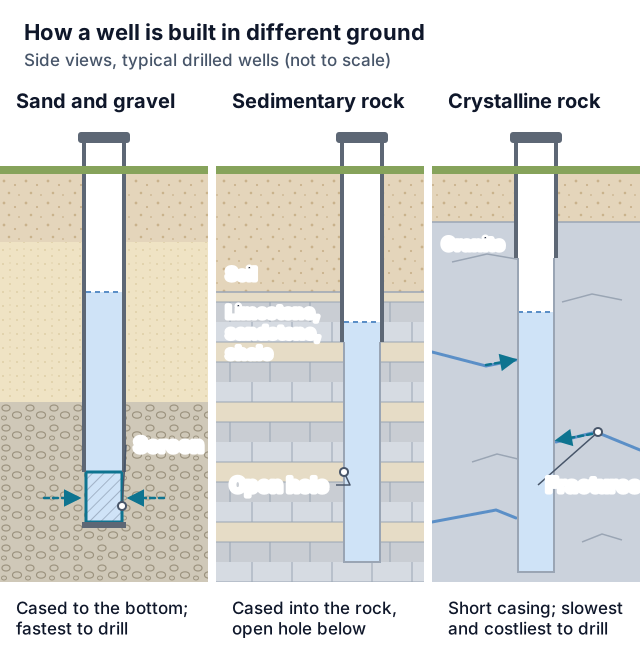
- Rock or sand: under 15A NCAC 02C .0107(d) a well that draws from consolidated rock needs casing seated firmly, five feet or more, into the rock, while a well in an unconsolidated formation such as gravel, sand or shells needs casing at least one foot into the top of the water-bearing formation and, under .0107(g), a screen that keeps formation material out after development.
- Tight lots: when space, lot size or other fixed conditions prevent the required distances, the county rules let the Health Director require casing and grout to at least 50 feet if the Director finds the restriction creates a topographical, geological or environmental threat to groundwater; a liner and packer may be installed instead. A single-family domestic well built at the state's reduced distances under 02C .0107(a)(3) also needs casing to at least 43 feet and a water source more than 43 feet below land surface.
Permits & Local Rules
- Certification (G.S. 87-98.4): nobody may perform, manage or supervise well contractor activity, which Article 7A defines as building, installing, repairing, altering or abandoning any well, without being certified. Exempt from that requirement are workers employed by a certified contractor, or doing labor or services for one, when the work is done under that contractor's personal supervision; a person building, repairing or abandoning a well located on land that person owns or leases; a government agency employee acting solely within the scope of that government job; a plumbing contractor licensed under Article 2 of Chapter 87 who installs pumps or pumping equipment, breaks, installs or reinstalls a well seal, or disinfects the well as part of installing, altering or replacing pumping equipment in or near it, provided the plumber keeps documentation showing that, within the two years before the job, the plumber took a continuing education course that covered well seal installation, protection and sanitation and stays on site until the well has been disinfected and sealed; and the persons and activities in 87-98.4(b)(4) through (12) and (14), each on the conditions written there, plus any activity the commission exempts by rule under 87-98.4(c). These exemptions concern certification only; they do not waive the G.S. 87-97 permit or the county permit.
- Selling the job: under 87-98.4(a), someone who is not certified, or who lacks employment with a certified well contractor, may offer well work only if a certified well contractor will do it and, before work starts, the landowner receives in writing that contractor's name, certification number and employer's company name.
- The commission: Article 7B places the Well Contractors Certification Commission in the NC Department of Health and Human Services, Division of Public Health. It adopts the certification rules and makes the final agency decision on certification matters and on civil penalties under Article 7A. DHHS notes that only individuals, never companies, hold certification, and that any well contractor activity needs at least one contractor certified at the appropriate level there in person to do or supervise it.
- County driller registration: Section III of the county rules requires every person, firm or corporation in the business of using power machinery to drill, bore, core or construct wells in Johnston County to register with the Health Department each year, during December 1 to 31 or at another time the department sets. Registration uses the department's application form, accompanied by a copy of the state certification of each person who manages or supervises on-site activities, and a properly completed application earns a certificate of registration.
- Permit first: under Section IV the well owner or the owner's authorized agent must obtain the permit before anyone builds a well in the county, and a private or semi-public well site is approved only after Environmental Health staff complete a detailed site investigation. The driller may not begin drilling until the permit is issued and is responsible for meeting all required setbacks and separations. Under 02C .0306(b), the well contractor must keep a copy of the well construction, repair or abandonment permit on the job site at all times during the construction, repair or abandonment of the well and must meet all the permit's conditions. Unless the department states otherwise in writing, a permit lapses 60 months after issuance if construction is not complete, and a new permit is then needed. State law requires the health department to issue a permit or a denial within 30 days of receiving an application to construct or repair a well; only if it fails to act within those 30 days is the permit issued automatically, and the department may then challenge that issuance under Chapter 150B. The statute also sets a five-year validity subject to revocation if a fact or circumstance the permit rested on materially changes (G.S. 87-97(e)-(f)).
- Plan changes: after a construction permit is issued, the owner or agent must tell the health department before construction if the 02C .0107 separation criteria cannot be met; the house or other structure will sit somewhere other than shown on the permit; the structure's use changes; the septic system has to move; landscaping changes may affect the well's integrity; groundwater-use restrictions under G.S. 87-88(a) exist or are pending; a domestic well's water source is next to a water-bearing zone suspected or known to be contaminated; or anything else in the application changes (02C .0306(a); the county rules carry the same list).
- Setbacks: the county table in Section V(a)(3) includes 100 feet to a septic tank, drainfield and designated repair area, 50 feet to a building foundation, 50 feet to surface water bodies, 50 feet to a cemetery or burial plot and 10 feet to property boundaries. For a well serving a single-family dwelling where the lot's size or other fixed conditions make the table distances impossible, the county requires the greatest distance possible and never less than 50 feet to a septic tank and drainfield, 25 feet to a water-tight sewage or liquid-waste collection or transfer facility, 50 feet to animal barns, 25 feet to building foundations and 50 feet to cesspools and privies. The county rules also say actual distances must satisfy the most stringent applicable federal, state or local requirement; the state table in 02C .0107(a)(2) sets its own distances for sources such as landfills, coal ash sites and building perimeters, including attached decks and garages that need a building permit.
- Grout: 02C .0107(f) requires grout to at least 20 feet below land surface and deeper where needed to seal off zones with contaminated, saline or other non-potable water, placed within seven days after the casing is set, or within one day where the well penetrates a saline water-bearing zone; .0107(e)-(f) list the allowed grouts and placement methods with their limits. The county rules add a surface slab at least 4 inches thick reaching at least 2 feet out in every direction and require grouting within five working days after the casing is set.
- Grout checks: 02C .0305 has the contractor schedule a grout inspection with the department and sets when the contractor may grout without one and certify the grout instead, and G.S. 87-97(e2)-(e4) add a notice-based self-certification route with its own deadline, content and holiday conditions and an exception for wells under a grout-depth variance. Because the route depends on notice and timing, ask Environmental Health before grouting day.
- Before anyone moves in: Section IV(h) of the county rules bars occupying a residence, place of business or place of public assembly, and bars using any newly constructed well, until the department finds through inspection and required testing that coliform bacteria are absent and that the well meets the rules and every permit condition. The county issues no certificate of completion for a new or repaired well until a compliance bacteriological sample shows no coliform (Section VIII(a)), though Section XII(5) lets a permanent continuous disinfection device meet the compliance requirement with the Health Director's approval; state law bars putting a new well in service, or returning a repaired one to service, without that certificate (G.S. 87-97(g)).
- Records: 02C .0114 requires the person who completes or abandons a well to file form GW-1 (construction) or GW-30 (abandonment) with the Division of Water Resources at DEQ no later than 30 days afterward, with a copy to the county health department when it is a water supply well; handing the record to anyone else does not count as filing with the Division. Repair records go to the health department and the Division within 30 days of the repair (02C .0307). The county rules also require a record of construction, abandonment or repair, certified by the person who did the work, to reach the Health Department and the well owner within 15 days, and capacity-test results, including well depth, grout depth, static water level, casing depth, diameter, gallons per minute, completion date and the contractor's signature, within five days after the test.
- Closing a well: 02C .0304(a) requires a well abandonment permit from the local health department before a private drinking water well is permanently abandoned, and the county rules require abandoned wells, temporary or permanent, to be handled under 02C .0113, which sets the watertight-cap requirements for wells temporarily out of service and the fill and seal procedures for permanent abandonment by well type. The notice, optional inspection and contractor certification steps are in 02C .0309, and the county rules say the driller shall complete the construction or abandonment of the well within 30 days of commencement of the construction.
- New-well water tests (G.S. 87-97(h), (j)): no later than 30 days after a newly built well receives its certificate of completion, the health department tests the water, or ensures a certified lab has sampled and tested it, for bacterial indicators, pH, nitrates, nitrites, sodium, fluoride, arsenic, barium, cadmium, chromium, copper, iron, lead, magnesium, manganese, mercury, selenium, silver and zinc. The owner receives the results, and so, to the extent practicable, does any leaseholder of a dwelling unit or other facility the well served when it was sampled. Johnston's wells page adds that the new-well bacteria samples must be free of coliform before a certificate of completion is issued and that a private lab may take the samples.
Geology & Water Table Notes
- Bedrock: NC Geological Survey Open-File Report 90-7 (Carpenter, 1990) places the Powhatan 7.5-minute quadrangle, in Johnston County, in the eastern Piedmont within the Eastern slate belt. Most of its crystalline rock is deeply weathered and crops out only in stream valleys, and across most of the quadrangle a sedimentary veneer a few centimeters to a few meters thick covers it, thickening to the south and east. The veneer includes Cretaceous fluvial sand and clay, probable Tertiary marine sands with minor gravel, Tertiary or Quaternary channel deposits and Quaternary stream alluvium.
- Radionuclides: a Johnston County Environmental Health handout says Late Paleozoic granites and granodiorites occur naturally in the western and northern parts of the county, that as this rock decays it gives off alpha and beta particles and breaks down to elements such as uranium, radon and radium, which can be released into soil, air and groundwater, and that testing by a certified lab is the only way to be sure whether a private well has them. The county's wells page says only a private laboratory can run this test.
- Historical test data: an NC DHHS county report on private well samples analyzed by the State Laboratory of Public Health from 1998 to 2010 counts, for Johnston County, 476 of 1,458 wells (32.65%) above the 300 micrograms per liter secondary standard for iron, 425 of 1,460 (29.11%) above the 50 micrograms per liter secondary standard for manganese, 10 of 1,460 (0.68%) above the 10 micrograms per liter arsenic MCL, and 564 of 1,463 (38.55%) below the 6.5 to 8.5 pH range. DHHS cautions that county averages may not reflect groundwater quality in a single well.
Communities Served
Smithfield · Clayton · Selma · Benson · Four Oaks · Kenly · Princeton · Pine Level · Micro · Wilson's Mills · Archer Lodge
Emergency Response Expectations
After a flood, the NC DHHS testing FAQ advises testing a well because contaminants may enter when the wellhead is under water, and Johnston's wells page links the State Laboratory of Public Health guide to disinfecting a well. When you flag a job as urgent, we pass it to independent contractors; we have no way to say how soon one will reply.
Johnston County FAQs
What does Johnston County charge for well permits and water tests?
The schedule effective July 1, 2026 lists $400 for a private well, $325 for an agricultural/irrigation well, no charge for well repair or abandonment and $50 for a reinspection. When the applicant collects the water, it lists $29 for total coliform and $74 for a full inorganic panel; the office-collects list starts with $30 per visit for water sampling and prices tests such as nitrates/nitrites at $32. Water-sampling prices carry the note State Lab Fee (subject to change).
Who can take the bacteria sample that clears a new well?
Under Section XII of the county rules, the collector must be a person the Health Department has approved, and approved collectors are limited to Johnston County Environmental Health staff, an authorized representative of a certified laboratory, Registered Sanitarians and certified well operators. An unbroken chain of custody runs from the collector to the lab, which must be the State Health Department Laboratory or a lab certified and approved by the Certification Section of the North Carolina Public Health Laboratory. Ask Environmental Health whether a particular collector is approved. It is taken at least 24 hours after the disinfectant has been removed, never from a well without a working pump or finished wellhead, a system still holding chlorine, an improperly chlorinated new system or an irrigation or agricultural well, and the owner supplies power for the sampling. With the Health Director's approval, a permanent continuous disinfection device may be used to meet the compliance requirement.
Is a permit needed just to swap out a well pump in Johnston County?
Not the state repair permit: under G.S. 87-97(c), repair work that involves only the repair or replacement of a pump or tank needs none. The county rules still call for disinfection after pump installation and say repairs that require breaking the well seal, other than routine maintenance, are inspected before use, so check with Environmental Health. The person doing the job still needs well contractor certification unless one of the G.S. 87-98.4 exemptions applies; the DHHS certification FAQ puts pump installer work at Level D or higher and says any activity beyond breaking the well seal or disinfecting the well, such as extending casing, requires Level C or higher.
How close to the property line can a well go?
Ten feet is the minimum in the county's separation table, which sits alongside the larger distances to septic systems, foundations and other sources. The state table in 02C .0107 has no property-line entry.
Should I test for uranium or radon?
The county flags naturally occurring granites in the western and northern parts of Johnston as a possible source and says a certified lab test is the only way to know. Only a private laboratory runs radionuclide tests, and the county's wells page links a list of certified labs.
What testing schedule does NC DHHS suggest for a well already in use?
The NC DHHS testing FAQ recommends total and fecal coliform bacteria every year, heavy metals, nitrates, nitrites, lead and copper every two years, and pesticides and volatile organic compounds every five years, or yearly for a pesticide you know is applied nearby. It says well water should be tested after repairs or replacements of any well component and after flooding, and says pregnant women and homes with infants should test for nitrates.
Sources
- Johnston County Environmental Health: Private Drinking Water Wells
- Johnston County Environmental Health: Fee Schedule (Effective Date July 1, 2026)
- Johnston County: Regulations Governing Private and Semi-Public Water Supply Wells (2008)
- Johnston County: Application for Septic System and Well
- Johnston County: Testing Private Drinking Water Wells for Radionuclides
- N.C. General Assembly, G.S. 87-97: well permits, inspections and water tests
- G.S. Chapter 87, Article 7A (Well Contractors Certification Act), N.C. General Assembly
- G.S. Chapter 87, Article 7B (Well Contractors Certification Commission), N.C. General Assembly
- 15A NCAC 02C well construction rules, Office of Administrative Hearings PDF
- NC DHHS Division of Public Health: well contractor certification questions
- NC DHHS Epidemiology: when and how to test a private well
- NC DHHS: Well water contaminants by county
- NC DHHS: Johnston County private well test results, 1998-2010
- NC Geological Survey Open-File Report 90-7: Powhatan quadrangle, Johnston County
- Census Bureau 2020 place-by-county codes, North Carolina
- Census Bureau 2020 county subdivision codes, North Carolina
Last reviewed 2026-10-29
Services Available in Johnston County
Well Drilling
New residential wells — find local drillers for site evaluation, depth estimates, and written drilling quotes.
Learn more →Water Well Drilling
Household water wells from site evaluation through casing, pump, and water test — written quotes from local drillers.
Learn more →Well Pump Repair
No water at the tap? Request urgent well pump repair — local pros diagnose pressure loss, dead pumps, and pressure tank failures fast.
Learn more →Well Pump Replacement
Pump at end of life or beyond repair? Get quotes for correctly-sized submersible and jet pump replacement from local well pros.
Learn more →Well Inspection & Testing
Buying a home with a well, or overdue for a water test? Local pros for flow tests, equipment inspection, and lab water-quality testing.
Learn more →Well Water Service
Water quality problems, treatment systems, and general well maintenance — connect with local pros for everything between drilling and pump work.
Learn more →Free Tools Before You Call
Ballpark the cost or narrow down the problem before talking to a Johnston County provider.
Well Drilling Cost Calculator
Estimate what drilling a well should cost — by depth, geology, and whether you need the pump and pressure tank included.
Use the free tool →No Water From Your Well? Diagnostic Wizard
Suddenly no water in the house? Answer a few questions to find out if it's the breaker, the pressure switch, the tank, the pump — or the well itself.
Use the free tool →Well Pump Size Calculator
Find what size well pump you need — GPM demand, total dynamic head, and a horsepower recommendation from four quick inputs.
Use the free tool →Need help in Johnston County, NC?
Send the short form — urgent requests get priority routing.