Well Drilling in Parker County, TX
Well drilling typically runs $3,000–$16,000 nationally, per our cost guide. Independent local pros serving Weatherford, Aledo, Willow Park and nearby communities. Describe the problem and we'll route your request — free, no obligation.
- Mark no-water pump problems as emergencies on the form
- County pages on local well depths, aquifers, and permits
- Well inspections, water testing, and treatment
- Free to use — no obligation, no markup
Fast response from independent local providers. No obligation.
Typical national cost$3,000 – $16,000Cost guide →Local Help in Parker County, TX
Water wells in Parker County fall under the Upper Trinity Groundwater Conservation District, which covers Hood, Montague, Parker and Wise counties and adopted its current rules on August 27, 2026. Rule 2.2(a)(1) requires registration of every well drilled on or after January 1, 2009, regardless of size, capacity or type of use, and Rule 2.2(i) says the owner or driller of a new well must hold an approved registration before drilling commences. Rule 2.2(n) leaves out leachate, monitoring, cathodic protection and closed-loop geothermal wells, except a monitoring well that will be converted to a producing well.
Rule 4.3 ties a new well's location to two numbers: the gallons per minute it can actually produce as equipped, which sets its spacing tier, and the acreage of the tract. Rule 1.1 defines the aquifer layers in the district: the Antlers, Paluxy, Glen Rose and Twin Mountains units of the Trinity Aquifer group, and the Wichita, Cisco/Bowie, Canyon and Strawn units of the Cross Timbers Aquifer. This site owns no rigs and hands each request to independent contractors, so read the rule summaries below as questions to settle with a licensed driller and the district.
Parker County Service Details
What providers in this area actually see: coverage, common jobs, local pricing factors, and rules worth knowing.
Service Area Notes
- Census Bureau 2020 place-by-county records list Weatherford, Aledo, Willow Park, Hudson Oaks, Springtown, Reno and Azle as cities and Annetta and Millsap as towns in Parker County; Azle and Reno also have rows under Tarrant County, and Springtown under Wise County. The Bureau's current TIGERweb layer of incorporated places adds Peaster, a town inside the county.
- Other authorities: Rule 2.1(g) tells applicants that district approval may not grant all the authority needed to drill, and to check the rules of other bodies with possible jurisdiction, naming the county, the city, the special district, TDLR and TCEQ. The new-well registration form (revised August 24, 2026) asks whether a local permit is required for a water well and whether public water system service is available to the property.
- Older wells: a well begun before January 1, 2009 must be registered unless it is exempt under Rule 3.1(a)(1), (2) or (3) (Rule 2.2(a)(2)). The owner of an exempt pre-2009 well may still register it under Rule 2.2(b) to document that it predates certain district rules and to gain, among other entitlements, the spacing protection existing wells receive. Rule 4.3(b) adds that registering is the only way an owner can make sure such a well is protected by the spacing rules and considered in exception cases.
- Drilling a well and installing its pump fall under two separate TDLR licenses, and TDLR's online license search shows which one a contractor carries.
Common Jobs in Parker County
- Exempt household wells, registered with and approved by the district before drilling
- Livestock and agricultural wells planned around the exemption limits for wells drilled or approved from September 1, 2026
- Picking a pump capacity that fits the tract's Rule 4.3 spacing tier
- Exception applications for lots platted smaller than the current minimum tract size
- Replacement wells, authorized by the district before the new hole is drilled (Rule 2.15)
- Pump and pressure tank replacement that stays within the rules' maintenance-and-repair definition
- Flow restrictors on wells run by variable frequency drives
- Abandoned wells capped to TDLR standards or plugged by a licensed well driller or pump installer; deteriorated wells plugged by one of those licensees (Rule 5.7(c))
- Bacteria sampling through an accredited lab
What Drives Pricing Here
- Pump capacity shapes the site plan. Rule 4.3 measures the most the well can actually produce as equipped, and each higher tier needs more distance from other well sites and from the tract's property lines, so pump size and lot layout have to be settled together.
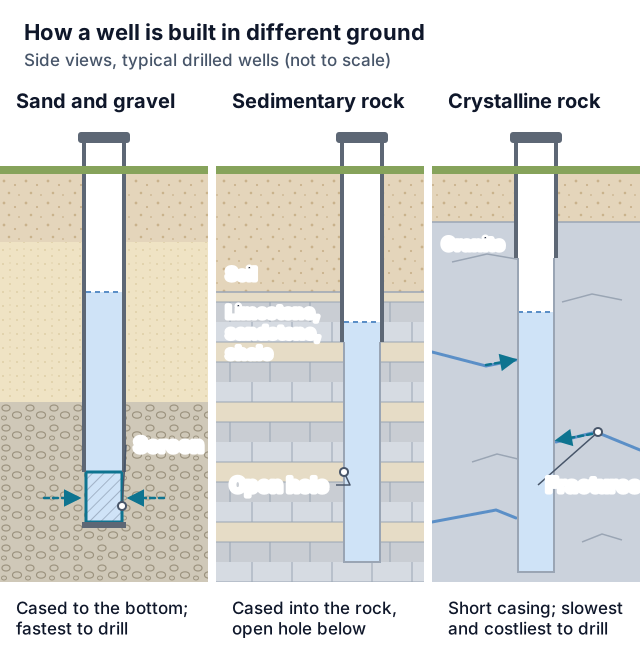
- Completion depth: Rule 4.4(d) requires that, once completion and equipping are done, a new well has at least 50 feet of groundwater in the bore over the pump, or fully penetrates the aquifer or layer it is screened in with the pump at the lowest practicable location. If the driller goes through the bottom of that aquifer or layer, Rule 4.4(e) requires appropriate steps so the well is completed in a way that prevents pollution or harmful alteration of fresh groundwater by saltwater or other deleterious matter, or other commingling of waters that differ in chemical quality, as 16 TAC chapter 76 requires; the driller may ask the district for help settling the depth. Ask whether the footage in a quote meets these standards.
- District fees are set by Board resolution rather than in the rules (Rules 6.6 and 6.7). The board's August 14, 2025 minutes record Resolution 25-004, with its fee schedule effective January 1, 2026, and the October 15, 2026 meeting agenda listed possible adoption of Resolution 26-004 for calendar year 2027, so take current amounts from the district's Forms & Fees page.
- The State of Texas Well Report deposit that Rule 6.6 allows comes back when every required tracking number reaches the district on time; it becomes district property if one does not, or if rights in the registration are not timely used. Rule 2.2(k) also forfeits it when nobody notifies the district within five business days of completing construction.
- Non-exempt wells carry extra steps: a permit is required before drilling, substantially altering, operating or producing from them (Rule 2.5(a)), and a pre-application meeting with district staff is mandatory (Rule 2.3(f)). Rule 6.1 applies groundwater use fees to wells not exempt under Rule 3.1, with the agricultural rate set at $0.00, and Rule 8.1 requires those wells to be metered unless Rule 8.2 exempts them.
- The cost calculator on this site takes a depth from you, applies a per-foot rate that changes with the geology option chosen, and adds pump, pressure tank and generic permit lines. Upper Trinity's own fees are not in it, and the figure it returns is an estimate rather than a quote.
Permits & Local Rules
- Exemptions, Rule 3.1(a): wells are exempt from district permitting, reporting, fees and metering if they are (1) of any size and used solely for domestic use; (2) used solely for livestock, poultry or agricultural use and drilled or approved before September 1, 2026; (3) drilled or approved before that date, not a retail public utility well, unable to produce more than 17.36 gpm as equipped, and used at least partly for some other purpose; (4) drilled, altered or approved on or after September 1, 2026, used solely for livestock, poultry or agricultural use, and either capable of no more than 17.36 gpm on a tract larger than 10 acres or no more than 8 gpm on a tract meeting Section 4's minimum size; or (5) leachate, monitoring or closed-loop geothermal wells, other than a monitoring well to be converted to production. Wells in a well system are judged on their combined capacity (Rule 3.1(b)), a retail public utility well is never exempt (Rule 3.1(f)), and Rule 3.1(e) still makes a new exempt well register and meet Section 4's tract size and spacing.
- State floor: Texas Water Code 36.117(b)(1) requires every groundwater district to exempt from permitting a well used solely for domestic use or for livestock or poultry if it sits on a tract larger than 10 acres and is drilled, completed or equipped so that its output cannot exceed 25,000 gallons of groundwater a day. Section 36.117(h) has districts require well owners to register under district rules and to equip and maintain wells to the district's casing, pipe and fitting rules.
- Spacing table, Rule 4.3(a) (capacity as equipped: distance from other well sites / from the property line): 8 gpm or less, 150 ft / 50 ft; more than 8 to 17.36 gpm, 300 ft / 100 ft; more than 17.36 to 30 gpm, 500 ft / 150 ft; more than 30 to 50 gpm, 1,000 ft / 250 ft; more than 50 to 80 gpm, 1,750 ft / 500 ft; more than 80 to 100 gpm, 2,500 ft / 750 ft; more than 100 to 150 gpm, 3,250 ft / 1,000 ft; more than 150 gpm, 4,000 ft / 1,250 ft. The well-site distance runs to then-existing registered or permitted wells, approved well sites and unregistered wells the General Manager identifies under Rule 4.3(b). It does not apply where the vertical offset between the two wells is 100 feet or more, or where the district finds an aquitard leaves no more than de minimis vertical hydraulic conductivity between them (Rule 4.3(c)); such wells must still meet the tract size, property-line distances and Rule 4.4 completion standards. Property-line distances have their own exceptions. An applicant who owns the right to produce groundwater on two or more contiguous tracts need not meet them at the line between those tracts, but they apply again if a road, highway or other easement separates the tracts and the applicant does not own or lease the right to produce groundwater under it, and a later sale of a tract brings Rule 4.3(e) into play (Rule 4.3(f)). Under Rule 4.3(g) a retail public utility, which must still meet the distances from then-existing wells, may use its CCN boundary (its political subdivision boundary if it has no CCN, or for a Facilities Only or Facilities +200 Feet CCN the Rule 5.3(a) polygon of the properties it serves) as its property line, and the acreage inside its CCN or political subdivision boundary for tract size; a utility well that relies on this without meeting the distances from the utility's actual property lines is not treated as an existing well for later spacing. Rule 4.2(a) separately applies the state spacing and location rules in 16 TAC chapter 76 unless TDLR grants a written variance and the applicant forwards a copy to the district.
- Minimum tract size, Rule 4.3(h): two acres by default, but five acres where the total average thickness of all Trinity Aquifer layers is 60 feet or less under the latest TWDB-approved Groundwater Availability Model of the Northern Trinity and Woodbine Aquifers (or as the district determines from credible evidence), and on any other tract in the district west of the line that criterion defines. Management-zone requirements adopted under Rule 5.4 can add to these. Once a well is registered, the owner must keep the surface acreage and groundwater rights needed to stay in compliance, or the district may reduce the well's authorized production or capacity or require it to be plugged (Rule 4.3(e)).
- Registration review: applications are sworn and filed on the district's form by mail, email, fax or hand delivery (Rule 2.1(c)), with the contents Rule 2.2(c) lists. Within ten business days the General Manager says whether the application is administratively complete; an incomplete one expires if not completed within 120 days of the district's request. It counts as complete, and may be approved without notice or hearing, if it substantially complies with the rule, is not inconsistent with county or municipal platting rules or decisions the General Manager knows of, and, for a well drilled after January 1, 2009, includes the State of Texas Well Report deposit and proposes a well meeting Section 4. The General Manager may instead set it for the Board, and a denial may be appealed by written request for a Board hearing (Rule 2.2(d)).
- Exempt status and the drilling clock: the General Manager decides within five business days after receipt of the completed application whether the well qualifies for a permitting exemption, and the applicant may appeal within 30 days of the written determination (Rule 2.3(b)). An exempt registrant may begin drilling on receipt of the approved registration and has 120 days from approval to drill and complete; the General Manager may approve one extension of up to 120 days, and any further extension needs Board approval (Rule 2.3(c)). The district's Forms & Fees page links a Request to Extend form.
- On site: the well must be drilled within ten feet of the registered coordinates, and if it is not at the exact point the driller reports its exact location within five business days of completion (Rule 4.2(c)). Within five business days after the well is completed, altered or equipped and a pump installed, the driller or pump installer must notify the district so it can test the flow rate before the well goes into operation (Rule 2.3(e) also names the well owner); the well must allow an open flow test before any pressure tank, and only permanent, non-adjustable flow restrictors are allowed (Rule 2.16(d)).
- Reports: whoever drills, deepens, completes or alters a well files the State of Texas Well Report tracking number with the district no later than 60 days after completing the work (Rule 2.16(a)). 16 TAC 76.70(1) separately has the driller, by the 60th day after drilling, deepening or altering is completed or stops, deliver the well log to TDLR electronically through its well report system, with copies to the well's owner (or the person it was drilled for) and to the groundwater conservation district.
- Exceptions: the General Manager may approve a tract-size exception only if the well is solely for domestic use or for emergency use by a fire department or other emergency services provider, cannot produce more than 8 gpm as equipped, has a registration meeting the rules, and sits on a tract platted or lawfully configured below the minimum before that minimum was adopted and not split into smaller tracts after that date and before drilling, completion or equipping of the well, or as Rule 4.5(f) otherwise allows (Rule 4.6(b)). That well must still meet spacing where a compliant spot exists on the tract; if none does, the General Manager may approve another location (Rule 4.6(c)). Other tract-size exceptions and spacing exceptions go to the Board under Rules 4.5 to 4.7. Rule 4.5(b) bars a tract-size exception for a tract under two acres when a public water system is available, meaning water is already on the property, a main on or next to it can legally be connected, or the approved plat calls for public water that can be delivered within a reasonable time on request; applications by retail public utilities and by emergency services providers for emergency-only wells are excepted. Owners of non-exempt wells must also show that no economically feasible alternative supply is available (Rule 4.5(c)), and applicants for non-exempt wells or permits must schedule a pre-application meeting with the General Manager before filing (Rule 4.3(b)). An exception granted because no such supply was available requires a written agreement that, once the district finds one available, the applicant will at its own cost and at the district's sole discretion either remove the well's equipment and give the district access to monitor it, or have a licensed well driller or pump installer plug the well within 90 days of the district's final decision rescinding authority to operate it (Rule 4.5(h)). A granted exception is recorded in the county deed records (Rule 4.7(j)), and a well drilled under a spacing exception is not protected as an existing well in later applications (Rule 4.5(g)).
- Board-route exceptions: the Board may not approve one until the General Manager has declared the application administratively complete, the applicant has given written notice on the district's form to the owners of record listed under Rule 4.5(d)(3), and a public hearing has been held (Rule 4.7(e)). Rule 4.7(f) and Rule A.6 set the notice contents, the timing (no less than ten calendar days before the hearing) and the allowed service methods; read them, or ask the district, before mailing anything.
- Licensing: Occupations Code 1901.151 and 1902.151 bar acting as a water well driller or pump installer without a TDLR license; the chapters' definitions, their dewatering-project exemptions (Secs. 1901.161 and 1902.161) and 16 TAC 76.30 set out who is excluded or exempt. District Rule 4.4(b) bars drilling, completing, equipping, altering or plugging a well in the district without a current driller's or pump installer's license as required under 16 TAC chapter 76.
- Plugging: under Occupations Code 1901.255(c), once a landowner or other possessor learns a well is abandoned or deteriorated, plugging or capping to TDLR standards must be done by the 180th day. Statewide, 16 TAC 76.104 lets a licensee or the well owner plug, but in this district Rule 5.7(c)-(d) requires the well, within that 180 days, to be plugged by a licensed well driller or licensed pump installer or capped under TDLR standards, and a deteriorated well must be plugged by such a licensee. 16 TAC 76.104(d) allows capping only where the well is not deteriorated, its casing is in good condition and it is beneficial to the landowner; the covering has to stop surface pollutants, hold a weight of at least 400 pounds and not come off easily by hand. Under Rule 5.7(e) the district may require an open or uncovered well to be kept closed or capped except when in use, and the owner must cap or close it within ten days of receiving the district's notice. The licensee who plugs a well sends the district the State of Texas Well Plugging Report or its tracking number within 30 days (Rule 2.16(f)), and 16 TAC 76.70(3) gives whoever plugged it the same 30 days to get the plugging report to TDLR and to the owner.
Geology & Water Table Notes
- The district's groundwater management plan, adopted April 17, 2025, describes the Trinity layers from earlier studies: the Paluxy Sand typically yields small to moderate quantities of fresh to slightly saline water; the Glen Rose Formation is mostly limestone with some shale, sandy shale and anhydrite and yields small quantities in localized areas; and Twin Mountains wells, mostly completed in the formation's lower part, typically yield fresh and slightly saline water in moderate to large quantities. It places the Antlers, where the Paluxy and Twin Mountains merge, north of the line where the Glen Rose thins out, in about central Wise County.
- The same plan says the Cross Timbers formations (formerly called the Paleozoic aquifers) are a significant source in western Parker County where the Trinity Aquifer is absent. Using TWDB groundwater database records as of November 2009, it put 5.4 percent of Parker County's wells in those formations and 3.0 percent in alluvial deposits, which it says produce water especially along the Brazos River in Parker County.
- TWDB's Trinity Aquifer page says groundwater in the aquifer's outcrop is in general fresh but very hard, and that total dissolved solids rise from under 1,000 milligrams per liter in the east and southeast to 1,000 to 5,000 milligrams per liter as depth to the aquifer increases, with sulfate and chloride also tending to rise with depth.
- Water testing: TCEQ publication GI-433 (June 2023 revision) addresses owners who suspect contamination after recent flooding, a drop in water pressure or a digestive problem that keeps recurring; it suggests asking an accredited lab for total coliform and E. coli tests and collecting the sample in the lab's sterile container with its form. The district's Forms & Fees page says its water quality test procedures and form are available from the district office.
Communities Served
Weatherford · Aledo · Willow Park · Hudson Oaks · Annetta · Springtown · Reno · Azle (Parker County part) · Millsap · Peaster
Emergency Response Expectations
Flag a no-water problem as an emergency in your request, and say how many people and animals depend on the well so a contractor can judge whether temporary water is needed. A pump replacement within the maintenance-and-repair definition can go ahead without a district amendment, but a replacement well needs district authorization first under Rule 2.15(a). Response depends on which providers are available.
Parker County FAQs
Does a household well in Parker County need a district permit?
Not if it is used solely for domestic use: Rule 3.1(a)(1) exempts such wells of any size from permitting, reporting, fees and metering. It must still be registered and approved before drilling and meet the Section 4 tract size and spacing rules (Rules 2.2(i) and 3.1(e)). Rule 1.1 defines domestic use as household use such as drinking, washing, cooking, lawn and family garden or orchard irrigation and watering domestic animals, and excludes commercial use and any use supporting an activity where consideration is given or received or the product is sold, use by or for a public water system or retail public utility, and irrigation of crops in fields or pastures. Using the well for a non-exempt purpose ends the exemption (Rule 3.1(c)).
How does pump size change where I can put the well?
Rule 4.3 sorts wells by the most they can actually produce as equipped. The Rule 4.3(a) table starts at 150 feet from other well sites and 50 feet from the property line for 8 gpm or less, sets 300 and 100 feet for over 8 to 17.36 gpm, and climbs to 4,000 and 1,250 feet above 150 gpm. Those are default distances, not fixed ones: the vertical-offset provision in Rule 4.3(c) can lift the well-to-well distance, Rule 4.3(f) waives the property-line distance at a shared line between contiguous tracts where you own the right to produce groundwater on both, unless a road, highway or other easement separates them and you do not own or lease the right to produce groundwater under it, Rule 4.3(g) gives retail public utilities other boundaries, and Rules 4.5 to 4.7 allow exceptions. The tract must also meet the Rule 4.3(h) minimum, two acres by default and five acres where that rule applies, unless an exception is granted. Ask the district which of these fit your site.
My lot is smaller than the minimum tract size. Can I still drill?
Possibly, through an exception. The General Manager can approve one only for a domestic or emergency-services well that cannot produce more than 8 gpm, with a compliant registration, on a lot platted or lawfully configured small before the minimum was adopted and not split further, or as Rule 4.5(f) otherwise allows; other requests go to the Board after a noticed hearing. Under Rule 4.5(b) a lot under two acres cannot get a tract-size exception when a public water system is available to it, as that rule defines availability, except on applications by retail public utilities or by emergency services providers for emergency-only wells. Talk to the district before paying for a drilling quote.
How deep is a new Parker County well likely to go?
This page gives no typical depth: the publications reviewed for it do not print one for the county. Depth depends on which Trinity or Cross Timbers layer is targeted and on Rule 4.4(d), which requires at least 50 feet of groundwater over the pump or full penetration of the layer with the pump set as low as practicable. Rule 4.4(e) adds a safeguard when the hole passes the bottom of that aquifer or layer: the completion must prevent saltwater or other deleterious matter from polluting or harmfully altering fresh groundwater, and prevent other commingling of waters that differ in chemical quality, as 16 TAC chapter 76 requires. Neighbors' well reports help: on TDLR's site, reports on wells drilled after 2002 are in the Texas Well Reporting System, and older ones are under TCEQ well reports.
Do I need to tell the district if I replace my pump?
A pump swap that fits the Rule 1.1 maintenance-and-repair definition needs no registration amendment (Rule 2.4): the replacement pump either does not exceed the maximum design capacity of the pump it replaces or stays within the Rule 4.3 maximum for the tract and spacing, and the work is not a substantial alteration. Increasing the pump discharge column pipe size, the pump size or the maximum designed capacity is a substantial alteration needing approval first (Rule 2.1(a)(3)), unless the altered well stays within the Rule 4.3 maximum for its tract and spacing. Separately, Rule 2.3(i) requires written notice to the district before anyone installs a variable frequency drive. A well whose drive could be set above its registered capacity needs a flow restrictor that mechanically limits it, unless the Board or the General Manager in writing approves another method; wells that had such a drive before September 1, 2026 have until January 1, 2027.
I bought land with an old well. What do I have to do?
If the well is registered, Rule 2.4 lists a change in ownership among the substantial changes for which the registrant must apply for and obtain an approved amendment beforehand, and the district posts a Transfer of Well Ownership form. An abandoned or deteriorated well has 180 days, counted from when the landowner, well owner or other possessor learns of its condition, to be plugged by a licensed well driller or licensed pump installer or capped under TDLR standards (Rule 5.7(d)); a deteriorated well must be plugged.
Sources
- Upper Trinity GCD: District Rules, adopted August 27, 2026
- Upper Trinity GCD: Rules page (current rules, spacing chart, management plan)
- Upper Trinity GCD: August 27, 2026 minutes (Resolution 26-003 adopting the rules)
- Upper Trinity GCD: Forms & Fees
- Upper Trinity GCD: New well registration application, revised August 24, 2026
- Upper Trinity GCD: August 14, 2025 minutes (Resolution 25-004 fee schedule)
- Upper Trinity GCD: October 15, 2026 meeting agenda (Resolution 26-004)
- Upper Trinity GCD: Groundwater Management Plan, adopted April 17, 2025
- Texas Water Code chapter 36 (Sec. 36.117)
- Texas Occupations Code chapter 1901: Water Well Drillers
- Texas Occupations Code chapter 1902: Water Well Pump Installers
- 16 TAC 76.70: State well reports and plugging reports
- 16 TAC 76.30: Exemptions
- 16 TAC 76.104: Capping and plugging of wells
- TDLR: Water Well Drillers and Pump Installers
- TDLR: Abandoned or deteriorated water wells
- TWDB: Trinity Aquifer
- TCEQ GI-433: How to Sample Your Private Well Water for Microbial Contaminants
- Census Bureau: 2020 Texas places by county
- Census Bureau TIGERweb: Peaster town (incorporated places layer)
Last reviewed 2026-10-30
Nearby Counties
Services Available in Parker County
Well Drilling
New residential wells — find local drillers for site evaluation, depth estimates, and written drilling quotes.
Learn more →Water Well Drilling
Household water wells from site evaluation through casing, pump, and water test — written quotes from local drillers.
Learn more →Well Pump Repair
No water at the tap? Request urgent well pump repair — local pros diagnose pressure loss, dead pumps, and pressure tank failures fast.
Learn more →Well Pump Replacement
Pump at end of life or beyond repair? Get quotes for correctly-sized submersible and jet pump replacement from local well pros.
Learn more →Well Inspection & Testing
Buying a home with a well, or overdue for a water test? Local pros for flow tests, equipment inspection, and lab water-quality testing.
Learn more →Well Water Service
Water quality problems, treatment systems, and general well maintenance — connect with local pros for everything between drilling and pump work.
Learn more →Free Tools Before You Call
Ballpark the cost or narrow down the problem before talking to a Parker County provider.
Well Drilling Cost Calculator
Estimate what drilling a well should cost — by depth, geology, and whether you need the pump and pressure tank included.
Use the free tool →No Water From Your Well? Diagnostic Wizard
Suddenly no water in the house? Answer a few questions to find out if it's the breaker, the pressure switch, the tank, the pump — or the well itself.
Use the free tool →Well Pump Size Calculator
Find what size well pump you need — GPM demand, total dynamic head, and a horsepower recommendation from four quick inputs.
Use the free tool →Need help in Parker County, TX?
Send the short form — urgent requests get priority routing.