Well Drilling in Union County, NC
Well drilling typically runs $3,000–$16,000 nationally, per our cost guide. Independent local pros serving Monroe, Waxhaw, Indian Trail and nearby communities. Describe the problem and we'll route your request — free, no obligation.
- Mark no-water pump problems as emergencies on the form
- County pages on local well depths, aquifers, and permits
- Well inspections, water testing, and treatment
- Free to use — no obligation, no markup
Fast response from independent local providers. No obligation.
Typical national cost$3,000 – $16,000Cost guide →Local Help in Union County, NC
Union County Environmental Health says roughly 25 percent of the county's population relies on groundwater for drinking water. Under the North Carolina Well Construction Act (G.S. 87-83 et seq.), every county runs a private drinking water well permitting, inspection and testing program through its local health department (G.S. 87-97), and here that office is Union County Environmental Health. The Environmental Management Commission's rules in 15A NCAC 02C set the construction standards, and the Well Contractors Certification Act (G.S. 87-98.1 et seq.) governs who may build or repair a well.
One rule applies only to part of the county. 15A NCAC 02C .0117(7) covers Union County generally east of a line that starts where SR 1117 meets the state line and runs along SR 1111, NC 75, NC 16, SR 1008, SR 1520, NC 218, US 601 and SR 1600 to the Cabarrus County line. A water supply well built in that area, or within 400 feet of it, must be cased to at least 43 feet and grouted to 20 feet, and 02C .0107(b) requires its water source to lie more than 43 feet below land surface. Because the line follows road segments, ask Environmental Health which side a parcel falls on. We are a referral service: a request made here is passed to an independent contractor, and we drill nothing ourselves.
Union County Service Details
What providers in this area actually see: coverage, common jobs, local pricing factors, and rules worth knowing.
Service Area Notes
- Census places: rows for Union County in the bureau's 2020 North Carolina place codes name Monroe city; Fairview, Hemby Bridge, Indian Trail, Marshville, Mineral Springs, Mint Hill, Stallings, Unionville, Waxhaw, Weddington and Wingate towns; Lake Park, Marvin and Wesley Chapel villages; and the JAARS census-designated place. The 2020 county subdivision codes names nine townships: Buford, Goose Creek, Jackson, Lanes Creek, Marshville, Monroe, New Salem, Sandy Ridge and Vance.
- Added reviews: the county's wells page says an application for a parcel served by public sewer or water is reviewed by Union County Public Works, and every well applied for in the City of Monroe needs approval from the Monroe Water Resources Department. The county says this generally increases permit preparation time by seven days or longer.
Common Jobs in Union County
- New private drinking water wells, irrigation wells and water-producing geothermal wells, all of which the county lists as needing a permit
- Repairs such as deepening, changing casing depth, cleaning or redevelopment, which need a county repair permit; maintenance that does not break or open the well seal, and work limited to repairing or replacing a pump or tank, do not (G.S. 87-85(12), 87-97(c))
- Pump installation, with a plate showing the install date, intake depth and horsepower attached within 72 hours under 02C .0107(j)(3)
- Hydrofracturing a low-yield bore, which the DHHS certification chart lists as a Level B activity
- Permanently closing old or unused wells under a county abandonment permit
- Arsenic, manganese and bacteria testing through Environmental Health, followed by treatment chosen from the lab results
What Drives Pricing Here
- Estimator: the cost tool on this site multiplies the depth you enter by a national per-foot band for the geology you pick, adds a generic permit allowance and, by default, pump and pressure tank allowances; its code cites Angi, HomeGuide and HomeAdvisor cost pages for those figures. It holds no Union County well data, so treat its result as rough budgeting.
- Depth: no source cited on this page publishes a typical well depth for Union County. USGS Water-Supply Paper 2341-A (1989), based on more than 6,200 wells in the fractured crystalline rocks of 65 western North Carolina counties, describes the average well drilled in those rocks as a domestic well 125 feet deep, 6 inches or less in diameter, on a hill or ridge. The identification plates on nearby wells, which must show total depth, give a closer local picture.
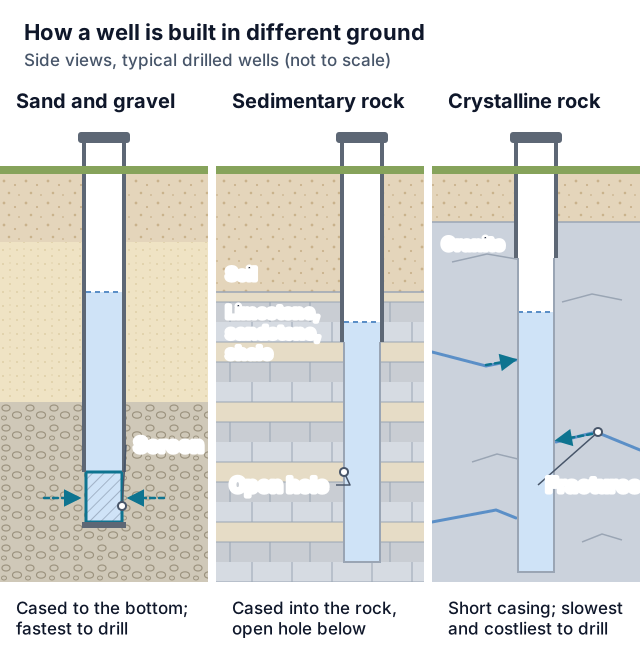
- Casing: outside the .0117 area, 02C .0107(d) sets a 20-foot minimum casing depth, except for wells built at reduced separation distances (see setbacks below), which need 43 feet. A well drawing from rock also needs its casing firmly seated at least five feet into the rock, and the casing top ends at least 12 inches above land surface.
- Yield: NC State Extension publication AG-473-6 puts average yields in the Carolina Slate Belt at 15 to 16 gallons per minute, against 18 to 21 gpm through most of the Piedmont, and WSP 2341-A found that wells in draws or valleys average three times the yield of wells on hills and ridges. Each domestic well must be tested for capacity by one of the methods in 02C .0110.
Permits & Local Rules
- Who may do the work: G.S. 87-98.4 bars anyone from performing, managing or supervising the construction, installation, repair, alteration or abandonment of a well without well contractor certification. It exempts people employed by or working for a certified contractor under that contractor's personal supervision; someone who builds, repairs or abandons a well sited on land they own or lease (DHHS describes this as your own property for your own personal use and says those wells must still meet all State and local construction standards); government employees working solely within the scope of their employment; and the other persons and activities listed in G.S. 87-98.4(b), each on its own conditions, plus any the certification commission exempts by rule. Under G.S. 87-98.4(a), a person who is not a certified well contractor or who is not employed by a certified well contractor may not offer to perform any well contractor activity unless that person uses a certified well contractor to perform it and, before the work is done, discloses to the landowner in writing the name of the certified well contractor who will perform it, that contractor's certification number and the name of the company that employs the contractor. These exemptions concern certification only; the G.S. 87-97 permit requirement still applies to private drinking water wells other than those the Environmental Management Commission permits under G.S. 87-88.
- Plumbers: the Act does not apply to a licensed plumbing contractor who installs pumps or pumping equipment, installs, breaks or reinstalls a well seal, or disinfects a well incident to installing, altering or replacing pumps or pumping equipment within or near a well, provided the contractor keeps documentation of a continuing education course covering well seal installation, protection and sanitation attended within the two years before the work, and remains on site while the work is performed until the well is disinfected and sealed (G.S. 87-98.4(b)(13)).
- Certification levels on the DHHS chart: Level D covers pump installation and installing other equipment in a well, pump repair that breaks the seal, chlorination, disinfection and down-hole cameras; Level C adds work including grouting, abandonment, well development, packers and liners; Level B adds hydrofracturing, cable tool, hollow stem auger, direct push and jetting, but not air or mud rotary, wet rock coring or sonic drilling; Level A covers all well contractor activities, including those methods and geothermal loop installation. Certification applies only to individuals, not companies, and DHHS says at least one certified contractor of the appropriate level must be physically present to supervise or conduct the work.
- Applying: the owner or agent applies to Environmental Health with the items 15A NCAC 02C .0303 lists. Union County asks for a site plan showing property line dimensions, structures, pools, septic systems and the other contamination sources named on its form, with the fee due at submission. After a field visit, the permit carries a scaled drawing showing contamination sources and setbacks, and the well may go anywhere outside the setback areas.
- Decision and validity (G.S. 87-97): the health department must issue or deny a construction or repair permit within 30 days of receiving the application; if it does not act in time the permit issues automatically, though the department may challenge it under Chapter 150B. A construction permit is conditioned on properly closing any abandoned well on the site, and a permit is valid for five years unless revoked for a material change in a fact or circumstance it was issued on.
- Setbacks to contamination sources existing when the well is built (02C .0107(a)(2)) include 50 feet from a single-family septic tank and drainfield including its repair area (100 feet for a saprolite system); 100 feet from septic systems serving other facilities and other subsurface absorption systems; 25 feet from building perimeters, counting attached garages, patios or decks that need a building permit; 25 feet from a watertight sewer lateral, 50 feet from a sewer main built to water-main standards and 100 feet from other sewage collection lines; 50 feet from surface water bodies that act as sources of groundwater recharge, such as ponds, lakes and reservoirs; and 25 feet from all other surface water bodies, such as brooks, creeks, streams and rivers. The rule sets distances for other named sources too, such as 100 feet for animal barns and chemical storage areas, 500 feet for sanitary, municipal solid waste and construction and demolition landfills (100 feet for land clearing and inert debris landfills), and 50 feet for any source it does not name. Where lot size or other fixed conditions rule these out for a water supply well serving a single-family dwelling for domestic use, (a)(3) requires the greatest distance possible but never less than 25 feet to such a sewer main or 50 feet to animal barns, and the well then needs 43 feet of casing and a source deeper than 43 feet.
- Grout: the casing is grouted to at least 20 feet, and deeper wherever needed to seal off contaminated, saline or other non-potable zones, within seven days after it is set (one day if a saline zone is penetrated); 02C .0107(e)-(f) specifies the permitted grouts and how each may be placed. Under 02C .0305 the contractor contacts the local health department to schedule a grout inspection, giving the location, permit number and anticipated grouting time. If the department cannot inspect within one hour of the scheduled time, the contractor may grout without the inspection and must certify in writing that the grout complies with 02C .0100; a completed GW-1 stating so serves as that certification, and the department accepts it for the certificate of completion if it was contacted to schedule the inspection, could not inspect within that hour and finds no evidence at final inspection that the grout fails the rules. Separately, G.S. 87-97(e2) says the local health department shall not conduct a grouting inspection during construction, repair or abandonment of a private drinking water well when all of these apply: the contractor gives written, verbal or electronic notice of intent to grout before 9:00 a.m. on the grouting date; the notice includes the location, permit number and anticipated grouting time and indicates that grouting may occur after normal business hours or on the weekend; for grouting on a State holiday, the notice is given by the last business day before the holiday; and the contractor gives the department written certification, in a format and method specified by the Commission, that the well was grouted in compliance with the rules adopted under the Article. Under (e3) the department may still choose to be present. Under (e4), if a variance has been issued to a rule requiring grouting to a certain depth, the contractor must schedule a grout time and inspection with the department, and only the department may certify the grout.
- Finishing: before the rig leaves, the casing gets a watertight cap or well seal, and within 72 hours an identification plate goes on with the items 02C .0107(j)(2) lists, among them the contractor's certification number, total depth, casing depth, yield and static water level. Under 02C .0111 the well is then disinfected to at least 100 ppm chlorine, with the casing and equipment above the water rinsed, left 24 hours or more and pumped until no chlorine residual is detectable, unless the Department has approved an equally effective method in advance. The county inspects the grout and wellhead, checks that the GW-1 well construction record has arrived and, if the well complies, issues a certificate of completion with an as-built drawing; no one may place a new well, or return a repaired one, into service without it.
- Well records (02C .0114): whoever completes or abandons a well files a record with DEQ's Division of Water Resources within 30 days, certifying the work met the rules, on form GW-1 for construction (DEQ calls online GW-1 submission its preferred method) or GW-30 for abandonment, and sends the county health department a copy for a water supply well. Under 02C .0307 a repair record goes to both offices within 30 days as well.
- New-well testing: within 30 days after issuing a certificate of completion for a new well, the health department tests the water, or makes sure a certified laboratory does, for arsenic, barium, cadmium, chromium, copper, fluoride, lead, iron, magnesium, manganese, mercury, nitrates, nitrites, selenium, silver, sodium, zinc, pH and bacterial indicators (G.S. 87-97(h)). Results go to the owner and, where practicable, to any leaseholder of a dwelling or facility the well serves.
- Closing a well: a county abandonment permit comes first (02C .0304), and the applicant or contractor gives the health department the location, permit number and expected time. The department may choose to inspect; if it opts not to, or cannot within one hour of the scheduled time, the contractor may proceed and must certify the abandonment in writing, for which a GW-30 stating compliance serves (02C .0309). 02C .0113 sets the fill and grout methods for each well type. The owner is responsible for abandonment unless it is needed because of a contractor's improper well work or someone's improper pump work, in which case that person is, and whoever drills a test boring abandons it when the boring is done.
Geology & Water Table Notes
- Slate belt: Union County Environmental Health says metamorphosed volcanic and sedimentary rocks, commonly called the Carolina Slate Belt, cover about two-thirds of the county, and that slate belt areas of the Piedmont, Union County among them, have a greater number of drinking water wells with arsenic than other regions, though low arsenic levels turn up in groundwater throughout North Carolina.
- Arsenic study: NC DEQ Groundwater Circular 2009-01 states that the Cid Formation underlies a major portion of Union County. Near its Morgan Mill study site in the formation's Mudstone Member, 14 of 23 private supply wells sampled exceeded the EPA's maximum contaminant level of 10 micrograms per liter, with results from below the 5 microgram detection limit to 77; all of the exceedances were in the Mudstone Member, while wells in the Flat Swamp Member generally stayed below 5. The report says its data suggest the arsenic is naturally occurring and comes primarily from the bedrock, with iron-sulfide minerals the apparent main source; pyrite often lines fractures in the site's rock core.
- Manganese: the county cites the EPA's 0.05 mg/L secondary standard, notes that people often treat above it because manganese affects color, taste and staining, says treatment or bottled water should be considered above 0.3 mg/L, and says drinking water for pregnant women and young children should be below the manganese standard level.
Communities Served
Monroe · Waxhaw · Indian Trail · Weddington · Marvin · Wesley Chapel · Stallings · Wingate · Marshville · Mineral Springs · Unionville · Fairview
Emergency Response Expectations
After a flood, Union County's wells brochure says to leave the pump's power off until floodwater recedes and, if flooding was extensive, not to drink the well water until it has been tested; it refers owners to the county's wells page for shock chlorination steps. We forward urgent requests to independent contractors but cannot promise when one will respond.
Union County FAQs
Do I need a county permit to replace my well pump?
No. G.S. 87-97(c) exempts work limited to repairing or replacing a pump or tank from the repair permit. Unless a G.S. 87-98.4 exemption applies, such as the owner or plumbing-contractor exemptions described above, the work still needs a certified well contractor (Level D or higher on the DHHS chart), and the well must be disinfected afterward under 02C .0111.
Which parts of Union County need 43 feet of casing?
Land generally east of the line in 15A NCAC 02C .0117(7) and within 400 feet of it, plus wells built at reduced separation distances under 02C .0107(a)(3). Elsewhere in the county the minimum is 20 feet.
Should I test for arsenic?
Yes. Arsenic is on the panel G.S. 87-97(h) requires for every new well. For an existing well, the county suggests sampling to see whether arsenic exceeds the EPA's 10 ppb standard, and running a full inorganic panel before choosing treatment because iron, manganese and other constituents can change which option works.
How often should an existing well be tested?
The DHHS testing FAQ says every year for total and fecal coliform bacteria, every two years for heavy metals, nitrates, nitrites, lead and copper, and every five years for pesticides and VOCs (yearly if a particular pesticide is applied nearby), and again after well repairs or flooding. Union County's page puts the metals, nitrate, nitrite, lead and copper tests at every two or three years.
Can I get an irrigation well if I have public water?
The county says yes under its local irrigation well ordinance, if all required setbacks can be met and the well has no cross-connection to the public supply. G.S. 87-97.1 requires the application to state that the well will not be interconnected with plumbing connected to a public system and will serve only irrigation or other nonpotable uses; the section does not apply where the system's operator is being assisted by the Local Government Commission.
What should we do with an old well we no longer use?
The county says it depends: a well that is a safety problem or a possible contamination source should be abandoned under an Environmental Health permit, while one that is structurally sound, protected, not a contamination source and within all setbacks generally need not be. A well temporarily out of service gets a watertight cap or seal that cannot be removed without hand or power tools and is kept from becoming a source or channel of contamination (02C .0113(a)).
Why is my well producing less water than before?
The county lists a dropped static water level, a failing pump, sediment blocking the water-bearing fracture, or a well that has stopped producing, and recommends an evaluation by a certified well contractor.
Sources
- N.C. General Assembly: G.S. 87-97, private drinking water wells
- N.C. General Assembly: Well Construction Act, Chapter 87 Article 7
- N.C. General Assembly: Well Contractors Certification Act, Chapter 87 Article 7A
- NC Office of Administrative Hearings: 15A NCAC 02C rule text
- NC DEQ: 15A NCAC 02C well construction rules
- NC DEQ Division of Water Resources: GW-1 and GW-30 forms
- Union County Environmental Health: Wells and Water Testing
- Union County Environmental Health: Fees
- Union County: Wells & Water Testing brochure
- NC DHHS: Well Contractor Certification Levels
- NC DHHS: Well Contractors Certification FAQ
- NC DHHS Epidemiology: Private well testing FAQ
- NC DEQ Groundwater Circular 2009-01 (Abraham): hydrogeological assessment of arsenic, Union County
- NC State Extension AG-473-6: Ground Water in the Piedmont and Blue Ridge
- USGS Water-Supply Paper 2341-A (Daniel, 1989)
- U.S. Census Bureau: North Carolina place-to-county file (2020)
- U.S. Census Bureau: North Carolina county subdivision file (2020)
Last reviewed 2026-10-28
Services Available in Union County
Well Drilling
New residential wells — find local drillers for site evaluation, depth estimates, and written drilling quotes.
Learn more →Water Well Drilling
Household water wells from site evaluation through casing, pump, and water test — written quotes from local drillers.
Learn more →Well Pump Repair
No water at the tap? Request urgent well pump repair — local pros diagnose pressure loss, dead pumps, and pressure tank failures fast.
Learn more →Well Pump Replacement
Pump at end of life or beyond repair? Get quotes for correctly-sized submersible and jet pump replacement from local well pros.
Learn more →Well Inspection & Testing
Buying a home with a well, or overdue for a water test? Local pros for flow tests, equipment inspection, and lab water-quality testing.
Learn more →Well Water Service
Water quality problems, treatment systems, and general well maintenance — connect with local pros for everything between drilling and pump work.
Learn more →Free Tools Before You Call
Ballpark the cost or narrow down the problem before talking to a Union County provider.
Well Drilling Cost Calculator
Estimate what drilling a well should cost — by depth, geology, and whether you need the pump and pressure tank included.
Use the free tool →No Water From Your Well? Diagnostic Wizard
Suddenly no water in the house? Answer a few questions to find out if it's the breaker, the pressure switch, the tank, the pump — or the well itself.
Use the free tool →Well Pump Size Calculator
Find what size well pump you need — GPM demand, total dynamic head, and a horsepower recommendation from four quick inputs.
Use the free tool →Need help in Union County, NC?
Send the short form — urgent requests get priority routing.