Well Drilling in Hays County, TX
Well drilling typically runs $3,000–$16,000 nationally, per our cost guide. Independent local pros serving Wimberley, Dripping Springs, Driftwood and nearby communities. Describe the problem and we'll route your request — free, no obligation.
- Mark no-water pump problems as emergencies on the form
- County pages on local well depths, aquifers, and permits
- Well inspections, water testing, and treatment
- Free to use — no obligation, no markup
Fast response from independent local providers. No obligation.
Typical national cost$3,000 – $16,000Cost guide →Local Help in Hays County, TX
Groundwater in Hays County is split among separate regulators, so the first job on any well is finding out which one covers the parcel. The Hays Trinity Groundwater Conservation District's rules, amended effective August 6, 2026, define its territory as all of Hays County not inside the Edwards Aquifer Authority, the Barton Springs/Edwards Aquifer Conservation District or the Plum Creek Conservation District. The management plan its board adopted on December 4, 2025 puts that at the western 55.15 percent of the county, about 370 square miles, and says the Trinity Aquifer is the sole aquifer supplying groundwater to district residents.
The Barton Springs/Edwards district's rules, effective August 14, 2025, describe it as serving southern Travis County, central and eastern Hays County and parts of northwestern Caldwell County. Its Shared Territory is the part of Hays County inside the Edwards Aquifer Authority's boundaries but outside Plum Creek as those boundaries stood on February 1, 2015; there the district regulates groundwater from every aquifer except the Edwards, which stays with the Authority. Plum Creek's management plan, adopted as amended August 15, 2023, places it in parts of Caldwell and Hays counties with authority over aquifers inside its boundary that neither the Authority nor the Barton Springs district regulates. Each agency posts its own map for checking an address.
Hays County Service Details
What providers in this area actually see: coverage, common jobs, local pricing factors, and rules worth knowing.
Service Area Notes
- Place names follow the Census Bureau's 2020 place-by-county file for Hays County: the cities of Buda, Creedmoor, Dripping Springs, Hays, Kyle, Mountain City, Niederwald, San Marcos, Uhland, Wimberley and Woodcreek, the village of Bear Creek, the census-designated places of Belterra and Driftwood, and part of the city of Austin. Each also appears in the Bureau's current TIGERweb place layers.
- This page does not match towns to districts. Look up the exact address on the district maps instead.
- Texas licenses water well drillers under Occupations Code chapter 1901 and pump installers under chapter 1902; the Texas Department of Licensing and Regulation (TDLR) runs both programs.
Common Jobs in Hays County
- New household wells registered with Hays Trinity GCD as exempt-use wells
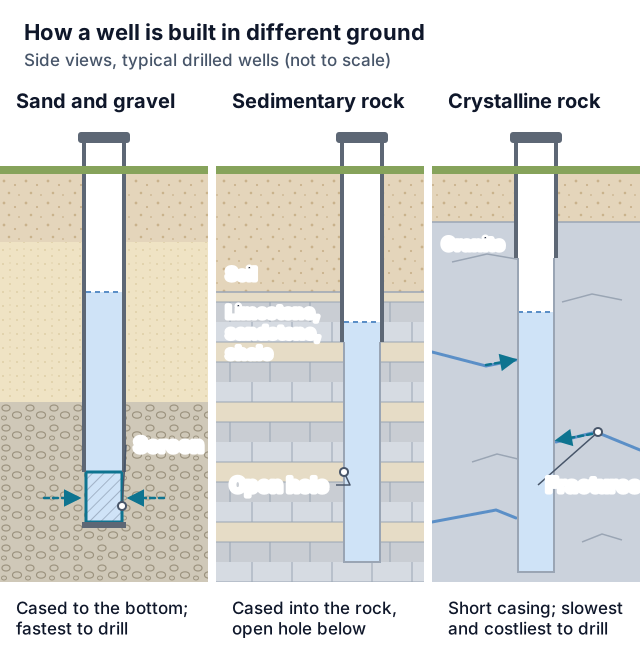
- Middle Trinity (Cow Creek) or Lower Trinity wells sealed so each is open to one aquifer
- Edwards Aquifer wells built under an Edwards Aquifer Authority construction permit
- Replacing, deepening or re-setting pumps in wells that have lost water in drought
- Pump, pressure tank and sanitary wellhead seal work
- Plugging deteriorated wells, which 16 TAC 76.72(e) requires, and abandoned wells inside Hays Trinity GCD, where Rule 6.3.1 calls for plugging
- Closing abandoned wells in the other districts' territory by capping or plugging, as 16 TAC 76.72(e) and that district's rules allow
- Coliform and E. coli testing after flooding or a loss of pressure
What Drives Pricing Here
- Hays Trinity GCD fees: the fee schedule the district posts, effective November 2, 2023, sets a one-time $1,000 well construction fee for a new exempt well drilled after November 30, 2015 (domestic or residential use, or combined agricultural and residential use) and the same $1,000 for a new non-exempt well. A new agriculture-only well is listed at no charge but needs a Texas Comptroller agricultural or timber registration number. On land in another district, get that agency's current charges directly.
- Grout depth: Hays Trinity Rule 4.1.2 calls for a borehole 3 inches wider than the casing's outside diameter over the first 50 feet and grout in that annular space from the surface to 50 feet. The seal may stop at the depth of the first potable water-bearing strata when the well targets that interval for production, but never shallower than 10 feet. It must go to 100 feet when the well is closer than 150 feet to an existing or proposed concentrated contamination source such as livestock or poultry facilities, 50 feet to a septic tank, or 100 feet to septic drain fields or wastewater irrigation; remediation wells are decided case by case.
- One aquifer per well: Rule 4.1.5 requires every well, exempt or not, to be open to only one of the Upper, Middle or Lower Trinity, so a Lower Trinity well needs an annular seal (packers, bentonite or cement grout, or another approved material) that seals off the Upper and Middle Trinity. The rule says a shale trap is not adequate.
- How the cost tool works: footage times a rate keyed to the geology selected, with separate pump, tank and permit lines added on. Nothing in it is tuned to Hays County, so plug in the footage from a driller's written bid and use the output as a rough sketch, not a quote.
Permits & Local Rules
- Hays Trinity GCD notice: Rule 3.4.1 requires a well construction notification before anyone drills, equips, caps, plugs or completes a well, substantially changes the size of a well or its pump, or converts an oil or gas well to a water well. The form must come with a property plat and map showing the well location, the Hays County property identification number and the construction fee, and the district does not process incomplete notifications. Its Forms page says the resulting confirmation is required for all wells before drilling commences.
- Confirmation (Rule 3.4.2): once a notification for a well exempt from drilling-permit requirements is administratively complete, staff have a minimum of three workdays to process and approve it without Board action, and the confirmation goes to both the owner or operator and the drilling company. It stays valid for 90 days; further 90-day extensions, up to 270 days in all, may be obtained from staff on request.
- Permits (Rules 3.3.1 and 3.5.1): owners of the well types in 3.3.1(D), among them a well drilled and operated solely for domestic use and built so it cannot produce more than 25,000 gallons a day, give notice but are excused from a drilling permit to drill, complete or equip it. Other wells need a drilling permit, though maintenance or repair that does not increase production capability above the authorized rate does not, and every non-exempt well also needs an operating permit.
- Exempt status in Hays Trinity GCD: an exempt well must be registered with the district as an exempt-use well and used exclusively for an exempt use. Rule 3.11.1's list of wells that need no operating permit includes a well used solely for domestic use by a single private residential household that cannot produce more than 25,000 gallons a day (17.36 gallons per minute), and a domestic shared well: one well on private property owned by a resident of the property, serving no more than four single-family dwellings on the same or adjoining properties, used exclusively for domestic use and unable to produce more than 25,000 gallons a day. Community water systems are non-exempt.
- State floor: Texas Water Code 36.117(b)(1) makes districts exempt from permits a well used solely for domestic use or for livestock or poultry if it is on a tract larger than 10 acres and cannot produce more than 25,000 gallons of groundwater a day; 36.117(a) lets a district add exemptions by rule. Exempt or not, 36.117(h) has each district make owners register wells under district rules, and 36.117(j) takes the exemption away from a well whose water goes to a subdivision requiring Local Government Code chapter 232 plat approval.
- Barton Springs/Edwards Aquifer CD: Rule 3-1.1 has every well in the district registered, exempt and abandoned wells included, and Rule 3-1.2 requires an application on district forms before anyone constructs, drills, modifies, completes, plugs, abandons, changes the use of or alters the size of a well, or runs a dye trace. Under Rule 3-1.3(B)(1) and (4), a domestic well drilled after August 14, 2003 in the Western or Eastern Freshwater Edwards Management Zone, or after July 16, 2015 in the Upper, Middle or Lower Trinity Management Zones, is exempt only if it is registered, used solely for domestic needs, built so it cannot produce more than 10,000 gallons a day and on a tract larger than 10 acres; livestock and poultry wells carry the same gallon and acreage limits. A non-exempt well needs a Well Drilling Authorization and a Production Permit (and, where warranted, a Transport Permit) before it is drilled or pumped.
- A domestic or livestock well that misses the Barton Springs exemption tests may be eligible for the district's Limited Production Permit under Rule 3-1.20(B), which sets its own eligibility test and annual production cap; ask the district before planning around it.
- Edwards Aquifer Authority: its registration page says state law requires every well that withdraws water from the Edwards Aquifer to be registered with the Authority. To be recognized as exempt from a withdrawal permit, the owner must register the well and show it cannot produce more than 25,000 gallons a day, is used solely for domestic or livestock use and does not serve a subdivision requiring platting, which the Authority defines as supplying more than three homes in a neighborhood or development whose parcels were subdivided and recorded with a county. Drilling into or through the Edwards Aquifer also takes an Authority well construction permit application.
- Plum Creek CD: under its rules adopted November 20, 2018, all wells, exempt wells included, must be registered with or permitted by the district (Rule 4). Rule 10 frees from its operating permit a well used solely for domestic use and unable to produce more than 25,000 gallons a day, unless it supplies a subdivision needing plat approval under Local Government Code chapter 232, and a livestock or poultry well on a tract larger than 10 acres held to the same daily limit, which also stays subject to the district's spacing rule; either way the well must meet the rest of Rule 10, including registration. The owner or driller of an exempt well files the well log, a completion report and any available geophysical log with the district.
- Hays Trinity drought limits: on October 30, 2026 the district's homepage reported Emergency Drought Stage, with 40% curtailment district-wide and 30% in the Jacob's Well Groundwater Management Zone, and said water wells are failing at an unprecedented rate. In Stage 3 or Stage 4, Rule 13.3.3 bars new wells other than replacements for existing permitted wells and wells for exempt uses, and stops new operating permit applications and amendments to increase production. The Board may grant a variance if it would significantly lessen an existing condition imminently threatening public health, safety or welfare, or would reduce production within a groundwater management zone; Rule 14.1 has the request filed with the registration or application on the district's variance request and notice form.
- Management zones: Rules 15.1.4 and 16.1.4 say an exempt-use well in the Jacob's Well or Blanco Valley groundwater management zone must remain exempt and may not be converted to non-exempt use.
- Hays Trinity spacing (Rule 4.3.2): the table sorts new wells by projected pumping capability in daily average gallons per minute (and acre-feet per year). A well projected below 17.36 gpm must sit at least 150 feet from existing wells and 100 feet from adjacent property lines, and each higher capability tier needs more distance. The district may authorize a shorter distance from registered wells in the same aquifer management zone if site-specific geological or hydrogeological information supports a finding that the well's location and use will not create unreasonable impacts. Half the width of a utility, road or other conveyance right-of-way that forms part of the property line, if not subject to groundwater development, may count toward the line distance, with the well at least 10 feet from the line itself. The line distance drops to 50 feet only with district approval of the location, compliance with district rules and Texas regulations, and pressure cementing of the top 100 feet of annular space; on tracts too small for that, TDLR's alternative siting methods in 16 TAC 76.100(b)(2) apply.
- Construction (Hays Trinity Rules 4.1.1 and 4.1.3): work follows Occupations Code chapters 1901 and 1902 and 16 TAC chapter 76 as clarified by district standards. Every well needs a watertight sanitary seal; an existing well without one must get it the next time the wellhead is repaired or the pump is pulled, and a well with odd-size casing, or a wellhead with no factory-made watertight seal available, must be completed or modified to meet the rule's intent.
- Who may drill or set pumps: Occupations Code 1901.151 and 1902.151 bar anyone from acting or offering to act as a driller or pump installer without a TDLR license. Two groups fall outside those definitions: people drilling a well, or installing or repairing a pump, on their own property for their own use, and helpers working under a licensee's direct supervision who are not primarily responsible for the drilling or installation.
- Well reports: 16 TAC 76.70 gives the driller 60 days after completing or stopping work on a well to send the State of Texas Well Report to TDLR electronically, to the owner or person who had the well drilled, and to the groundwater district. The owner, or the person the well was drilled for, can have TDLR keep the log confidential by sending a written request by certified mail (Occupations Code 1901.251(c)).
- Plugging and capping: Occupations Code 1901.255(c) gives a landowner or other possessor 180 days after learning a well is abandoned or deteriorated to have it plugged or capped under TDLR standards, and 16 TAC 76.72(e) adds that a deteriorated well must be plugged while an abandoned one may be capped or plugged. Hays Trinity Rule 6.3.1 says a deteriorated or abandoned well shall be plugged within 180 days after the possessor learns of its condition, requires a district drilling permit before plugging, and has whoever plugs it (driller, licensed pump installer or owner) file a plugging report with the district within 30 days; Rule 6.2.1 requires a district drilling permit before capping. TDLR's 16 TAC 76.70(3) adds a state filing: the plugger gets the State of Texas Plugging Report to TDLR within 30 days of finishing, with copies for the district and the owner. Within the Edwards Aquifer Authority, plugging and capping each need an Authority permit before work begins.
Geology & Water Table Notes
- USGS Scientific Investigations Map 3540 (Clark, Morris and Lamberts, 2025), which covers about 560 square miles of Hays County, follows Ashworth (1983) in dividing the Trinity aquifer into zones: the upper zone in the upper member of the Glen Rose Limestone, the middle zone in the lower Glen Rose, the Hensell Sand and the Cow Creek Limestone, and a lower zone that in the study area yields water from the Sycamore Sand. The Hammett Shale separates the middle and lower zones.
- The Hays Trinity management plan calls the Middle Trinity's Cow Creek Formation the primary groundwater-producing unit in western Hays County and describes the Upper Trinity as generally a shallow perched system that is unreliable in dry conditions. It says the Lower Trinity (Sligo and Hosston formations) has taken on a greater role in northern Hays County since the mid-1990s, particularly where pumping depleted the Middle Trinity, but that its water quality is generally poor, with high total dissolved solids and sulfate.
- Water quality: in TWDB's statewide Trinity Aquifer summary, groundwater in the outcrop is described as generally fresh but very hard, with dissolved solids, sulfate and chloride tending to climb as the aquifer deepens.
- Testing: TCEQ guide GI-433 (revised June 2023) describes lab testing for total coliform and E. coli when flooding, lost water pressure or a recurring digestive problem raises concern about a private well. It calls for a sterile container and form from an accredited lab, a sample taken straight from a faucet rather than through a hose, and fast delivery, since the sample must be tested within 30 hours of collection.
- Nearby records: the Hays Trinity district's Well Information page links TWDB's state well report search, and TDLR's water well page points to TCEQ for reports on wells drilled before 2003.
Communities Served
Wimberley · Dripping Springs · Driftwood · Woodcreek · Kyle · Buda · San Marcos · Mountain City · Niederwald · Uhland · Hays · Creedmoor · Bear Creek · Belterra
Emergency Response Expectations
If a well in the Hays Trinity district goes dry, the district's Forms page has an online form for reporting water level changes or a dry well. For a pump or pressure failure, mention any livestock that depend on the well when you submit a request; response times depend on provider availability.
Hays County FAQs
Which agency handles a well on my Hays County land?
That turns on the parcel and, in the Barton Springs district's Shared Territory, on the aquifer: there an Edwards well goes to the Edwards Aquifer Authority and a Trinity well to the Barton Springs district. Run the address through each agency's map before signing a drilling contract.
What does Hays Trinity GCD charge to drill a new household well?
Its posted fee schedule, effective November 2, 2023, lists a one-time $1,000 well construction fee for a new exempt well drilled after November 30, 2015, including wells used for both residential and agricultural purposes. Rule 3.3.3 waives the fee for a well used solely for conventional farming and ranching if the owner provides a Texas Agricultural or Timber Registration card; a well serving both a household and farming still pays. Confirm the amount with the district when you file.
Can I drill a household well while Hays Trinity GCD is in Emergency Drought Stage?
Rule 13.3.3(C) still allows wells for exempt uses and replacements for existing permitted wells during Stage 3 or Stage 4, so that rule does not bar a household well that meets the exemption; the notification, fee and registration steps still apply. As of October 30, 2026, the district's homepage says it will accept no new permits for production or non-exempt well construction until conditions improve.
Who can plug an old well on my property, and what has to be filed?
TDLR's abandoned-well page allows two routes: hire a licensed driller or pump installer, or, as the landowner, plug the well on your own property to the 16 TAC 76.104 specifications; either way a State of Texas Plugging Report follows. In the Hays Trinity district a drilling permit comes first (its Forms page handles plugging through the Well Modification Application), and the plugging report goes to the district within 30 days. The Edwards Aquifer Authority's page says such wells are to be sealed from the bottom up by a licensed well contractor, under an Authority permit obtained before work begins.
Why can two Hays County wells a few lots apart turn out so differently?
The Hays Trinity management plan says Trinity yields can change considerably over short distances, and the USGS Hays County map reports that faults, fractures and geologic structure influence groundwater recharge and flow paths. Agree in writing on per-foot terms and on what happens if the hole comes up short.
Sources
- Hays Trinity GCD: District rules, amended effective Aug. 6, 2026
- Hays Trinity GCD: Fee & settlement schedule, effective Nov. 2, 2023
- Hays Trinity GCD: Homepage (drought stage)
- Hays Trinity GCD: Forms
- Hays Trinity GCD: Well information
- Hays Trinity GCD: 2026 groundwater management plan
- Barton Springs/Edwards Aquifer CD: Rules, Volume 1, effective Aug. 14, 2025
- Barton Springs/Edwards Aquifer CD: Well permits and forms
- Edwards Aquifer Authority: Well registration and updates
- Edwards Aquifer Authority: Well closure procedures and construction
- Plum Creek CD: Groundwater rules, adopted Nov. 20, 2018
- Plum Creek CD: Management plan, amended Aug. 15, 2023
- Texas Water Code chapter 36 (36.117)
- Texas Occupations Code chapter 1901: Water well drillers
- Texas Occupations Code chapter 1902: Water well pump installers
- Texas Secretary of State: 16 TAC §76.70
- Texas Secretary of State: 16 TAC §76.72
- Texas Secretary of State: 16 TAC §76.100
- Texas Secretary of State: 16 TAC §76.104
- TDLR: Water well drillers and pump installers
- TDLR: Abandoned or deteriorated wells
- TWDB: Trinity Aquifer
- USGS SIM 3540: Edwards and Trinity aquifers within Hays County (2025)
- TCEQ GI-433: How to sample your private well water (June 2023)
- Census Bureau: 2020 places by county, Texas
Last reviewed 2026-10-30
Services Available in Hays County
Well Drilling
New residential wells — find local drillers for site evaluation, depth estimates, and written drilling quotes.
Learn more →Water Well Drilling
Household water wells from site evaluation through casing, pump, and water test — written quotes from local drillers.
Learn more →Well Pump Repair
No water at the tap? Request urgent well pump repair — local pros diagnose pressure loss, dead pumps, and pressure tank failures fast.
Learn more →Well Pump Replacement
Pump at end of life or beyond repair? Get quotes for correctly-sized submersible and jet pump replacement from local well pros.
Learn more →Well Inspection & Testing
Buying a home with a well, or overdue for a water test? Local pros for flow tests, equipment inspection, and lab water-quality testing.
Learn more →Well Water Service
Water quality problems, treatment systems, and general well maintenance — connect with local pros for everything between drilling and pump work.
Learn more →Free Tools Before You Call
Ballpark the cost or narrow down the problem before talking to a Hays County provider.
Well Drilling Cost Calculator
Estimate what drilling a well should cost — by depth, geology, and whether you need the pump and pressure tank included.
Use the free tool →No Water From Your Well? Diagnostic Wizard
Suddenly no water in the house? Answer a few questions to find out if it's the breaker, the pressure switch, the tank, the pump — or the well itself.
Use the free tool →Well Pump Size Calculator
Find what size well pump you need — GPM demand, total dynamic head, and a horsepower recommendation from four quick inputs.
Use the free tool →Need help in Hays County, TX?
Send the short form — urgent requests get priority routing.