Well Drilling in Montgomery County, TX
Well drilling typically runs $3,000–$16,000 nationally, per our cost guide. Independent local pros serving Conroe, Magnolia, Montgomery and nearby communities. Describe the problem and we'll route your request — free, no obligation.
- Mark no-water pump problems as emergencies on the form
- County pages on local well depths, aquifers, and permits
- Well inspections, water testing, and treatment
- Free to use — no obligation, no markup
Fast response from independent local providers. No obligation.
Typical national cost$3,000 – $16,000Cost guide →Local Help in Montgomery County, TX
Groundwater in Montgomery County is managed by the Lone Star Groundwater Conservation District. Its rules, adopted September 8, 2020 and amended effective January 1, 2026, say no one may drill a well without first getting either a district permit or, for a registration, a separate Notice to Proceed (Rule 2.1(a)(1)). District Rule 5.3(a) then has every new well completed to the construction standards that TDLR, the Texas Department of Licensing and Regulation, keeps in 16 TAC chapter 76.
The district regulates three strata separately: the Chicot and Evangeline aquifers, counted as one aquifer for regulatory purposes, the Jasper aquifer and the Catahoula aquifer (Rule 1.1). Picking one is a paperwork decision as well as a geology one, because spacing between permitted wells and the reach of an operating permit both follow the aquifer. This site passes each Montgomery County request along to independent contractors and owns no rigs; read the rules here as a checklist for those conversations.
Montgomery County Service Details
What providers in this area actually see: coverage, common jobs, local pricing factors, and rules worth knowing.
Service Area Notes
- Any part of the county is fine for a request. Census Bureau place records for Montgomery County include the cities of Conroe, Magnolia, Montgomery, Willis, Splendora, Cut and Shoot and Panorama Village and the census-designated places of Porter Heights and Pinehurst.
- Inside a city: the district's exempt registration form has you initial that, if the well will be within city limits, you are responsible for contacting the proper agencies before drilling. It lists TCEQ, the Montgomery County Environmental Health Department, TDLR, the city (inside its limits or ETJ) and the local utility company, such as a MUD, as agencies you may need to contact. If a public water system is available in the area, it also has you initial that you will give that system proper notice of your intent to drill an exempt well.
- Buying land with a well: the district's FAQ says the buyer must make sure the well is registered. For a well that must be registered or permitted, Rule 2.17(a) gives the new owner 60 days after the ownership change to file a Transfer of Well Ownership form, capped or inactive wells included, and Rule 2.17(f) bars producing water from the well after 90 days from the change until any required transfer form is filed. Resolution 25-004 charges $50 to transfer an exempt registration and $150 for a non-exempt permit.
Common Jobs in Montgomery County
- New household or livestock wells registered as exempt with Lone Star GCD and drilled after the district issues its Notice to Proceed
- Non-exempt wells, which Rule 2.5(a) says need an operating permit before drilling, construction or operation
- Replacement wells, approved by the district before the new well is drilled
- Pump and pressure tank work by TDLR-licensed pump installers, after checking whether the district treats the change as an alteration
- Plugging abandoned or deteriorated wells, with plugging reports to TDLR and the district
- Sampling for total coliform and E. coli through an accredited laboratory
What Drives Pricing Here
- District fees: Lone Star's administrative fee schedule (Resolution 25-004, amended and approved November 11, 2025, effective January 1, 2026) lists its application fees as non-refundable. New well registration is $500 per well, which the schedule says covers exempt, non-exempt, test and replacement wells. A non-exempt well also pays an operating permit application fee of $500, or $1,500 when a hydrogeologic report is required.
- Spacing exception fees in the same schedule: $250 for an exempt well when no notice and hearing is needed and $500 when it is; $500 for a non-exempt well without a hydrological report and $1,500 with one. A field operations technician re-inspection, before or after drilling, is $250 per site visit.
- Hydrogeological reports: the district's FAQ describes this as a report sealed by a Texas-licensed professional engineer or geoscientist and requires it for a new well or well system with a proposed aggregate capacity of 700 gallons per minute or more and for changes that would equip existing wells to produce 700 gpm or more. Rule 3.4(a) also requires one for a non-exempt well's spacing exception, while an exempt well seeking relief from the 50-foot rule does not need one.
- Screen placement: Rule 5.3(f) has the screens set only in the district aquifer named in the application. If a test hole first went into a deeper district aquifer, the borehole must be plugged back under state plugging standards to within 20 feet of the well's total depth; ask whether a quote covers that.
- Measuring access and pump size: Rule 5.3(c) requires new and re-completed wells, and wells reworked in a way that pulls the pump, to be designed or equipped so a water-level measuring device can be installed. For exempt wells, Rule 5.3(b) has the district inspect the column pipe's inside diameter, and it may require flow tests on any well whose column pipe is wider than 1.5 inches inside.
- Construction estimates: our cost calculator offers a sand/gravel choice, yet every dollar figure in it comes from nationwide Angi, HomeGuide and HomeAdvisor pages rather than local bids, and it knows nothing about which district aquifer gets screened. Line up written quotes item by item: depth, casing, screen, grout, pump.
Permits & Local Rules
- Exempt wells: state law sets a floor. Texas Water Code 36.117(b)(1) obliges each groundwater district to waive its permit for a well whose only uses are domestic, livestock or poultry water, if the well stands on more than 10 acres and its drilling, completion or equipment keeps it from yielding over 25,000 gallons of groundwater daily; 36.117(h) keeps the district's registration duty in place. Lone Star Rule 2.2(a)(4) carries that exemption for wells completed after April 14, 2009, and older wells have their own categories in Rule 2.2(a)(1)-(3), such as a well completed on or after April 14, 2009 but before January 1, 2026 with an inside casing diameter of 5 inches or less and used solely for domestic or livestock use, which is exempt whatever the tract size. Rule 2.2(a)(9) adds one for wells completed on or after January 1, 2026 with an inside casing diameter of 5 inches or less, incapable of producing more than 25,000 gallons a day, used solely for domestic or livestock use, on a tract of 1.5 acres or larger unless the lot was recorded or listed on the Montgomery County tax rolls before December 1, 1986. The exempt registration form revised March 31, 2026 lists the over-10-acre options plus an 'Other' line, so confirm with the district which exemption fits your lot.
- What the exemption covers: Rule 1.1 defines domestic use as a single household's essential use, including landscape watering of no more than one acre next to one residence, a family garden or orchard, domestic animals, filling residential pools and hot tubs and closed-loop residential geothermal systems. Left out: water supporting an activity for which consideration is given or received, or one whose product is sold, watering crops or pasture, supplying a public water system, and open-loop residential geothermal. Livestock use is defined as open-range watering of livestock. Rule 2.2(b) strips the exemption, or denies it from the start, in four cases: non-exempt use; a district finding that the water no longer goes solely to the exempt purpose; a replacement well built with more capacity than the one it replaces; and water serving a subdivision whose plat must be approved under chapter 232 of the Local Government Code.
- Registering: Rule 2.3(a) makes owners register every new exempt well except oil-and-gas rig-supply wells and leachate, monitoring and dewatering wells, by filing in person, by mail, by email or online. The required contents are in Rule 2.3(e) and on the district's form; one is a statement that you will contact the Montgomery County Health Department if the well is to be drilled on less than 1 1/2 acres. Rule 2.3(f) ties the Notice to Proceed to an administratively complete registration and a site that satisfies Rule 3.2. Rule 5.3(d) then requires the well to be drilled, inspected and metered within 120 days after the Notice to Proceed is issued for an exempt well, or within 365 days after a permit is issued. The same rule sets extension terms for non-exempt wells, and the forms page posts extension request forms for exempt and non-exempt wells, so ask the district before a deadline passes.
- Location: Rule 3.2 keeps every new well, exempt or not, at least 50 feet from the nearest adjacent property line, and Rule 5.3(d) requires drilling within 30 feet of the location in the registration. Under Rule 3.3, a new non-exempt well must also stand back from registered and permitted wells completed in the same district aquifer by at least 2.0 feet times its maximum allowable pumping rate in the Chicot/Evangeline, 1.5 feet in the Jasper and 1.0 foot in the Catahoula; Rule 1.1 defines that rate as the maximum instantaneous rate, in gallons per minute, the well can produce.
- Spacing exceptions, Rule 3.4: there are three routes. The exception is granted automatically on a sworn statement, with evidence, that the abutting land or wells are owned or controlled by the same person as the proposed well. With notarized written waivers from every registered and permitted well owner and/or property owner within the spacing distance, the district may grant or deny the request, in full or in part, on notice to the applicant only and without a hearing. Otherwise, under Rule 3.4(d), the applicant notifies every registered and permitted well owner and/or adjacent property owner, as applicable, within the spacing distance by certified mail, return receipt requested, and must give the General Manager proof of the mailed notice and the return receipt no less than 20 days before the public hearing, after which the board decides; the district's waiver instructions have the applicant use its 20-day Notice of Hearing letter once a board meeting date is set. If all of those owners sign notarized waivers at any time before the hearing, the exception is granted without one. Every route starts with the district's application form, a boundary survey or sketch drawn to scale and the certifications the rule lists.
- Operating permits: Rule 2.5(a) requires one before a new non-exempt well is drilled, constructed or operated, and under Rule 2.5(b) a permit applies to only one district aquifer. Rule 13.3 schedules a permit hearing on each operating permit application, with notice given by the general manager; the district's FAQ says non-exempt applications are reviewed within 60 days after a complete package arrives.
- Replacement wells, Rule 2.13(b): the application must show the new well will be within 50 feet of the old one, in the same district aquifer at a generally similar depth interval; a property diagram showing both wells with the spacing buffer and other structures; no closer to other registered or permitted wells or authorized well sites than the old well, if feasible at the general manager's discretion; pumping equipment not designed or able to pump at a higher maximum allowable pumping rate than the pump being replaced, with the contractor's information for the new pump; and that the owner will stop producing from the old well as soon as the new one operates and begin efforts to plug it within 90 days after the replacement is completed.
Geology & Water Table Notes
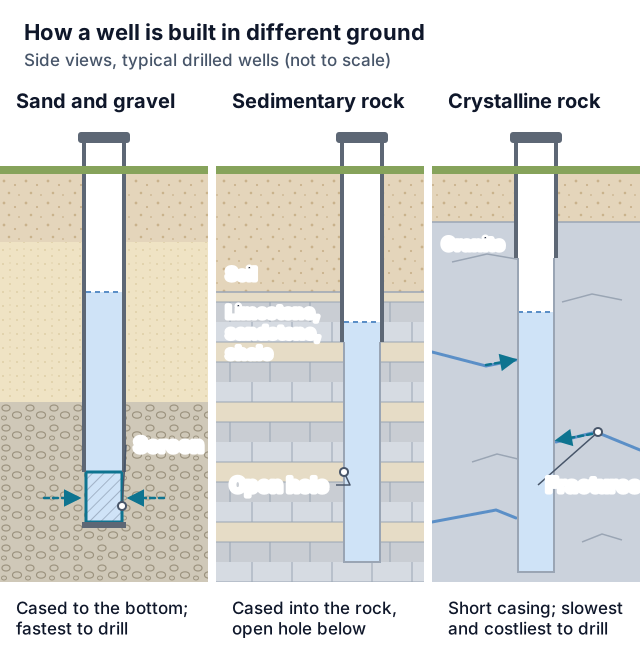
- Aquifers: the district's FAQ says the Gulf Coast Aquifer beneath Montgomery County is made up of the Chicot, Evangeline, Jasper and Catahoula aquifers and the Burkeville confining layer. TWDB describes the Gulf Coast Aquifer's units as discontinuous sand, silt, clay and gravel beds and says its water quality varies with depth and locality.
- Historical baseline: TWDB Report 136, Ground-Water Resources of Montgomery County, prepared by the U.S. Geological Survey and published in November 1971, found that the Chicot, the Evangeline and the upper part of the Jasper generally held fresh water throughout the county, while the Catahoula Sandstone and the lower Jasper held fresh and slightly saline water in the northern and central parts. In 1966, it reported, almost all ground water used in the county came from the Evangeline and the upper Jasper.
- Planning goal: the district's management plan, adopted March 4, 2025, states the district's desired future condition as no less than 70 percent median available drawdown remaining in 2080 and says the district will maintain a network of monitoring wells and subsidence stations. It encourages well owners to volunteer wells for that monitoring network.
- Finding an existing well's record: the district's FAQ says it keeps the driller reports provided to it and points to TWDB's Submitted Drillers Report database. TWDB warns that paper reports from before that online system are missing and that state staff have not checked the well locations it shows; for wells drilled before 2003, TDLR's program page points to TCEQ's well reports instead.
Communities Served
Conroe · Magnolia · Montgomery · Willis · Splendora · Cut and Shoot · Panorama Village · Porter Heights · Pinehurst
Emergency Response Expectations
If the well stops producing, mark the request urgent and mention any recent pump, tank or electrical work; how soon someone calls depends on which independent contractors are free. Lone Star's definition of altering a well includes changing pump horsepower and replacing a pump to maintain or increase the maximum allowable pumping rate, and Rule 2.13(a) requires district authorization before a pump is altered, so check with the district before the new pump goes in. When a pump comes out and the well is going to sit unattended, 16 TAC 76.72(g) puts the pump installer in charge of covering the casing with a cap that is hard to take off.
Montgomery County FAQs
Does the person drilling or setting the pump need a Texas license?
Yes for anyone working as a driller or installer: Occupations Code 1901.151 and 1902.151 forbid acting, or offering to act, in either role without a TDLR license. Owners get a carve-out, because the statutory definitions of water well driller (1901.001(15)) and installer (1902.001(5)) do not reach someone who drills, bores, cores or constructs a water well, or installs or repairs the well's pumps and equipment, on that person's own property for that person's own use, nor an assistant directly supervised by a driller or installer who does not carry primary responsibility for the drilling or installation. TDLR's rule 16 TAC 76.30(3) widens the pump carve-out to leased or rented property used for the person's own use, and sections 1901.052(b) and 1902.052(b) bar TDLR rules regulating pump installation or repair by a person on property the person owns or controls for the person's own use, that person's employee, or an unpaid person acting on the person's behalf. The remaining exemptions cover dewatering work for highway, road, bridge, drainage or underground utility projects (1901.161, 1902.161), observation wells drilled by holders of a Class A or B underground storage tank installer license in the backfill of the original tank excavation, including piping trenches, no more than two feet below the tank (a licensed driller is needed past 20 feet total depth), and environmental hand-auger soil borings no deeper than 10 feet. Lone Star's exempt registration form, however, has you certify the well will be drilled by a TDLR licensed driller and/or apprentice, so ask the district before planning to drill it yourself.
What construction standards apply to a new well here?
Distances first. Under 16 TAC 76.100(a), keep the well 100 feet or more away from any septic drain field or spray area, existing or planned, and from a dry litter poultry facility. Keep it 150 feet or more from what the rule calls concentrated sources of potential contamination (it names cemeteries, privies, pesticide mixing and loading sites and livestock or poultry yards), and 50 feet or more from any sewage or liquid-waste collection facility built water-tight; those two distances do not bind monitoring, dewatering, piezometer and recovery wells, which may go where necessity dictates. Subsection (b) offers alternative siting with deeper grouting under conditions spelled out on the rule page. Next the seal around the casing, 76.100(e): over its top 10 feet or more, a water well's borehole must be 3 inches larger in diameter than the casing's outside diameter, and that gap is filled to at least 10 feet below grade using cement slurry or bentonite grout, or else 8 feet of solid granular sodium bentonite capped by 2 feet of cement as an atmospheric barrier. Where lesser-quality zones lie above the producing zone, 76.100(c)(1) has the annulus pressure grouted with bentonite or cement from the top of the producing zone to the surface unless formations make total grouting impossible or impractical, in which case all of the groutable annulus is grouted and sealed. Unless the landowner waives it in writing, a new, repaired or reconditioned well, or a pump installation or repair, on a well supplying water for human consumption must be properly disinfected.
Who files the well report, and when?
The driller does. 16 TAC 76.70(1) sets a 60-day clock that starts when drilling, deepening or other alteration of the well is completed or stops; by the 60th day the State of Texas Well Report has to reach three places: TDLR, electronically via the Texas Well Report Submission and Retrieval System; the well owner or the person who ordered the well; and the groundwater district. Lone Star Rule 2.3(g) separately has the person who drills or completes an exempt well file the Driller's Well Report with the district within 60 days after completion; non-exempt owners also owe the district a Well Completion Report under Rule 11.2(c). If you want the log kept out of the public record, Occupations Code 1901.251(c) has TDLR protect it once the owner, or whoever had the well drilled, asks in writing by certified mail.
What has to happen to an old, unused well?
Occupations Code 1901.255(c) gives a landowner or other person who possesses an abandoned or deteriorated well 180 days after learning of its condition to have it plugged or capped under the state's standards and procedures. TDLR's rules split the two: 76.72(e) requires plugging for a deteriorated well and allows capping or plugging for an abandoned one. A cap qualifies under 76.104(d) only on a well that is not deteriorated, has casing in good condition and is beneficial to the landowner, and the cover must stop surface pollutants, bear at least 400 pounds and resist easy removal by hand. Lone Star Rule 5.4(c) prohibits deteriorated and abandoned wells, says the district will require the owner or operator to plug, repair or destroy them under district policy, and repeats the 180-day plug-or-cap deadline, while the district's FAQ says abandoned wells must be plugged; ask the district before choosing a cap. TDLR says a landowner may hire a licensed driller or pump installer, or plug a well on their own property under 76.104 and submit a State of Texas Plugging Report. Paperwork after plugging: 76.70(3) gives the person who did the plugging 30 days from completion to get the plugging report to TDLR, with copies going to the groundwater district and to the well's owner or whoever the plugging was done for, and Lone Star Rule 11.4 likewise wants the district's report within 30 days.
How should I test my well water?
TCEQ's guide GI-433 (revised June 2023) is written for owners worried after flooding, a loss of water pressure or a recurring digestive concern, and says lab tests for total coliform and E. coli, the most common fecal indicator organisms, can help show whether a well is contaminated. It says to find an accredited drinking water lab, use the sterile container and form that lab provides, take the sample straight from a clean faucet rather than through a hose, and get it to the lab quickly, because the sample must be tested within 30 hours after you collect it.
Sources
- Lone Star GCD: Rules (amended effective Jan. 1, 2026)
- Lone Star GCD: Administrative fee schedule (Resolution 25-004, effective Jan. 1, 2026)
- Lone Star GCD: Forms & documents
- Lone Star GCD: Exempt well registration form (rev. Mar. 31, 2026)
- Lone Star GCD: Spacing waiver instructions
- Lone Star GCD: FAQ
- Lone Star GCD: Management plan (adopted Mar. 4, 2025)
- Texas Water Code ch. 36
- Occupations Code ch. 1901
- Occupations Code ch. 1902
- Texas Secretary of State: 16 TAC §76.30
- Texas Secretary of State: 16 TAC §76.70
- Texas Secretary of State: 16 TAC §76.72
- Texas Secretary of State: 16 TAC §76.100
- Texas Secretary of State: 16 TAC §76.104
- TDLR: Water Well Drillers and Pump Installers
- TDLR: Abandoned wells
- TWDB: Gulf Coast Aquifer
- TWDB: Report 136, Ground-Water Resources of Montgomery County (1971)
- TWDB: Groundwater data and well reports
- TCEQ: How to Sample Your Private Well Water for Microbial Contaminants (GI-433)
- Census Bureau: 2020 places by county, Texas
Last reviewed 2026-10-30
Nearby Counties
Services Available in Montgomery County
Well Drilling
New residential wells — find local drillers for site evaluation, depth estimates, and written drilling quotes.
Learn more →Water Well Drilling
Household water wells from site evaluation through casing, pump, and water test — written quotes from local drillers.
Learn more →Well Pump Repair
No water at the tap? Request urgent well pump repair — local pros diagnose pressure loss, dead pumps, and pressure tank failures fast.
Learn more →Well Pump Replacement
Pump at end of life or beyond repair? Get quotes for correctly-sized submersible and jet pump replacement from local well pros.
Learn more →Well Inspection & Testing
Buying a home with a well, or overdue for a water test? Local pros for flow tests, equipment inspection, and lab water-quality testing.
Learn more →Well Water Service
Water quality problems, treatment systems, and general well maintenance — connect with local pros for everything between drilling and pump work.
Learn more →Free Tools Before You Call
Ballpark the cost or narrow down the problem before talking to a Montgomery County provider.
Well Drilling Cost Calculator
Estimate what drilling a well should cost — by depth, geology, and whether you need the pump and pressure tank included.
Use the free tool →No Water From Your Well? Diagnostic Wizard
Suddenly no water in the house? Answer a few questions to find out if it's the breaker, the pressure switch, the tank, the pump — or the well itself.
Use the free tool →Well Pump Size Calculator
Find what size well pump you need — GPM demand, total dynamic head, and a horsepower recommendation from four quick inputs.
Use the free tool →Need help in Montgomery County, TX?
Send the short form — urgent requests get priority routing.