Well Drilling in Pasco County, FL
Well drilling typically runs $3,000–$16,000 nationally, per our cost guide. Independent local pros serving Dade City, Zephyrhills, San Antonio and nearby communities. Describe the problem and we'll route your request — free, no obligation.
- Mark no-water pump problems as emergencies on the form
- County pages on local well depths, aquifers, and permits
- Well inspections, water testing, and treatment
- Free to use — no obligation, no markup
Fast response from independent local providers. No obligation.
Typical national cost$3,000 – $16,000Cost guide →Local Help in Pasco County, FL
Pasco County's well permits come from the Southwest Florida Water Management District, known as SWFWMD. The Florida Department of Health's 2026 Well Permitting Agencies list names the district as Pasco's permitting agency, and the district's well construction page says local agencies issue permits only in Manatee, Sarasota and Marion counties. Once the state authorizes such a program, s. 373.308(1), F.S., makes permit issuance the sole responsibility of the district, a delegated local government or a county health department, and bars other local governments from imposing additional or duplicate requirements or fees, or setting up a separate permitting program, for the location, boring or abandonment of a groundwater well or other activities reasonably associated with installing and abandoning one.
A 1988 U.S. Geological Survey report on Pasco County (Water-Resources Investigations Report 87-4188, by J.D. Fretwell; the study began in July 1983) found that the Upper Floridan aquifer supplied 99 percent of the roughly 80 million gallons per day used in the county for irrigation, industry, and rural and public supply in 1984. It lists the aquifer's formations from the bottom up as the Avon Park Formation, Ocala Limestone, Suwannee Limestone and Tampa Limestone, beneath sand and clay it put at zero to about 100 feet thick; in some areas that sand forms an unconfined surficial aquifer.
Pasco County Service Details
What providers in this area actually see: coverage, common jobs, local pricing factors, and rules worth knowing.
Service Area Notes
- The Census Bureau's 2020 place codes list six incorporated places in Pasco County: the cities of Dade City, Zephyrhills, San Antonio, New Port Richey and Port Richey, and the town of St. Leo. All six remain active in the Bureau's current TIGERweb layer. Wesley Chapel, Land O' Lakes, Hudson, Holiday, Shady Hills, Lacoochee, Trilby and Crystal Springs, also named on this page, are census-designated places.
- DOH-Pasco, the Department of Health's office in the county, permits, inspects and processes variances for limited use water systems, the public water systems regulated by the department, and handles certain variance applications for private water systems. Its staff also sample drinking water wells under the State Underground Petroleum Environmental Response (SUPER) Act and the Dry Cleaning Solvents Program. Its drinking water page does not describe a sampling service for private wells, so ask the office what it offers.
- Under DOH's statewide guidance, serving two or more rental residences, a business or commercial establishment, or a home used as an assisted living facility, nursing home, group home or day care facility turns a well into a public water system rather than a private one. The department says smaller systems of that kind are typically regulated by DOH as limited use systems and larger ones by the Department of Environmental Protection.
Common Jobs in Pasco County
- Building new wells under District construction permits
- Repairing or modifying an existing well under a District permit
- Irrigation wells that need a District water use permit first
- Plugging abandoned or incomplete wells
- Installing pumps, pressure tanks and water conditioning equipment
- Coliform bacteria, nitrate and lead testing through a state-certified lab
- Checking hardness and iron before choosing treatment
What Drives Pricing Here
- District fees: Rule 40D-1.607(6), F.A.C., in its version effective August 17, 2014, sets well application fees by well type. An application for a well that is not a public supply well is $50, rising to $100 if it is a potable well inside a Chapter 62-524 delineated area. For public supply wells, and wells constructed to their standards, the fee is $130, and $500 applies to a public supply well within a delineated area. Abandonment applications are fee-exempt (40D-1.607(9)(b)), and extending a permit costs nothing beyond the original fee (40D-3.321(4)).
- Delineated areas: Rule 62-524.430 lists a single map for Pasco County, titled Lutz and dated 11/94. Confirm with SWFWMD whether your lot lies inside a delineated area before budgeting for the $100 potable-well fee.
- Water use permits: Rule 40D-2.041 decides when a withdrawal needs an individual water use permit. Where one is needed, Rule 40D-3.045 does not let the well permit issue ahead of it, except for wells used to gather hydrogeologic data and the route that rule provides for a compelling need while a complete application is pending.
- Cost estimates on this site come from a calculator that applies third-party per-foot rates (Angi, HomeGuide and HomeAdvisor) by geology type, with an allowance of $200 to $500 for a county permit and optional pump and tank lines. For Pasco, substitute the District fee above for that allowance; ask drillers for a written per-foot quote.
Permits & Local Rules
- Permit first: except where a statute or District rule expressly exempts the work, building, repairing, modifying or abandoning any water well, abandoned and incomplete wells included, requires a SWFWMD permit beforehand, and the permit has to be available at the well site during the work (Rule 40D-3.041). Rule 40D-3.051(1) exempts three groups: wells excluded by the definition of a well in s. 373.303(7), F.S.; wells used under six months to temporarily dewater ground for construction, mining or quarrying; and wells 2 inches or less in diameter and under 20 feet deep used for no more than ten days to obtain shallow soil or water information. Qualifying for one of those does not excuse any other permit the law requires.
- Permit conditions (40D-3.301): the applicant holds a current Florida water well contractor license, unless the well qualifies for the owner exemption of s. 373.326(2), F.S. (see the FAQs); files the application under Rule 40D-3.101; submits a complete application that meets Chapter 373, F.S., and Chapter 40D-3; already holds any water use permit Chapter 40D-2 requires; has no overdue completion reports; and demonstrates that the proposed well poses no adverse impact to the water resource. The District attaches the reasonable conditions needed to protect the water resource and keep the work consistent with its overall objectives; an applicant who believes a condition is unreasonable or unnecessary for those purposes may petition for an administrative hearing under Chapter 120, F.S.
- Permit term: a District well permit lasts 90 days. The District grants extensions of up to 90 days each, to a limit of one year from the issue date, when the permittee asks in writing before expiry and shows that circumstances and conditions are not substantially different from those at issuance, so the well still poses no adverse impact to the water resource. Once a permit has expired, no work on the well may start or continue (40D-3.321).
- Contractors: Florida water well contractors are licensed by a water management district; that license is the only water well contractor license required to build, repair or abandon wells anywhere in the state, and it is valid in every district. Section 373.323 and Chapter 62-531, F.A.C., set the eligibility, examination and coursework requirements. Under s. 373.336(1)(b), only someone on a licensed water well contractor's payroll or under that contractor's supervision, or someone exempt under s. 373.326, may build, repair or abandon a well or operate drilling equipment for that purpose. Each drilling rig a contractor owns, leases or operates must show the contractor's license number prominently (s. 373.323(9)), and a business may not advertise well drilling or construction if it is not owned by a licensed water well contractor or does not employ a full-time one (s. 373.336(1)(g)).
- Pumps: pump installation is not part of "construction of water wells" as s. 373.303(2) defines it. Section 373.323(10) allows licensed water well contractors to install, repair and modify pumps and tanks following Florida Building Code, Plumbing, Section 614, and, beyond that, to install water conditioning equipment, pumps and tanks for water systems of every kind. A contractor may also arrange for an appropriately licensed contractor to do incidental work, limited to a pump's electrical connection, connecting the well to a home, a pump house or pump vault of 100 square feet or less, a nonstructural well slab of 100 square feet or less, fencing and landscaping, and is not authorized to do work that needs a Chapter 489 license (s. 373.323(11)).
- Location: Rule 40D-3.505 requires wells to be located so they pose no threat of contamination to the water resource and protect the user's health, safety and welfare, takes minimum distances from septic tanks, drainfields and other sanitary hazards from s. 381.0065, F.S., and Rule 62-532.400(7), has the District lengthen them when needed to protect people from contaminated groundwater, and lets it deny a well whose use would increase the potential for harm to public health, safety and welfare or that would degrade aquifer water quality by spreading pollutants; variances follow Rule 40D-1.1001. For a single-family potable well, the setbacks listed in SWFWMD's August 2020 Q&A include a 75-foot separation from septic tanks and drainfields and the same distance from drainage or retention ponds, and the District recommends, if possible, building the well on the highest ground so surface water drains away from it.
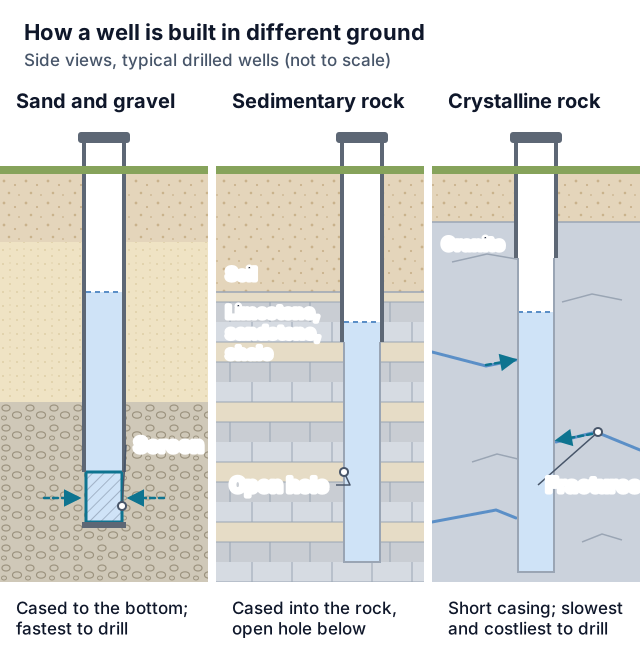
- Casing (Rule 62-532.500(3)): in unconsolidated material, the casing extends from the well's upper end down to the screen, joined to it with a watertight seal. Where casing seats in rock or other consolidated material, it has to run unbroken from the well's upper end down to the uppermost consolidated unit's top or deeper (telescoping casings count as one continuous casing if the grout requirements are met), end at or below the water level in the aquifer that is meant to supply the well, and cover every caving zone beneath that unit.
- Wellhead: casing on private, multi-family and irrigation wells has to project 12 inches or more above finished grade. If a structure or traffic hazard may be present, or there is a potential public health threat, the casing top may instead sit inside an enclosure that ends at finished grade, built for vertical access for maintenance and inspection and for gravity drainage; the casing then ends 18 inches or less below grade and is sealed watertight against surface water and contaminants (Rule 62-532.500(4)(b)2).
- Grouting (Rule 40D-3.517): the annular space around casing is grouted and sealed under that rule and Rule 62-532.500(3), with neat cement or bentonite grout unless the District grants a variance, introduced from the bottom up. Lead packers are not allowed, and any polymer added to a bentonite slurry needs District approval before use. Sealing with bentonite slurry is restricted to wells of five inches or less nominal outside diameter, and it requires a formation packer or a five-foot neat cement plug at the casing seat plus an upper ten feet of neat cement to keep the bentonite seal from deteriorating or being damaged (40D-3.517(2)(b)2). The annulus-thickness and driven-casing provisions of 62-532.500(3)(i) are worth going over with the contractor before drilling.
- Completion report: the water well contractor or any individual permittee sends the District a State of Florida Well Completion Report, due 30 days after construction, repair or abandonment is finished; when no work is done or the well is not completed, a report stating that is due within 30 days of the permit's expiration. If drilling problems arise, the District requires a construction record before the completion report, requested orally or in writing and due 7 days after the contractor or individual permittee receives the request, giving well depth, casing depth, grout quantity, the geologic material and the problems met. The contractor must also keep an accurate field log under each permit, open to inspection on site while work is in progress (40D-3.411).
- Plugging (Rule 40D-3.531): a District permit must be issued before any well, including an incomplete one, is abandoned. Abandoned and incomplete wells that cannot be repaired under Chapter 40D-3 are plugged with grout from bottom to top after obstructions are cleared, by a licensed contractor, other than for 40D-3.051(1) exempt wells and wells permitted through the owner route of 40D-3.301(1)(a). Using clean aggregate or any other material needs the District's prior approval, and aggregate may bridge a cavernous or lost-circulation zone only when measurements show grout loss and the borehole or screened section does not connect two or more aquifers of differing water quality. The contractor notifies the District at least 24 hours ahead, and a District representative must watch unless all four of these hold and the District authorizes the contractor to proceed without one: the contractor complies with all other District rules, has not violated a license condition or District rule in the past two years, and has had at least ten earlier abandonments observed by the District, and no District representative can be at the site at that time. The work is documented on the Well Grouting/Abandonment Form.
- Bentonite limits (40D-3.517(2)(b)3-4): for abandonment, bentonite grout is not restricted by well size, but it cannot be used to plug a dry well or placed above the static water level; any part of the well above that level gets neat cement, and the uppermost 10 feet must be neat cement at least. When bentonite grout is used on a public supply well or in an identified contamination area, it must be a grout the National Sanitation Foundation has approved. Where artesian flow occurs, a neat cement plug has to stop it before bentonite goes in. Bentonite is off-limits in contaminated wells whose contaminants would keep it from sealing adequately, and in wells with more than 10,000 mg/L total dissolved solids.
- Testing: Florida DOH strongly recommends testing a private well for bacteria and nitrate at least yearly. It adds that most homeowners should have lead tested every three years and that a state-certified laboratory should do the testing; the Department of Environmental Protection keeps a database of certified labs.
Geology & Water Table Notes
- Confinement (1988 report): the Upper Floridan was generally unconfined in northwestern Pasco and semiconfined across the rest of the county. Over the limestone in most of the county, the report mapped a predominantly clay upper confining unit, locally exposed at the surface and including the Hawthorn and Alachua Formations, from zero to more than 100 feet thick and, in general, thickest under the Brooksville Ridge. The top of the limestone sequence ranged from near sea level at the coast to about 100 feet above sea level along the ridge, averaging about 50 feet above sea level.
- Karst: the report describes a network of cavities in the carbonate rock, many below the water table, that greatly facilitate groundwater flow, and sinkholes formed where cavity roofs collapsed. Among the county's water concerns it lists poor-quality water reaching the aquifer through sinkholes. The Florida Geological Survey says sinkhole risk is considerably higher in some regions of the state and that private residential wells are typically not sufficient to affect the water table enough to cause sinkholes.
- Coast (1988 report): high chloride turned up only near the coast, in a saltwater-freshwater transition zone the report found generally near land surface from the coast to 2.5 miles inland, after which it dropped sharply. The report warned that drawdown around pumping wells can cause saltwater to upwell, especially near the coast where the freshwater section is thinnest. These are findings of a study begun in 1983, not current mapping.
- Hardness and iron (1988 report): deep well water generally had hardness above 120 milligrams per liter and shallow well water generally below 60. Deep wells with high dissolved iron tended to cluster in the Cross Bar well field and turned up scattered through swampy areas. The wells sampled for the study ranged from 5 to 957 feet deep.
- Crystal Springs: the report put the spring's average flow into the Hillsborough River, just above the Hillsborough County line, at 38 million gallons per day from 1980-84 records, and said it supplied 50 to 80 percent of the river's flow from 1980 through 1985.
Communities Served
Dade City · Zephyrhills · San Antonio · St. Leo · Wesley Chapel · Land O' Lakes · Hudson · Shady Hills · Lacoochee · Trilby · Crystal Springs
Emergency Response Expectations
SWFWMD issues emergency well construction permits, through its Executive Director or a designee, in three situations under Rule 40D-1.1022: a well serving a particular use has failed and has to be replaced right away; people's health, safety or general welfare would be jeopardized without one; or immediate action is needed to mitigate or resolve potentially hazardous degradation of water resources. The request can be made orally, with the written application, fee and any information the District asks for following within 48 hours. Where Chapter 40D-2 applies, a filed water use permit application is a precondition, and completion reports under 40D-3.411 are still required. No arrival time is promised here.
Pasco County FAQs
Which agency issues well permits in Pasco County?
SWFWMD issues them under Chapter 40D-3, F.A.C.; Pasco is not one of the counties where the district has delegated permitting. Its application fee is $50 for a well that is not a public supply well, or $100 if that well is a potable well inside a Chapter 62-524 delineated area.
Can I drill my own well in Pasco County?
Only within s. 373.326(2), F.S.: the well must be 2 inches or less in diameter, on property you own or lease, used only to supply the single-family home you live in or only for farming on your farm, with its water not intended for the public or any residence other than yours, and you must follow every local and state well construction rule. You still need a SWFWMD permit before starting and must file the completion report within 30 days of finishing. SWFWMD cautions that mandatory well designs in certain areas could make the job hard for an unlicensed person.
How deep will my well be?
No source reviewed here gives a typical Pasco County well depth. The 1988 USGS study's sampled wells ranged from 5 to 957 feet, and casing depth follows the casing rule under permits. SWFWMD's permit map shows well construction permits issued near your lot.
Do I need a well test to buy or sell a house in Pasco County?
No. DOH says Florida does not require well sampling when a private home is sold; its general advice is to test for coliform bacteria, nitrates and lead. DOH names the counties whose health departments enforce local rules requiring tests of newly built or repaired wells, and Pasco is not one of them.
Can my well cause a sinkhole?
The Florida Geological Survey says private residential wells are typically not sufficient to affect the water table enough to cause sinkholes. Its list of probable triggers for a collapse is drought, construction terra-forming, blasting, heavy ground loading, heavy rainfall and heavy groundwater pumping.
Sources
- Fla. Stat. s. 373.303
- Fla. Stat. s. 373.308
- Fla. Stat. s. 373.323
- Fla. Stat. s. 373.326
- Fla. Stat. s. 373.336
- F.A.C. ch. 40D-3: Regulation of Wells
- F.A.C. ch. 40D-1 (fees, emergency permits)
- F.A.C. ch. 40D-2: Water use permits
- F.A.C. ch. 62-532: Water well permitting and construction
- F.A.C. ch. 62-531: Contractor licensing
- F.A.C. ch. 62-524: Delineated areas
- SWFWMD: Well Construction Permits
- SWFWMD: well construction Q&A, August 2020
- Florida DOH: Well Permitting Agencies, 2026
- Florida DOH: Private Well Water Testing
- DOH-Pasco: Drinking Water
- USGS WRI 87-4188 (Fretwell, 1988), Pasco County
- Florida Geological Survey: Sinkhole FAQ
- Census Bureau 2020 place codes, Florida
Last reviewed 2026-10-29
Services Available in Pasco County
Well Drilling
New residential wells — find local drillers for site evaluation, depth estimates, and written drilling quotes.
Learn more →Water Well Drilling
Household water wells from site evaluation through casing, pump, and water test — written quotes from local drillers.
Learn more →Well Pump Repair
No water at the tap? Request urgent well pump repair — local pros diagnose pressure loss, dead pumps, and pressure tank failures fast.
Learn more →Well Pump Replacement
Pump at end of life or beyond repair? Get quotes for correctly-sized submersible and jet pump replacement from local well pros.
Learn more →Well Inspection & Testing
Buying a home with a well, or overdue for a water test? Local pros for flow tests, equipment inspection, and lab water-quality testing.
Learn more →Well Water Service
Water quality problems, treatment systems, and general well maintenance — connect with local pros for everything between drilling and pump work.
Learn more →Free Tools Before You Call
Ballpark the cost or narrow down the problem before talking to a Pasco County provider.
Well Drilling Cost Calculator
Estimate what drilling a well should cost — by depth, geology, and whether you need the pump and pressure tank included.
Use the free tool →No Water From Your Well? Diagnostic Wizard
Suddenly no water in the house? Answer a few questions to find out if it's the breaker, the pressure switch, the tank, the pump — or the well itself.
Use the free tool →Well Pump Size Calculator
Find what size well pump you need — GPM demand, total dynamic head, and a horsepower recommendation from four quick inputs.
Use the free tool →Need help in Pasco County, FL?
Send the short form — urgent requests get priority routing.