Well Drilling in Alpena County, MI
Well drilling typically runs $3,000–$16,000 nationally, per our cost guide. Independent local pros serving Alpena, Ossineke, Alpena Township and nearby communities. Describe the problem and we'll route your request — free, no obligation.
- Mark no-water pump problems as emergencies on the form
- County pages on local well depths, aquifers, and permits
- Well inspections, water testing, and treatment
- Free to use — no obligation, no markup
Fast response from independent local providers. No obligation.
Typical national cost$3,000 – $16,000Cost guide →Local Help in Alpena County, MI
USGS Open-File Report 2007-1236, a county-by-county summary of Michigan hydrogeology, places Alpena County in the northeastern Lower Peninsula, drained in part by the Lone Lake-Ocqueoc, Thunder Bay, Au Sable and Lake Huron watersheds. Using the February 2005 Wellogic database, the report counted approximately 39 percent of the county's wells as completed in glacial deposits and 41 percent in bedrock units, with too little information to classify the other 20 percent. It adds that glacial wells are more abundant in the southern part of the county and bedrock wells dominate the north.
Well permits here come from District Health Department No. 4 (DHD4), which also covers Cheboygan, Montmorency and Presque Isle counties. Its Sanitary Code, effective October 12, 2009 and linked from its forms page, adopts by reference Part 127 of the Public Health Code (MCL 333.12701 to 333.12715) and the state rules beginning at R 325.1601, and DHD4's water supply page says construction of water supplies must comply with both the state's well construction code and the district's sanitary code. This site forwards requests to independent contractors; it does not drill or service wells itself.
Alpena County Service Details
What providers in this area actually see: coverage, common jobs, local pricing factors, and rules worth knowing.
Service Area Notes
- Places and townships: in the Census Bureau's 2020 place-by-county file, Alpena County is listed with Alpena city and the Ossineke census-designated place, and Hillman village appears under both Alpena and Montmorency counties. Its county subdivision file lists Alpena city and eight townships: Alpena, Green, Long Rapids, Maple Ridge, Ossineke, Sanborn, Wellington and Wilson. The Census Bureau's current TIGERweb layers show the same names.
- Finding an old well log: according to EGLE's Wellogic page, contractors have submitted well, pump and abandoned-well plugging records to that system electronically since 2000. More than a million records sit there, open to anyone through 22 search fields, and an account is needed only to submit or change data. DHD4's residential water page links to Wellogic.
- Checking a contractor's status: EGLE runs a yearly registration for well drilling contractors, pump installers and drilling rigs. All registrations lapse on April 30 by law and renewals are due by March 1; a contractor still unrenewed on May 1 is barred from well drilling and pump installation until it renews, per EGLE's registration page.
Common Jobs in Alpena County
- New private wells and Type III public supply wells, both applied for on DHD4's EH-216 application
- Type II noncommunity wells, which DHD4 describes as serving 25 or more persons 60 days a year or 15 or more service connections, applied for on EGLE's public water supply application (form EQP2024), which DHD4 posts with its own noncommunity instructions
- Work the Sanitary Code lists among the extensive changes that need a permit, including replacing or removing a casing, changing aquifers or water sources, and deepening or plugging back a well
- Bedrock wells on lots where rock sits 25 feet or less below grade (R 325.1637)
- Geothermal, irrigation, test, dewatering and industrial wells, which DHD4 says it also regulates
- Plugging wells that are abandoned when municipal water is installed (R 325.1662(3))
- Chlorinating new or repaired wells before the owner's required samples
What Drives Pricing Here
- Permit fee: DHD4's Environmental Health fee schedule, approved February 17, 2026, lists $270 for a private residential well permit, made up of the $210 permit and $60 for the water bottles. The same schedule lists $525 for a public drinking water well construction permit (sample bottles not included) and $250 for a residential geothermal permit, plus $10 for each additional well when a geothermal project has more than 5 wells. Starting construction or installation without a permit is charged double the permit fee plus the $110 stop work fee.
- Water testing: that schedule prices partial chemical and bacteria water sample analysis at $30 each, and a well-only existing system evaluation, which includes bacteriological and partial chemistry samples, at $250.
- Ballpark totals: the drilling cost calculator on this site has no Alpena-specific data. It multiplies a depth you supply by a per-foot band for the rock type you select, then adds a flat permit allowance and, if left switched on, pump and pressure tank allowances, with every rate taken from national cost articles by Angi, HomeGuide and HomeAdvisor. Treat its output as a national ballpark rather than a local bid.
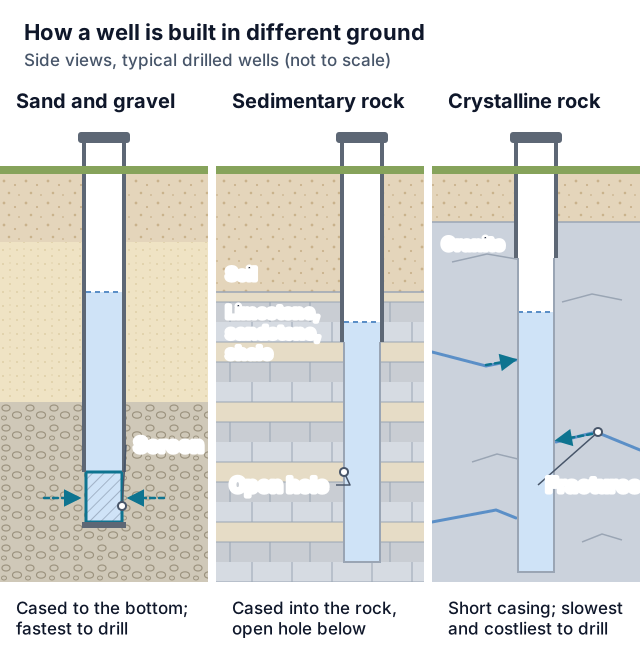
- Casing length: under R 325.1632(3), casing goes no less than 25 feet into the ground and sticks up no less than 12 inches; a well cased for under 26 feet needs written approval from the health officer (R 325.1613) before anyone uses it. In a paved area, R 325.1632(6) lets the health officer approve in writing a casing top as low as 2 inches above the surface, provided the spot does not flood, connections and openings are threaded or welded and watertight, and acceptable casing venting is in place.
- Shallow rock: R 325.1637(1) applies when the drill reaches bedrock 25 feet or less below the surface. The hole must then be oversized and the permanent casing grouted in neat cement to a depth of 25 feet or more.
- Fractured or cavernous rock: R 325.1637(2) applies where a well can be developed only in fractured, jointed or cavernous bedrock. There the casing may end in the formation only if at least 25 feet of soil lies above the bedrock, there is no record of the bedrock containing contaminated water, and geologic conditions offer no natural direct surface or near-surface water inlets into the bedrock aquifer. Where the overburden is thinner and deeper strata will not produce potable water, the well owner must get the health officer's written approval for the water treatment and construction features needed for a safe supply. Hydraulic fracturing of bedrock needs the health officer's prior written approval (R 325.1637(3)).
- Grout work: R 325.1633a bars shale traps, cementing baskets, packers or similar devices from holding grout above an open annular space. The neat cement or bentonite grout is pumped from the lowest point of the annular space upward to the surface without stopping, through either the permanent casing or a separate pipe, until the grout returning at the surface matches the density of what is being pumped in. The borehole must be at least 2 inches wider than the casing's nominal size, or 2 7/8 inches wider if grouting through a pipe set outside the casing, except as R 325.1635 provides for driven casing. As a temporary casing is pulled out, the gap it leaves outside the permanent casing has to be filled during that removal with pumped neat cement or bentonite grout, or with poured bentonite chips, bentonite pellets or granular bentonite; the rule forbids pouring granular bentonite into a space that contains drilling fluid or water (R 325.1633a(5)). Neat cement made with the cement types the rule lists must set at least 24 hours, and neat cement with added bentonite at least 48 hours, before drilling resumes (R 325.1633a(6)).
- Grout length: a well drilled by rotary, auger or a similar method, with its permanent casing set in an oversized borehole, is grouted with neat cement or bentonite grout along the casing's entire length; when a screen is installed, the grout runs from no more than 10 feet above the top of the screen up to the surface. The health officer may shorten the grouted length only through a written deviation under R 325.1613(2)(f), which is limited to a well more than 100 feet deep that does not penetrate a confining layer (R 325.1634a(2)); R 325.1613(3) requires the deviation to be in writing and to state its reasons.
- Grout checks: R 325.1637a lets the department or health officer require the driller to dig out the wellhead for inspection when an open annular space is visible, grout cannot be found 2 feet or more below the water service line connection, tracer dye placed around the casing shows up in the well water, or a well log shows the well was not grouted or has missing or incomplete grouting information.
Permits & Local Rules
- Who may drill: a business that drills wells or installs pumps must first register with the state each year, either as a well drilling contractor or as a pump installer, and hold that certificate before starting the work (MCL 333.12704(1)). Registered drilling contractors may also install pumps (MCL 333.12704(3)), while R 325.1608 confines registered pump installers to pump work, with no drilling. A master plumber licensed under Michigan's plumbing law may do pump installer work without that registration (MCL 333.12703(3)), as DHD4's driller page also notes.
- Owner-built wells: under MCL 333.12703(2), Part 127 does not bar someone from building their own well or putting in their own pump, but only on land the person owns or leases, and only where the well serves either a single-family home that is the person's own permanent residence or farming on the person's own farm, with none of the water intended for the public or for another residence. That owner must still turn in the well record MCL 333.12707 calls for and build to the state construction code. DHD4 adds that such an owner must apply for a permit first, meet the construction codes, and receive the department's written authorization, which it bases on a pre-drilling site visit.
- When a permit is needed: Section 903.A of the Sanitary Code bars anyone from starting a new water supply, or making extensive changes to an existing one, without first getting a water supply construction permit from DHD4. Section 900 says Part IX does not apply to installing wells, water mains, service lines and other items that are part of a Type I public water supply. Section 903.C carries an emergency exception for registered well drillers, covered in the FAQ below.
- Applying: Section 903.D requires a written application on the district's form, signed by the property owner or a representative, showing the owner, property, well, sewage, building, surface water, pavement and flood plain details the section lists. The EH-216 form adds its own 12-item site sketch checklist and requires directions to the site.
- Permit terms: a permit lasts two years (24 months) from issuance unless declared void, and cannot be moved to another person or location (Section 903.E). Under 903.F the health officer may void a permit and post a stop work order for reasons including an undisclosed change in the project's scope, permit conditions that cannot be met, inaccurate or untrue application information, or work that is substantially certain to threaten public health or the environment. By signing EH-216, the applicant also agrees that the health officer must give final approval before the system is covered or used and to have underground utilities marked before any health department activity on the property.
- Grounds for refusal: Section 903.I lets the health officer reject an application where the water supply would be inaccessible for maintenance and repair, the property is too small for the isolation distances the health officer requires, the site is subject to flooding or within the 100-year flood plain, the parcel is known to have been divided in violation of the Land Division Act or the Condominium Act, an aquifer under the site is known to be contaminated, or conditions exist or may be created that could endanger public health or the environment.
- Notice to the district: Section 903.H has the permit holder or the licensed well drilling contractor notify the health officer before construction, through the permit application, and again within 60 working days after the water supply is finished.
- Separation distances: R 325.1622 wants a well upgradient of pollution sources where possible and as far from them as practical, and sets floors such as 800 feet to septage spread on land or to the active work area of a landfill, 300 feet to oil or gas wells, 150 feet to places where fertilizers or other chemicals are stored or prepared, and 50 feet to septic tanks, subsurface disposal fields, outhouses, animal yards and most buried sewers. Ten feet suffices for a lake, pond, river or stream, and for a buried gravity-flow sewer of service-weight or heavier ductile iron or schedule 40 PVC with watertight joints, or of other materials the director approves in writing. R 325.1622(2) lets the health officer increase or decrease a distance for an individual well only through a written deviation under R 325.1613, which sets the conditions, so ask DHD4 whether a particular lot qualifies. Keeping these distances on land the owner owns is the owner's job. The isolation table in Section 405 of DHD4's code sets 75 feet between Type III or Type IIb public wells and septic tanks, absorption systems or sewers, and 200 feet for Type I and Type IIa wells.
- Logs and pump records: a well drilling contractor has 60 days from a well's completion to deliver a well log, on the department's standard form or on the contractor's own form if the department has approved it, one copy for the owner and two for the health officer, and must retain its own copy; the health officer sends one copy to the Department of Natural Resources within 30 days of receiving them (R 325.1675(1); MCL 333.12707). The log records the owner's name, where the well is, how deep it goes, each geologic material penetrated and its thickness, how much casing was used, the static water level, and anything else the rules or construction code require; for a drive point well, which takes no earth out of the bore, a log stating the owner's name, the well's location and depth, its casing and screen data, and the static water level is sufficient. The log must carry the signature of a registered well drilling contractor (R 325.1675(4)). During construction the contractor keeps a record of the geologic materials and thicknesses at the site, open for inspection (R 325.1675(2)), and if a contractor misses the 60-day deadline or skips that on-site record, the department or health officer can require geophysical logging to verify the materials and thicknesses penetrated (R 325.1675(5)). For a pump put on a new well, R 325.1676 requires a pump installation record within 60 days, one copy to the owner and two to the health officer, with a copy kept by the contractor or pump installer who did the work and one forwarded by the health officer to the Department of Natural Resources within 30 days. It lists the pump type, capacity in gallons per minute, drop pipe length, motor horsepower, model number and manufacturer, and it needs the signature of either a registered pump installer or a registered well drilling contractor.
- Approval before use: Section 903.J says a new water supply may not be used until the health officer approves it, after receiving the completed Water Well and Pump Record from the contractor or pump installer and results showing that the raw water meets minimum public health standards. The analysis must include coliform bacteria and any other parameter the health officer deems necessary, and must be done by a laboratory certified by the Michigan Department of Environmental Quality, as the 2009 code words it.
- Disinfection: once the well has been pumped to waste, the driller or pump installer chlorinates whatever portion of the water system it worked on, choosing one Table 5 pairing in R 325.1661: a minimum contact time of 10 hours at 100 parts per million of chlorine, 4 hours at 250, 2 hours at 500, or 1 hour at 1,000. After the chlorine is flushed out, samples from the sampling faucet must be free of coliform organisms before a new, repaired or reconditioned system goes into service. Collecting them falls to the owner or a representative the owner designates, and the driller or pump installer has to inform the owner of that responsibility.
- Plugging: an abandoned well or dry hole may be plugged by its owner or by a registered well drilling contractor, except that the registered contractor is mandatory on a property where a well supplies the public or any home besides the owner's (R 325.1662(1)). The pump, drop pipe, packer and other obstructions come out first if possible (R 325.1662(2)). Under R 325.1663, a well ending in overburden is filled with neat cement, concrete grout, bentonite chips, bentonite pellets or bentonite grout; a bedrock section is filled with neat cement or concrete grout from the bottom to at least 20 feet above the top of the bedrock or to the surface, and the section above that is filled with the overburden materials. Gravel, sand, stone aggregate or other materials acceptable to the department may be used for the part of the well that passes through lost circulation zones such as gravel or cavernous, creviced or fractured bedrock, and flowing wells and wells that discharge subterranean gases must be plugged with neat cement or concrete grout. R 325.1664 sets how each material is placed and allows other materials and methods only with a health officer's prior approval and only if they keep the well from acting as a channel for contamination or escaping gases; large dug or crock wells follow R 325.1665.
- Plugging reports and orders: within 60 days of plugging, the person who did it files two copies of a report with EGLE or the local health department stating the owner's name, the well's location, depth and diameter, how it was plugged, with what material, and how much. Two shortcuts exist: if a replacement well is planned or already built, the plugging information can be entered on that new well's log, and one well log form can cover multiple abandoned wells or dry holes on the same parcel provided they have similar geologic materials and were plugged in similar ways (R 325.1675(3)). Section 905 of DHD4's code lets the health officer require plugging of an abandoned well, a well installed without a permit after the code took effect, a well that violates the code or its permit, or a well that lets a contaminant into an aquifer.
- Keeping an unused well: R 325.1670 keeps a temporarily abandoned well subject to the construction and isolation distance requirements, and requires that it be cut off from the water distribution piping with a secure cap on the casing that keeps out surface water and foreign material and prevents access.
Geology & Water Table Notes
- Glacial cover: the USGS summary, citing Western Michigan University (1981), puts glacial deposits at up to 600 feet thick in Alpena County. It describes coarse-grained till across the western and central county, eskers in the central county, outwash in the southwest and ice-contact outwash in the southeast, coarse-grained lake deposits at the surface in the northeast and along the eastern border, sand dunes along the Lake Huron shoreline and inland, and peat and muck in the northwest.
- Bedrock units: according to the same report, the Sunbury Shale, Berea Sandstone and Bedford Shale subcrop in the southwestern part of the county, and the Antrim Shale and Traverse Group make up the rest of the bedrock surface. It describes the Traverse Group as mainly fossiliferous limestone and says most of the county's bedrock wells are where the Traverse Group forms the bedrock surface.
- Karst: the report notes several karst features across the northern part of the county, formed by dissolution and later collapse of carbonate and evaporite bedrock. It names sinkhole lakes near Leer and lists Devil's, Long, Fitzgerald and Mindack Lakes as karst solution lakes, citing Kimmel (1983). These describe the county broadly rather than any one lot; DHD4 can say what applies to a particular site.
- Sample handling: the collection instructions on DHD4's forms page send samples to the Northern Michigan Regional Laboratory in Gaylord, which accepts them Monday through Thursday. They say the bacteriological test is valid only for 30 hours after collection and that the partial chemical sample travels in a cooler with the ice pack provided. A state DEQ fact sheet enclosed with them cautions that coliform and partial chemical tests do not detect petroleum products, industrial solvents, arsenic and heavy metals, herbicides or pesticides, and that a local health department can assist in choosing other tests for a site.
Communities Served
Alpena · Ossineke · Alpena Township · Green Township · Long Rapids Township · Maple Ridge Township · Ossineke Township · Sanborn Township · Wellington Township · Wilson Township
Emergency Response Expectations
Section 903.C of DHD4's Sanitary Code lets a registered well driller begin a new water supply or extensive changes without notification or permit when lack of water will cause undue hardship while the district's offices are closed, or when the driller is doing repair work and it is deemed necessary to start a new well immediately; the driller then contacts the health officer on the next regular working day to obtain the permit. This site hands requests to independent contractors and has no control over how quickly any of them responds.
Alpena County FAQs
What does a home well permit cost in Alpena County?
DHD4's fee schedule approved February 17, 2026 lists $270 for a private residential well permit: $210 for the permit and $60 for water bottles. Work begun without a permit costs double the permit fee plus a $110 stop work fee.
Can I drill my own well on my Alpena County land?
Only under MCL 333.12703(2), which covers land you own or lease where the well will supply nothing but your own single-family permanent home, or nothing but farming on your own farm, and none of the water is meant for the public or another residence. You must still submit the well record and meet the state construction code, and DHD4 requires a permit first plus its written authorization after a pre-drilling site visit.
Which water tests does DHD4 require on a new well?
Its water sampling page says new, repaired and reconditioned wells need a coliform bacteria sample, which must show no coliform, and a partial chemistry sample covering chloride, fluoride, sodium, sulfate, hardness as CaCO3, iron, nitrate and nitrite, and that newly built wells also need a nitrate sample. Owners collect the samples, bottles with a shipping container come from the local office, the sample must be taken or mailed to a state-certified laboratory, and DHD4 may require other samples as a permit condition, for example near a contamination source. The page also says seasonal wells that are depressurized should be disinfected and sampled before the water is consumed at the start of the season, and recommends annual coliform sampling.
Can a driller start before the permit when a well quits?
Section 903.C of the Sanitary Code allows it in two cases: when lack of water will cause undue hardship and DHD4's offices are closed, or when the driller is already doing repair work and it is deemed necessary to begin a new well immediately. In either case the code lets a registered well driller begin the extensive changes or new water supply without notification or permit; the driller must contact the health officer on the next regular working day and obtain a permit.
What changes when limestone is close to the surface?
If bedrock is within 25 feet of the ground, R 325.1637(1) requires an oversized borehole and neat cement grout around the casing for at least 25 feet. Where only fractured, jointed or cavernous rock will yield water, R 325.1637(2) sets the conditions for ending the casing in that rock, and when the cover is thinner and deeper rock will not give potable water, the owner needs the health officer's written approval for the treatment and construction features required for a safe supply. Ask DHD4 how these apply on your lot.
Must an old well be plugged once a home switches to municipal water?
If the well is abandoned, yes. R 325.1662(3) says a well that is abandoned when municipal water is installed must be plugged under the state rules, EGLE's abandoned wells page lists wells disconnected and taken out of service at the time of a municipal connection among those that must be plugged, and DHD4's abandoned well page says a written abandonment report goes to the local health department within 60 days of plugging. Either the owner or a registered contractor may do the plugging, unless a well on the property supplies the public or a home other than the owner's, in which case a registered contractor must do it.
Sources
- District Health Department No. 4: Residential and Type III public water supplies
- District Health Department No. 4: Well drillers and pump installers
- District Health Department No. 4: Water sampling
- District Health Department No. 4: Abandoned water wells
- District Health Department No. 4: Type II public water supplies (non-community)
- District Health Department No. 4: Permits, applications, forms and fees
- District Health Department No. 4: Environmental Health fee schedule 2026 (approved February 17, 2026)
- District Health Department No. 4: Sanitary Code (effective October 12, 2009)
- District Health Department No. 4: EH-216 well and septic permit application and site plan
- District Health Department No. 4: Drinking water sample collection instructions
- Michigan Legislature: Public Health Code Part 127, MCL 333.12701 to 333.12715
- Michigan Administrative Code R 325.1601 to R 325.1781: Groundwater Quality Control
- EGLE: Water well contractor registration
- EGLE: Wellogic water well records
- EGLE: Abandoned water wells
- USGS Open-File Report 2007-1236: Summary of Hydrogeologic Conditions by County for the State of Michigan (Apple and Reeves)
- U.S. Census Bureau: 2020 places by county, Michigan
- U.S. Census Bureau: 2020 county subdivisions, Michigan
Last reviewed 2026-10-28
Nearby Counties
Services Available in Alpena County
Well Drilling
New residential wells — find local drillers for site evaluation, depth estimates, and written drilling quotes.
Learn more →Water Well Drilling
Household water wells from site evaluation through casing, pump, and water test — written quotes from local drillers.
Learn more →Well Pump Repair
No water at the tap? Request urgent well pump repair — local pros diagnose pressure loss, dead pumps, and pressure tank failures fast.
Learn more →Well Pump Replacement
Pump at end of life or beyond repair? Get quotes for correctly-sized submersible and jet pump replacement from local well pros.
Learn more →Well Inspection & Testing
Buying a home with a well, or overdue for a water test? Local pros for flow tests, equipment inspection, and lab water-quality testing.
Learn more →Well Water Service
Water quality problems, treatment systems, and general well maintenance — connect with local pros for everything between drilling and pump work.
Learn more →Free Tools Before You Call
Ballpark the cost or narrow down the problem before talking to an Alpena County provider.
Well Drilling Cost Calculator
Estimate what drilling a well should cost — by depth, geology, and whether you need the pump and pressure tank included.
Use the free tool →No Water From Your Well? Diagnostic Wizard
Suddenly no water in the house? Answer a few questions to find out if it's the breaker, the pressure switch, the tank, the pump — or the well itself.
Use the free tool →Well Pump Size Calculator
Find what size well pump you need — GPM demand, total dynamic head, and a horsepower recommendation from four quick inputs.
Use the free tool →Need help in Alpena County, MI?
Send the short form — urgent requests get priority routing.