Well Drilling in Fresno County, CA
Well drilling typically runs $3,000–$16,000 nationally, per our cost guide. Independent local pros serving Sanger, Reedley, Selma and nearby communities. Describe the problem and we'll route your request — free, no obligation.
- Mark no-water pump problems as emergencies on the form
- County pages on local well depths, aquifers, and permits
- Well inspections, water testing, and treatment
- Free to use — no obligation, no markup
Fast response from independent local providers. No obligation.
Typical national cost$3,000 – $16,000Cost guide →Local Help in Fresno County, CA
Outside city limits, well permits in Fresno County come from the Department of Public Health's Environmental Health Division. It permits new wells, the reconstruction, repair or deepening of existing ones, and the destruction of abandoned wells, and it issues those permits to properly licensed well drilling contractors. For a well inside an incorporated city, the division's well permitting page tells owners to contact that city directly.
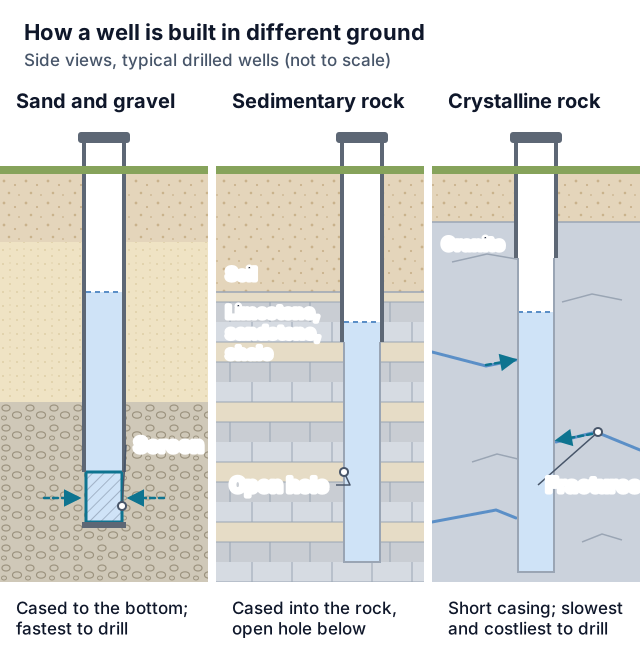
Below the valley floor, a 1999 U.S. Geological Survey circular (Circular 1182) describes shallow unconfined or partly confined aquifers throughout the San Joaquin Valley and a lake-laid clay, the Corcoran Clay, spread through the central and western valley. The clay runs from a feather edge to about 160 feet thick beneath what the circular calls the present bed of Tulare Lake, and it confines a deeper aquifer system. California's well standards (DWR Bulletins 74-81 and 74-90) point to this same clay as the natural divider between groundwaters of varying quality in the valley.
Fresno County Service Details
What providers in this area actually see: coverage, common jobs, local pricing factors, and rules worth knowing.
Service Area Notes
- Census Bureau 2020 place codes list Clovis, Coalinga, Firebaugh, Fowler, Fresno, Huron, Kerman, Kingsburg, Mendota, Orange Cove, Parlier, Reedley, Sanger, San Joaquin and Selma as the county's incorporated cities, all still active in the Bureau's current TIGERweb layer. Auberry, Biola, Caruthers, Del Rey, Friant, Laton, Riverdale, Shaver Lake and Tranquillity appear in the same files as census-designated places, not cities.
- The county Public Works and Planning SGMA page lists groundwater sustainability agencies by subbasin: for Delta-Mendota, Fresno County Management Areas A and B and Central Delta-Mendota; for Kings, the Central Kings, James, Kings River East, McMullin, North Fork Kings, North Kings and South Kings GSAs; plus Pleasant Valley and Westside entries. It sends readers to its interactive map to find their GSA.
- A county map titled "Water Short Areas Requiring Well Test" (in the Water and Natural Resources Division's packet, revised May 2018) shades the county's northeastern section, crossed on the map by Route 168 and Kings Canyon Road, and a band along the western edge, crossed by Interstate 5 and taking in the Coalinga area. Building permits there need proof of water, covered under permits below.
Common Jobs in Fresno County
- New domestic, agricultural or industrial wells under a county well permit
- Deepening, reconditioning or repairing an existing well, which falls under the same county fee item
- Destroying an abandoned well under its own permit and fee
- Well yield tests for building permits in the mapped water-short areas
- Pump installation and repair, which the C-57 classification names alongside the well itself
- Chlorinating a well and its water lines after a coliform result, per the county's disinfection sheet
What Drives Pricing Here
- Permit fees: in the county's Environmental Health fee schedule, posted as effective April 1, 2026, item 945 (Well Permit: Construct, Deepen, Destroy, Recondition or Repair) lists $918 each for a domestic, agricultural, cathodic, test-hole or industrial well, $281 per monitoring well, $249 per soil boring and $619 per well destruction. Item 946 puts the Consumer Protection Unit's hourly rate for re-inspection and consultation at $122.
- Depth: USGS Scientific Investigations Report 2024-5009 studied domestic-supply wells sampled in 2013-15 across five southeastern San Joaquin Valley study areas, Kings among them. It reports spatially weighted median well depths of 172 to 366 feet below land surface for domestic-supply wells (its term for private domestic wells and small water systems) in those areas, against 301 to 605 feet for the public-supply wells it compared, and says depths vary systematically by well type, study area and position in the basin. DWR's WCR Map Application searches completion reports by address or coordinates.
- Subsidence: Circular 1182 lists collapsed well casings among the direct damages of San Joaquin Valley land subsidence and says damage estimates did not fully account for underreported well rehabilitation and replacement costs.
- Treatment: the county's DBCP notice names a replacement well or a granular activated carbon filter at the well as potential solutions. Its gross alpha notice warns that treatment for gross alpha radioactivity, radium or uranium needs ongoing maintenance and monitoring and that some types may generate hazardous waste, which may bring costly disposal issues.
- Lab work: the State Water Board's GAMA testing page puts basic sampling at $100 to $400, depending on the constituents and the lab, and suggests asking for a written estimate before sampling.
- Our drilling cost calculator takes your depth times a per-foot drilling and casing rate keyed to geology (rates from Angi, HomeGuide and HomeAdvisor), then adds a generic $200-$500 permit line and, if you choose, an installed pump and pressure tank. Replace its permit line with the county fee above.
Permits & Local Rules
- Licensing: Water Code s. 13750.5 bars anyone from digging, boring or drilling a water well, cathodic protection well, groundwater monitoring well or geothermal heat exchange well, deepening or reperforating one, or abandoning or destroying one, unless the person responsible for that work holds a C-57 Water Well Contractor's License; the class (Cal. Code Regs. tit. 16, s. 832.57) installs and repairs water wells and pumps. Fresno County says only active C-57 holders may construct, reconstruct or destroy wells, and its destruction sheet bars a contractor without a C-57 from destroying a well as an "incidental part" of a larger job. Owners in unincorporated areas planning a well must contact a properly licensed driller, and the permit is issued to the contractor doing the work.
- Applying: the driller submits a completed Well Permit Form in the county Citizen Portal with a plot plan and the permit fees. An application found acceptable on review is approved and emailed to the driller, and only then may drilling begin. Permits are valid for 180 days. A destruction permit application must come with all available construction data for the well.
- Rules in force: the county enforces the California Well Standards Ordinance with Bulletins 74-81 and 74-90, Ordinance Code Title 14 (primarily Chapters 14.04 and 14.08) and General Plan policies PF-C.19 and PF-C.20. Water Code s. 13801(c) required each county, city or water agency, where appropriate, to adopt by January 15, 1990, a well ordinance meeting or exceeding Bulletin 74-81, unless a water agency with well-permit authority had adopted one for the same area, and s. 13755 has everyone follow the chapter and its regulations in addition to city or county standards.
- Bulletin 74: DWR says the standards were last updated in 1991 and lists a tentative public comment period for the revision from November 5, 2026, to January 7, 2027. Part I lets the enforcing agency waive a requirement it finds impractical because of unusual conditions, or one that would produce an unsatisfactory well, if it prescribes alternatives giving equal protection.
- Setbacks: Bulletin 74-81 Section 8 treats these minimums as generally adequate where a significant layer of unsaturated, unconsolidated sediment less permeable than sand lies above the groundwater: 50 feet from any sewer (sanitary, industrial or storm, main or lateral), 100 feet from a watertight septic tank or subsurface sewage leaching field, 150 feet from a cesspool or seepage pit, plus 100 feet from an animal or fowl enclosure (for a radial collector well, from its furthest extended point), and notes local conditions may require more. The enforcing agency must increase them or require special protection where it sees adverse conditions, and may approve lesser distances case by case where physical conditions prevent compliance and special means of protection are provided.
- Annular seal: Section 9.A runs the seal from ground surface to at least 50 feet for community water supply and industrial wells and 20 feet for individual domestic, agricultural, air-conditioning and all other wells. Its exceptions carry their own conditions: a shallower seal needs enforcing-agency approval, applies only where the water to be produced is less than 20 feet deep, must still reach at least 10 feet below land surface and be at least 10 feet long, and calls for caution in siting, such as greater separation distances than Section 8 lists; a well the agency approves closer to a pollution source than Section 8 allows is sealed to the first impervious stratum if possible and in every case to at least 50 feet; and the seal top may sit below ground, never more than 4 feet down, in the freezing areas the section defines or, with agency approval, where traffic or other conditions require, if the seal and casing extend to a watertight, structurally sound subsurface vault or equivalent feature that itself runs from the seal top to at least ground surface (DWR calls such vaults rare and discouraged and says pitless adapters should be used in their place where appropriate). Section 9.D allows neat cement, sand cement, concrete or bentonite, never cuttings or drilling mud, and limits bentonite: it may not be used where roots from trees and other deep-rooted plants might invade and disrupt the seal or damage the casing, or where flowing water might erode it, and may not seal intervals of fractured rock or of highly unstable, unconsolidated material that could collapse and displace it unless the enforcing agency approves; unamended bentonite should not be used where the seal needs structural strength or will dry. Section 9.D also sets water-quality limits and mix ratios for the materials, and Subsections E and F set seal thickness and placement rules. The county page says the ordinance requires at least 48 hours' notice before the seal goes in so staff can arrange an inspection, adds that the notice was not being enforced during the 2021 drought, and tells drillers to call well program staff for more information.
- County well log: within 30 days after construction, deepening or destruction is completed, the contractor gives Environmental Health a Notice of Completion, also called a Well Driller's Report or Well Log, documenting that the work met the Well Standards Ordinance. For a new well, the county then writes to the owner to schedule a final inspection.
- State report: Water Code s. 13751 also requires a completion report to DWR, on DWR forms, within 60 days from the date the construction, alteration, abandonment or destruction is completed. For a water, cathodic protection or monitoring well it must include, among whatever else DWR requires, a site description exact enough to locate the well, a detailed log, the type of construction, perforation details, the methods for sealing off surface or contaminated waters and for keeping contaminated water in one aquifer out of another, and the driller's signature. Under s. 13754, noncompliance or willful falsification is a misdemeanor, though except for falsification the person first gets a reasonable chance to comply.
- Report access: s. 13752 opens these reports to government agencies and, on request, to the public; DWR may charge a fee no higher than its reasonable costs, and disclosure must comply with the Information Practices Act of 1977. For a report missing from the WCR map, DWR's South Central Region Office in Fresno takes requests for Fresno County, and a fee may apply.
- GSAs: the county permits well installation while GSAs regulate the use of wells, and the county cannot enforce or negotiate GSA requirements. The county suggests sending the GSA the permit at the same time it goes to the county and, since permits will most likely be issued before GSAs respond, contacting the GSA so owners know before drilling how they can and cannot use the well. Domestic private wells, some agricultural wells, cathodic and monitoring wells and test holes are usually processed normally; domestic public, industrial, commercial, some agricultural and other wells may get more GSA review time.
- Destruction: no one may destroy a well without first applying for and receiving a county permit, and the work follows Part III, Sections 20-23, of Bulletins 74-81 and 74-90. The county sheet adds digging around the casing to 5 feet below ground and removing the casing to that depth (a variance from excavating may be requested for special circumstances), letting the upper sealing material spill over to form a cap, backfilling with native soil once it sets, and filing the well log within 30 days. If pollutants or contaminants are known or suspected in the well, Section 23 has the enforcing agency told as soon as possible, and work proceeds only with its approval.
- Idle wells: a well unused for one year is considered abandoned unless the owner shows intent to use it again, and abandoned wells must be destroyed. The county's inactive-well sheet and Bulletin 74-81 Section 21 list the four upkeep conditions under Health and Safety Code s. 115700 that serve as evidence of that intent, covering water quality, a secured cover, marking and a clear surrounding area.
- Water-short areas: inside the mapped areas, the county issues building permits or mobile home occupancy permits only on evidence that adequate water is available and can be served to the property: written confirmation from a community water system's operator or, for a private well, a sustainable minimum yield shown by the county's well test (a proposed shared well follows Section II(h)7 of the Fresno County Improvement Standards). The packet names who may run the test, the notice the person who will supervise and certify it must give the Water and Natural Resources Division at least 48 hours before the test starts, and the pumping, recovery and seasonal standards; a test is valid for one year after completion.
- Testing and disinfection: the State Water Board's GAMA program says domestic well owners are responsible for making sure their water is safe and recommends annual testing if you drink from the well. If a result is above a primary MCL, it recommends not drinking the water until appropriate actions are taken and contacting your local environmental health department for advice on making it safe to drink. Bulletin 74-81 Section 11 requires wells producing domestic water to be disinfected after construction, repair or pump work, before going into service.
Geology & Water Table Notes
- Kings study area: in SIR 2024-5009, the domestic-supply wells assessed there were all above the Corcoran Clay, while public-supply wells shifted from mostly below to mostly above it as the clay deepened toward the valley trough. The dense cluster of public-supply wells near Fresno lay east of the clay.
- Subsidence: in 1970, the year of the last comprehensive surveys, subsidence of more than 1 foot covered more than 5,200 square miles of irrigable land, half the San Joaquin Valley, and the maximum, near Mendota, was more than 28 feet, according to Circular 1182. It correlates most measured subsidence with groundwater pumping and lower water levels in the deep confined aquifer system.
- Groundwater quality: in the 2024 report, 60 percent of the Kings study area's domestic-supply groundwater had high concentrations (above the benchmark) of one or more inorganic constituents that have MCLs. Across the five study areas, nitrate, uranium and arsenic were the inorganic constituents most often high; organic constituents with MCLs were high in 19 percent of the domestic-supply resource, all of them fumigants, primarily 1,2,3-TCP and DBCP. The report says its results describe the groundwater wells tap, not the drinking water they deliver.
- DBCP: the state fact sheet the county posts says California use of the pesticide stopped in 1977 and that the contamination found in farm areas where it was used lies mainly in the San Joaquin Valley. The county's DBCP notice cites a state MCL of 0.0002 parts per million.
- Radioactivity: the county's gross alpha notice cites the state MCL of 15 picocuries per liter for gross alpha radioactivity, which it says is caused by emissions from radium and/or uranium, both naturally occurring in groundwater in certain areas of Fresno County, and suggests that owners interested in identifying the radioactive elements have the water tested for uranium or radium by a state-certified lab.
Communities Served
Sanger · Reedley · Selma · Kerman · Kingsburg · Caruthers · Laton · Riverdale · Biola · Del Rey · Tranquillity · Auberry · Friant · Shaver Lake
Emergency Response Expectations
If a disaster damages a well, Fresno County says reconstruction must be done by a licensed C-57 contractor under an Environmental Health permit and a building permit from Public Works and Planning's Building and Safety Team; a new well goes through the regular permit. The well page links guides on flooded wells, private wells after a fire and emergency water sources. A 2021 county flyer says the Housing Assistance Rehabilitation Program may offer a zero interest loan to owners or renters of homes in the unincorporated area whose household income meets the program's low-moderate limits and whose property has available equity; check current terms with the county. This site cannot promise when a driller will arrive.
Fresno County FAQs
Who pulls the well permit in unincorporated Fresno County?
Your driller. The licensed contractor applies through the county Citizen Portal, the permit is issued to that contractor, and it stays valid for 180 days. Inside an incorporated city, ask the city.
How much is a Fresno County well permit?
The fee schedule the county posts as effective April 1, 2026, lists $918 for a domestic, agricultural, cathodic, test-hole or industrial well and $619 for a well destruction. Confirm the amount with Environmental Health before applying.
Can I drill or destroy a well on my own land?
Water Code s. 13750.5 requires the person responsible for drilling, deepening, reperforating, abandoning or destroying a well to hold a C-57 license, and Fresno County says only active C-57 holders may do construction, reconstruction or destruction work on wells.
How deep are domestic wells around Fresno?
USGS SIR 2024-5009 reports spatially weighted median depths of 172 to 366 feet for domestic-supply wells across five southeastern San Joaquin Valley study areas, including Kings. Depth varies by location, so check nearby completion reports on DWR's WCR map.
Do I need to contact a GSA before drilling?
If the well is in a critically overdrafted subbasin, the county tells owners they must consult the proper GSA about any limits on using the well and any other requirements. The county permits the installation; the GSA regulates use.
Does the county test water from a new well?
For new or deepened domestic private wells, staff will, if possible, sample the water at the final inspection for certain contaminants of health concern, free of charge at this time. The county notes private wells are not required to meet any water quality standards.
Sources
- Fresno County Environmental Health: Well Permitting Program
- Fresno County Environmental Health fees, effective April 1, 2026 (PDF)
- Fresno County: Well Destruction Requirements (PDF)
- Fresno County: Maintaining an Inactive Water Well (PDF)
- Fresno County: DBCP notice (PDF)
- State DBCP consumer fact sheet, via Fresno County (PDF)
- Fresno County: Gross alpha radioactivity notice (PDF)
- Fresno County: Well Disinfection Procedures (PDF)
- Fresno County: Running Out of Water loan flyer, 2021 (PDF)
- Fresno County Public Works and Planning: SGMA and GSAs
- Fresno County: Water short areas well test packet and map (PDF, rev. May 2018)
- Cal. Water Code ss. 13750.5-13755 (Reports)
- Cal. Water Code ss. 13800-13806 (Quality Control)
- CSLB: C-57 Well Drilling Contractor classification
- Cal. Code Regs. tit. 16, s. 832.57 (official CCR)
- California DWR: Well Standards and Bulletin 74 update
- DWR Bulletin 74-81/74-90, Part I: General
- DWR Bulletin 74-81/74-90, Part II: Construction
- DWR Bulletin 74-81/74-90, Part III: Destruction
- California DWR: Well Completion Reports
- USGS Circular 1182: San Joaquin Valley chapter, 1999 (PDF)
- USGS SIR 2024-5009: southeastern San Joaquin Valley, 2013-15
- State Water Board GAMA: Domestic Well Owners
- State Water Board GAMA: Domestic Well Testing
- U.S. Census Bureau: 2020 places by county, California
Last reviewed 2026-10-28
Nearby Counties
Services Available in Fresno County
Well Drilling
New residential wells — find local drillers for site evaluation, depth estimates, and written drilling quotes.
Learn more →Water Well Drilling
Household water wells from site evaluation through casing, pump, and water test — written quotes from local drillers.
Learn more →Well Pump Repair
No water at the tap? Request urgent well pump repair — local pros diagnose pressure loss, dead pumps, and pressure tank failures fast.
Learn more →Well Pump Replacement
Pump at end of life or beyond repair? Get quotes for correctly-sized submersible and jet pump replacement from local well pros.
Learn more →Well Inspection & Testing
Buying a home with a well, or overdue for a water test? Local pros for flow tests, equipment inspection, and lab water-quality testing.
Learn more →Well Water Service
Water quality problems, treatment systems, and general well maintenance — connect with local pros for everything between drilling and pump work.
Learn more →Free Tools Before You Call
Ballpark the cost or narrow down the problem before talking to a Fresno County provider.
Well Drilling Cost Calculator
Estimate what drilling a well should cost — by depth, geology, and whether you need the pump and pressure tank included.
Use the free tool →No Water From Your Well? Diagnostic Wizard
Suddenly no water in the house? Answer a few questions to find out if it's the breaker, the pressure switch, the tank, the pump — or the well itself.
Use the free tool →Well Pump Size Calculator
Find what size well pump you need — GPM demand, total dynamic head, and a horsepower recommendation from four quick inputs.
Use the free tool →Need help in Fresno County, CA?
Send the short form — urgent requests get priority routing.