Well Drilling in Union County, GA
Well drilling typically runs $3,000–$16,000 nationally, per our cost guide. Independent local pros serving Blairsville, Suches, Choestoe and nearby communities. Describe the problem and we'll route your request — free, no obligation.
- Mark no-water pump problems as emergencies on the form
- County pages on local well depths, aquifers, and permits
- Well inspections, water testing, and treatment
- Free to use — no obligation, no markup
Fast response from independent local providers. No obligation.
Typical national cost$3,000 – $16,000Cost guide →Local Help in Union County, GA
District 2 Public Health, the health district that serves Union County, notes that some counties have adopted a well construction permit program to ensure proper location and protection of water wells, and it names Hall, Hart, Union and White as the District 2 counties that issue construction permits for wells. Two offices matter for a new well here: Union County Environmental Health, which District 2 tells residents to contact about testing and permitting procedures, and the Water Well Standards Advisory Council, whose licensing work Georgia EPD carries out as the Council's agent.
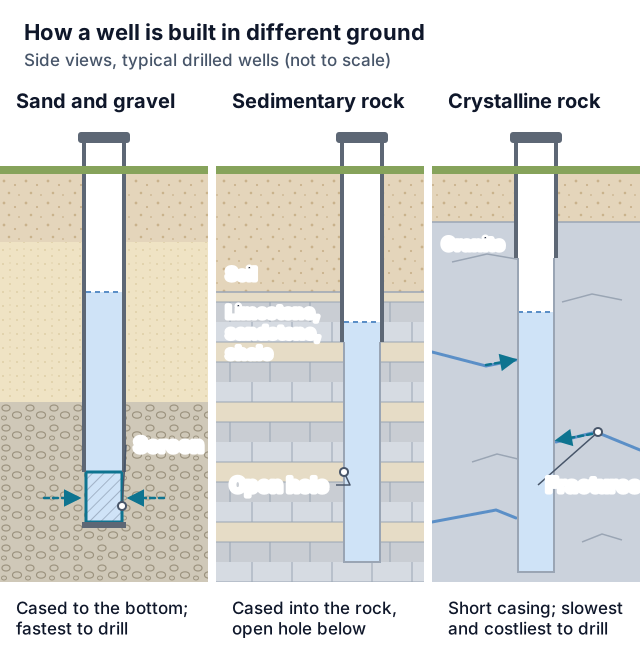
Underground, this is fractured-rock country. USGS monitoring-location records for wells in the county, such as well 14PP10, list their national aquifer as the Piedmont and Blue Ridge crystalline-rock aquifers. The USGS Georgia groundwater-conditions page says water in those aquifers occurs in discontinuous joints and fractures, that the aquifers are local in extent, and that they can be greatly affected by localized water use and climate.
Union County Service Details
What providers in this area actually see: coverage, common jobs, local pricing factors, and rules worth knowing.
Service Area Notes
- Place names: the Census Bureau's 2020 place file lists Blairsville city in Union County, and its 2020 county subdivision file lists the Blairsville, Ivylog and Suches census county divisions; the Bureau's current TIGERweb layers still show each of them. The USGS Geographic Names Information System lists Suches, Choestoe, Ivylog, Gaddistown and Owltown as populated places in Union County, and Nottely Lake as a reservoir there.
- District 2's Union County Health Department page lists Environmental Health Services at its own Blairsville office, apart from the clinic, and District 2's well page directs testing and permitting questions to the local Environmental Health office.
- Checking a contractor: EPD posts three separate lists, each marked updated 9.2.2026, of licensed water well contractors, certified pump contractors, and bonded drilling contractors acting under a professional geologist or professional engineer, which EPD labels as not water well contractors.
- Rule 770-5-.05 gives you a visual check on site: each rig and commercial vehicle a licensed or certified contractor uses in well construction or pump installation must carry, permanently and prominently on each side, the name of the person, firm or corporation, the letters 'GA Lic.' and/or 'GA Cert.' as appropriate, and the license or certificate number, in bold letters and numerals at least two inches high on a contrasting background.
Common Jobs in Union County
- New drilled domestic wells; in crystalline-rock areas HA 730-G says wells are ordinarily cased through the regolith
- Replacing a well whose yield fell off once its few shallow fractures drained
- Pump installation, removal and service, each followed by the chlorine disinfection Rule 770-5-.09(3) requires
- Filling, sealing and plugging abandoned wells, which DPH makes the present owner's duty
- Coliform (W35) sampling through the county health department or UGA Extension, and W33C chemical screening through UGA Extension
- Notice of Intent filings with the county health department before drilling
What Drives Pricing Here
- Yield, not just depth: HA 730-G puts the average reported yield of Piedmont and Blue Ridge wells at roughly 15 to 20 gallons per minute, with large-diameter public supply wells averaging about 30, and says granite gneiss can be expected to yield more water than mica schist and mica gneiss. It describes a Carroll County pair in which the well that missed a granitic gneiss and schist contact zone produced about 1 gallon per minute and the one that went through it produced 100.
- Lot position: the same atlas says regolith is usually thin beneath ridges, hilltops, steep slopes and steep draws, that the thickest regolith, in places as much as about 100 feet, lies under broad draws, broad valleys and a few upland flats, and that wells yielding 50 gallons per minute or more turn up most often in broad draws and valleys where regolith is more than 50 feet thick. Wells on slopes and hills, it says, generally yield only small volumes, and wells drilled along lineaments or known fracture traces consistently yield more water than randomly located wells.
- Calculator: the site's estimator takes whatever depth you enter, prices it with a per-foot band tied to the formation you select, then adds a permit allowance (a generic $200 to $500) and, if you tick them, a pump and a pressure tank; Angi, HomeGuide and HomeAdvisor national cost pages supply its rates. No agency publication reviewed here prints a typical well depth for Union County, so this page shows no county total; get the permit fee from Union County Environmental Health and a written per-foot price from the driller.
- Pump jobs: Rule 770-5-.09(4) requires all materials used to replace or repair a water well pump to meet the requirements for a new installation, and paragraph (3) adds the disinfection step to every installation, removal or onsite service.
Permits & Local Rules
- County permit: District 2 names Union among its counties that issue well construction permits. Before drilling, ask Union County Environmental Health what its construction permit requires for your well and what it costs.
- Notice of Intent: according to Georgia DPH, the water well contractor must tell the county health department, before actual construction, that it intends to drill a water well, supplying the information the Council's forms call for. EPD's Notice of Intent to Drill a Water Well (version January 21, 2026) is addressed to the county health department and asks for the well's purpose (individual water well, small multiple-connection non-municipal well, industrial well, agricultural irrigation well with its Letter of Concurrence number, or public water system with its number of connections); the owner's name, phone and address; any subdivision or park name; an address, directions or coordinates from the nearest city, or a map; the nominal diameters of the primary and any secondary casing at the surface; and the date drilling is expected to begin. The form requests three days' notice; for irrigation wells without a firm date it allows a date plus or minus 30 days.
- On the same form the licensed contractor gives a license number, states whether the contractor will drill personally or authorizes named partners, officers or employees to perform drilling operations allowed under that license, accepts responsibility for drilling operations by those authorized persons, acknowledges any Letter of Concurrence conditions for an irrigation well, certifies that the well will be located and constructed to the standards of section 12-5-134 of the Water Well Standards Act of 1985, and signs and dates it. Rule 770-5-.08 makes a licensee responsible for well construction work the licensee performs or approves, and requires each approved activity to be posted at the site on Council forms.
- Who needs a license: Rule 770-3-.01(1) requires anyone who wants to engage in the business of water well construction or of pump installation in Georgia to apply to the Council for a water well contractor license or a pump contractor certificate. Rule 770-2-.01 defines construction to cover locating and drilling as well as installing, removing or servicing pumps and pumping equipment, so a licensed water well contractor may also do pump work, while a pump contractor is someone in the pump business who does not also construct wells. Rule 770-7-.01(h) lets the Council suspend or revoke a license or certificate for allowing an unlicensed driller or uncertified pump contractor to work under it, but the rule says that ground does not apply to any Full-Time Employee, licensed driller or certified pump contractor, or to a bona fide Business Partner of the licensed or certified Water Well Contractor. Rule 770-2-.01 defines a Full-Time Employee as someone formally employed by the licensed or certified contractor to do well construction or pump installation under that license or certificate, shown by an employment agreement signed by both or by other sufficient employment records such as federal or state employment tax forms, and a Bona Fide Business Partner as someone with a written partnership agreement, signed by both parties, forming a business with the contractor to carry out that work and share its risks and benefits. The owner exemption is in the FAQs.
- Qualifications and bond: an applicant needs passing results on examinations prepared by the National Ground Water Association and administered by a provider it designates, with a 70 percent passing grade (Rule 770-3-.02(5)), and two years' experience: in the water well construction business under a licensed water well contractor for a license, or in the pump installation business under a certified pump contractor or a licensed water well contractor for a pump certificate. Under Rule 770-3-.01(4) the applicant lists that experience on the application, naming the contractors it was gained from with their addresses and any other references, and proves it in one of two ways. The first is certified affidavits: for a water well contractor license, from one or more licensed water well contractors stating at least two years of full-time experience; for a pump certificate, from one or more certified pump contractors or licensed water well contractors. If the experience was gained under two or more contractors, each of them must give a certified affidavit specifying the exact dates, and the Council may require the applicant and the contractors who swore the affidavits to appear before it. The second, in lieu of affidavits, is other proof of two years' experience that satisfies the Council. Rule 770-3-.01(5) says people who can document being in the business of installing, removing or servicing pumps and pumping equipment before December 31, 2003 may be granted a pump certificate on a complete application with examination scores, the fees and an acceptable bond or irrevocable letter of credit. EPD's application (version 9.17.2026) also allows reciprocity for holders of a valid Alabama or Mississippi water well contractor license, who need only the Georgia Water Well Law exam. No license or certificate is approved, issued or renewed until an acceptable performance bond or irrevocable letter of credit is received; the application lists $30,000 for water well contractors and $20,000 for pump contractors, and says licenses expire on June 30 of odd-numbered years and pump certificates on June 30 of even-numbered years.
- Siting: DPH says a well should be located as far from known or potential sources of pollutants as the general layout of the premises and surroundings permits, and must not be located in areas subject to flooding unless its casing extends at least two feet above the highest known flood of record. DPH's distance list, which it says the Water Well Standards Act requires, keeps a sewer line 10 feet or more away, a septic tank 50, a septic tank absorption field 100, a cesspool or seepage pit 150, and an animal or fowl enclosure 100. EPD's Well Completion Data Form has checkboxes for 'Health Dept. notified' and 'Health Dept. variance'; ask Union County Environmental Health about variances rather than assuming one is available.
- Construction: Rule 770-5-.08(4) requires every well to be built in accordance with the Act and the standards typically used in the industry, and any drilling fluid to be disinfected or taken from a source meeting all maximum contaminant levels under the Georgia Safe Drinking Water Act. Page 2 of EPD's Well Completion Data Form, where boxes are ticked if done, includes watertight casing and liner joints, a sanitary seal, grouting to 10 feet for individual wells (20 to 50 feet for irrigation and nonpublic wells), a concrete curb or pad more than 4 inches thick extending more than 2 feet and sloped, sealing of water-bearing formations likely to be polluted, and well disinfection.
- Well records: EPD's Well Completion Data Form records total depth, static water level, drilling method, hole diameter, casing, grouting method and material, any screen and filter pack, pump and test-pump data, and a driller's log marking water-bearing zones. The licensed well contractor signs that the information is correct, with a second signature line for a licensed geologist or engineer; the original goes to the property owner, the file copy to the contractor and a copy to the regulatory agency.
- Abandoned wells: DPH says any existing abandoned well or borehole shall be filled, sealed and plugged by the present owner, treats a well no longer in use as abandoned, and describes temporarily abandoned wells as generally unused for at least 365 days and permanently abandoned ones as unused for three years. Ask Union County Environmental Health how the plugging must be done, and by whom, before work starts.
Geology & Water Table Notes
- Rock: HA 730-G describes Blue Ridge and Piedmont bedrock as many metamorphic and igneous rock types, mainly gneiss and schist, with locally present quartzite and marble, and notes more than 90 units on the 1976 geologic map of Georgia. Because the rocks have few primary pore spaces, groundwater comes from the regolith above them and from fractures in the rock. Saprolite is the largest part of the regolith, reaching 150 feet thick in places, though its thickness is extremely variable.
- Fractures: the atlas says fractures in these rocks have traditionally been described as steeply inclined and generally more numerous at shallower depths, because they tend to be sealed as lithostatic pressure increases with depth. Wells that hit no fractures yield little or no water, and wells that hit only a few small shallow fractures may start out adequate and then drop off suddenly once those fractures drain. It also reports nearly horizontal fractures 1 to 8 inches high, at depths from about 30 to 1,650 feet, in some high-yield wells it describes in the Georgia and South Carolina Piedmont and Blue Ridge.
- Water table: water in these aquifers is generally unconfined, and the water table follows the land surface in subdued form, lying tens to hundreds of feet down under hills and steep ridges and at or near the surface in valleys and beside lakes, ponds and wetlands.
- Water quality: HA 730-G finds the water generally suitable for drinking, with dissolved constituents other than fluoride, iron, manganese and, locally, sulfate seldom exceeding state and federal standards, and radioactive minerals only rarely causing problems. DPH's 2023 testing fact sheet notes arsenic detections at elevated levels in some South Georgia wells and says lead usually enters water through plumbing fixtures and components.
- Use: the USGS Georgia page reports that about 100.5 million gallons per day were withdrawn from Georgia's crystalline-rock aquifers during 2015, primarily for domestic use, citing Painter (2019).
Communities Served
Blairsville · Suches · Choestoe · Ivylog · Gaddistown · Owltown
Emergency Response Expectations
This site cannot promise when anyone will arrive. Pump installation done as a business falls under the Council's water well contractor license and pump contractor certificate rules, including the employee and partner exception in Rule 770-7-.01(h) explained under Union County Service Details, and an owner may do the work under the Rule 770-5-.09(5) waiver only within the limits in the FAQs; in every case, Rule 770-5-.09(3) requires the well and pumping equipment to be chlorinated, with at least two hours of contact, before the well is pumped again.
Union County FAQs
Does Union County require a well permit?
Check with the county before drilling. District 2 Public Health lists Union among the counties that issue well construction permits, so Union County Environmental Health is the office to confirm what your well needs. Separately, a licensed water well contractor notifies the county health department with a Notice of Intent before construction.
Can I drill my own well or replace my own pump?
Rule 770-5-.08(3) waives the water well contractor license for someone building a well on land they own or lease, provided the well will serve only a single-family house that is the builder's permanent residence, or only farming on the builder's farm, will produce under 25,000 gallons per day, and will not supply the public or any residence besides the builder's own. Drilling on property you own and are developing for resale still requires the license. Rule 770-5-.09(5) waives the pump contractor certificate for installing, removing or servicing a pump on your own or leased property for use only in your single-family permanent residence or only for farming, again for a well producing less than 25,000 gallons per day whose water will not go to the public or any other residence; pump work on property you own and are developing for resale needs a Georgia water well contractor license or pump contractor certificate. These waivers cover licensing only: Rule 770-5-.08(4) still holds every well to the Act, so ask Union County Environmental Health about its permit either way.
How far must a well be from my septic system?
On DPH's list the septic tank must be at least 50 feet away and the absorption field at least 100, with 10 feet required for a sewer line and 150 for a cesspool or seepage pit. DPH also wants the well as far from pollution sources as the layout of the property permits, and on ground subject to flooding the casing must extend at least two feet above the highest known flood of record.
What water tests does Georgia recommend for a private well?
DPH recommends testing a private well for coliform bacteria every year (the W35 total coliform/E. coli test, offered through your county health department or UGA Extension) and a W33C chemical screening every three years. The W33C, also called the Private Well Chemical Test, adds arsenic and lead to the older W-33 profile and is offered through UGA county Extension offices. DPH's testing fact sheet adds that private water wells in Georgia are not subject to any regulatory authority, so monitoring water quality is the owner's responsibility.
What does the Union County Extension basic water test cover?
The Union County Extension office describes its basic test (W1) as covering aluminum, boron, calcium, chromium, copper, iron, magnesium, manganese, molybdenum, nickel, phosphorus, potassium, silica, sodium and zinc, plus pH and hardness. Bacteria, arsenic and lead are not on that list; the office says other water test analyses are available and asks residents to contact it about them and their fees.
What happens after a pump is pulled or replaced?
Under Rule 770-5-.09(3), after any pump installation, removal or onsite service the well and pumping equipment must be disinfected with chlorine to at least 50 parts per million in all wetted parts, with at least two hours of contact before the well is pumped.
What if a new well or pump job was done badly?
EPD investigates written complaints submitted within two years of the well's completion, or within one year of the pump installation's completion. Licensed water well contractors and certified pump contractors must carry a performance bond or letter of credit before the Council will license or renew them.
Sources
- District 2 Public Health: Environmental Health, Individual Well Water (county well permits)
- District 2 Public Health: Union County Health Department (Environmental Health Services office)
- Georgia DPH: Well Water (setbacks, contractor notice, testing, abandonment)
- Georgia DPH: Recommendations for Well Water Testing (Rev. 7/2023)
- Georgia EPD: Water Well Standards (Council, licensing, complaints)
- Georgia EPD: Water Well Standards Act contractor lists
- Georgia EPD: Notice of Intent to Drill a Water Well (version January 21, 2026)
- Georgia EPD: Well Completion Data Form
- Georgia EPD: Water Well Contractor / Pump Contractor application (version 9.17.2026)
- Ga. Comp. R. & Regs. Chapter 770-2 (definitions)
- Ga. Comp. R. & Regs. Chapter 770-3 (applications and examinations)
- Ga. Comp. R. & Regs. Chapter 770-5 (license and certificate; construction and pump activities)
- Ga. Comp. R. & Regs. Chapter 770-7 (enforcement; Rule 770-7-.01(h) employee and partner exception)
- USGS HA 730-G: Piedmont and Blue Ridge aquifers
- USGS Georgia: Groundwater conditions, crystalline-rock aquifer
- USGS monitoring location 14PP10 (Union County, GA well record)
- UGA Extension Union County: Water Quality Testing
- Census Bureau: 2020 places by county, Georgia
- Census Bureau: 2020 county subdivisions, Georgia
- USGS GNIS: Domestic Names, Georgia (populated places)
Last reviewed 2026-10-30
Services Available in Union County
Well Drilling
New residential wells — find local drillers for site evaluation, depth estimates, and written drilling quotes.
Learn more →Water Well Drilling
Household water wells from site evaluation through casing, pump, and water test — written quotes from local drillers.
Learn more →Well Pump Repair
No water at the tap? Request urgent well pump repair — local pros diagnose pressure loss, dead pumps, and pressure tank failures fast.
Learn more →Well Pump Replacement
Pump at end of life or beyond repair? Get quotes for correctly-sized submersible and jet pump replacement from local well pros.
Learn more →Well Inspection & Testing
Buying a home with a well, or overdue for a water test? Local pros for flow tests, equipment inspection, and lab water-quality testing.
Learn more →Well Water Service
Water quality problems, treatment systems, and general well maintenance — connect with local pros for everything between drilling and pump work.
Learn more →Free Tools Before You Call
Ballpark the cost or narrow down the problem before talking to a Union County provider.
Well Drilling Cost Calculator
Estimate what drilling a well should cost — by depth, geology, and whether you need the pump and pressure tank included.
Use the free tool →No Water From Your Well? Diagnostic Wizard
Suddenly no water in the house? Answer a few questions to find out if it's the breaker, the pressure switch, the tank, the pump — or the well itself.
Use the free tool →Well Pump Size Calculator
Find what size well pump you need — GPM demand, total dynamic head, and a horsepower recommendation from four quick inputs.
Use the free tool →Need help in Union County, GA?
Send the short form — urgent requests get priority routing.