Well Drilling in Erath County, TX
Well drilling typically runs $3,000–$16,000 nationally, per our cost guide. Independent local pros serving Stephenville, Dublin, Hico and nearby communities. Describe the problem and we'll route your request — free, no obligation.
- Mark no-water pump problems as emergencies on the form
- County pages on local well depths, aquifers, and permits
- Well inspections, water testing, and treatment
- Free to use — no obligation, no markup
Fast response from independent local providers. No obligation.
Typical national cost$3,000 – $16,000Cost guide →Local Help in Erath County, TX
Erath County sits wholly inside the Middle Trinity Groundwater Conservation District, whose boundaries match those of Erath, Comanche, Bosque and Coryell counties. The district's 2023 management plan says Comanche and Erath counties lie primarily over the outcrop of the Trinity Aquifer, and its registration rules have covered new wells in Erath County since May 11, 2004.
A new well here answers to two sets of rules. The district's registration decides whether the well is exempt from permitting or needs an operating permit. Texas Department of Licensing and Regulation (TDLR) rules in 16 TAC chapter 76 govern where the well may sit and how it is cased, grouted, capped and plugged. We share Erath County requests with independent well contractors; this page lays out the rules so you know what to ask them.
Erath County Service Details
What providers in this area actually see: coverage, common jobs, local pricing factors, and rules worth knowing.
Service Area Notes
- Requests can come from anywhere in the county. The Census Bureau's 2020 place-by-county list shows six places with territory in Erath County: the cities of Stephenville and Dublin, part of the city of Hico, and the census-designated places of Bluff Dale, Huckabay and Lingleville.
- Bought land with a registered well on it? District Rule 5.2(k) says the new owner should apply for a registration amendment within 60 calendar days of the ownership change, and the district's realtor notice says the transfer costs nothing.
Common Jobs in Erath County
- New domestic and livestock wells, registered with the Middle Trinity GCD before the rig arrives
- Irrigation, commercial and other wells that need a district operating permit and must be drilled within 30 feet of the location or alternative location the permit specifies
- Pump, pressure tank and drop-pipe work by TDLR-licensed pump installers
- Replacement wells, filed with the district as an amendment to the existing registration or permit under Rule 6.1
- Plugging abandoned, deteriorated or replaced wells as district Rule 11.5(b) requires, with the plugging report filed afterward, and capping a non-deteriorated well when the rules allow it
What Drives Pricing Here
- Calculator basis: this site's cost calculator multiplies the depth you enter by a per-foot rate ($25–$65 when geology is unknown) and adds $200–$500 for a permit, $900–$2,500 for an installed pump and $400–$1,500 for a pressure tank. Those figures come from Angi, HomeGuide and HomeAdvisor national cost pages, not Erath County bids, so plan around a driller's written quote.
- District paperwork: an operating permit application, needed only for a non-exempt well, goes in with a $200 deposit per well, which the district's forms page says is refunded within 30 days of the district receiving the state driller's report.
- Casing size and spacing: Rule 7.4(a) keeps a new permitted well away from existing registered or permitted wells, and from other proposed wells, by casing diameter, from 300 feet for casing up to 4 inches to 1,000 feet at 10 inches or more. Under Rule 7.4(d), the board may grant an exception for a well producing from a different aquifer or subdivision only after the applicant gives written notice to all owners of existing permitted or registered wells inside the distance and a public hearing is held. Rule 10.2(h) has that notice sent by certified mail not less than 14 days before the hearing, carrying the information the rule cross-references from Rule 10.2(a), the nature of the exception sought, and information telling each recipient that the proposed well would sit closer to their well than the Rule 7.4 minimum distances; confirm the notice contents with the district before mailing. An applicant may also present signed no-objection waivers from every landowner and well owner inside the distance; the general manager may then waive certain spacing requirements or take the request to the board.
- Grout depth: the standard annular seal under 16 TAC 76.100(e) fills an annulus at least 3 inches wider than the casing from the surface to no less than 10 feet down, with cement slurry, bentonite grout, or 8 feet of granular sodium bentonite under a 2-foot cement barrier. The alternative siting methods in 76.100(b) call for a much deeper seal; the septic FAQ below gives the conditions for moving closer to contamination sources.
- Property-line encroachment: under 76.100(b)(2), a well cemented by positive displacement from at least 100 feet to the surface, or tremie pressure filled from 100 feet to the surface with an annular space 3 inches larger than the casing's outside diameter, may come within 5 feet of the adjacent property line. For a well less than 100 feet deep, the seal goes to the top of the producing layer, and in what the rule calls shallow, unconfined aquifers having artesian head it need not go below the top of the water production zone. Ask for any such grouting as its own quote line.
- Old wells: the district says it caps or plugs wells holding less than 100 feet of standing water free of charge on the homeowner's behalf.
Permits & Local Rules
- Register first: under Rule 5.2, no one may drill, operate, modify, complete, change the type or location of use of, plug, abandon or substantially alter the size of a well in the district without registering it, even if it is exempt from permitting. If staff find the well excluded or exempt under Rule 5.4, work may begin once the approved registration is received; if not, no one may drill, equip, complete or substantially alter it until the permit or amendment is issued.
- Household exemption, Rule 5.4(a)(1)-(2): no operating permit is needed for a well used solely for domestic use, livestock use or poultry and drilled, equipped or completed so it cannot produce more than 25,000 gallons a day, on a tract larger than 10 acres. On 10 acres or less, an Erath County tract must also have been platted before May 11, 2004 and not further subdivided after that date and before the well is drilled, completed or equipped. The district's registration form marks a permit as required above 17 gallons per minute of maximum pumping capacity.
- Exemption limits: domestic use excludes water for activities for which consideration is given or whose product is sold, confinements such as ponds holding over 50,000 gallons, non-closed geothermal systems and public water systems; livestock use means open-range watering of livestock, exotic livestock, game or fur-bearing animals and excludes public water systems and concentrated animal feeding operations. Rule 5.4(g) denies the exemption to a well supplying a subdivision that needs plat approval under Local Government Code chapter 232. Exempt wells must still be registered, equipped to prevent groundwater escape and pollution, and sited under Rule 7.3.
- Operating permits: per the district's forms, the application goes in with a complete registration form and the deposit, must be notarized, and must arrive by the posted agenda deadline for the next monthly permit hearing; no well may be drilled until the board approves it. Under Rule 5.5(c), an initial permit runs five years, and production must begin within nine months unless one extension of up to six months is granted.
- Siting for a water well, 16 TAC 76.100(a): 150 feet from concentrated contamination sources such as existing or proposed livestock or poultry yards, cemeteries, pesticide mixing sites and privies; 100 feet from an existing or proposed septic absorption field or spray area or a dry litter poultry facility; 50 feet from any water-tight sewage or liquid-waste collection facility; and 50 feet from a property line, provided the well also meets the source distances. The property-line distance does not bind the driller where a groundwater district's rules regulate spacing, where property restrictions regulate spacing of wells and on-site sewage systems, or where the owner uses public wastewater service; ask the district which applies.
- Who may drill and install pumps: Occupations Code 1901.151 and 1902.151 require a TDLR license to act or offer to act as a driller or pump installer. The definitions exclude a person drilling, or installing or repairing pumps, on the person's own property for the person's own use, and a helper under a licensee's direct supervision who is not primarily responsible; 16 TAC 76.30(3) extends the pump exclusion to leased or rented property used for one's own use. An owner who drills still has to register with the district.
- Well reports: no later than the 60th day after drilling, deepening or other alteration of a well is completed or stops, 16 TAC 76.70(1) has the driller file the State of Texas Well Report with TDLR electronically and send copies to the owner or person the well was drilled for and to the groundwater district. The owner or the person the well was drilled for may ask TDLR by certified mail to keep the log confidential (Occupations Code 1901.251(c)).
- Plugging: 16 TAC 76.104 sets the methods, which vary with well type, diameter, standing water and water quality; TDLR's abandoned-wells page links the specifications. District Rule 11.5(b) requires registration before or with plugging. Under 16 TAC 76.70(3), the person who plugs a well sends the State of Texas Plugging Report to TDLR within 30 days after plugging is complete, and also delivers, transmits or mails copies to the groundwater conservation district and to the owner or person for whom the well was plugged. District Rule 11.5(c) separately has a driller, licensed pump installer or well owner who plugs an abandoned or deteriorated well submit the report to the district and TDLR within 30 days of completion.
Geology & Water Table Notes
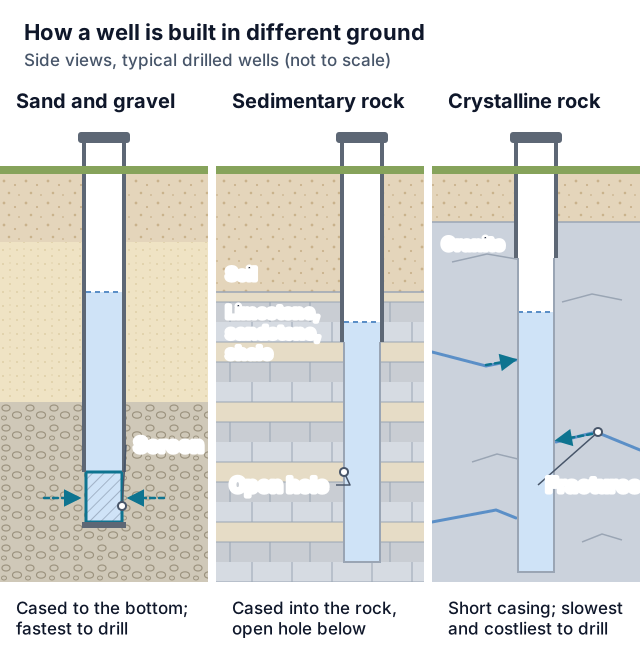
- Trinity Aquifer: TWDB describes the Trinity as a major aquifer made up of smaller aquifers in the Trinity Group, including the Antlers, Glen Rose, Paluxy, Twin Mountains, Travis Peak, Hensell and Hosston, built of limestones, sands, clays, gravels and conglomerates.
- Erath County units: the district's management plan lists all seven as Trinity subdivisions in its Erath County table and notes that the county's northern portion also contains the Twin Mountains. Its geology page has an Erath County cross-section showing where the water-bearing sands and limestones lie shallow and where they dip deeper.
- Water quality: TWDB's statewide summary says Trinity water is generally fresh but very hard in the outcrop, and sulfate and chloride tend to increase with depth.
- Depth evidence: a driller's log records the strata penetrated, water-bearing zones and casing (Occupations Code 1901.251). TDLR points to TWDB's well reporting system for wells drilled after 2002 and to TCEQ for older ones; TWDB says mailed-in reports from before its electronic system are not included and that well locations in its driller-report database are not verified by state staff.
Communities Served
Stephenville · Dublin · Hico · Bluff Dale · Huckabay · Lingleville
Emergency Response Expectations
If a well quits producing, mark the request urgent and say whether the pump, tank or controls were worked on recently; arrival depends on which independent contractors are free. When a pump is pulled and the well will be re-equipped later, district Rule 11.5(a) requires the well to be capped, or plugged if deteriorated casing would let water strata commingle.
Erath County FAQs
Do I need the groundwater district's approval before drilling a house well in Erath County?
Yes. Every new well must be registered with the Middle Trinity GCD before drilling. If staff find it exempt from permitting, work can start once you receive the approved registration. If not, you need the district permit first; the district's forms page says no well may be drilled until the board approves the operating permit.
Can I drill my own well or set my own pump without a license?
Texas law does not treat you as a driller or pump installer when the work is on your own property for your own use. You still register the well first, and the district's rules point every new well to the state siting and completion standards in 16 TAC 76.100.
What must I do about an old, unused well on my property?
Inside the Middle Trinity GCD, district Rule 11.5(b) requires a deteriorated or abandoned well, or a well replaced under Rule 6.1, to be plugged under 16 TAC chapter 76; seeing that it is plugged is the landowner's responsibility, and the well must be registered before or along with plugging. The district defines an abandoned well as one that for at least a year has been left unused, unattended and improperly protected from contamination, has not been used for a beneficial purpose, or is not registered or permitted with the district, and it counts a non-deteriorated well that is operational or capped under Rule 11.5 as in use. State law (Occupations Code 1901.255) allows plugging or capping within 180 days of learning of the condition, and 16 TAC 76.104(d) limits capping to a non-deteriorated well with casing in good condition that is beneficial to the landowner. Because the district rule is stricter, ask the district whether your well may be capped before choosing that over plugging.
How often should an Erath County well be tested?
Texas A&M AgriLife Extension guidance is at least once a year, at minimum for nitrate, total dissolved solids and E. coli or fecal coliform, and again after well or pump maintenance, after a change in color, taste or odor, whenever contamination is suspected, and after a suspicious illness in someone who drinks it. The district offers one free test per well per year for bacteria, pH, nitrate and nitrite, hydrogen sulfide and dissolved solids.
What separation does Texas require between a new well and my septic system?
Under 16 TAC 76.100(a), 100 feet from the absorption field or spray area and 50 feet from any water-tight sewage collection facility. Outside the Edwards Aquifer, 76.100(b)(1) lets the 100-foot distance drop to no less than 50 feet if the well is cemented by positive displacement from at least 100 feet to the surface, or tremie pressure filled from 100 feet to the surface with an annular space 3 inches larger than the casing's outside diameter. For a well less than 100 feet deep, the seal goes to the top of the production zone; in shallow, unconfined aquifers it need not go below the production zone, and in shallow, confined aquifers with artesian head it need not go below the top of the water-bearing strata. TDLR's construction specifications page has diagrams of these completions.
Sources
- Middle Trinity GCD: District Rules (adopted Sept. 10, 2026)
- Middle Trinity GCD: Forms
- Middle Trinity GCD: Well registration form
- Middle Trinity GCD: Realtor notice
- Middle Trinity GCD: Management Plan (2023)
- Middle Trinity GCD: Well capping and plugging
- Middle Trinity GCD: Water testing
- Middle Trinity GCD: Geology
- Occupations Code ch. 1901
- Occupations Code ch. 1902
- Texas Secretary of State: 16 TAC §76.30
- Texas Secretary of State: 16 TAC §76.70
- Texas Secretary of State: 16 TAC §76.100
- Texas Secretary of State: 16 TAC §76.104
- TDLR: Well construction and plugging specifications
- TDLR: Abandoned wells
- TDLR: Water well program
- TWDB: Trinity Aquifer
- TWDB: Well reports
- AgriLife Extension: Water Well Basics
- Census Bureau: 2020 places by county, Texas
Last reviewed 2026-10-26
Services Available in Erath County
Well Drilling
New residential wells — find local drillers for site evaluation, depth estimates, and written drilling quotes.
Learn more →Water Well Drilling
Household water wells from site evaluation through casing, pump, and water test — written quotes from local drillers.
Learn more →Well Pump Repair
No water at the tap? Request urgent well pump repair — local pros diagnose pressure loss, dead pumps, and pressure tank failures fast.
Learn more →Well Pump Replacement
Pump at end of life or beyond repair? Get quotes for correctly-sized submersible and jet pump replacement from local well pros.
Learn more →Well Inspection & Testing
Buying a home with a well, or overdue for a water test? Local pros for flow tests, equipment inspection, and lab water-quality testing.
Learn more →Well Water Service
Water quality problems, treatment systems, and general well maintenance — connect with local pros for everything between drilling and pump work.
Learn more →Free Tools Before You Call
Ballpark the cost or narrow down the problem before talking to an Erath County provider.
Well Drilling Cost Calculator
Estimate what drilling a well should cost — by depth, geology, and whether you need the pump and pressure tank included.
Use the free tool →No Water From Your Well? Diagnostic Wizard
Suddenly no water in the house? Answer a few questions to find out if it's the breaker, the pressure switch, the tank, the pump — or the well itself.
Use the free tool →Well Pump Size Calculator
Find what size well pump you need — GPM demand, total dynamic head, and a horsepower recommendation from four quick inputs.
Use the free tool →Need help in Erath County, TX?
Send the short form — urgent requests get priority routing.