Well Drilling in Lawrence County, PA
Well drilling typically runs $3,000–$16,000 nationally, per our cost guide. Independent local pros serving New Castle, Ellwood City, New Wilmington and nearby communities. Describe the problem and we'll route your request — free, no obligation.
- Mark no-water pump problems as emergencies on the form
- County pages on local well depths, aquifers, and permits
- Well inspections, water testing, and treatment
- Free to use — no obligation, no markup
Fast response from independent local providers. No obligation.
Typical national cost$3,000 – $16,000Cost guide →Local Help in Lawrence County, PA
Pennsylvania leaves the private well itself largely unregulated. Asked whether the state regulates private homeowner wells, the Department of Environmental Protection (DEP) answers no, and the Department of Conservation and Natural Resources (DCNR) says the state has construction standards for public water-supply wells but not for private ones, so protecting and maintaining a private well falls to the homeowner. What state law does control is the driller: the Water Well Drillers License Act (Act 610, approved May 29, 1956; 32 P.S. §§ 645.1 to 645.13) and its rules in 17 Pa. Code Chapter 47 cover licensing, rig permits, notice before drilling, well records and notice before a well is abandoned. Requests made through this site are passed to independent contractors; the site does not drill or service wells.
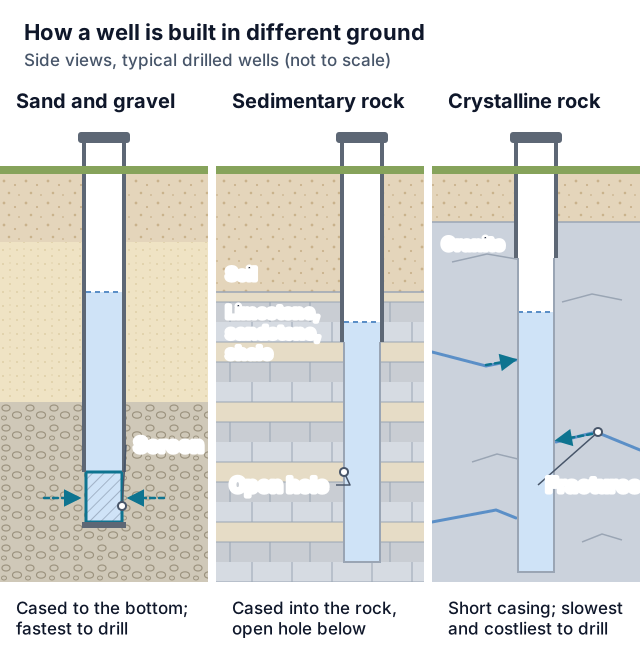
A published groundwater study covering part of the county is Pennsylvania Geological Survey Water Resource Report 15 (Carswell and Bennett, 1963), prepared by the U.S. Geological Survey in cooperation with the state survey. It covers the Neshannock 15-minute quadrangle, 225 square miles split into two nearly equal halves by the Mercer-Lawrence county line. The authors found that upland wells draw mostly from sandstones, while wells in the valleys may tap either sandstone or glacial sand and gravel, and they cautioned that because individual sandstones vary in permeability from place to place and the gravels are generally discontinuous, a well's performance is hard to predict before it is drilled.
Lawrence County Service Details
What providers in this area actually see: coverage, common jobs, local pricing factors, and rules worth knowing.
Service Area Notes
- Municipalities: the Census Bureau's 2020 county subdivision list, which matches its current TIGERweb layer, divides Lawrence County into New Castle city; the boroughs of Bessemer, Ellport, Ellwood City, Enon Valley, New Beaver, New Wilmington, S.N.P.J., South New Castle, Volant and Wampum; and Hickory, Little Beaver, Mahoning, Neshannock, North Beaver, Perry, Plain Grove, Pulaski, Scott, Shenango, Slippery Rock, Taylor, Union, Washington, Wayne and Wilmington townships. The 2020 place list adds the census-designated places of Chewton, Frisco, Frizzleburg, New Bedford, New Castle Northwest, Oakland, Oakwood and West Pittsburg.
- State office: Lawrence is among the counties DEP assigns to its Northwest Regional Office, and DEP's private-well testing page names that office among the DEP offices where bacterial test kits can be bought.
- Existing well records: DCNR's Pennsylvania Groundwater Information System (PaGWIS) holds hundreds of thousands of water well records, most of them from completion reports filed by drillers, and the public can search it by criteria or by map area through the PaGEODE web application. DCNR notes that drillers began sending paper completion reports in the mid-1960s and that some records carry only a scanned image and basic data without coordinates; a map search finds those only if you choose to include unlocated wells within intersected municipalities.
- Checking a driller: DCNR's Licensed Water Well Drillers database can be searched by name, by county served and by service type. DCNR cautions that holding a license does not imply a driller knows proper drilling or construction practice, and that National Ground Water Association certification is voluntary, so its absence does not show a driller cannot build a well properly.
Common Jobs in Lawrence County
- New wells drilled into the county's sandstone and shale bedrock, cased into solid rock and grouted along the lines DCNR recommends
- Valley wells that tap glacial sand and gravel, or the sandstone under the valley fill
- Deepening an upland well into a lower sandstone and casing off the upper one when hardness or iron is the complaint
- Pump, pressure tank and pitless adapter work on existing wells
- Replacing loose well caps with vented, vermin-proof caps and raising buried casings above grade
- Sealing unused wells, with the notice of intent to abandon sent to the department at least 10 days ahead
- Water sampling right after a new well is drilled and once a year after that
What Drives Pricing Here
- Depth and the first sandstone: Water Resource Report 15 found that in upland areas, taking a well down into deeper sandstones tends to raise its specific capacity but lower its static water level, which can mean a larger pump and higher pumping costs. For domestic wells it suggested a brief pumping or bailer test once the first sandstone is reached, with no further drilling if that test shows enough water of suitable quality. In the major valleys it expected water levels to rise slightly as wells were deepened. Penn State Extension's statewide figures put Pennsylvania wells anywhere from under 10 feet to over 1,000 feet deep, with the average usually between 100 and 200 feet; that is not a Lawrence County figure, and completion reports for nearby wells in PaGWIS are the closer guide.
- Casing and grout: DCNR's recommendations for bedrock wells (guidance, not a state rule) call for new casing meeting ASTM standards, at least 20 feet long, set at least 5 feet into solid bedrock and ending at least 12 inches above ground, or higher where runoff collects or flooding occurs. Grout goes in from the bottom up, from the casing bottom to at least the base of the pitless adapter, and at least 30 feet of a long casing should be grouted. DCNR suggests drilling and grouting the cased section first and finishing the hole after the grout cures, though grouting after all drilling is finished can sometimes work, and in either case care should be taken to keep grout out of the open-rock part of the well. For PVC casing it says bentonite or a Jaswell-type seal can be effective and cement grout should not be used, because the heat it releases while curing can soften PVC. DCNR says a well built this way costs more than one without these features, and that the added cost may be offset by better health for users, protection of the water resource and avoiding costly treatment equipment later.
- Water quality versus extra footage: Report 15 offered its water-quality findings as tentative hypotheses. In upland areas, water from deeper sandstones was generally softer and lower in iron, but the report says such wells must generally be cased and sealed through the upper aquifer to get that water, which adds cost; the lower water level of the deeper zone can add to pump and operating costs; the deeper water contains some hydrogen sulfide in many places; and any improvement depends on the well not being extended into rocks containing connate brine. The authors expected many owners to choose softening equipment over deepening and casing, while noting that many wells in the quadrangle had been deepened and had obtained a better supply.
- Reading this site's estimate: the well drilling cost calculator prices footage by the rock or soil type selected, times whatever depth is typed in, and then tacks on a standard permit line plus, by default, pump and pressure-tank lines. Those rates were set from nationwide cost pages published by Angi, HomeGuide and HomeAdvisor, which makes the total a rough national figure and not a quote for a Lawrence County lot. The permit line is not a Pennsylvania fee; DEP says it does not regulate private wells, so ask your municipality whether any local permit or charge applies.
Permits & Local Rules
- What the state does not regulate: DCNR's fact sheet on bedrock wells says Pennsylvania does not regulate the construction details of private water wells and sets no requirements for their location, construction method, materials, yield or water quality, while still requiring drillers to hold a license and a valid rig permit and to give the state and the homeowner a Water Well Completion Report. It adds that a few municipal and county governments have passed private-well standards, that federal mortgages may require certain water analyses, and that other lenders may set sampling requirements.
- Local rules: Penn State Extension's private water systems FAQ (updated October 13, 2025) says that apart from a few county or local ordinances there are no statewide construction standards for private wells in Pennsylvania, so ask your township, borough or city office whether it has adopted one before drilling starts.
- Who must be licensed: Section 4 of Act 610 bars anyone from drilling a water well in Pennsylvania without first obtaining a license from the department, unless that person is drilling within the scope of employment by a licensed well driller; 17 Pa. Code § 47.1 adds that employees of a licensed driller do not need individual licenses, because the contractor is the one licensed. The Act defines a water well driller as a water well contractor who has contracted for drilling, digging, driving, boring, coring, washing, jetting, constructing, altering or repairing a water well. Section 4(b) exempts two cases: a farmer performing any function on land the farmer owns or leases for farming purposes, and a natural person drilling a well on land that person owns or leases and uses as a residence. The compiler's note on DCNR's copy of the Act records that Act 18 of 1995 vested these powers in DCNR.
- License, rig permit and fees: 17 Pa. Code § 47.3 sets a fee of $60 for a water well drilling license and $20 for each rig permit (as amended in 1983, effective July 1, 1981). Under Section 7 of the Act every license and rig permit expires on the last day of May after it is issued, and DCNR describes the license year as June 1 to May 31. The license is displayed at the contractor's principal place of business, the rig operator must carry the rig permit at all times while the rig is in operation, and each rig's permanent permit number is painted in a conspicuous place on it in characters at least 2 inches high (§§ 47.2 and 47.4).
- Notice before drilling: within 24 hours of making a contract to drill a well, written or oral, the driller files a notice of intention to drill (17 Pa. Code § 47.5); Section 10(c) of the Act says it includes the owner's name and address, the township and county where the well will be, and the approximate date drilling will begin. Once that notice arrives, the department may ask for samples of cuttings to be saved and will supply containers, and in some circumstances may make additional inspections and tests on the well (§ 47.6).
- Well record: Section 10(a) of Act 610 has every licensee keep a record of each well on the department's form, giving its exact geographic location and a log describing the materials penetrated, the size and depth, the diameters and lengths of casing and screen installed, the static and pumping levels, the yield and any other construction or operating information the department requires, and make that record available to the department on request, although no driller has to report coal deposits or other valuable minerals. Under 17 Pa. Code § 47.7 the record goes on Form WWI with every pertinent space filled in; on completion of each well the driller sends one copy to the department and one to the owner, keeps the record at least 10 years and may not dispose of it at any time without the department's express permission. Section 10(b) lets the department require reports drawn from these records, but never before 21 days after the well is completed.
- Old wells: Section 5 of the Act lets the department require a well owner to seal effectively or fill an abandoned well on the owner's property under its rules, and Section 11(f) makes it a misdemeanor for an owner to abandon an existing well without effectively sealing or filling it when the department has requested that. Under 17 Pa. Code § 47.8, a notice of intent to abandon must be sent to the department at least 10 days before the well is sealed or filled. DCNR's groundwater page says the property owner is responsible for filling and sealing abandoned wells according to its Water Well Abandonment Guidelines, recommends hiring a licensed driller for abandonment, and asks that the completed Water Well Abandonment Form be sent to the Water Well Drillers Licensing Service at the Pennsylvania Geological Survey.
- How a well is sealed (guidance): the Water-Well Abandonment Guidelines, first published as a chapter of a DEP groundwater monitoring manual, describe themselves as minimum guidelines in the absence of more stringent regulatory standards. They tie the method to the hydrogeology, geology, well construction and groundwater quality, and call for more rigorous procedures where artesian conditions, multiple aquifers, cavernous rock or the threat or presence of contamination are involved. Because the guidelines set conditions on when aggregate fill may be used and when the casing seal should be lengthened, this page does not summarize the sealing steps; have a licensed driller work from the guidelines document itself, and report the abandonment to the survey on its form with the original driller's log if available and the details of the procedure.
- Testing: DEP's private-well testing page advises a yearly test covering total coliform bacteria, pH, nitrates and total dissolved solids, testing for any other contaminant you suspect, and always using a state-certified laboratory that does drinking water tests. It links DEP's lists of accredited laboratories for chemical and for bacteriological testing and its Pennsylvania maximum contaminant level chart, and says to install a treatment device for any contaminant found above those levels. Penn State Extension's routine schedule is total coliform bacteria every year and pH and total dissolved solids every three years. DCNR's bedrock-well fact sheet asks for a test promptly after drilling and then yearly for total coliform at a minimum, an E. coli test if coliform is found, and every few years pH, total dissolved solids and locally significant parameters such as hardness, sodium, chloride, nitrates, hydrogen sulfide, iron, barium or manganese.
Geology & Water Table Notes
- Surface bedrock: the USGS state geologic map compilation shows the Pennsylvanian Allegheny Formation (cyclic sandstone, shale, limestone, clay and coal, including the Vanport Limestone) at the surface across 59% of Lawrence County and the Pottsville Formation (mainly gray sandstone and conglomerate with thin shale, claystone, limestone and coal) across 34%, with smaller areas of the Mississippian Shenango Formation (4%), the Glenshaw Formation (3%) and the Cuyahoga Group (0.4%).
- Layering: Report 15 describes Mississippian and Pennsylvanian rocks, mostly alternating shale and sandstone, dipping to the south and southeast at about 15 feet per mile. Its Pottsville sandstones, in the Sharon, Connoquenessing, Mercer and Homewood formations, lie in poorly defined elongate belts that intertongue sideways with shale rather than in continuous sheets, and the Allegheny Group above them includes the Clarion and Kittanning formations and the Vanport Limestone.
- Which rock gives water: according to drilling experience cited in Report 15, most wells that penetrate only shale yield very little and those that reach sandstone yield more, although fractures can make a domestic well in shale successful; no well in the quadrangle was known to draw water from limestone or coal.
- Glacial cover: the quadrangle lies entirely within the glaciated part of the Allegheny Plateau. The Mahoning and Shenango rivers and Neshannock and Lackawannock creeks flow on thick glacial deposits in valleys of preglacial or interglacial origin, the valley flanks hold kames, kame terraces and valley-train deposits, and glacial till covers most of the upland. Available information suggested the fill in the major valleys is mostly fine silt and clay, and the water table lies at a relatively shallow depth across most of the quadrangle.
- Fresh water above brine: the report places circulating fresh water in roughly the first few hundred feet below the water table, meeting in a direct contact the highly saline connate brine of the deeper formations, which the authors presumed to be static and which may contain as much as 180,000 ppm dissolved solids.
- Measured chemistry: in Report 15's samples, water from shallow upland aquifers held 50 to 100 ppm calcium, 10 to 40 ppm magnesium and 0.40 to 7.5 ppm iron, while deep-aquifer water held 3.0 to 22 ppm calcium and 0.02 to 1.4 ppm iron but 150 to 500 ppm sodium and 8 to 350 ppm chloride, and hydrogen sulfide was frequently seen bubbling out when those deeper wells were pumped. Owners and drillers reported water high in iron and hardness from shallow valley zones in many places, and high chloride had been reported from the deeper unconsolidated sediments of the Mahoning and lower Shenango valleys.
Communities Served
New Castle · Ellwood City · New Wilmington · Volant · Bessemer · Enon Valley · Wampum · Neshannock Township · Shenango Township · Pulaski Township · Hickory Township · Plain Grove Township · Scott Township · Slippery Rock Township · Wilmington Township
Emergency Response Expectations
If the house has no water, mark the request as urgent; how soon a contractor can come out in Lawrence County depends on who is available, and this site does not promise a response time.
Lawrence County FAQs
Does Pennsylvania regulate how a private well is built in Lawrence County?
No. DEP says it does not regulate private wells, and DCNR says the state sets no requirements for a private well's location, construction method, materials, yield or water quality. State law regulates the driller instead: a DCNR license and rig permit, a notice of intention to drill and a completion report. A few municipal and county governments have their own private-well standards, so check with your township, borough or city.
Does a Lawrence County landowner need a license to drill a well on their own property?
Section 4(b) of Act 610 lifts the license requirement in two cases only: a farmer performing any function on land the farmer owns or leases for farming purposes, and a natural person drilling on land that person owns or leases and uses as a residence. Anyone else who drills must hold a DCNR license or work within the scope of employment for a licensed driller. DCNR still recommends hiring a licensed driller for new construction, modification or abandonment.
Where can I find the completion report for a well that is already on my property?
DCNR says the driller must give the owner a printed copy of the water well completion report, so ask the driller first. Otherwise search PaGWIS through the PaGEODE web application, and if nothing turns up on the map, rerun the search with unlocated wells within intersected municipalities included, since some older records have no coordinates.
How deep will a new well in Lawrence County be?
The sources used for this page do not publish a countywide depth figure. Penn State Extension says Pennsylvania wells range from under 10 feet to over 1,000 feet, with the average usually 100 to 200 feet statewide. For domestic wells, Report 15 suggested a brief pumping or bailer test once the first sandstone is reached and no further drilling if the well already supplies the needed yield of suitable water. Completion reports for neighboring wells in PaGWIS are the closest local guide.
Where can Lawrence County well owners find a certified lab or a bacteria test kit?
DEP says to use a state-certified drinking-water laboratory and links its lists of accredited labs for chemical and bacteriological tests. Its testing page also says bacterial test kits can be bought from the DEP offices it lists, including the Northwest Regional Office that serves Lawrence County.
Why does water from a deeper well here smell like rotten eggs?
Report 15 found hydrogen sulfide dissolved under pressure in many of the deeper aquifers; when the water is pumped up, the pressure drops and the gas comes out of solution. It affects taste and odor rather than causing the problems hardness or iron do, and the authors suggested that owners who object to it may prefer to treat hardness or iron some other way than deepening the well.
What should I test for if my home is near farming, coal mining or gas drilling?
Penn State Extension's well guide pairs nearby land uses with tests: nitrate, coliform bacteria and pesticides near agricultural operations; pH, iron and manganese near coal mining; sodium, chloride and barium near gas drilling; metals and volatile organic compounds near a dump, landfill or factory; and sodium, chloride and total dissolved solids near heavily salted roads.
What notice and paperwork apply when an old well on my land is sealed?
17 Pa. Code § 47.8 requires a notice of intent to abandon to be sent to the department at least 10 days before the well is sealed or filled. DCNR's groundwater page says the property owner is responsible for sealing it according to DCNR's abandonment guidelines, says completed Water Well Abandonment Forms should be sent to the Pennsylvania Geological Survey, and recommends a licensed driller for the job.
Sources
- PA DEP: Private wells (does the state regulate private homeowner wells?)
- PA DEP: Private wells, water testing (annual tests, certified labs, test kits by regional office)
- PA DEP: Northwest Regional Office (counties served)
- PA DEP: Accredited drinking water labs, chemical testing (PDF)
- PA DEP: Accredited drinking water labs, bacteriological testing (PDF)
- PA DCNR: Apply for a water well drillers license and rig permit
- PA DCNR: Water Well Drillers License Act (Act 610, May 29, 1956), agency copy (PDF)
- 17 Pa. Code Chapter 47: Drilling water wells
- PA DCNR: Groundwater (private wells and abandoned wells)
- PA DCNR: Water-Well Abandonment Guidelines (PDF)
- PA DCNR: Recommendations for Construction of Private Water Wells in Bedrock (PDF)
- PA DCNR: Pennsylvania Groundwater Information System
- PA DCNR: Licensed water well drillers
- Pennsylvania Geological Survey Water Resource Report 15: Geology and hydrology of the Neshannock quadrangle, Mercer and Lawrence Counties (1963)
- USGS Mineral Resources: Geologic units in Lawrence County, Pennsylvania
- Penn State Extension: Private water systems FAQs
- Penn State Extension: Best management practices for private water wells
- Census Bureau: 2020 county subdivisions, Pennsylvania
- Census Bureau: 2020 places by county, Pennsylvania
- Census Bureau TIGERweb: current county subdivisions, Lawrence County, PA
Last reviewed 2026-10-27
Services Available in Lawrence County
Well Drilling
New residential wells — find local drillers for site evaluation, depth estimates, and written drilling quotes.
Learn more →Water Well Drilling
Household water wells from site evaluation through casing, pump, and water test — written quotes from local drillers.
Learn more →Well Pump Repair
No water at the tap? Request urgent well pump repair — local pros diagnose pressure loss, dead pumps, and pressure tank failures fast.
Learn more →Well Pump Replacement
Pump at end of life or beyond repair? Get quotes for correctly-sized submersible and jet pump replacement from local well pros.
Learn more →Well Inspection & Testing
Buying a home with a well, or overdue for a water test? Local pros for flow tests, equipment inspection, and lab water-quality testing.
Learn more →Well Water Service
Water quality problems, treatment systems, and general well maintenance — connect with local pros for everything between drilling and pump work.
Learn more →Free Tools Before You Call
Ballpark the cost or narrow down the problem before talking to a Lawrence County provider.
Well Drilling Cost Calculator
Estimate what drilling a well should cost — by depth, geology, and whether you need the pump and pressure tank included.
Use the free tool →No Water From Your Well? Diagnostic Wizard
Suddenly no water in the house? Answer a few questions to find out if it's the breaker, the pressure switch, the tank, the pump — or the well itself.
Use the free tool →Well Pump Size Calculator
Find what size well pump you need — GPM demand, total dynamic head, and a horsepower recommendation from four quick inputs.
Use the free tool →Need help in Lawrence County, PA?
Send the short form — urgent requests get priority routing.