Well Drilling in Erie County, NY
Well drilling typically runs $3,000–$16,000 nationally, per our cost guide. Independent local pros serving Holland, Colden, Sardinia and nearby communities. Describe the problem and we'll route your request — free, no obligation.
- Mark no-water pump problems as emergencies on the form
- County pages on local well depths, aquifers, and permits
- Well inspections, water testing, and treatment
- Free to use — no obligation, no markup
Fast response from independent local providers. No obligation.
Typical national cost$3,000 – $16,000Cost guide →Local Help in Erie County, NY
In Erie County the rules for a private well come mostly from Albany, with the county stepping in at the points where homes are built or sold. The Erie County Department of Health (ECDOH) says it completes drinking water well inspections for house property transfers and for new house construction, and it answers owners' questions about water quality and sampling.
The state side has two parts. Under Environmental Conservation Law §15-1525, anyone in the business of water well drilling in New York must first obtain a certificate of registration from the Department of Environmental Conservation (DEC), and the same section requires all water well drilling to follow rules the Commissioner of Health adopts under Public Health Law §206(18): the Standards for Water Wells in 10 NYCRR Appendix 5-B. This site is a referral service: we forward Erie County requests to independent well contractors and do no drilling or pump work ourselves.
Erie County Service Details
What providers in this area actually see: coverage, common jobs, local pricing factors, and rules worth knowing.
Service Area Notes
- Requests are welcome from every town and city the Census Bureau's current TIGERweb layer lists in Erie County: the towns of Alden, Amherst, Aurora, Boston, Brant, Cheektowaga, Clarence, Colden, Collins, Concord, Eden, Elma, Evans, Grand Island, Hamburg, Holland, Lancaster, Marilla, Newstead, North Collins, Orchard Park, Sardinia, Tonawanda, Wales and West Seneca, and the cities of Buffalo, Lackawanna and Tonawanda.
- Check for a water main before planning a well. ECDOH's list of public water providers (page updated December 20, 2023) names the City of Buffalo; the Erie County Water Authority, which the list says "covers most areas not specifically listed"; the towns of Colden, Collins, Elma, Evans, Grand Island, Holland and Tonawanda; and the villages of Akron, Alden, Angola, East Aurora, Farnham (with the Town of Brant), Kenmore, North Collins, Orchard Park and Springville. Ask the supplier whether service reaches your lot; ECDOH's property-transfer page warns that where public water is available and accessible to a lot, the owner may be required to connect.
- Before hiring, look the contractor up in DEC's Water Well Contractor Search Tool. Completion-report data for nearby upstate wells is on DECinfo Locator, though DEC cautions it is in most cases not verified.
Common Jobs in Erie County
- New drilled wells for homes beyond public water mains, with DEC's preliminary notice filed before drilling and a Water Well Completion Report afterward
- Inspecting excavated (dug) wells when a home with one is sold, after which ECDOH requires either filtration and chlorine disinfection or abandoning the dug well and drilling a new one
- Repairing a well casing or cap that an ECDOH property-transfer survey finds in poor condition, which must be fixed before the transfer certification issues
- Submersible pump, pitless adapter and drop-pipe work that opens the well casing, supervised on site by a person who has passed a qualifying pump certification exam with at least a 70 percent score
- Shock disinfection, resampling and permanent chlorination or UV units after positive coliform results
- Decommissioning abandoned, dry or replaced wells and filing DEC's Water Well Abandonment and Decommissioning Report
What Drives Pricing Here
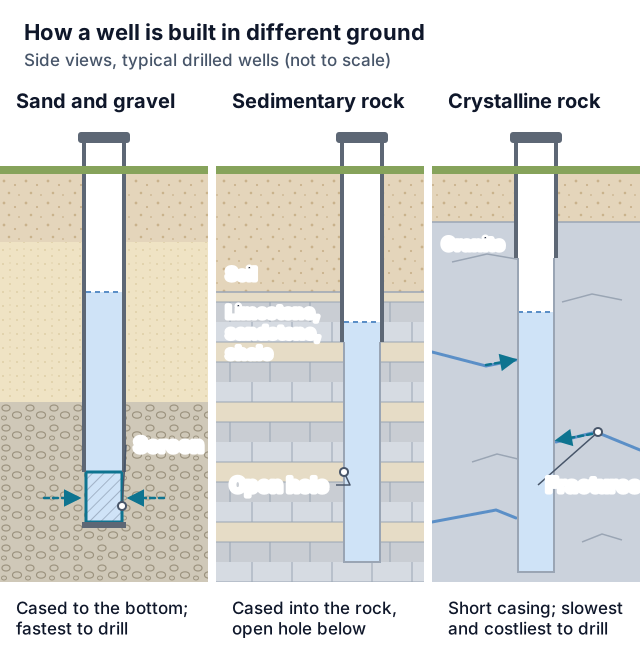
- Depth depends on which aquifer you reach, and we know of no published county-wide figure. DEC's consumer guide says there is no standard well depth. A 1985 USGS study (WRI 84-4334) found that wells at Sardinia are either shallow, under 25 feet, or very deep, 110 to 344 feet; near Sardinia, where the surface outwash is thin, many private wells are set in buried sand and gravel at those depths, and one was drilled 344 feet before reaching a significant water-producing zone. In the Onondaga aquifer of eastern Erie County, USGS WRI 86-4317 (1987) reported that wells which went dry during the 1981–85 water-level declines had been 30 to 77 feet deep, averaging 50, and that the redrilled wells were 72 to 130 feet deep, averaging 95.
- We have no Erie County price survey to offer. This site's cost calculator charges by the foot of depth and then adds lines for the pump, the pressure tank and a permit, but its rates are national figures taken from Angi, HomeGuide and HomeAdvisor rather than bids gathered here, and the permit line is a placeholder, so compare written per-foot quotes from contractors.
- Casing and grout footage: Appendix 5-B section 5-B.3(b)(4) calls for casing from one foot above finished grade to nineteen feet below it. Longer casing may be needed depending on geology under Table 2, and where the only viable source is a shallow aquifer requiring a well shallower than nineteen feet, the Department or local health department may allow casing under twenty feet with extra measures such as larger separation distances. Where bedrock is within 19 feet of the surface, paragraph (16) requires an oversized borehole with the casing grouted to at least 19 feet below grade or five feet into competent bedrock, whichever is deeper.
- Yield test time: section 5-B.4 requires new and redeveloped wells to be tested for yield before use. Its standard test should include at least four hours of stabilized drawdown at a constant pumping rate, then watching recovery until the level returns to 90 percent of its starting point or for 24 hours, whichever comes first. The standard test may be modified, or replaced by another that meets the section's performance requirements, where the local health department finds adequate hydrogeologic information and uniform conditions, when an experienced hydrogeologist or licensed professional engineer directs and certifies it, by pumping, bailing or air lift methods for planned use under 500 gallons per day, or by direct flow measurement at a flowing artesian well whose flow meets the desired use rate.
- Treatment equipment: the USGS studies found mineralized water in the lower sand and gravel zone at Alden, relatively high nitrate in parts of the Springville aquifer, and road-salt sodium and chloride in some shallow wells along the Thruway. The report also passes on a local driller's estimate that about 90 percent of wells in the Alden area have iron bacteria encrustation, which can clog screens and reduce yields.
Permits & Local Rules
- Who may drill: under ECL §15-1502, water well drilling covers construction and reconstruction of water wells, establishing or repairing a connection through the well casing, and well repairs, including those that open the casing. A water well driller is a person who does that work for compensation or as part of property development and sale; public corporations, political subdivisions, and government agencies, departments or bureaus of the state or a municipality are excluded from that definition. For homes, NYSDOH's guidance for code enforcement officials (revised June 2018) quotes Residential Code subsection P2602.1.1: private wells "shall be installed by a well driller registered with the Department of Environmental Conservation" and comply with Appendix 5-B.
- Who supervises: ECL §15-1525(5) requires the person responsible for on-site supervision of drilling to have passed, with at least a 70 percent score, a two-part National Ground Water Association certification exam or an equivalent the commissioner offers or approves. For pump repair or installation that requires opening the well casing, subdivision (5)(b) requires the on-site supervisor to have passed, also with at least a 70 percent score, a certification exam developed by NGWA or the Water Systems Council, or an equivalent exam the commissioner offers or approves. DEC's consumer guide says the law does not cover pipes, pumps or treatment equipment outside the well.
- Registration terms: the fee is $10 a year, a certificate is valid for up to one year, from April 1 through March 31 of the following year, and the statute requires the registration number to be displayed on the registrant's drilling machinery. Registered work is subject to article 36-A of the General Business Law, which DEC's guide says requires a written contract for home improvement services and materials over $500.
- Paperwork for each well: ECL §15-1525(3) requires the registered driller to file a preliminary notice with DEC before drilling begins and, on completion, a completion report giving the well log, size and depth, the capacity of the pump or pumps attached or to be attached, and any other information DEC's rules require, with a copy to the well owner. DEC's registration packet says completion reports should reach DEC and the owner within 30 days of completion of construction, and section 5-B.4 adds that a new well's yield is recorded on that report and the yield test data go to the owner.
- County requirements: the Erie County Sanitary Code posted on ECDOH's site lists Article V, Water Supplies, as deleted in July 2000, and we found no county permit to drill a well in it. NYSDOH says some counties set their own approvals for new and replacement wells, and that code enforcement officials review well location and construction before issuing building permits and certificates of occupancy, so ask ECDOH and your town or city building department what they need before work starts.
- Sale of a home: Article IV, Section 12 of the county Sanitary Code bars transferring title to a structure used for human occupancy until the Commissioner of Health has inspected its water supply and sewage disposal system and certified them. The section exempts foreclosure transfers, transfers without consideration other than in a sale (including bona fide gifts), partition and federal bankruptcy transfers, and transfers for $100 or less; no water certification is needed where an approved public water supply serves the structure, and none for sewage where it discharges only to a public sewer owned and operated by a public sewer or other special service district. ECDOH's page says the seller submits the application and fee, $496 for a property with both a septic system and a private well; it also covers using an outside professional engineer and the cases in which the buyer must apply for a variance instead, so read it before setting a closing date.
- Siting under Table 1 of Appendix 5-B: a well must stand at least 50 feet from a septic tank, aerobic unit or watertight effluent line to a distribution box, 100 feet from an absorption field or bed, 150 feet from a seepage pit and 25 feet from a stream, lake, watercourse, drainage ditch or wetland. Those distances grow by 50 percent when aquifer water comes into the well at a point shallower than 50 feet below grade, or by the greatest possible increase plus additional measures where 50 percent cannot be achieved. Sources marked with Note 5, among them absorption fields, seepage pits, non-watertight septic components and barnyards, need 200 feet when they are in coarse gravel or upgrade and in the direct path of drainage to the well. Table 1 also covers manure, chemical storage, cemeteries and other sources, some with conditions of their own, and NYSDOH's code-official guidance says deviations from the distances need local health department approval. ECDOH's guidance puts a well at least 50 feet from your septic tank and any neighboring septic tanks and, in general, for a well more than 50 feet deep and not in coarse gravel, at least 100 feet from the leaching area or sand filter of your own and your neighbor's systems; it asks owners to contact the department when the well is less than 50 feet deep or in coarse gravel, seepage pits are used in the area, or agricultural or other sources are present.
- Old wells: section 5-B.6 points capping, abandonment and decommissioning to Appendix 5-A. DEC's program page says all wells must be either maintained or properly decommissioned by a NYS registered well driller and asks that its Abandonment and Decommissioning Report be submitted when a well becomes inactive or is decommissioned. NYSDOH's fact sheet says decommissioning may be done by the homeowner but strongly recommends a DEC-registered driller, and says to consult the local health department about requirements first.
Geology & Water Table Notes
- Clarence, Lancaster and Newstead: USGS WRI 84-4334 describes a discontinuous surface aquifer of morainal, beach and outwash sand and gravel over the Onondaga Limestone, which it says generally yields 10 to 100 gallons per minute and is tapped by most wells in the area. The limestone's water held more sulfate, which the report says is probably due to solution of gypsum minerals. Around the landfill near Lancaster, it says, most private domestic wells are drilled through the thin saturated sand and gravel into the limestone to minimize the chance of drying up during a severe drought.
- Karst in the Onondaga: USGS WRI 86-4317 calls the aquifer a nearly flat-lying cherty limestone 25 to 110 feet thick, with sinkholes, disappearing streams and solution-widened joints, where most water moves through widened bedding planes. Yields from 42 wells ranged from 3 to 100 gallons per minute, averaging 20. Water levels in parts of the aquifer fell in the fall of 1981 and again in the summers and falls of 1982–85, when more than 60 wells and several wetlands went dry; most wells that went dry were deepened another 25 to 80 feet, mostly finishing in the lower Onondaga, with several of the deeper ones in the Akron and Bertie Dolomites.
- Sardinia and Springville valleys: per WRI 84-4334, 10 to 95 feet of outwash sand and gravel is separated by till and lake beds from several deeper confined sand and gravel zones in buried preglacial valleys 400 to 600 feet deep. Under the Sardinia aquifer, some of those thin confined zones are significant water-bearing zones under artesian pressure. Appendix 5-B section 5-B.3(b)(18) requires an artesian well that overflows at land surface to be constructed, equipped and operated to control its rate of discharge.
- Alden: the same report, working largely from a driller's description because well logs other than the village well field's were unavailable, found two sand and gravel zones separated by 10 to 20 feet of clay or till. Most wells use the lower zone, and because it is only 5 to 15 feet thick they are commonly extended 6 to 8 feet into the shale below as a storage reservoir; the lower zone's water is more mineralized because of recharge from that shale.
- Both USGS reports are from the 1980s. They describe aquifers across study areas, not what a contractor will find under a particular lot.
Communities Served
Holland · Colden · Sardinia · Concord · Wales · Marilla · Boston · Eden · Brant · North Collins · Collins · Alden · Newstead · Clarence
Emergency Response Expectations
If you suspect fecal contamination, ECDOH advises boiling water at a rolling boil for one minute before using it for drinking, food preparation, brushing teeth or washing dishes, or using bottled water, and testing for coliform at a NYSDOH-certified lab; if you suspect herbicides, pesticides or other chemicals, it says not to use the water for any of those purposes until it is verified to be safe. NYSDOH notes that boiling or disinfecting will not remove oil and other chemicals. We pass along urgent no-water requests but cannot promise a response time.
Erie County FAQs
Do I need a county permit to drill a well in Erie County?
We found no county drilling permit: the Sanitary Code on ECDOH's site shows its water supply article as deleted in July 2000. ECDOH does inspect wells for new house construction, and NYSDOH says local code enforcement officials review a new well's location and construction before issuing building permits and certificates of occupancy, so check with ECDOH and your town or city building department first.
Can a homeowner drill their own well?
DEC's consumer guide answers that question by citing the State Building Code, which it says requires all wells to be drilled by a registered contractor. NYSDOH quotes Residential Code P2602.1.1, which requires private wells to be installed by a DEC-registered well driller and built to Appendix 5-B.
What does ECDOH check on a well when a house is sold?
Its page lists how the well was built (drilled or dug), whether the casing is sound and at least 18 inches above grade, any path for surface water to enter, a secured and intact cap, operation of any disinfection system, cross-connections, and air gaps or backflow devices on treatment discharges. Staff also sample the water for bacteriological quality; nitrate, nitrite and lead tests can be added with the application's Additional Sampling form.
What if the transfer sample shows bacteria?
If total coliform or E. coli is present, ECDOH requires the well to be disinfected and resampled. If the resample is also positive, its property-transfer page says a permanent disinfection system must be installed and sampled again, while its water-and-wells page gives the alternative of retaining a certified well driller to remediate the source of contamination. ECDOH prefers chlorination but accepts UV units when water quality meets the manufacturer's recommendations.
How often do ECDOH and NYSDOH say to test well water?
ECDOH recommends testing at least annually for total coliform bacteria and nitrate, with nitrate and total coliform tests early in a pregnancy and again during a baby's first six months. NYSDOH says to test for bacteria at least yearly and other contaminants every 3 to 5 years, using a lab certified by its Environmental Laboratory Approval Program (ELAP); ECDOH notes the Erie County Public Health Laboratory is one.
What should a brand-new well be tested for?
NYSDOH's recommended list for new residential wells, sampled after installation and development and before use, covers arsenic, chloride, coliform bacteria, lead, nitrate, nitrite, iron, manganese, turbidity, sulfate, pH, hardness, alkalinity and sodium. It suggests added tests for regional constituents such as barium, fluoride, methane, radium, radon and uranium, and notes some local health departments set their own requirements.
Sources
- Erie County Department of Health: Water and Wells
- Erie County Department of Health: Property Transfers
- Sanitary Code of Erie County (Article IV, Section 12; Article V deleted July 2000)
- NYS Environmental Conservation Law §15-1525: water well driller registration
- NYS Environmental Conservation Law §15-1502: definitions
- NYSDEC: Water Well Contractor Program
- NYSDEC: Water Well Contractor Program registration packet
- NYSDEC: Water Well Consumer Protection Guide
- NYSDOH: 10 NYCRR Part 5, Subpart 5-1, Appendix 5-B, Standards for Water Wells
- NYSDOH: Private Wells, Protect Your Family's Water
- NYSDOH Fact Sheet #3: Recommended Residential Water Quality Testing
- NYSDOH Fact Sheet #4: Decommissioning Abandoned Wells
- NYSDOH Fact Sheet #6: Guidance for Code Enforcement Officials
- USGS WRI 84-4334: Hydrogeologic appraisal of five selected aquifers in Erie County, New York (1985)
- USGS WRI 86-4317: Geology and hydrology of the Onondaga aquifer in eastern Erie County, New York (1987)
- U.S. Census Bureau TIGERweb: county subdivisions of Erie County, NY (current layer)
Last reviewed 2026-10-27
Nearby Counties
Services Available in Erie County
Well Drilling
New residential wells — find local drillers for site evaluation, depth estimates, and written drilling quotes.
Learn more →Water Well Drilling
Household water wells from site evaluation through casing, pump, and water test — written quotes from local drillers.
Learn more →Well Pump Repair
No water at the tap? Request urgent well pump repair — local pros diagnose pressure loss, dead pumps, and pressure tank failures fast.
Learn more →Well Pump Replacement
Pump at end of life or beyond repair? Get quotes for correctly-sized submersible and jet pump replacement from local well pros.
Learn more →Well Inspection & Testing
Buying a home with a well, or overdue for a water test? Local pros for flow tests, equipment inspection, and lab water-quality testing.
Learn more →Well Water Service
Water quality problems, treatment systems, and general well maintenance — connect with local pros for everything between drilling and pump work.
Learn more →Free Tools Before You Call
Ballpark the cost or narrow down the problem before talking to an Erie County provider.
Well Drilling Cost Calculator
Estimate what drilling a well should cost — by depth, geology, and whether you need the pump and pressure tank included.
Use the free tool →No Water From Your Well? Diagnostic Wizard
Suddenly no water in the house? Answer a few questions to find out if it's the breaker, the pressure switch, the tank, the pump — or the well itself.
Use the free tool →Well Pump Size Calculator
Find what size well pump you need — GPM demand, total dynamic head, and a horsepower recommendation from four quick inputs.
Use the free tool →Need help in Erie County, NY?
Send the short form — urgent requests get priority routing.