Well Pump Replacement in Morgan County, IN
Well drilling typically runs $3,000–$16,000 nationally, per our cost guide. Independent local pros serving Martinsville, Mooresville, Monrovia and nearby communities. Describe the problem and we'll route your request — free, no obligation.
- Mark no-water pump problems as emergencies on the form
- County pages on local well depths, aquifers, and permits
- Well inspections, water testing, and treatment
- Free to use — no obligation, no markup
Fast response from independent local providers. No obligation.
Typical national cost$3,000 – $16,000Cost guide →Local Help in Morgan County, IN
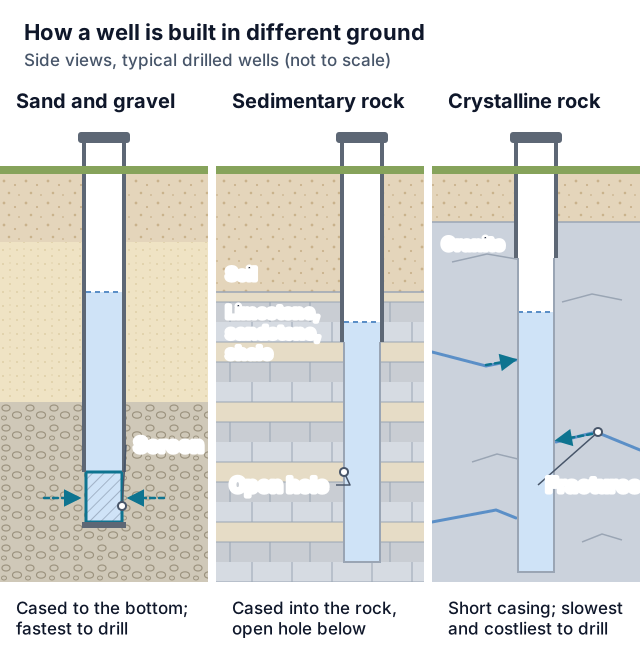
Most wells here are in rock. The Indiana DNR Division of Water's April 2010 report on Morgan County's bedrock aquifer systems says approximately 69 percent of all wells in the county are completed in bedrock, and that the outcrop/subcrop area of the Borden Group Aquifer System includes nearly all of Morgan County. The Borden there is siltstone and shale, with fine-grained sandstones also common. Its wells are typically 70 to 150 ft deep, domestic capacities are typically 2 to 10 gpm, and reported static water levels range from 12 to 40 ft below surface.
The companion April 2010 report on unconsolidated aquifers accounts for the rest: approximately 31 percent of all wells completed in the county are completed in unconsolidated deposits. It maps the White River and Tributaries Outwash Aquifer System primarily along the White River and along portions of White Lick Creek and Indian Creek. Wells completed in it range from 16 to 195 ft but are typically 40 to 80 ft deep, with domestic capacities of 10 to 90 gpm and static water levels from 10 to 25 ft below the ground surface.
Cornelia Cove LLC passes Morgan County requests to independent pump installers and drillers and does none of the pump or drilling work itself. Pump prices, Indiana license rules and the Martinsville PCE plume are covered further down.
Morgan County Service Details
What providers in this area actually see: coverage, common jobs, local pricing factors, and rules worth knowing.
Service Area Notes
- Requests are accepted from anywhere in Morgan County. The Census Bureau's 2020 places-by-county file lists the city of Martinsville, the towns of Bethany, Brooklyn, Monrovia, Mooresville, Morgantown and Paragon, and the Painted Hills census-designated place in the county.
- For a rural address, give the township and nearest road in the request, and say whether you can see the well head or think it is buried.
Common Jobs in Morgan County
- Pulling and replacing a failed submersible pump in a Borden bedrock well
- Resetting a pump so the well keeps the available drawdown 312 IAC 13-4-3.5 calls for
- Pressure tank replacement inside the house
- Replacing a buried well head with a pitless unit that ends at least 1 ft above ground
- Chlorinating the well and sampling for coliform once pump work is finished
- Capping idle wells and arranging plugging of abandoned ones
What Drives Pricing Here
- Pump type: NGWA distinguishes submersible pumps, which sit down in the water inside the well, from jet pumps on the surface close to the wellhead, and says a well's performance demands might favor one type over the other.
- Pump setting: 312 IAC 13-4-3.5 asks for at least 50 ft of available drawdown from the pumping apparatus in a bedrock well and at least 20 ft in an unconsolidated-aquifer well, unless the department approves otherwise, and does not apply to monitoring or dewatering wells. 312 IAC 13-1-3.2 measures available drawdown from the static water level down to the pump setting. DNR's water availability FAQ says 25 ft rather than 20 ft for unconsolidated wells, so confirm with DNR if that difference matters for your well.
- Bedrock yield: DNR's bedrock report identifies two systems in the county, the Borden Group and the Blue River and Sanders Groups (the latter limited to portions of western and southwestern Morgan County), and for both it says greater capacities have been reported in isolated areas, but higher yields are commonly associated with significant to complete drawdown.
- Parts beyond the wellhead: according to DNR's FAQ, Indiana's well drilling statute and rules leave unregulated the piping and electrical connections running from the well to the building, and well-related equipment inside it such as pressure tanks. Ask for those items to be priced separately from the pump.
Permits & Local Rules
- Who may do the work: IC 25-39-3-1(a) requires a license to act as a water well driller or water well pump installer, and anyone who installs or repairs water well pumps counts as a pump installer (IC 25-39-2-15.5). Each license expires on December 31 of the year for which it was issued, and a licensee who is installing a pump or operating drilling equipment has to carry the license and show it to a department representative on request (IC 25-39-3-1(c)-(d)). The fee in 312 IAC 13-2-2(a), readopted May 17, 2023, is $100 for a calendar year; DNR issues one card showing whether the holder is licensed as a driller, a pump installer, or both.
- Exempt work: under IC 25-39-1.5-3, the licensing chapter (IC 25-39-3) and the regulation chapter (IC 25-39-4) do not reach (1) a person putting in a personal-use well whose inside diameter is at most 1 1/4 inches and whose depth is at most 24 feet; (2) a plumber licensed under IC 25-28.5 who has also registered with DNR as IC 25-39-1.5-4 requires, when the wells stay within that same 1 1/4-inch and 24-foot ceiling; (3) a person who installs or repairs pumps or pumping equipment on a water well for personal use; or (4) someone working at a licensee's direction and under that licensee's personal supervision. 312 IAC 13-1-19.3 counts use as personal when the water supply well or pumping equipment sits on property owned or in possession of a person, as IC 14-8-2-202 defines person, or, for a public water supply utility, is possessed by a permanent employee of that utility.
- County office: the Morgan County Health Department's Drinking Water Wells/Water Testing page says private wells should be checked once per year, or more often if you are concerned about contamination, and links the state's recommended well standards, a state test kit order form and Indiana's certified drinking water laboratories. Its septic division issues septic permits. Before a well or pump job, ask the department whether any local requirement applies; its contact page is listed in the sources.
- Well head height: 312 IAC 13-3-2(a)(3) requires earthen material placed around the finished casing or pitless unit so surface water drains away from the well, with the casing or pitless unit finishing at least 1 ft above ground level. Inside a designated flood hazard area there are two options: a top at least 2 ft above the regulatory flood elevation, or a watertight pitless unit cap or well seal plus venting to an elevation at least 2 ft above that flood level. Subsection (b) excludes monitoring and dewatering wells.
- Well records: 312 IAC 13-2-6 gives the water well driller 30 days after a well's completion to submit accurate records for it, on a departmental form or one the division approves. Every required item is listed in that section, among them the pump type and pump setting depth where applicable. DNR's online database of over 400,000 Indiana well records can't be searched by owner name; its web viewer offers street address and zip code searches.
- Idle wells: if a well sits unused for longer than three months but has not been permanently abandoned, 312 IAC 13-10-1 requires it to be capped watertight at or above the ground surface, the cap welded, threaded, or mechanically attached, and maintained so it cannot become a source or channel of ground water contamination. IC 25-39-2-2 has two tests for an abandoned well: its original purpose and use have been discontinued for more than five years, or it is in such a state of disrepair that using it to obtain ground water is impractical or a health hazard.
- Plugging: when a well is abandoned after December 31, 1987, the person who owns the land has one year from abandonment to get it plugged. The statute, IC 25-39-4-6(b), says the plugging is done by a water well driller; the rule, 312 IAC 13-10-2(c), says a water well driller or water well pump installer, using an impervious grouting material. Under 13-10-2(f) the division shall be notified in writing of the abandonment within thirty days after plugging is completed (the rule does not name who gives that notice). A shorter clock applies to an uncased well drilled after December 31, 1987: the driller must plug it within 72 hours after drilling is completed (IC 25-39-4-4; 312 IAC 13-10-2(d)). Wells abandoned before 1988 fall under 13-10-2(a)-(b), and plugging materials and methods are set out in 13-10-2(e).
Geology & Water Table Notes
- Cover over the rock varies widely. DNR's unconsolidated report puts its total thickness at less than one foot where bedrock is shallow or outcrops along sections of White River tributaries, rising to an estimated 240 ft in the northwest part of the county.
- The Till Veneer / Dissected Till and Residuum Aquifer System, mapped throughout much of the county, covers thin glacial deposits in central and southern Morgan County and thin till, generally less than 50 ft thick, in the north and east. DNR says nearly all wells drilled there bypass the unconsolidated deposits in favor of the underlying bedrock, and that yields from this system are generally less than 7 gpm with significant to complete drawdowns reported.
- DNR's report counts registered significant groundwater withdrawal facilities by aquifer system: 14 facilities (41 wells) with capacities of 100 to 3000 gpm in the White River and Tributaries Outwash Aquifer System, 5 facilities (13 wells) with capacities up to 500 gpm in the related outwash subsystem along several White River tributaries, and 5 facilities (15 wells) with reported yields up to 650 gpm in the Martinsville Hills / Tipton Complex Aquifer System, which is mapped only in east-central Morgan County and has completed well depths of 80 to 185 ft.
- EPA's site profile for the Pike and Mulberry Streets PCE Plume Superfund site in Martinsville describes a 38-acre groundwater plume, contaminated primarily with tetrachloroethylene (PCE), that has affected one of Martinsville's municipal drinking water wells; the well field serves about 15,000 people. EPA says Martinsville has operated an activated carbon filtration system since 2005 to remove PCE, and that monitoring has shown PCE levels continue to increase.
- EPA placed the site on the National Priorities List in May 2013, chose groundwater and soil vapor remedies in a 2020 Record of Decision, began designing them in 2022, and in 2023 and 2024 installed several dozen vapor intrusion mitigation systems on homes and businesses at the site.
- Water lines: to keep them from freezing, the state health department's recommended standards list a 48-inch minimum bury depth for Morgan County, measured from the top of the pipe to finished grade.
Communities Served
Martinsville · Mooresville · Monrovia · Paragon · Brooklyn · Bethany · Morgantown · Painted Hills
Emergency Response Expectations
A Morgan County request with no water at the tap can be flagged as urgent, but this site cannot promise when an independent contractor will arrive.
Morgan County FAQs
How much should I budget for a new well pump in Morgan County?
NGWA's 2021 Well Owner's Guide (page 8) gives national survey figures: $3,000 to $3,200 for a typical household submersible pump and about $1,545 to $1,570 for a typical household jet pump. NGWA says these are a general indication rather than exact costs in any locale, and that costs can vary over time and by location. Before work starts, check with the county health department whether anything local applies to your job.
My pump runs, but the water spits air and then quits. Why?
NGWA's drought page compares a well near the water table to a straw in a glass: if the water level falls and the straw is not lowered, you end up sucking air. It also says increased pumping by larger capacity wells during a drought may draw the groundwater level down below your pump's intake. For Morgan County bedrock, DNR's report says higher yields are commonly associated with significant to complete drawdown. A licensed pump installer can compare the static water level and the pump setting with the minimum available drawdown in 312 IAC 13-4-3.5.
Could a high-capacity well nearby be lowering my water level?
Under IC 14-25-4-8, within 24 hours after receiving a written complaint from the owner of a nonsignificant ground water withdrawal facility (under IC 14-25-4-3, a person's ground water withdrawal facility that, in the aggregate, can withdraw less than 100,000 gallons of ground water in one day) that a water well on property in the owner's possession has failed to furnish its normal supply of water or potable water, the DNR director shall cause an onsite investigation. Whether an emergency is declared or compensation is owed turns on the findings and conditions in IC 14-25-4-9 and 14-25-4-17, so read the chapter or ask the Division of Water.
Do I need a license to swap the pump in my own well?
Not for personal use: IC 25-39-1.5-3(3) exempts a person installing or repairing a water well pump or pumping equipment for that purpose, and 312 IAC 13-1-19.3 defines personal use by reference to property the person owns or possesses (or, at a public water supply utility, equipment a permanent employee possesses). Doing the same job for a neighbor or client takes a DNR license, unless the worker is under a license holder's direction and personal supervision (IC 25-39-1.5-3(4)).
I have a private well near Martinsville. Should I test it for PCE?
The Morgan County Health Department's PCE Plume page says that if you are concerned about a well on your property, you may have your water tested at a private lab at your own expense, and it points to the state's certified laboratory list, where labs able to test VOCs are marked under "Chemistry".
What testing should follow a pump replacement?
Indiana Department of Health guidance (its recommended standards) puts disinfection on the pump installer after a pump is installed or repaired: enough chlorine for at least a 100 mg/l dose, held in the well and water system for 24 hours or more, with 25 mg/l or more left at the 24-hour mark. Once the chlorine is flushed out, the standards call for a sample, in a sterile bottle from a lab certified for bacteriological analyses, showing less than two coliform organisms per 100 milliliters before the installation is used for drinking, and for repeating disinfection and sampling until results are satisfactory. The state lab recommends testing well water annually for bacteria and nitrate.
Sources
- Indiana DNR: Bedrock Aquifer Systems of Morgan County (Maier, April 2010)
- Indiana DNR: Unconsolidated Aquifer Systems of Morgan County (Maier, April 2010)
- Indiana Code 2026, Title 25, Article 39 (IC 25-39)
- Indiana Code 2026, IC 14-25-4
- Indiana Administrative Code 312 IAC 13 (2026 edition)
- Indiana DNR: Driller and pump installer licensing
- Indiana DNR: Water availability and use rights FAQ
- Indiana DNR: Online water well record database
- IDOH: Recommended standards for private wells
- IDOH Laboratories: Well water testing
- Morgan County Health Department: Drinking Water Wells/Water Testing
- Morgan County Health Department: PCE Plume
- Morgan County Health Department: Contact
- EPA: Pike and Mulberry Streets PCE Plume, cleanup activities
- EPA: Pike and Mulberry Streets PCE Plume, announcements
- U.S. Census Bureau: Indiana places by county (2020)
- NGWA: Drought and your well
- NGWA: Well Owner's Guide (2021), page 8
Last reviewed 2026-10-31
Services Available in Morgan County
Well Drilling
New residential wells — find local drillers for site evaluation, depth estimates, and written drilling quotes.
Learn more →Water Well Drilling
Household water wells from site evaluation through casing, pump, and water test — written quotes from local drillers.
Learn more →Well Pump Repair
No water at the tap? Request urgent well pump repair — local pros diagnose pressure loss, dead pumps, and pressure tank failures fast.
Learn more →Well Pump Replacement
Pump at end of life or beyond repair? Get quotes for correctly-sized submersible and jet pump replacement from local well pros.
Learn more →Well Inspection & Testing
Buying a home with a well, or overdue for a water test? Local pros for flow tests, equipment inspection, and lab water-quality testing.
Learn more →Well Water Service
Water quality problems, treatment systems, and general well maintenance — connect with local pros for everything between drilling and pump work.
Learn more →Free Tools Before You Call
Ballpark the cost or narrow down the problem before talking to a Morgan County provider.
Well Drilling Cost Calculator
Estimate what drilling a well should cost — by depth, geology, and whether you need the pump and pressure tank included.
Use the free tool →No Water From Your Well? Diagnostic Wizard
Suddenly no water in the house? Answer a few questions to find out if it's the breaker, the pressure switch, the tank, the pump — or the well itself.
Use the free tool →Well Pump Size Calculator
Find what size well pump you need — GPM demand, total dynamic head, and a horsepower recommendation from four quick inputs.
Use the free tool →Need help in Morgan County, IN?
Send the short form — urgent requests get priority routing.