Well Drilling in Eaton County, MI
Well drilling typically runs $3,000–$16,000 nationally, per our cost guide. Independent local pros serving Charlotte, Eaton Rapids, Grand Ledge and nearby communities. Describe the problem and we'll route your request — free, no obligation.
- Mark no-water pump problems as emergencies on the form
- County pages on local well depths, aquifers, and permits
- Well inspections, water testing, and treatment
- Free to use — no obligation, no markup
Fast response from independent local providers. No obligation.
Typical national cost$3,000 – $16,000Cost guide →Local Help in Eaton County, MI
In the Tri-County region of Clinton, Eaton and Ingham counties, groundwater is withdrawn primarily from the Saginaw aquifer, according to U.S. Geological Survey Scientific Investigations Report 2009-5244: water-bearing sandstones in the Grand River and Saginaw Formations of Pennsylvanian age, with aquifers in the glacial deposits and other bedrock units important in some places. An older USGS study, Water-Supply Paper 1969 (1973), describes each quarter of Eaton County as it stood in 1969; those findings are summarized below as history, not as a forecast for any parcel.
The Barry-Eaton District Health Department (BEDHD) issues well permits. Its Sanitary Code, in the version the department posts (effective April 3, 2000), applies throughout Barry and Eaton counties, and Article X adopts the state's Groundwater Quality Control rules (issued under Public Health Code Part 127, 1978 PA 368) as the standard for new water wells, with Act 399 of 1976 governing public water supplies.
Eaton County Service Details
What providers in this area actually see: coverage, common jobs, local pricing factors, and rules worth knowing.
Service Area Notes
- Census Bureau 2020 place codes for Eaton County list the cities of Charlotte, Eaton Rapids, Grand Ledge, Olivet and Potterville, the villages of Bellevue, Dimondale, Mulliken, Sunfield and Vermontville, and the Waverly census-designated place; Lansing city also appears under the county. The county subdivision file names Delta, Oneida and Windsor charter townships and Bellevue, Benton, Brookfield, Carmel, Chester, Eaton, Eaton Rapids, Hamlin, Kalamo, Roxand, Sunfield, Vermontville and Walton townships.
- Community supplies differ: using 2005 data, the 2009 USGS report lists Grand Ledge and Potterville as drawing from the Saginaw aquifer; Charlotte, Sunfield and Vermontville from aquifers in the glacial deposits; Eaton Rapids from both; and Bellevue and Olivet as taking a small amount from the Marshall aquifer in southwestern Eaton County.
- Article X, Section XI of the BEDHD code bars any municipality, township or other agency from issuing a building permit, or otherwise letting construction start, on land without public water until the Health Officer has approved construction of a well.
- Old records: BEDHD's residential application points owners to its Environmental Health office for earlier site evaluations, permits and final inspections. EGLE's Wellogic database has taken electronic well, pump and plugging records since 2000, holds over a million records open to the public, and needs no account for searching.
Common Jobs in Eaton County
- New and replacement residential wells under a BEDHD well permit
- Irrigation and test wells, permitted by BEDHD in under-70 and over-70 gallons-per-minute classes
- Type II and Type III public supply wells; BEDHD's Type II examples include schools, day-care centers, motels, churches and restaurants
- Disinfecting a new or flooded well before the owner's coliform sample
- Plugging abandoned wells and dry holes
- Pump and pressure tank work by a registered pump installer, a registered well drilling contractor or a licensed master plumber
What Drives Pricing Here
- Permit fees: BEDHD's FY2027 Environmental Fee Schedule, linked from its well page and checked October 28, 2026, lists $390 for a residential well permit under 70 gallons per minute, $455 for a well permit over 70 gpm or high capacity, $423 for a Type III well permit, and $667 (transient) or $876 (non-transient) plus the lab fee for a Type II well permit. The schedule and the FY2027 residential application both say a well installed without a permit is charged double.
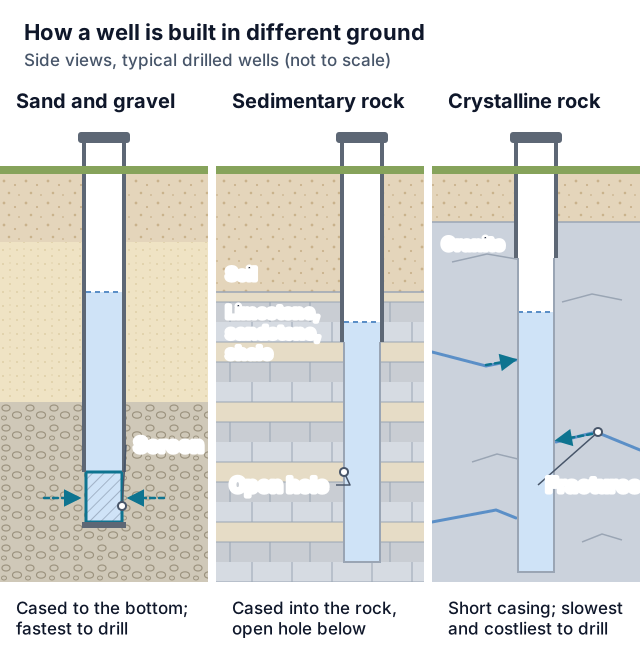
- How deep: Water-Supply Paper 1969 found that only the upper part of the bedrock is a source of fresh water, with strata below a depth of 500 feet in the region generally holding saline water, and that a Saginaw Formation well's yield is controlled mainly by how much sandstone it penetrates. Logs filed for neighboring wells can be looked up in Wellogic.
- Using the site's cost calculator: you type a depth and choose a geology type that sets the per-foot range, and the tool adds a standard permit allowance plus, unless you untick it, a pump and pressure tank. Because those figures are drawn from national Angi, HomeGuide and HomeAdvisor cost pages, treat the total as a national ballpark rather than an Eaton County bid.
- Rock near the surface: the 2009 USGS report notes glacial deposits are missing in a small area near Grand Ledge, where the 1973 report says the Saginaw Formation crops out along the Grand River. Where bedrock is encountered within 25 feet of the ground surface, R 325.1637(1) requires an oversized borehole, with the permanent casing grouted with neat cement for a minimum depth of 25 feet.
- Large pumps: EGLE's withdrawal tool page says a landowner needs EGLE's approval before operating a new or increased withdrawal that relies on one pump or several able to deliver 70 gallons per minute or more. BEDHD's application, for a well producing 70 gpm or more alone or combined with other wells on the property, makes it the owner's job to run EGLE's Water Withdrawal Assessment Tool and see whether the well would cause an Adverse Resource Impact on a nearby surface water body.
Permits & Local Rules
- Who may drill: anyone in the business of drilling wells or installing pumps first needs a state well-drilling-contractor or pump-installer registration, renewed every year (MCL 333.12704). A driller's registration covers pump work as well; pump installers cannot drill (R 325.1608); licensed master plumbers may install pumps with no pump installer registration (MCL 333.12703(3)); and a county, city, village, township or other governmental unit doing this work also registers (MCL 333.12704(4)). Per EGLE, every registration lapses April 30, renewal applications are due March 1, and an unrenewed contractor is barred from drilling and pump installation from May 1 until renewal.
- Owner-built wells: MCL 333.12703(2) exempts a person who builds a well or installs a pump on land he or she owns or leases, but only when the well will serve just a single-family home that is the person's permanent residence, or just farming on the person's own farm, and the water is not meant for public use or for anyone else's residence. Such owners must still submit the MCL 333.12707 drilling record and meet the construction code, and BEDHD's permit requirement covers them as well.
- Permit trigger: Article X, Section IV makes it unlawful to build a new water supply system, or make extensive changes to an existing water supply well, without a construction permit from the Health Officer obtained by the owner or the owner's representative. Section V says extensive changes include, but are not limited to, replacing the entire casing, removing the casing from the ground or changing aquifers; ask BEDHD about other work.
- Applying: what to send, including the site-plan requirements, differs for new, replacement, and irrigation or test well permits, so work from BEDHD's current residential application, linked from its well page, rather than a summary here. Under Article X, Section VII a permit is valid for no more than one year and cannot be transferred to a new owner or to another location.
- After drilling: BEDHD's well page says the driller chlorinates the well, tells the owner about sampling, gives the well record to the owner and BEDHD, and builds to state and local requirements. The owner arranges BEDHD's final inspection of the well and pressure tank, flushes out the chlorine, and submits a sample for coliform bacteria and a partial chemical analysis (nitrate, nitrite, sulfate, hardness, fluoride, sodium, chloride and iron); residential wells must be sampled before final approval.
- Setbacks: among the minimum separations in R 325.1622 are 300 feet to an oil or gas well; 150 feet to a place where fertilizers, agricultural chemicals or other chemicals that could contaminate soil or groundwater are prepared or stored; 50 feet to a septic tank, a subsurface disposal field or an animal or poultry yard; and 10 feet to surface water such as a lake or stream. Under R 325.1613 the health officer can set a larger or smaller distance for a particular well, and buildings and pump rooms need 3 feet unless a deviation is issued (R 325.1624).
- Records: the driller has 60 days after completion to deliver the well log, one copy to the owner and two to the health officer, bearing a registered well drilling contractor's signature (MCL 333.12707, R 325.1675). Missing that deadline, or failing to keep the geologic record at the site during drilling, can lead the department or health officer to order geophysical logging. A pump installed on a new well gets its own signed record on the same 60-day timeline (R 325.1676).
- Plugging: the state rule (R 325.1662) puts plugging of an abandoned well or dry hole in the hands of the owner or a contractor registered for well drilling, and reserves it to a registered contractor when a well on the property serves the public or someone else's residence. BEDHD's well page draws a tighter local line, saying plugging is performed only by a licensed well driller, so talk to the department before doing it yourself. R 325.1663 to R 325.1665 give methods, and R 325.1675(3) covers the plugging report due within 60 days.
Geology & Water Table Notes
- Northwest (1973 report): glacial deposits were the chief aquifer, and the Saginaw and Michigan Formations served many household wells without being highly productive; Mulliken-area wells drew from glacial deposits or the Saginaw.
- Northeast (1973 report): the Saginaw Formation and glacial drift were the main aquifers, the Saginaw giving moderate to large supplies in southern Windsor and Benton townships and eastern Oneida Township. The 2009 report says most wells in this area's buried-outwash zone are completed in bedrock because of better water quality at depth.
- Southwest (1973 report): the glacial drift and the Marshall Formation were the main aquifers, but the Marshall yielded saline water in all but a few square miles of that area, and where it was fresh and the overlying Michigan Formation was saline, the report said the saline water must be sealed off in Marshall wells.
- Southeast (1973 report): the Saginaw Formation was highly productive in much of the northern half and less so in the southern half, while glacial deposits and the Michigan Formation generally yielded only a few gallons per minute, though glacial deposits were potential sources of large supplies in some localities.
- Water quality: the 1973 report found Saginaw and Grand River water suited to household needs at nearly all wells, though generally hard or very hard with objectionable iron. BEDHD recommends at least annual sampling where nitrate contamination is known in the area or results approach 10 mg/L, and EGLE recommends that homeowners have their well water tested for arsenic.
Communities Served
Charlotte · Eaton Rapids · Grand Ledge · Olivet · Bellevue · Potterville · Dimondale · Vermontville · Mulliken · Sunfield
Emergency Response Expectations
BEDHD says water from a flooded well is not safe to drink and that testing is the only way to verify it is safe. It tells owners to disinfect the well, referring them to a registered well driller or licensed well pump installer for proper chlorination, and to contact the department about sampling; its flooded-well guidance also covers when to boil water or use bottled water. This site can pass an urgent request to contractors but cannot control how quickly one responds.
Eaton County FAQs
Do I need a BEDHD permit before a well is drilled in Eaton County?
Yes for a new water supply system or an extensive change to an existing well, such as replacing the entire casing or changing aquifers (Sanitary Code Article X, Sections IV and V). BEDHD charges double when a well goes in without a permit.
May I drill my own well?
Michigan exempts owner-built wells only in narrow cases (MCL 333.12703(2)): the land is yours by ownership or lease, and the well supplies either your own single-family permanent home or farming on your own farm, never the public or another household. The drilling record, the construction code and BEDHD's permit still apply.
What happens if a sample shows high nitrate?
Above 10 mg/L, BEDHD recommends using another drinking water source where possible and bottled water for infant formula, and asks owners to contact Environmental Health. It warns that boiling does not remove nitrate and can concentrate it.
Which aquifer will a new well tap?
It depends on location; the 1973 USGS report's quarter-by-quarter findings are summarized above. Logs filed for neighboring wells in Wellogic show what drillers recorded nearby.
Who may plug an unused well on my land?
R 325.1662 lets either you, as owner, or a contractor registered for well drilling plug it, though only a registered contractor may do so if any well on the property serves the public or a residence other than yours. BEDHD's well page says plugging is to be performed only by a licensed well driller, so check with the department first.
Sources
- Barry-Eaton District Health Department: On-Site Drinking Water Wells
- Barry-Eaton District Health Department: FY2027 Environmental Fee Schedule
- Barry-Eaton District Health Department: Residential Property Development Application, revised FY2027
- Barry-Eaton District Health Department: Sanitary Code (effective April 3, 2000)
- Michigan Legislature PDF: MCL 333.12701-333.12715 (Public Health Code, Part 127)
- Groundwater Quality Control rules, Mich. Admin. Code R 325.1601-325.1781 (state ARS copy)
- EGLE: Water well contractor registration
- EGLE: Wellogic water well records
- EGLE: Water Withdrawal Assessment Tool
- EGLE: Arsenic in well water
- USGS Scientific Investigations Report 2009-5244 (Luukkonen, 2009): groundwater flow in Clinton, Eaton and Ingham Counties
- USGS Water-Supply Paper 1969 (Vanlier, Wood and Brunett, 1973): water supply in Clinton, Eaton and Ingham Counties
- Census Bureau 2020 place-by-county reference codes for Michigan (Eaton is county 045)
- Census Bureau 2020 county subdivision reference codes for Michigan
Last reviewed 2026-10-28
Nearby Counties
Services Available in Eaton County
Well Drilling
New residential wells — find local drillers for site evaluation, depth estimates, and written drilling quotes.
Learn more →Water Well Drilling
Household water wells from site evaluation through casing, pump, and water test — written quotes from local drillers.
Learn more →Well Pump Repair
No water at the tap? Request urgent well pump repair — local pros diagnose pressure loss, dead pumps, and pressure tank failures fast.
Learn more →Well Pump Replacement
Pump at end of life or beyond repair? Get quotes for correctly-sized submersible and jet pump replacement from local well pros.
Learn more →Well Inspection & Testing
Buying a home with a well, or overdue for a water test? Local pros for flow tests, equipment inspection, and lab water-quality testing.
Learn more →Well Water Service
Water quality problems, treatment systems, and general well maintenance — connect with local pros for everything between drilling and pump work.
Learn more →Free Tools Before You Call
Ballpark the cost or narrow down the problem before talking to an Eaton County provider.
Well Drilling Cost Calculator
Estimate what drilling a well should cost — by depth, geology, and whether you need the pump and pressure tank included.
Use the free tool →No Water From Your Well? Diagnostic Wizard
Suddenly no water in the house? Answer a few questions to find out if it's the breaker, the pressure switch, the tank, the pump — or the well itself.
Use the free tool →Well Pump Size Calculator
Find what size well pump you need — GPM demand, total dynamic head, and a horsepower recommendation from four quick inputs.
Use the free tool →Need help in Eaton County, MI?
Send the short form — urgent requests get priority routing.