Well Drilling in Hickman County, KY
Well drilling typically runs $3,000–$16,000 nationally, per our cost guide. Independent local pros serving Clinton, Columbus, Moscow and nearby communities. Describe the problem and we'll route your request — free, no obligation.
- Mark no-water pump problems as emergencies on the form
- County pages on local well depths, aquifers, and permits
- Well inspections, water testing, and treatment
- Free to use — no obligation, no markup
Fast response from independent local providers. No obligation.
Typical national cost$3,000 – $16,000Cost guide →Local Help in Hickman County, KY
The Kentucky Geological Survey's groundwater report for Hickman County places it in the Mississippi Embayment region, names Clinton as the county seat, and notes that the bluff at Columbus-Belmont State Park rises approximately 170 feet above the Mississippi River. The same report estimated the 2008 population at 4,936, with 40 percent on public water, and says the majority rely on private domestic wells.
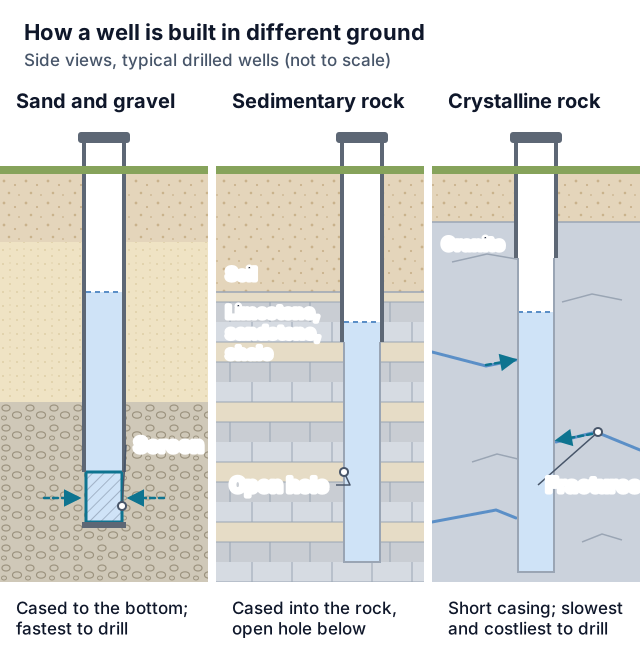
KGS also says water in Hickman County is obtained from unconsolidated sediments of Tertiary and Quaternary age, and that most of the region's Cretaceous and younger sediments remain unconsolidated and soft, in marked contrast to the older hard rocks beneath them. Kentucky regulates who may build, repair and plug those wells through KRS 223.400 to 223.460 and the Energy and Environment Cabinet's regulations 401 KAR 6:320 (certification) and 401 KAR 6:310 (construction standards). This site forwards requests to independent contractors and does no drilling itself.
Hickman County Service Details
What providers in this area actually see: coverage, common jobs, local pricing factors, and rules worth knowing.
Service Area Notes
- Requests are taken from the two incorporated cities the Census Bureau lists in Hickman County, Clinton and Columbus, and from other places that the USGS Geographic Names Information System records as populated places in the county, among them Moscow, Fulgham, Oakton and Spring Hill.
- Researching an existing well? KRS 223.440(3) has the cabinet furnish a copy of each driller's well record to the Kentucky Geological Survey, and the Division of Water's well-records page notes that KRS 151.035 makes KGS the official repository for groundwater information. KGS's Water Well & Spring Records Database can be searched by county. KGS gives every repository well and spring an eight-digit AKGWA number, uses the prefix 000 for Division of Water domestic wells, and updates the data from the Division of Water several times a year, usually quarterly.
- Checking a rig: 401 KAR 6:320 Section 4(3) requires a certified driller's certificate number to be displayed prominently on the drill rig used at the well site, in the format KY. CERT. followed by the number, in figures at least three inches high and in a color easily distinguished from the rig. The Division of Water's Well Driller Certification Program page links a map and a directory for finding a certified driller.
Common Jobs in Hickman County
- New domestic wells, which KRS 223.405 reserves for a certified water well driller or a certified driller's assistant
- E. coli sampling of a new potable well within 30 days of completion, as 401 KAR 6:310 Section 9(6) requires
- Irrigation wells, which need a double check valve backflow preventer, plus a reduced pressure backflow preventer when the well can pump more than 10,000 gallons per day or supplies a center pivot system
- Modifying older wells, including eliminating a well pit and raising the casing above grade
- Plugging hand-dug, bored, driven and drilled wells that are no longer suitable for use
- Pump, wiring and pressure tank checks; the Water Well Owner's Guide suggests having a certified water well driller or plumber look at leaks or anything that does not look right
What Drives Pricing Here
- Target depth: KGS says groundwater is available for domestic, irrigation and industrial uses from depths of a few feet down to 750 feet. Depth to groundwater is generally under 100 feet, except in the uplands and in the western part of the county, where water is found from 100 to 250 feet, and some deeper wells of 250 to 750 feet yield more than 1,000 gallons per minute. These are county-wide ranges from KGS, not a reading for any one lot; the KGS database holds records for individual wells.
- About the site calculator: this site's drilling cost tool takes your depth, applies a per-foot range that changes with the geology setting, and adds a pump, a pressure tank and a generic permit line. Those figures are drawn from Angi, HomeGuide and HomeAdvisor pages on national costs, so the result is a rough estimate, not a Hickman County quote. Ask the driller whether any permit or fee actually applies to your job.
- Building in loose sediment: for wells in unconsolidated formations, 401 KAR 6:310 Section 7 calls for a borehole at least 4 inches wider than the outside diameter of the casing and screen (or steel casing advanced by the dry-driven grout method), at least 20 feet of permanent casing below finished grade not counting the screened interval, a screen slot size that keeps out fine sediment, and either a developed natural filter pack or an artificial one that is disinfected and reaches at least 2 feet above the screen.
- Sealing the annulus: in a single-cased well in sediment, the annulus is sealed either entirely with sealing materials or with 2 feet of sealing materials directly above the filter pack and the rest with drill cuttings, sealing materials, native clay or a combination, and the seal must reach at least 18 feet below finished grade; Section 7(5)(a) also allows the second method combined with a mechanical packer. Section 3 has grout placed from the bottom up by grout pipe or pressure grouting device in one continuous operation to 2 feet below the surface or the pitless adapter, and bars bentonite grout, pellets, chips and granules where groundwater chlorides exceed 1,000 ppm.
- Iron: KGS says water from deeper zones sometimes contains naturally occurring iron in objectionable amounts, and that in some formations slightly acidic groundwater reacts with steel well casing and pump equipment to produce high iron content. It names iron and hydrogen sulfide (sulfur water) as the main naturally occurring constituents occasionally found in objectionable amounts in the county.
- Old well pits: under 401 KAR 6:310 Section 10, a well being modified must be brought into compliance with the regulation. An existing well pit is eliminated by breaking out and removing its floor and walls and filling it with compacted earth, and the casing is extended at least 4 inches above finished grade.
Permits & Local Rules
- Who may do the work: KRS 223.405 makes it unlawful for any person to construct, alter or repair a water well without first obtaining a valid certificate as a water well driller or water well driller's assistant, and 401 KAR 6:320 Section 1(3) applies the same requirement to abandoning a well. KRS 223.400(7) leaves out of the definition of a water well any well used for watering stock or for general farmstead use if it does not provide water for human consumption, and KRS 223.400(1) does not count replacement or repair of a water pump or associated piping as alteration or repair of a well. KRS 223.425(3) exempts water witchers, dowsers and diviners only for locating underground water, not for installing wells.
- Assistants: a certified assistant works under a certified driller's direct supervision, and a driller may supervise at most two assistants at a time (KRS 223.425(7)-(8)). 401 KAR 6:001 defines direct supervision as the driller overseeing the assistant's work and giving specific instruction, without having to supervise in person at the drilling site. Any change to well specifications during a job must be approved in advance by a certified driller, recorded on an amended Uniform Kentucky Well Construction Record, kept by the assistant and made available for cabinet inspection (401 KAR 6:310 Section 1(4)). KRS 223.440(1)(k) bars an assistant from certifying well records.
- Getting certified: under KRS 223.425(2), a driller applicant must be at least 18, legally permitted to work in the United States, have worked two years under a certified driller's supervision or have other experience or education the cabinet finds suitable (drillers in business on July 13, 1984 met the experience requirement by drilling over the two previous years), and pass the examination. 401 KAR 6:320 sets a 70 percent passing score, requires proof of the insurance and bond KRS 223.430 calls for, issues certificates that name the drilling methods the holder may use, and has certificates run to the following June 30 (to June 30 of the next calendar year if first issued after May 1), with renewal due by July 1.
- Setbacks from 401 KAR 6:310 Section 5, Table C: 100 feet from a leaching pit or petroleum storage tank; 75 feet from a grave or cemetery, a manure pile, animal waste storage or confined animal feeding operation, or a wastewater treatment disposal system; 70 feet from the side wall of a lateral trench, bed or lagoon, or an ungrouted closed-loop geothermal system; 50 feet from another water supply well, a septic tank or sewer line, or a livestock pen, corral or stable; 25 feet from a surface water body; 20 feet from a grouted closed-loop geothermal system or a grouted abandoned water well; and 10 feet from property lines, utility lines or a roadway right of way. Every distance doubles where the unconsolidated material is less than 20 feet thick and predominantly sand or gravel, and the driller must also evaluate land uses on the property and adjacent properties and identify any other potential pollution sources.
- Placement and flooding: a well must clear any building projection by at least 5 feet and may not be built in a pit or basement. It may go in an identified special flood hazard area only if no alternate site exists, with the casing ending at least 2 feet above the highest base flood elevation at the site and above any known flooding from drainage or runoff. Section 9(1) also has every casing end at least 4 inches above finished grade with the ground sloped away from the well. KGS describes Obion Creek as a braided stream with swampy areas and small oxbow lakes along its valley.
- Disinfection and testing: once the well is developed until the water column is free of visible sediment, Section 9(3) has it chlorinated to at least 100 ppm, circulated for at least 30 minutes, left to stand at least 30 minutes and purged, with the chlorinated water discharged to the ground without environmental harm and never to surface water. A well for potable use is then analyzed for E. coli within 30 days of completion, sampled only after residual chlorine is purged, in sterile containers kept at 4 degrees Celsius and delivered within six hours to a laboratory certified under 401 KAR 8:040. KRS 223.440(2) also makes the driller of a potable well responsible for fecal coliform testing and initial disinfection, and for giving the owner and the cabinet the written results of all testing and a written assurance of proper disinfection within 30 days of completion.
- Well records: KRS 223.440(1) requires the certified driller to keep a record, in a form the cabinet prescribes, of each well constructed, altered or sealed after July 13, 1984, to furnish a signed copy to the cabinet within 30 days after the construction or alteration is completed, and to give the property owner a copy within 30 days of the well's completion. The record shows the name and address of the well owner and of the persons constructing or altering the well; a sketch of distances from any road, intersection, septic tank drain fields and permanent structures; the dates construction or alteration began and ended; casing depth, diameter and type; the kind of joint couplings; screens and type of completion; a flowing well's discharge in gallons per minute and shut-in pressure in pounds per square inch; the static water level with reference to the land surface, the estimated well yield, and the drawdown with respect to the amount of water yielded per minute; the kind, nature, approximate thickness and water-bearing capacity of each stratum penetrated that shows water, with at least one entry for each change in rock type; and the type and amount of disinfectant used and the date of disinfection. 401 KAR 6:310 Section 1(6) separately gives the driller 60 days after a well is completed, modified or abandoned to submit the Uniform Kentucky Well Construction Record or Uniform Kentucky Well Maintenance and Plugging Record to the cabinet, with all depth and materials information and the bacteriological sampling results, and Section 1(7) gives 60 days after a well is completed or modified to give the owner a copy of that record, the bacteriological results, the Water Well Owner's Guide and the results of any additional water quality analysis. Each new or modified well is tagged with a cabinet well identification number.
- Variances: when conditions at a site prevent meeting the regulation, the certified driller can ask the cabinet for a variance before the work, using the Kentucky Water Well Variance Request form signed by the driller and the well owner. 401 KAR 6:310 Section 1(9) sets out what the request must contain, the written and emergency verbal routes, and the sampling and notice conditions an approval can carry, so ask the Division of Water about a specific case.
- Withdrawal permits: KRS 151.140 requires a cabinet permit to withdraw public water, groundwater included, but no permit is required for agricultural and domestic uses including irrigation, for amounts below the level set by regulation, for water used by steam generating plants whose retail rates the Public Service Commission regulates or that need its certificate of environmental compatibility, or for water injected underground for oil or gas production. 401 KAR 4:010 Section 1 requires a permit when the average withdrawal exceeds 10,000 gallons per day unless KRS 151.140 exempts it, requires none for a relatively constant daily withdrawal averaging 10,000 gallons per day or less, and allows the cabinet to require one for irregular withdrawals that are a significant portion of the available supply or whose data is needed for water resource planning.
Geology & Water Table Notes
- Mapped units: KGS lists Hickman County's formations as alluvium and glacial outwash sediments (Qa), loess, terrace gravel deposits and continental deposits (QTcl), and the Jackson and Claiborne formations (Tjc), and identifies the Tertiary Claiborne Formation as the oldest formation exposed at the surface in the county.
- Jackson and Claiborne sands: these form uplands and high-level erosional surfaces and extend beneath river terraces along the Mississippi valley. KGS says the sand yields enough water for domestic use in areas of perched water, and that drilled wells penetrating the main zone of saturation where beds are thick yield as much as 1,700 gallons per minute, with hardness of 7 to 212 ppm, dissolved solids of 28 to 431 ppm and iron that may be present in objectionable amounts.
- Mississippi alluvium: shallow driven wells in the Mississippi valley are adequate for domestic use, but near the river water levels fluctuate greatly and some shallow wells are dry or inadequate in summer and fall. Drilled wells can draw large amounts from the deeper, gravelly unit except where the saturated thickness is less than 10 feet; KGS gives that thickness as generally about 30 to 150 feet, expects yields of 1,000 gallons per minute in most places and 3,000 or more in favorable areas, and describes the water as hard with objectionable amounts of iron and manganese.
- Upland gravels and loess: the terrace gravel and continental deposits occur on uplands and eroded edges of uplands above 370 feet and yield small quantities suitable for household use, most wells less than 10 gallons per minute, with water-bearing gravel usually over clay or indurated layers and iron generally low. KGS says the loess is not an aquifer, yields small amounts of water to a few wells, and when saturated by rainfall passes water to the aquifers below.
- Saline water at depth: KGS puts the fresh-saline water interface at elevations from 1,600 feet below sea level in the county's southeastern corner up to 1,000 feet below sea level in the northeastern corner, corresponding to depths of 1,300 to 1,900 feet below the principal valley bottoms, and cautions that drilling too deep through the freshwater interval may make a good well unsuitable for various uses.
- Pollution sensitivity: citing the Division of Water's Groundwater Branch, KGS reports that Hickman County has areas of low to moderate-high sensitivity to groundwater pollution, while noting that the statewide sensitivity map is not intended for site-specific use.
Communities Served
Clinton · Columbus · Moscow · Fulgham · Oakton · Spring Hill
Emergency Response Expectations
A well that stops delivering water may have a pump, control or well problem. The Water Well Owner's Guide calls for disinfecting the well and plumbing after a pump repair or replacement and after floodwaters cover the well. Under 401 KAR 6:310 Section 1(9)(c), the certified driller may ask the cabinet for a verbal emergency variance when the delay of the written variance process could cost the intended user access to potable water, leave an existing or impending environmental emergency unaddressed under KRS 224.1-400, or create a risk to public health or safety; the cabinet will not grant one unless the proposed construction protects groundwater quality and public health and safety. The approval lists its conditions, including the approved alternate construction procedures, sampling requirements and any required notice to surrounding property and well owners. The driller must submit a Kentucky Water Well Variance Request form signed by the driller and the well owner within 15 days of the date the cabinet approves the verbal variance, and a copy of that signed form within 60 days of completing the well. If the variance concerns the well's location relative to the pollution sources in Section 5(1), the well must be sampled and analyzed for the parameters the variance approval states, and the driller must send a copy of the analytical results on the Water Well Bacterial Report and Chain of Custody form to the well owner and the cabinet within 10 days of receiving them from the laboratory (Section 1(9)(f)). We forward urgent requests but cannot promise how quickly a contractor will respond.
Hickman County FAQs
Who is allowed to drill or repair a well in Hickman County?
A certified water well driller, or a certified assistant under a certified driller's direct supervision (KRS 223.405 and 223.425). The statute's definition of a water well excludes wells used for watering stock or for general farmstead use if they do not provide water for human consumption, and its definition of alteration or repair excludes replacing or repairing a pump or associated piping.
Does pumping from a home well require a state withdrawal permit?
KRS 151.140 says no permit is required for agricultural and domestic uses, including irrigation. Other withdrawals averaging more than 10,000 gallons per day need a Division of Water permit unless another KRS 151.140 exception applies, and irregular withdrawals may need one in the cases 401 KAR 4:010 describes; ask the cabinet if your use is unusual.
How deep are wells in Hickman County?
KGS reports abundant groundwater available from depths of a few feet down to 750 feet, with depth to water generally under 100 feet except in the uplands and the western part of the county, where water is found from 100 to 250 feet.
How far must a new well be from a septic system?
Under Table C of 401 KAR 6:310 the minimums are 50 feet to a septic tank or sewer line, 70 feet to the side wall of a lateral trench, bed or lagoon, and 75 feet to a wastewater treatment disposal system. All distances double where the unconsolidated material is less than 20 feet thick and predominantly sand or gravel.
What paperwork should the driller give me?
A copy of the well record filed with the cabinet, the bacteriological results, the Water Well Owner's Guide and any other analytical results (401 KAR 6:310 Section 1(7)), plus the written assurance of disinfection KRS 223.440(2) requires for a potable well.
Who tests private well water in Hickman County?
The Purchase District Health Department, which serves Ballard, Carlisle, Fulton, Hickman and McCracken counties, samples private water sources for bacteriological quality on request; its environmental page, checked October 27, 2026, lists a $50 fee and testing for coliforms and fecal coliforms. The Division of Water's Water Well Owner's Guide recommends annual coliform testing through the local health department or a private laboratory.
How is an old hand-dug or bored well closed?
401 KAR 6:310 Section 11 requires a damaged well, or one otherwise unsuitable for its intended use, to be abandoned within 30 days from the date that is determined. Before plugging, the certified driller records the well depth, diameter and depth to static water level; all obstructions are removed, or, if the pump or equipment is stuck and cannot be removed, it is pushed as far toward the bottom of the well as possible; and the well is disinfected. Bored wells are then filled and sealed under Section 11(5) and hand-dug wells under Section 11(8), and the driller sends a Uniform Kentucky Well Maintenance and Plugging Record to the cabinet, and to the owner if known, within 60 days after abandonment.
Can a well be put in a pit or basement?
No. 401 KAR 6:310 bars building wells in pits or basements, and an existing pit has to be eliminated when the well is modified.
Sources
- KRS 223.400: definitions for the water well driller statutes
- KRS 223.405: certificate required to construct, alter or repair a water well
- KRS 223.425: driller and assistant certification, dowser exemption, supervision
- KRS 223.440: water well records and potable well testing
- KRS 151.140: water withdrawal permits and exceptions
- 401 KAR 6:310: Water supply well construction practices and standards
- 401 KAR 6:320: Certification of water well drillers and assistants
- 401 KAR 6:001: Definitions for 401 KAR Chapter 6
- 401 KAR 4:010: Water withdrawal permits, criteria, reports
- Kentucky Division of Water: Well Driller Certification Program
- Kentucky Division of Water: Well Records and Supporting Documentation
- Kentucky Division of Water: Water Well Owner's Guide (DOW6020)
- Kentucky Geological Survey: Groundwater Resources of Hickman County, overview
- Kentucky Geological Survey: Hickman County water use
- Kentucky Geological Survey: Hickman County topography
- Kentucky Geological Survey: Hickman County geology
- Kentucky Geological Survey: Hickman County groundwater availability
- Kentucky Geological Survey: Hickman County water quality
- Kentucky Geological Survey: Water Well & Spring Records Database
- Kentucky Geological Survey: About AKGWA number assignment
- Purchase District Health Department: environmental services
- Purchase District Health Department: about and locations
- U.S. Census Bureau: 2020 places by county, Kentucky
- USGS Geographic Names Information System: Kentucky domestic names file
Last reviewed 2026-10-27
Nearby Counties
Services Available in Hickman County
Well Drilling
New residential wells — find local drillers for site evaluation, depth estimates, and written drilling quotes.
Learn more →Water Well Drilling
Household water wells from site evaluation through casing, pump, and water test — written quotes from local drillers.
Learn more →Well Pump Repair
No water at the tap? Request urgent well pump repair — local pros diagnose pressure loss, dead pumps, and pressure tank failures fast.
Learn more →Well Pump Replacement
Pump at end of life or beyond repair? Get quotes for correctly-sized submersible and jet pump replacement from local well pros.
Learn more →Well Inspection & Testing
Buying a home with a well, or overdue for a water test? Local pros for flow tests, equipment inspection, and lab water-quality testing.
Learn more →Well Water Service
Water quality problems, treatment systems, and general well maintenance — connect with local pros for everything between drilling and pump work.
Learn more →Free Tools Before You Call
Ballpark the cost or narrow down the problem before talking to a Hickman County provider.
Well Drilling Cost Calculator
Estimate what drilling a well should cost — by depth, geology, and whether you need the pump and pressure tank included.
Use the free tool →No Water From Your Well? Diagnostic Wizard
Suddenly no water in the house? Answer a few questions to find out if it's the breaker, the pressure switch, the tank, the pump — or the well itself.
Use the free tool →Well Pump Size Calculator
Find what size well pump you need — GPM demand, total dynamic head, and a horsepower recommendation from four quick inputs.
Use the free tool →Need help in Hickman County, KY?
Send the short form — urgent requests get priority routing.