Well Drilling in Kent County, MI
Well drilling typically runs $3,000–$16,000 nationally, per our cost guide. Independent local pros serving Rockford, Cedar Springs, Lowell and nearby communities. Describe the problem and we'll route your request — free, no obligation.
- Mark no-water pump problems as emergencies on the form
- County pages on local well depths, aquifers, and permits
- Well inspections, water testing, and treatment
- Free to use — no obligation, no markup
Fast response from independent local providers. No obligation.
Typical national cost$3,000 – $16,000Cost guide →Local Help in Kent County, MI
Private wells in Kent County are permitted by the Kent County Health Department's Environmental Health Division under the Water Supply Regulations for Kent County. The county adopted them under Sections 2435 and 2441 of the Public Health Code, and they apply to all premises in the county, though not to installing the wells, mains, service lines and similar parts that make up a Type I (community) public water supply. The copy the department links from its Permits & Evaluations page is headed "As amended 2002 - Resolution 3-28-02-34" and says the regulations took effect on September 8, 1996.
Under Section 7.0, nobody may start building a new water supply in the county, or carry out extensive changes on one already in place, until the Health Department has issued a water supply construction permit. The state rule, R 325.1611(1), offers swapping out the whole casing, pulling casing out of the ground and switching aquifers as examples of extensive changes; Kent's own list also covers switching to a different source of water, moving the screen to a new elevation, deepening a bedrock well or plugging it back, a change of pump type, a liner pipe, and any significant increase in the supply's capacity. Section 17.0 carves out urgent cases, described in the emergency note below.
Section 6.0 links building permits to the well permit: where an approved municipal water supply is not available, a municipality, township or other agency may not issue a building permit, or otherwise let construction begin, for any habitable building until the Health Officer has issued the water supply construction permit.
Kent County Service Details
What providers in this area actually see: coverage, common jobs, local pricing factors, and rules worth knowing.
Service Area Notes
- Census Bureau 2020 place codes for Kent County list the cities of Cedar Springs, East Grand Rapids, Grand Rapids, Grandville, Kentwood, Lowell, Rockford, Walker and Wyoming; the villages of Caledonia, Casnovia, Kent City, Sand Lake and Sparta (Casnovia village is also listed under Muskegon County); and the Byron Center, Cannonsburg, Comstock Park, Cutlerville, Forest Hills and Northview census-designated places. Each of those names is still listed in TIGERweb's current place layers.
- County subdivision codes from 2020 name Cascade, Gaines, Grand Rapids, Lowell and Plainfield as charter townships, and Ada, Algoma, Alpine, Bowne, Byron, Caledonia, Cannon, Courtland, Grattan, Nelson, Oakfield, Solon, Sparta, Spencer, Tyrone and Vergennes as townships.
- The county's residential well and septic application asks whether municipal water and municipal sewer are available at the property and, if so, whether they will be used. Apartment complexes, group homes, agricultural labor camps and other multi-family structures go on the separate non-residential application.
- Gathering the paperwork: Section 9.2 of the regulations defines a complete application as the filled-in form with all requested information, the signature of the property owner or the owner's authorized representative, the required fee, and a site plan showing where the proposed water source sits relative to the building, the property lines, every known, suspected or potential contamination source and every well on the lot, usable or abandoned, plus any data the Health Officer asks for. The application form itself asks, among other things, for the permanent parcel number and the number of bedrooms (marked required), and for a sketch showing structures, planned structures, septic systems, sewage lift pumps, wells, driveways and utilities; it requires a surveyed site plan and house plan for new construction, and says every service requires MISS Dig marking of underground utilities before the site visit, with anyone breaking ground on site required to submit a MISS Dig ticket.
Common Jobs in Kent County
- New wells under a Kent County water supply construction permit
- Casing replacement, screen changes, liner pipes and bedrock deepening, all listed as extensive changes in Section 7.0
- Irrigation wells, geothermal bore holes and test wells, each a separate line on the county's application
- Pump, control and pressure tank work (ask Environmental Health first if the pump type will change)
- Plugging an old well once the home is hooked up to a municipal main
- Coliform samples from the sampling faucet ahead of first use after construction or repairs
What Drives Pricing Here
- County fees: the residential application has separate fee lines for a new well, a well repair or replacement, an irrigation well, a geothermal bore hole, a test well and a site evaluation, but the form carries no effective or revision date, so no amounts are printed here; ask Environmental Health for the current figure before budgeting.
- Starting early costs more: under Section 10.0, a person who begins building a water supply without a permit pays a penalty equal to the normal application fee on top of that fee, must submit the application with both payments within five working days of being notified of the violation, and is not exempted by that payment from other penalties under the regulations. In the Section 17.0 emergency cases the Health Officer may waive this penalty. Section 11.0 also lets the Health Officer require proper abandonment of a well built without a permit or in violation of the regulations or permit conditions.
- Timing: Section 12.2 says a permit lapses automatically unless construction has started, or a contract for the construction has been signed, within 2 years of the issue date. On a written request to the Health Officer before it lapses, the permit may be extended one time only, for one more year, at no additional charge, and no work may start or continue under an expired permit. Section 12.3 makes permits non-transferable as to permit holder or property location.
- Site work on new construction: the application states that soils evaluation for new construction projects needs a backhoe or excavator or larger machine, and that the applicant is responsible for arranging and providing the equipment and operator or any other additional testing.
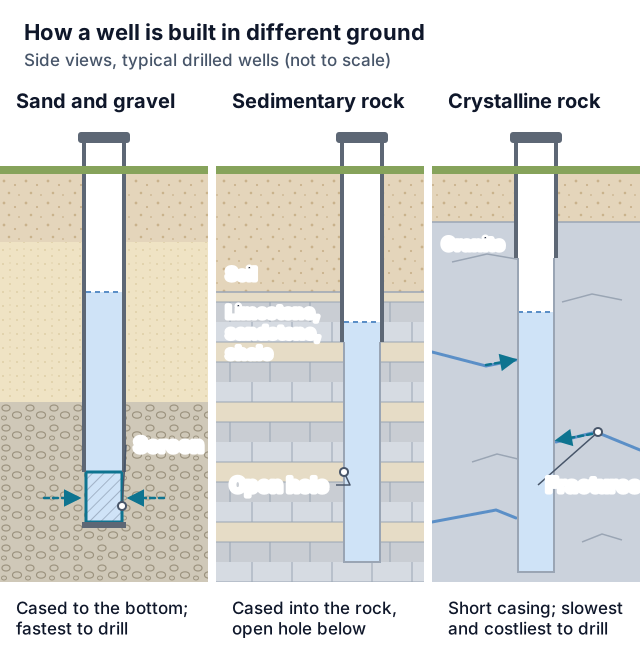
- About this site's calculator: it takes the depth you enter, multiplies it by a per-foot range tied to the formation you pick (sand and gravel, sedimentary rock, granite or other crystalline rock, or unknown), adds a generic permit allowance and, if left switched on, an installed pump and pressure tank. None of its inputs is specific to Kent County, so get written per-foot prices from drillers that state the casing length and grouting method.
Permits & Local Rules
- Applying: applications go on forms provided by the Health Officer (Section 9.1). The Health Officer must make a written decision within 30 days after receiving a completed application, and if the Health Officer fails to act in that period, the permit is considered issued subject to the terms of the application (Section 9.3). A site evaluation may be required before a permit issues, and a permit may carry limits or conditions the Health Officer deems necessary to protect public health or groundwater quality (Section 12.1). Where several similar wells are planned for one project, a single project permit may cover all of them (Section 8.0).
- Denial and revocation: an application may be denied in writing for incomplete, inaccurate or false information, or when the Health Officer determines the requirements cannot be met (Section 12.5). An issued permit may be revoked in writing for false, inaccurate or incomplete information from the holder, a change in the holder's plans affecting the supply's design, location or use, or new knowledge about the aquifer in the area that may result in a health hazard; no work may start or continue under a revoked permit (Section 12.4). To appeal a notice of violation, order, citation or decision, Section 20.1 requires a written petition to the Health Department for a hearing within 20 days of receiving it. Item 1052 of the attached appeals procedure calls for the request on the department's form, with a filing fee set by the Board of Commissioners, and explains the count: the day of receipt is left out, and when the last day is a Saturday, Sunday or legal holiday, the period runs until the end of the next Monday or non-holiday. Environmental Health can supply the current form and fee.
- Notices and inspection: the permit holder or well driller must tell the Health Officer at least one working day before construction of the water supply begins, and again within one working day after construction or pumping equipment installation is finished (Section 13.0). The Health Officer may inspect during or after construction (Section 14.0) and may issue a written stop work order for work that does not comply; work resumes only after the owner and/or contractor agree to the required corrections or other actions and the Health Officer rescinds the order (Section 16.0).
- Approval before use: Section 15.0 keeps a new water supply out of service until the Health Officer approves the construction and installation. That takes an on-site inspection by the Health Officer finding the supply in compliance with the regulations and permit, receipt of a completed "Water Well And Pump Record" prepared by the driller and/or pump installer, and lab results showing raw water quality meets minimum public health standards. The analysis tests for coliform bacteria plus whatever other parameters the Health Officer considers necessary, is done by laboratories certified by the Michigan Department of Public Health (the regulations' wording), and uses samples collected by the Health Officer or another person the Health Officer specifically approves.
- Disinfection under state rules: once the well has been thoroughly pumped to waste, the system is chlorinated, with each well drilling contractor or pump installer answerable for the part of it on which they performed work. Table 5 in R 325.1661(1) pairs each chlorine strength with a minimum contact period: 100 ppm needs 10 hours of contact, 250 ppm needs 4, 500 ppm needs 2 and 1,000 ppm needs 1. Nothing new, repaired or reconditioned may be put into service until all the chlorine is gone from the system and the sampling faucet has yielded at least one sample free of coliform organisms (R 325.1661(2)). Taking that sample is the water supply owner's job, though the owner may arrange for a designated representative to collect it, and the driller or pump installer is required to notify the owner of this duty (R 325.1661(3)). Samples drawn anywhere other than the sampling faucet do not oblige the driller or pump installer to disinfect again (R 325.1661(4)).
- Older and idle supplies: Section 18.1 lets a groundwater system that existed before the regulations took effect, and met state law when it was built, stay in service, subject to the rest of Section 18 and other laws, as long as it keeps performing satisfactorily, is not altered to include extensive repair, delivers water that meets quality standards, is not subject to contamination from improper installation, isolation or construction, and is not otherwise found to be a potential health hazard. A supply not used for more than one year may not be put back into operation, and a change in use that may significantly raise demand on the supply is not allowed, unless the supply is shown to be in substantial compliance with the regulations (Sections 18.2 and 18.3).
- Who may drill: MCL 333.12704(1) requires a yearly state certificate of registration, applied for on the department's form, before anyone goes into business drilling wells (registration as a well drilling contractor) or installing pumps (registration as a pump installer); dewatering well contractors and dewatering pump installers hold their own yearly registrations under subsection (2). Registered drillers may also install pumps and owe no separate pump installer fee for doing so (MCL 333.12704(3)), whereas a registered pump installer is barred from drilling (R 325.1608(2)). A certificate is not transferable and runs out on April 30, and a renewal made after July 1 costs the regular fee plus a surcharge of half the basic fee (MCL 333.12705(2)). According to EGLE's registration page, renewals are due March 1, and a contractor still unrenewed on May 1 must stop all drilling and pump installation until renewing. A new applicant is examined under the state rules and construction code, with the advisory board created under MCL 333.12711 determining and advising the department as to eligibility; when the applicant is a firm, partnership or corporation, at least one partner, officer or responsible full-time employee sits the examination on the company's behalf (MCL 333.12705(3)). There is also a reciprocal route: on application and payment of the prescribed fees, the department may register someone who holds a similar well drilling contractor or pump installer registration from another state or a foreign country, provided that registration's requirements do not conflict with Part 127, are of a standard no lower than the state rules and construction code, and Michigan registrants get equal reciprocal privileges there (MCL 333.12705(4)). EGLE can confirm which route applies.
- Checking the rig: under MCL 333.12706, both sides of a driller's well drilling machine must show, somewhere conspicuous, the registration number together with the county code number of the business location, in figures 2 inches tall or larger. Directly next to that number goes a seal from the department that shows the year the registration was issued or renewed and reads "Michigan registered water well drilling contractor." EGLE's water well construction page carries a link to a directory of registered contractors.
- Exceptions to registration: Sections 12701 to 12715 do not apply to a well, pump or other equipment used temporarily for dewatering during construction when the well is not more than 2 inches in diameter and not more than 25 feet in total depth below the natural ground surface, or is used in the relief of artesian pressure at hydroelectric projects, or is used with the drilling of oil or gas wells; nor to brine, test, storage or disposal wells regulated under Part 625 (mineral wells) of the natural resources and environmental protection act (MCL 333.12703(1)). A master plumber licensed under Act 266 of 1929 may do pump installer work without a pump installer registration (MCL 333.12703(3)). Governmental units such as counties, cities, villages and townships that drill wells or install pumps also register; they skip the fees only if the unit's own regular employees do the work using equipment the unit owns, on wells or pumps the unit intends to use itself (MCL 333.12704(4)).
- Building your own well: MCL 333.12703(2) does not stop someone from building a well or setting a pump on land they own or lease, provided the well is meant only for a single-family house they occupy as a permanent residence, or only for farming on their own farm, and the water it produces is meant neither for the public nor for anyone else's residence. Even then, the drilling record under MCL 333.12707 must be filed, and the rules and construction code still apply. Separately, R 325.1667 says a well drilled by someone other than the property owner, or by someone who is not a registered well drilling contractor, has to be plugged and abandoned following the rules. The county's Section 7.0 permit duty is worded "no person shall", so contact Environmental Health before starting an owner-built well.
- Local rules on top of state rules: R 325.1612(g) requires compliance with any local code that regulates wells or pumps and is not less restrictive than the state rules, and says a local board of health that finds stricter requirements necessary sets them and files a record of them with the director, with drillers in the affected counties notified in writing by the department or local health department at least 5 days before they take effect. Kent's Section 4.0 states that complying with the county regulations does not relieve anyone of other laws, naming Part 127 (MCL 333.12701 through 333.12715) and its rules, R 325.1601 through R 325.1676, among them.
- Isolation distances, nearest first: R 325.1622(1) begins by asking for a site that is not subject to contamination, picked using hydrogeologic data when they exist, upgradient of possible or known contamination sources where that can be done, and as far from such sources as is practical. Its floors then run as follows. Ten feet: surface water such as a lake, pond, river or stream; any sump, pit or unfilled space beneath the ground surface other than a crawl space; and a buried gravity-flow sewer with watertight joints, made of schedule 40 PVC, of ductile iron rated service weight or heavier, or of another material and joint type the director has accepted in writing. Fifty feet: a septic tank, a seepage pit, a cesspool, a dry well, a grease trap, an outhouse, a sewage pump chamber, a pressurized sewer, a subsurface disposal field, an animal or poultry yard, buried sewers other than the 10-foot kind, and wastewater handling or disposal units of any other sort, including any site where liquid wastes soak into the soil.
- Fifty feet also applies to storage tank systems regulated under Act 423 (underground or abovegrade, 1,100-gallon capacity or larger) that have secondary containment, and to tanks under 1,100 gallons storing motor fuel or heating fuel, if the use is noncommercial or the fuel is consumed on the premises where it is kept. One hundred fifty feet: areas used to prepare or store fertilizers, agricultural chemicals, or other chemicals capable of contaminating the soil or groundwater. Three hundred feet: oil and gas wells; facilities that process or store petroleum products; land application or subsurface injection of a municipal wastewater treatment facility's effluent or digested sludge; and that same class of Act 423 tank systems when secondary containment is not provided. Eight hundred feet: a landfill's active work area, and land where septage waste is applied to the surface.
- Changing a distance: R 325.1622(2) lets the responsible health officer move these floors up or down for an individual well through a deviation under R 325.1613, which must be in writing and give its reasons (R 325.1613(3)). Going closer is allowed only on a lot whose dimensions rule out the minimum, and then only if hydrogeologic data show groundwater at the source moving away from the well, or the well depth and casing grout depth the health officer specifies will give equivalent protection to groundwater and public health, or the new well replaces an existing water supply well on a site that has a habitable structure. Going farther can be required when local groundwater conditions, geology or other factors mean the minimum would not protect groundwater quality or public health. Next to a pressurized sewer the floor can drop to, but not below, 10 feet if the pipe and joints passed a post-installation pressure test of 100 psi or more and proved watertight, meet ASTM D 1785-91 or D 2241-89, and have walls at least as thick as schedule 40 or SDR 21. A hydrogeological study of the site may be required to back any of these deviations (R 325.1613(2)(b)). A well also stays 3 feet or more from a building, a pump room or anything projecting from one (R 325.1624(1)), and a deviation can shrink that only for a well replacing an abandoned one, on a property whose size and features leave no room for 3 feet, with access for maintenance kept (R 325.1613(2)(c)). Public supply wells are isolated under R 325.10101 et seq. instead (R 325.1622(3)), and keeping the distances on land the well owner owns is the owner's duty (R 325.1622(4)).
- Casing: steel permanent casing must measure 2 inches or more inside (R 325.1632(1)), with one exception: steel casing for a driven well point can be as narrow as 1 1/4 inches, though a driven well point needs the health officer's written approval before it may serve as a water supply well (R 325.1632a). PVC permanent casing must be 5 inches or more inside unless it is liner pipe, and it is set in an oversized borehole, never driven (R 325.1632(2)). The casing has to reach 25 feet or deeper below grade and stand 12 inches or more above it; a well with under 26 feet of casing may be used only with written approval from the health officer, given under R 325.1613 (R 325.1632(3)). Approval for casing shallower than 25 feet is limited to two cases: the well will serve neither habitable structures nor human consumption, carries clear and permanent identification as not suitable for drinking or body contact, and is separate from every potable system on the premises; or a well where there is reason to believe potable water in suitable quantity does not exist at a reasonable depth of more than 25 feet, and either the isolation distance is increased or a confining layer sits over the aquifer the shallow well will draw from (R 325.1613(2)(d)-(e)). For paved ground not subject to flooding, the health officer may sign off in writing on a casing that ends just 2 inches or more above grade (R 325.1632(6)), provided every connection and opening is threaded or welded and watertight and the casing is acceptably vented.
- Grouting: when rotary, auger or another drilling method leaves the permanent casing in an oversized hole, the full casing length gets neat cement or bentonite grout in the annulus, or, if a screen is installed, starting 10 feet or less above the screen top and running to the surface (R 325.1634a(1)). A shorter grouted length is possible by deviation only for wells deeper than 100 feet that pass through no confining layer (R 325.1613(2)(f), applied through R 325.1634a(2)). Grout goes in by way of the permanent casing or a grout pipe, filling the annulus from its bottom to the surface in a single uninterrupted operation, and grout emerging at the surface must be as dense as the grout entering (R 325.1633a(2)). Driven-casing wells aside, the borehole diameter exceeds the nominal casing size by at least 2 inches, or by at least 2-7/8 inches when grout goes down a pipe outside the casing (R 325.1633a(3)-(4)). If temporary casing was used, the gap around the permanent casing is grouted while the temporary casing is withdrawn, in one of two ways: neat cement or bentonite grout is pumped in, or bentonite in chip, pellet or granular form is poured in, except that granular bentonite may never go into a gap containing water or drilling fluid (R 325.1633a(5)). Driven-casing wells have their own grouting rule, R 325.1635. If bedrock shows up within 25 feet of the surface, the driller must make an oversized borehole and grout the permanent casing with neat cement to a depth of no less than 25 feet (R 325.1637(1)), and casing deeper than 25 feet may be required where nonpotable water is or may be present in the upper bedrock (R 325.1613(2)(g)).
- Logs and pump records: the well drilling contractor has 60 days from completing a well to deliver the log: the owner receives 1 copy, while 2 go to the department or local health department (MCL 333.12707; R 325.1675(1)). It must show who owns the well, where it is, how deep it goes, which geologic materials were drilled through and how thick each was, how much casing went in, the static water level readings, and whatever else the rules and construction code require. Standard forms come from the department, and a contractor may use its own forms once the department approves them; a drive point well where no earth materials come out of the bore needs a record listing only owner name, well location, depth, casing, screen data and static water level (MCL 333.12707). Under R 325.1675(4), a registered well drilling contractor signs every log. On site, the contractor writes down material types and thicknesses as drilling proceeds, and that record must be available for inspection; a log still missing 60 days after completion, or a site record not kept, may prompt the department or health officer to call for geophysical logging that checks the materials penetrated and their thicknesses (R 325.1675(2), (5)). Pumps set on new wells have a separate record due 60 days after the pump installation is finished, signed by a registered driller or registered pump installer, giving the kind of pump, its capacity in gallons per minute, how long the drop pipe is, the motor's horsepower, and the model number and manufacturer's name (R 325.1676).
- Who plugs: R 325.1662(1) allows the owner, or a well drilling contractor registered under the act, to plug an abandoned well or dry hole, but if the property also has a well that supplies the public or any residence besides the owner's, only a registered contractor may plug it. Before plugging, pumps, drop pipe, packers and other equipment, debris or obstructions are pulled if possible, and a well left unused when municipal water comes in must be plugged by these rules (R 325.1662(2)-(3)). Materials (R 325.1663): for a well or dry hole that ends in overburden, any of neat cement, concrete grout, bentonite grout, bentonite chips or bentonite pellets; for any part in bedrock, concrete grout or neat cement filling it upward from the bottom to 20 feet or more above the bedrock top, or to the surface, with the remainder above done as for overburden; through lost circulation zones (gravel, or cavernous, creviced or fractured bedrock), gravel, sand, stone aggregate or other material the department accepts may fill that portion; and neat cement or concrete grout to stop the flow of a flowing well or to seal a well that discharges subterranean gases. Placement (R 325.1664): chips and pellets go in slowly from the top to avoid bridging, never using the fine bentonite particles that build up in the shipping container, and pouring continues until they show at the surface, after which water is put into the casing or borehole so the bentonite above the static water level expands; neat cement, concrete grout and bentonite grout are placed by tremie pipe from the bottom to the surface; and substitute materials or methods need a health officer's approval in advance, given only where they will stop the well or hole from serving as a pathway for contamination or as an escape route for subterranean gases. R 325.1665 offers an alternative for large-diameter dug and crock wells.
- After plugging: the person who plugged the well has 60 days to give the department or local health department a report in duplicate stating the owner's name and the well's location, depth and diameter, plus the procedure followed, the material used and its quantity. When a replacement well is planned or already drilled, those details can be entered on its log instead, and multiple abandoned wells or dry holes within one parcel whose geology and plugging methods are alike can be reported together on a single form (R 325.1675(3)). The well owner bears responsibility for plugging, except where the owner's written contract with a registered driller provides otherwise, and a registered contractor found by the health officer or department to have improperly located or built a well bears the plugging (R 325.1669).
Geology & Water Table Notes
- Depth: this page quotes no typical well depth for Kent County, since none of the publications cited here prints one for the county. EGLE says Michigan contractors have filed water well, pump and plugging records electronically through Wellogic since 2000; its more than a million records are viewable by the public, searchable by 22 fields without an account, and EGLE offers county downloads that include lithology. Logs of wells near a parcel show what drillers found there and how deep they finished.
- North Kent PFAS investigation: the state's MPART page for the House Street Disposal Area (content updated September 2025) describes the area as a former licensed disposal facility owned and operated by Wolverine World Wide on House Street in Plainfield Township, a suspected disposal area north of 10 Mile Road in Algoma Township, and EGLE investigations of several citizen-reported unregulated dump sites across three townships in northern Kent County. A consent decree among the State, Plainfield and Algoma townships and Wolverine took effect on February 19, 2020, and frames Wolverine's response work, under EGLE oversight, in what the page calls the North Kent Study Area.
- Study area wells: the page directs residents to EGLE's North Kent Study Area data summary map for residential well sampling results and for the extent of the municipal water hookups the consent decree required, and says Wolverine will continue operating and maintaining whole-house and point-of-use filters in the study area under the decree. Those statements concern that study area only.
- Contamination checks at permit time: the Health Department's Permits & Evaluations page notes that knowledge of contamination in soils or groundwater near or on a property may factor into its public health decisions when evaluating or issuing a permit, and refers residents to EGLE's RIDE Mapper to see how close a property is to potential sources of contamination.
- Testing: according to MDHHS, private residential well owners are responsible for testing and are required to test when the well is constructed. Its suggested schedule: every year, coliform bacteria with E. coli, plus nitrate and nitrite; every 3 to 5 years, arsenic and lead; at least once, PFAS. MDHHS also suggests testing during a pregnancy in the household, when there is an infant or young child in the household, after flooding near the well, after repairs to it, and whenever the water tastes, looks or smells different.
Communities Served
Rockford · Cedar Springs · Lowell · Sparta · Kent City · Sand Lake · Caledonia · Byron Center · Ada Township · Cannon Township · Algoma Township · Plainfield Charter Township
Emergency Response Expectations
Section 17.0 of the county regulations covers urgent jobs. When the Kent County Health Department is closed and going without water would cause undue hardship, or when a driller on a repair job finds a new well has to be started right away, a registered well driller may start building a new water supply, or start extensive changes to one, with no advance notice and no permit. On the next regular working day the driller has to get in touch with the Health Officer to obtain the permit, and the Health Officer has discretion to waive the Section 10.0 late application penalty in these cases. This site forwards requests to independent providers and does not set or promise any response time.
Kent County FAQs
Who issues well permits in Kent County, and what do they cost?
The Kent County Health Department's Environmental Health Division, using its residential well and septic application (non-residential projects have their own form). The application lists fees by type of well work, but it shows no effective date, so confirm the current fee with the department when you apply.
How long does the Health Department have to decide on a permit?
Section 9.3 gives the Health Officer 30 days after receiving a completed application to make a written decision. If the Health Officer fails to act within that time, the permit is considered issued subject to the terms of the application.
When does a Kent County well permit expire?
Two years after it is issued, unless construction has started or a construction contract has been entered into by then (Section 12.2). If you ask the Health Officer in writing before the permit expires, it may be extended one time only, for one additional year, at no extra charge.
Can a well be started before the permit is issued?
Only in the Section 17.0 situations described in the emergency note, and the registered driller then has to reach the Health Officer for a permit on the next regular working day. Work started without a permit draws the Section 10.0 penalty, equal to the normal fee and charged on top of it, which the Health Officer may waive in Section 17.0 cases; Section 11.0 also lets the Health Officer require proper abandonment of a well built without a permit.
When can we start using a new well?
Once the Health Officer approves it under Section 15.0, after an on-site inspection, receipt of the completed well and pump record, and certified-lab results covering coliform bacteria plus any other parameters the Health Officer asks for, from samples taken by the Health Officer or a person the Health Officer approves.
How do I find out whether my well was sampled in the North Kent PFAS study?
Open EGLE's North Kent Study Area data summary map from the MPART House Street Disposal Area page. It shows residential well sampling results and the municipal water hookups required under the 2020 consent decree.
Can a homeowner drill their own well in Kent County?
State law allows it only on land you own or lease, for a well serving nothing but the single-family home you live in permanently, or solely for farming your own farm, with no water going to the public or to another residence (MCL 333.12703(2)). The 12707 drilling record and the construction code still apply to you, and Environmental Health should be contacted about the county permit first.
Who may plug our old well when city water arrives?
Either you or a registered driller, under R 325.1662(1). The exception is a property where some well supplies the public or another household; that job needs a registered contractor. Whoever does the plugging sends the plugging report, in two copies, to the department or the local health department within 60 days.
Sources
- Kent County Health Department: Permits & Evaluations (well and septic permits, regulations, application)
- Kent County Health Department: Water Supply Regulations for Kent County (as amended 2002, Resolution 3-28-02-34)
- Kent County Health Department: Residential well and septic application
- Michigan Legislature: Public Health Code Part 127, MCL 333.12701 to 333.12715 (PDF)
- Michigan Administrative Code: R 325.1601 to R 325.1781, Water Well Construction and Pump Installation Code (PDF)
- EGLE: Water well construction
- EGLE: Water well contractor registration
- EGLE: Wellogic
- MPART: House Street Disposal Area (Belmont, Kent County)
- MDHHS: Drinking water testing
- U.S. Census Bureau: 2020 place-by-county codes, Michigan
- U.S. Census Bureau: 2020 county subdivision codes, Michigan
- U.S. Census Bureau TIGERweb: current county subdivisions, Kent County, MI
Last reviewed 2026-10-30
Nearby Counties
Services Available in Kent County
Well Drilling
New residential wells — find local drillers for site evaluation, depth estimates, and written drilling quotes.
Learn more →Water Well Drilling
Household water wells from site evaluation through casing, pump, and water test — written quotes from local drillers.
Learn more →Well Pump Repair
No water at the tap? Request urgent well pump repair — local pros diagnose pressure loss, dead pumps, and pressure tank failures fast.
Learn more →Well Pump Replacement
Pump at end of life or beyond repair? Get quotes for correctly-sized submersible and jet pump replacement from local well pros.
Learn more →Well Inspection & Testing
Buying a home with a well, or overdue for a water test? Local pros for flow tests, equipment inspection, and lab water-quality testing.
Learn more →Well Water Service
Water quality problems, treatment systems, and general well maintenance — connect with local pros for everything between drilling and pump work.
Learn more →Free Tools Before You Call
Ballpark the cost or narrow down the problem before talking to a Kent County provider.
Well Drilling Cost Calculator
Estimate what drilling a well should cost — by depth, geology, and whether you need the pump and pressure tank included.
Use the free tool →No Water From Your Well? Diagnostic Wizard
Suddenly no water in the house? Answer a few questions to find out if it's the breaker, the pressure switch, the tank, the pump — or the well itself.
Use the free tool →Well Pump Size Calculator
Find what size well pump you need — GPM demand, total dynamic head, and a horsepower recommendation from four quick inputs.
Use the free tool →Need help in Kent County, MI?
Send the short form — urgent requests get priority routing.