Well Drilling in Pend Oreille County, WA
Well drilling typically runs $3,000–$16,000 nationally, per our cost guide. Independent local pros serving Newport, Cusick, Ione and nearby communities. Describe the problem and we'll route your request — free, no obligation.
- Mark no-water pump problems as emergencies on the form
- County pages on local well depths, aquifers, and permits
- Well inspections, water testing, and treatment
- Free to use — no obligation, no markup
Fast response from independent local providers. No obligation.
Typical national cost$3,000 – $16,000Cost guide →Local Help in Pend Oreille County, WA
Two watersheds split Pend Oreille County. Ecology's June 2023 sheet for WRIA 62, the area in Washington that drains to the Pend Oreille River, says it covers most of the county; its sheet for WRIA 55, the Little Spokane watershed, puts lower Pend Oreille County in that basin, where new household wells carry extra limits under the 2018 streamflow restoration law.
The Washington Department of Ecology regulates the well itself through chapter 173-160 WAC (construction) and chapter 173-162 WAC (operator licensing). The Northeast Tri County Health District (NETCHD) serves Ferry, Pend Oreille and Stevens counties; it regulates Group B water systems, evaluates proposed sites for new public drinking water wells and gives owners of private water systems technical help on drinking water safety. We pass Pend Oreille County requests to independent licensed contractors and do not drill wells ourselves.
Pend Oreille County Service Details
What providers in this area actually see: coverage, common jobs, local pricing factors, and rules worth knowing.
Service Area Notes
- We take requests from the whole county. Washington's 2020 place-by-county list from the Census Bureau shows five incorporated places in Pend Oreille County, the city of Newport and the towns of Cusick, Ione, Metaline and Metaline Falls, and no census-designated places.
- Ecology's wells page assigns Pend Oreille County to its Eastern region. The county is not on Ecology's list of delegated county and health district contacts for inspecting well construction and decommissioning work (revised July 23, 2025).
- Ecology asks owners to check with their local permitting agency before filing a notice of intent, since some areas may require additional fees or connection to a public water supplier.
Common Jobs in Pend Oreille County
- Household wells under the groundwater permit exemption, with Ecology holding the notice and fee 72 hours or more before work starts
- Pump replacement and well cleaning or sanitation, none of which WAC 173-160-111 treats as a well alteration
- Deepening or hydrofracturing an existing well, both counted as alteration under that same definition
- Sampling for coliform bacteria, nitrate, arsenic and uranium
- Wells for new or expanding Group B systems, after NETCHD's well site evaluation
- Decommissioning unused, unusable or hazardous wells, which Ecology says must be done by a licensed driller
What Drives Pricing Here
- State fees under RCW 18.104.055 and WAC 173-160-151 (in its current form since January 19, 2009), due with the notice of intent: a water well whose top casing is narrower than 12 inches costs $200, one 12 inches or wider costs $300 (dewatering wells are priced separately), and decommissioning a water well costs $50. Subsection (5) charges every unusable hole a decommissioning notice and fee of its own and sets when a follow-up attempt needs no new construction notice.
- Little Spokane basin surcharge: Ecology lists a $500 fee on new building permits tied to new household permit-exempt wells in WRIA 55, collected by the permitting authority and spent in that watershed on projects that offset household wells' effects on streams and fish.
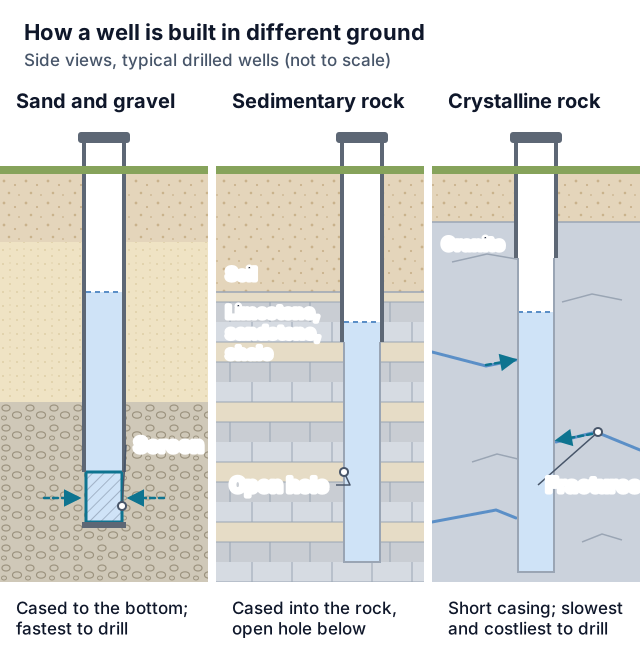
- Bedrock versus sediment: the WRIA 62 sheet says groundwater availability and yield from bedrock in that watershed is very limited by climate and geology, and a USGS study of the Little Spokane basin says its bedrock unit is the only available groundwater source where overlying sediments are absent or insufficiently saturated.
- We found no USGS or Ecology report that prints a typical well depth for the county. Well reports record each well's depth, and Ecology's State Well Report Viewer finds reports for wells near a lot.
- Our calculator prices unknown geology at $25 to $65 a foot of depth, plus placeholders for a permit ($200 to $500), pump ($900 to $2,500) and pressure tank ($400 to $1,500); it is a planning number, not a bid or Ecology's fee schedule.
Permits & Local Rules
- Who may drill: Ecology licenses well operators, and RCW 18.104.030(6) makes it unlawful to contract for well construction or work as an operator without that license unless RCW 18.104.180 applies. Its exemptions are (1) a person drilling personally, for personal farm or single-family residential use only, on owned or leased land or land held as a contract purchaser, limited to one well in any two-year span and bound by all other rules, among them the construction standards, fee and notice; (2) helpers doing labor for a well contractor under the direction, supervision and control of a licensed operator who is at the site, with trainees excluded and direct supervision required by WAC 173-162-050; and (3) holders of chapter 18.08 or 18.43 RCW licenses doing work those licenses cover, a group ORIA says means Washington-registered engineers, architects and land surveyors who are on site and follow the state's construction and decommissioning rules. Per ORIA, decommissioning falls outside the owner exemption.
- Start notice: at least 72 hours ahead of drilling or decommissioning, Ecology must receive a notice of intent on its form from the property owner, the owner's agent or the well operator, with the items WAC 173-160-151(2) lists and a copy of the water right permit or certificate whenever the withdrawal requires one. Ecology's wells page says filing it is not a permit, certificate, claim or water right application and does not approve using water from the well.
- Exempt uses, RCW 90.44.050: four groundwater uses skip the water right permit: watering stock; watering a lawn or noncommercial garden no bigger than half an acre; single or group domestic use of 5,000 gallons a day or less; and industrial use of 5,000 gallons a day or less (RCW 90.44.052 holds a separate pilot for Whitman County only). Ecology lets a project claim one exempt use of each type, totals the water from all of its wells, and reads 5,000 gallons as a cap on every day of use rather than an average. Its May 2025 focus sheet (publication 19-11-090) says a group domestic system can serve up to 14 homes under the exemption, while one serving 15 or more connections is a municipal use that the exemption does not cover and that needs an Ecology permit. A well outside these uses cannot be drilled until the owner holds an Ecology water right permit (WAC 173-160-121).
- WRIA 55 limits: Ecology says new permit-exempt domestic wells in the Little Spokane watershed may use 3,000 gallons a day as a maximum annual average and carry a $500 fee on the new building permit. Its WRIA 55 sheet leaves wells drilled before January 19, 2018 under RCW 90.44.050 alone, keeps the 5,000-gallon ceiling on any single day, counts lawn and garden watering (still one-half acre at most) inside the average, and holds each house in a subdivision to the 3,000-gallon average while the whole project stays within 5,000 gallons a day. RCW 90.94.020 has the permitting city or county record these limits on the property title.
- WRIA 62 limits: Ecology's sheet lists Surface Water Source Limitations on most sources and closures on Davis, Harvey, Indian, Maitlen and Skookum creeks and parts of Bracket Creek and the East Fork of Small Creek. It warns the permit exemption may not be available in areas closed to further appropriation and refers those questions to Ecology's regional office.
- Siting, WAC 173-160-171: the site must not pond water or lie in a floodway (chapter 86.16 RCW sets the exception), and the well needs protection from a 100-year flood and from drainage that could impair the water. Minimum distances for a well that will not serve a public system: any building or projection, 5 feet, with no well inside a garage, barn, storage building or dwelling; a septic tank, holding tank, containment vessel, pump chamber or distribution box, 50 feet; building sewers, public sewers and collection or nonperforated distribution lines (building drains excepted), 50 feet; a drainfield edge, approved proposed drainfield or reserve area, 100 feet; any other contamination source except a solid waste landfill, 100 feet; a solid waste landfill, 1,000 feet, subject to the rule's variance.
- Construction: WAC 173-160-231 needs a surface seal reaching at least 18 feet below land surface, with smaller minimums for driven, jetted, dewatering and certain dug wells set in their own sections; WAC 173-160-241(3) gives two sealing procedures for wells in or under consolidated rock; and under WAC 173-160-291 the casing must stand 6 inches or more above the ground, or 2 feet or more above the estimated 100-year flood level on sites subject to flooding, with pit completion prohibited.
- Records: WAC 173-160-141 gives whoever builds or decommissions a well 30 days from completion, or from the day the drilling equipment leaves the site, to send Ecology a complete report with the contents and signatures it lists, and WAC 173-160-311 has the operator tag each well it constructs, alters or reconstructs within 30 days of completion.
- Decommissioning, WAC 173-160-381: a well must be decommissioned once it is unusable or abandoned, its use has permanently stopped, its disrepair makes continued use impractical, or it poses an environmental, safety or public health hazard, and the procedure must be recorded and reported as Ecology requires. The step-by-step methods, materials and placement conditions for cased, uncased, dug and flowing artesian wells are in the rule itself, and the licensed driller follows them; Ecology tells owners they cannot legally decommission a well themselves.
- Shared wells: NETCHD regulates Group B systems (3 to 14 service connections, within the population limits its Group B page sets) and lists a well site evaluation as the first step for a new or expanding one; its Group B page explains who reviews the design at each size. WAC 173-160-171 requires final site approval from the Department of Health or the local health jurisdiction before any public supply well is built.
Geology & Water Table Notes
- Surface geology: in the USGS State Geologic Map Compilation, undivided Pleistocene glacial drift covers 31 percent of the county's surface, Mesozoic granitic rocks 25 percent, undivided Precambrian rocks 17 percent, Cambrian phyllite 6 percent and Holocene alluvium 4 percent.
- Little Spokane basin aquifers: USGS Scientific Investigations Report 2013-5124 describes groundwater in unconsolidated sediments and isolated basalt remnants over crystalline bedrock; its Upper aquifer, mostly sand and gravel, runs 4 to 360 feet thick with an average of 70 feet and is generally finer grained farther from the main outwash channels.
- Precipitation: Ecology's WRIA 62 sheet gives a range from 26 inches a year in Newport to more than 55 inches in the higher mountains, with most of it falling in winter and summer stream flows depending on groundwater inflow.
- Uranium: NETCHD says uranium is especially common throughout Ferry, Stevens and Pend Oreille counties because of the area's geology. USGS Scientific Investigations Map 3401 associates naturally occurring uranium in northeastern Washington with granitic and metasedimentary rocks and younger sedimentary deposits; in 2017 it found uranium in all 13 private wells it sampled, 6 of them above the 30 micrograms-per-liter limit EPA sets for Group A community systems.
- Testing schedule: NETCHD advises testing every year for coliform bacteria and nitrate, a retest in six months when nitrate comes back at 5 mg/L or above, testing arsenic once in summer and once in winter, and including uranium every three to five years, ideally between April and September. The state Department of Health gives the same yearly coliform and nitrate advice.
Communities Served
Newport · Cusick · Ione · Metaline · Metaline Falls
Emergency Response Expectations
In an emergency, a public health emergency or exceptional instances, WAC 173-160-151(3) lets Ecology accept a verbal notice at the appropriate regional office, followed within 24 hours by the notice of intent and fee; the rule names a failing well, or water quality issues that could raise a public health or safety concern, as examples. We can relay an urgent request but cannot promise an arrival time.
Pend Oreille County FAQs
When does NETCHD do a well site evaluation?
NETCHD's FAQ says WAC 246-290 and 246-291 require one in source approval for a new or previously unapproved public water system source (and WAC 246-290 for bottled water or ice plant wells). Individual owners usually request one for loan certification or help with a problem; for loans it fits lots with no existing well or a planned new one, and lots with a well in place should ask for an Operational Survey.
Should my well water be tested for uranium?
NETCHD strongly recommends it for individual wells, repeated every three to five years and best done in summer, alongside the yearly coliform and nitrate tests.
Can an owner drill a well in Pend Oreille County without a license?
Possibly, under RCW 18.104.180(1): you do the work yourself, the land is yours by ownership, lease or contract purchase, the well serves only your farm or single-family home, you build no more than one well per two years, and every other requirement, such as the standards, fee and notice, still applies. ORIA says the exemption does not cover sealing an old well.
The river flooded my well. What now?
NETCHD advises using another drinking water source until the well has been disinfected and tested safe, and warns that wells close to the river can be contaminated by floodwater moving underground, not only wells the water flowed over.
Sources
- RCW 18.104: Water Well Construction Act
- WAC 173-160: Well construction standards
- WAC 173-162: Operator licensing
- RCW 90.44.050: Groundwater permit exemption
- RCW 90.94: Streamflow restoration
- Ecology: Wells
- Ecology: Abandoned wells
- Ecology: Delegation reports and contacts
- Ecology: Groundwater permit exemption
- Ecology: Streamflow restoration planning
- Ecology 20-11-062: WRIA 62 water availability
- Ecology 20-11-055: WRIA 55 water availability
- Ecology 19-11-090: Permit-exempt wells
- Ecology: State Well Report Viewer
- ORIA permit handbook: Well operator license
- NETCHD: Drinking water and wells
- NETCHD: Group B water systems
- NETCHD: Well site evaluation FAQ
- NETCHD: Water testing
- NETCHD: Well water testing guidance
- NETCHD: Flood sanitation
- Washington DOH: Testing your water
- USGS SIR 2013-5124: Little Spokane hydrogeology
- USGS SIM 3401: Uranium in groundwater
- USGS geologic units in Pend Oreille County
- Census 2020 places by county, Washington
Last reviewed 2026-10-27
Nearby Counties
Services Available in Pend Oreille County
Well Drilling
New residential wells — find local drillers for site evaluation, depth estimates, and written drilling quotes.
Learn more →Water Well Drilling
Household water wells from site evaluation through casing, pump, and water test — written quotes from local drillers.
Learn more →Well Pump Repair
No water at the tap? Request urgent well pump repair — local pros diagnose pressure loss, dead pumps, and pressure tank failures fast.
Learn more →Well Pump Replacement
Pump at end of life or beyond repair? Get quotes for correctly-sized submersible and jet pump replacement from local well pros.
Learn more →Well Inspection & Testing
Buying a home with a well, or overdue for a water test? Local pros for flow tests, equipment inspection, and lab water-quality testing.
Learn more →Well Water Service
Water quality problems, treatment systems, and general well maintenance — connect with local pros for everything between drilling and pump work.
Learn more →Free Tools Before You Call
Ballpark the cost or narrow down the problem before talking to a Pend Oreille County provider.
Well Drilling Cost Calculator
Estimate what drilling a well should cost — by depth, geology, and whether you need the pump and pressure tank included.
Use the free tool →No Water From Your Well? Diagnostic Wizard
Suddenly no water in the house? Answer a few questions to find out if it's the breaker, the pressure switch, the tank, the pump — or the well itself.
Use the free tool →Well Pump Size Calculator
Find what size well pump you need — GPM demand, total dynamic head, and a horsepower recommendation from four quick inputs.
Use the free tool →Need help in Pend Oreille County, WA?
Send the short form — urgent requests get priority routing.