Well Drilling in Hillsborough County, NH
Well drilling typically runs $3,000–$16,000 nationally, per our cost guide. Independent local pros serving Amherst, Hollis, Brookline and nearby communities. Describe the problem and we'll route your request — free, no obligation.
- Mark no-water pump problems as emergencies on the form
- County pages on local well depths, aquifers, and permits
- Well inspections, water testing, and treatment
- Free to use — no obligation, no markup
Fast response from independent local providers. No obligation.
Typical national cost$3,000 – $16,000Cost guide →Local Help in Hillsborough County, NH
NHDES estimates that nearly half of New Hampshire residents get their water from a private well, and its Be Well Informed guide counts over 500,000 people who rely solely on domestic wells. Around Nashua, the aquifers are described in a 1987 USGS report on the Nashua Regional Planning Commission area (Water-Resources Investigations Report 86-4358, by Kenneth W. Toppin). It found 129 square miles of stratified drift, 40 percent of that 12-community area, forming the most productive aquifers wherever it is sufficiently saturated and permeable, and it noted that typical private bedrock wells there yield only a few gallons per minute.
Statewide law sets the construction standards. The Water Well Board dates to 1984 and RSA 482-B, which charges it with licensing well contractors and pump installers and with receiving a record of every new well; its rules, We 100-1000, cover building wells, installing pumps, sealing old wells and filing reports, and NHDES gives March 1, 2017 as their last revision. The Board's 2026 meeting list on the NHDES site includes a run of rule-update sessions, so check the current text before relying on any detail below, and ask the town where the lot sits whether it has a local requirement of its own. This site passes requests on to independent contractors and does no drilling or pump work itself.
Hillsborough County Service Details
What providers in this area actually see: coverage, common jobs, local pricing factors, and rules worth knowing.
Service Area Notes
- Place names here follow the Census Bureau's 2020 county subdivision list for Hillsborough County, which agrees with its current TIGERweb layer: Manchester and Nashua are cities, and every other subdivision, including each name listed under Communities Served, is a town.
- Historical water service: the 1987 USGS report listed Amherst, Hollis, Hudson, Litchfield, Merrimack, Milford, Nashua and Pelham as communities with public-supply wells in stratified drift, said Nashua and Wilton depended mainly on surface water for municipal supply, and said Brookline, Lyndeborough and Mont Vernon had no municipal systems and were served by privately owned dug, driven or drilled wells. That is a mid-1980s snapshot, so check present-day service with the town or water utility.
- Finding a past well record: NHDES says its well inventory was started in 1984 together with RSA 482-B, now has over 135,000 public records on NHDES OneStop, and does not include wells put in before 1984; the New Hampshire Geological Survey, as data steward, handles data entry and quality control. Because a mapped record may not pin-point the well on a given lot, NHDES suggests a Subsurface (Septic) Systems Bureau file review of the site plan, which shows where the well was approved.
- Checking a contractor: NHDES runs a OneStop lookup of licensed well and pump contractors, which its construction FAQ says can be searched by company, by area or by kind of license.
Common Jobs in Hillsborough County
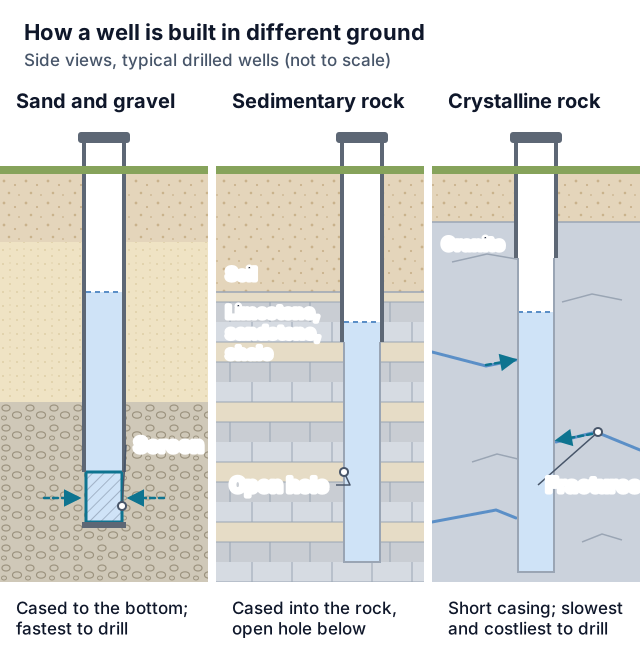
- Drilled bedrock wells with casing seated into competent rock (We 602.22)
- Gravel wells drilled or washed into sand and gravel and finished with open-end casing, a well screen, a gravel pack or perforated casing (We 602.25)
- Replacing a dug well in till; the 1987 USGS report says such wells can usually meet household needs but can be much less reliable in dry seasons
- Submersible pump, pitless adaptor and pressure tank installs under We 702
- Chlorinating a new well, or an existing well when its pump goes in or back in
- PFAS, arsenic and standard water testing following NHDES guidance
- Sealing a replaced or abandoned well (We 604)
What Drives Pricing Here
- Depth and yield: no typical local depth is quoted here. NHDES's construction FAQ points owners to its Well Completion Report Query, which holds the depth and yield of new wells reported since 1984. A 2002 USGS statewide bedrock study (Professional Paper 1660) drew on those reports, noting that NHDES had accurately located more than 20,000 wells reported since 1984 and that well yields in that database ran from zero to more than 500 gallons per minute.
- Fractures and fault zones: the 1987 report says water in the area's bedrock comes mainly from fractures and cracks, whose number and size tend to decrease with depth, and that the largest stored quantities are usually found in fault zones. It cites bedrock well MKW-147, on the Naticook fault zone in Merrimack, with a reported yield of more than 100 gallons per minute, and it left the extent and expected yields of those zones outside the study's scope.
- Casing in rock: a bedrock well gets no less than 20 feet of casing, installed so that at least 10 feet of it sits in competent bedrock (further if the casing and drive shoe need a deeper seat), and placed so that neither groundwater nor contaminants can get in at its foot or along its length (We 602.22). When bedrock is drilled by air rotary, water must be injected continuously at a rate sufficient to clean the well and prevent dust.
- Gravel wells: in sand and gravel, We 602.25 has the casing stand 8 inches or more above grade (higher in flood-prone areas, enough to keep surface water out, and 18 inches on a public water system well), capped with a sealed cover and grouted outside under We 602.05. For a gravel well, that section starts the grout 5 feet below the pitless adapter and carries it deep enough, by the well's design, that surface water cannot run down along the casing; the allowed grouts are neat cement, cement-sand, high-solids bentonite, and cement-bentonite holding 5 percent bentonite at most. Excavated wells and driven or drive-and-wash wells are outside We 602.05.
- Pump system: We 702.05 requires at least two check valves on a submersible installation, underground service pipe rated for a working pressure of at least 160 psi, a pitless adaptor on domestic wells with a casing inside diameter of 4 to 12 inches, and a supply line buried at least 4 feet deep, or shallower with added freeze protection where bedrock or ledge rules out 4 feet. Wells 6 inches or wider need a torque arrestor on a submersible pump unless the pump hangs on steel pipe or the well has a caving condition; when caving is the reason, double-jacketed wire or wire sleeved from the pump to the pitless adapter is used instead. We 702.04 runs the well wire in conduit from the well to the inside of the foundation wall. We 700 does not apply to pumps installed temporarily to take water samples, test yield or develop yield.
- About this site's estimate: the calculator takes your depth, prices each foot at a band tied to the ground type selected, and adds a catch-all permit line marked as varying by county, plus pump and pressure tank lines unless you switch them off. Those numbers are national, from Angi, HomeGuide and HomeAdvisor, so they are neither Hillsborough County bids nor any New Hampshire fee; the Board's fee rule is summarized in the FAQ.
Permits & Local Rules
- Licenses: RSA 482-B:5 makes an annual license a condition of doing business in well construction or pump installation; a license cannot pass to someone else and lapses each June 30. We 302.01 ties a contractor license to building supply, observation, geothermal (open or closed loop) and construction-dewatering wells over 20 feet deep and to technical drilling, and, subject to We 302.02, ties a pump installer license to putting in new or replacement pumps, running pumping tests, and maintaining or repairing pump systems already in service. Licenses are issued to a corporation or other business entity in conjunction with a named qualified individual (We 302.03(a)), and We 302.03(b) says the employees of a licensed contractor or pump installer need no license of their own.
- Work that needs no license: We 302.02 exempts wells of 20 feet or less that temporarily dewater a construction site and the pumps doing that dewatering, as well as exploratory excavations into foundation conditions for a structure. A licensed plumber (practicing plumbing under RSA 153:27, XIV) or licensed electrician (making electrical installations under RSA 319-C:2, III) may maintain and repair existing pump systems. Pumping tests on new wells may use a temporary pump put in by a water distribution system operator licensed in New Hampshire under RSA 332-E or by a professional engineer or geologist licensed in New Hampshire under RSA 310-A, after which only a licensed pump installer may do the final installation. RSA 482-B:17 then carves out two more cases, provided the work conforms to Board rules: an owner, or the owner's agent, repairing or replacing a pump installation on land the owner owns, and anyone who regularly employs a maintenance person whose job includes replacing and maintaining the pump installations on the employer's property, while that employee is doing that work.
- Drilling your own well: RSA 482-B:12 says nothing in the chapter prevents you from building a well on property you own or lease when the well is meant solely for noncommercial farming, or one whose water will serve neither the public nor anyone living anywhere other than your own permanent residence. You still owe the Board the RSA 482-B:10 well record and must follow any applicable rules, and We 801.03(h) lets the owner of such a well sign the completion report.
- Getting licensed: the experience, examination, reciprocity and continuing-education terms are in RSA 482-B:5 III to V and in We 302.05, We 304, We 305 and We 402; among them, RSA 482-B:5 III asks a drilling contractor for one year of experience drilling water wells in crystalline rocks of the Appalachian Region, within the 3 years in the trade the statute requires. The Board decides each applicant's eligibility for the exam and license, according to NHDES.
- Lots on public water: We 602.19 does not allow a private well on a lot served by a public water system if the requirements of RSA 485-A:30-b cannot be met or if the well would breach a subdivision approval under RSA 485-A:29. When both are satisfied, We 602.19(b), citing RSA 362:4, IV and V, says no property owner shall be required to connect to the public system. The bar in paragraph (a) does not apply to closed loop geothermal wells.
- Septic distances: We 602.07 sets at least 75 feet between a well and both the septic tank and the effluent disposal area of any system with a design flow up to 750 gallons per day, reducible to 50 feet for the tank alone if it is sealed and grouted and its soil line is SDR 26 or an equivalent; the rule otherwise determines septic setbacks under Table 1008-4 of Env-Wq 1008.06(b), reprinted in the rules' Appendix C. The contractor locates existing tanks and disposal areas and, when they cannot be seen, may reasonably rely on the owner's information. Distances to roads, surface water, sewers, livestock pens, salvage yards and similar sources are in We 602.09, underground storage tank distances in We 602.11, and the procedure for a site that cannot meet them, including the owner's Setback Reduction Form, in We 602.13 through We 602.17.
- Disinfection: a new well, and any well that receives a new or reinstalled pump, is chlorinated to a minimum of 50 parts per million for a minimum of 4 hours (We 602.03, We 702.02), and that water may not be released into surface water of the state (We 602.04, We 702.03).
- Well record: within 90 days after a well is completed, RSA 482-B:10 has the contractor give the Board a record of it; We 801 sets what the report must contain, who signs it, how it may be filed (including through NHDES OneStop), when a well counts as complete, and the consequences of a late, unsigned or incomplete report. We 602.02 adds a report for each well decommissioned.
- Sealing old wells: an abandoned well is one that is inactive, not maintained under We 603 and not sealed (We 604.03). Its owner is responsible for having it sealed, except that a licensed water well contractor is responsible for sealing a failed borehole, or an abandoned well whose abandonment both resulted from improper well construction and occurred within 12 months of the date of construction (We 604.06). A contractor who completes a replacement well must tell the owner about the We 603 and We 604 maintenance and abandonment requirements for the existing well. We 604.02(b) states that a well shall be sealed only by a licensed New Hampshire water well contractor, and We 604.04 and We 604.05 set out the removal of equipment and the sealing methods for each type of well. We 603.02 gives the options for a well that is unused but not abandoned.
Geology & Water Table Notes
- Bedrock: the 1987 report describes a northeast-southwest structural trend and three belts from east to west: metasedimentary rocks of the Berwick Formation (phyllites, granulites, gneisses and schists intruded by granodiorite and binary granite); plutonic rocks including Massabesic Gneiss, granitic migmatite, granite and binary granite; and metasedimentary rocks of the Rangeley, Perry Mountain and Smalls Falls Formations (quartzite, sandstone, siltstone, shale and mica schist, locally intruded by granite). Among the major northeast-trending fault zones it names are the Naticook, Bower Pond, Nashua, Chase Brook, Campbell Hill-Hall Mountain, Flint Hill and Silver Lake faults.
- Sand and gravel: the report gives saturated thicknesses from 0 or less than 20 feet near aquifer edges to more than 100 feet in the Souhegan and Merrimack River valleys, and transmissivity from less than 2,000 square feet per day across much of the area to more than 8,000 in Amherst, Brookline, Hollis, Hudson, Litchfield, Merrimack, Milford, Nashua and Pelham. Groundwater generally flows from valley walls toward surface waters, which drain the aquifers. Its analytical models estimated that six aquifers, the Amherst-Beaver Brook, Amherst-Milford Souhegan River, Litchfield-Darrah Pond, Merrimack-Naticook Brook, Merrimack-Merrimack River and Pelham-Beaver Brook aquifers, could provide an additional 12 million gallons per day, an analysis that did not weigh low-flow maintenance or the water-quality effects of induced recharge.
- Water quality in 1987: the report found naturally elevated iron and manganese, with 7 of 32 sampled wells over the USEPA recommended limits for both and 3 over the manganese limit only; slightly corrosive groundwater with pH from 5.0 to 7.3; and sodium averaging 24 mg/L, which it tied to highway deicing, with the USEPA recommended sodium limit of the time exceeded at 11 of 32 sites. It also reported groundwater contamination at two USEPA Superfund sites in Milford and Nashua that had shut down municipal and private supply wells.
- Arsenic: NHDES fact sheet DWGB-3-2 (2021) puts at about 25% the probability that a private well in the state contains naturally occurring arsenic above 5 micrograms per liter. The sheet says testing is the only way to find the level because arsenic in water has no color, taste or odor, and links the state's highly fractured bedrock to very different water quality in wells only a short distance apart. When a test is above 5 ppb, NHDES recommends a follow-up arsenic-III test before a treatment system is chosen.
- PFAS: NHDES says PFAS have affected private wells throughout the state, especially in the south, and recommends that all private well owners test for them. Its Saint-Gobain Performance Plastics page traces the investigation to PFOA found in 2016 in a tap water sample collected inside the company's Merrimack facility, whose water came from the Merrimack Village District's network of supply wells, and says airborne transport from the plant was an important pathway for regional groundwater contamination. Saint-Gobain's sampling of water supply wells inside the 2018 Consent Decree Outer Boundary, under way since 2019, has collected drinking water samples from approximately 2,600 properties and identified nearly 1,200 with an exceedance of state water quality standards; as of summer 2026 point-of-entry filtration had been installed at 860 properties, and water main extensions and connections for areas of Merrimack and Bedford that began in July 2024 was substantially completed in 2025.
Communities Served
Amherst · Hollis · Brookline · Milford · Merrimack · Litchfield · Hudson · Pelham · Bedford · Goffstown · New Boston · Weare · Mont Vernon · Wilton · Peterborough · New Ipswich
Hillsborough County FAQs
Does someone working on my well or pump need a New Hampshire license?
Generally yes. Building wells takes a Water Well Board water well contractor license and pump work takes a pump installer license (RSA 482-B:5, We 302.01), but an employee of a licensed contractor or installer needs no license of their own (We 302.03(b)). Within their own trades as RSA 153:27, XIV and RSA 319-C:2, III define them, licensed plumbers and electricians may also maintain and repair existing pump systems (We 302.02(d)). The owner and agent exception for pump work, the other We 302.02 exemptions and the limits on owner-built wells are set out in the permit notes above.
Can I put a private well on a lot that has town or city water?
Only where RSA 485-A:30-b can be met and the well would not violate a subdivision approval under RSA 485-A:29 (We 602.19). When both conditions are met, We 602.19(b) says the owner shall not be required to connect to the public system. Closed loop geothermal wells are not subject to that bar.
How far must a new well be from my septic system?
It depends on the system. For one designed for up to 750 gallons per day, the rule distance is 75 feet from both the tank and the disposal area, or 50 feet from a sealed, grouted tank with an SDR 26 or equivalent soil line (We 602.07); septic setbacks are otherwise determined under Table 1008-4 in Env-Wq 1008.06(b), and We 602.13 through We 602.17 apply when a lot cannot meet the distance.
What does NHDES recommend testing, and how often?
NHDES's April 2026 guidance splits its list by interval. Every year: bacteria (total coliform and E. coli), nitrate and nitrite. Every 3-5 years: arsenic, uranium, radon, lead and copper (each as stagnant and flushed samples), manganese, iron, chloride, sodium, fluoride, hardness, pH, and PFOA, PFOS, PFHxS and PFNA. Because PFAS sampling can be costly, it says that where initial PFAS sampling shows none and the household budget cannot cover retesting every 3-5 years, it is acceptable to wait longer, especially if surrounding land uses do not change. It advises anyone buying a home with a private well to test first unless the seller has already supplied a recent test, and owners who add treatment to test the treated water to confirm it works, then service the system and retest every 3-5 years. Testing of private domestic wells is not required by the state; NHDES points owners to NHELAP-accredited labs and to its Be Well Informed tool, which evaluates lab results and, if advisable, suggests treatment.
Is my well inside the Saint-Gobain PFAS sampling area?
NHDES says the 2018 Consent Decree Outer Boundary covers parts of Bedford, Hudson, Litchfield, Londonderry, Manchester and Merrimack and can be checked on its PFAS Sampling Map. Saint-Gobain is responsible for sampling water supply wells inside that boundary, so owners there request sampling from the company; owners outside it can ask NHDES to sample through its private well testing form, though NHDES says a request does not guarantee sampling, eligibility and priority are set against its records, and it does not resample private wells.
What are the Water Well Board's fees?
Annual license fees under We 303.02 depend on equipment: $100 for a contractor installing dug wells with a backhoe or similar machine, $150 for wash-well, percussion-hammer or cable-tool work, and $225 for rotary drilling, with a contractor who owns more than one kind paying the highest that applies. Technical drilling contractors pay $225 a year and pump installers $100. New applicants add a $25 application fee, and each license category carries a $10 examination fee. The Board has adopted a replacement We 303.02 that keeps those license fees and adds a $100 fee for every well completion report; by a June 4, 2026 vote it moved that rule's effective date from July 1, 2026 to January 1, 2027 so that processes for paying the fee when reports are submitted are in place. Renewing after July 31 costs a $20 late fee on top of the regular fee (RSA 482-B:5 I).
Sources
- NH General Court: RSA 482-B, Water Well Board statute (merged chapter)
- NH General Court: Water Well Board administrative rules We 100-1000
- NH Rulemaking Register Special Notice 2025-140: We 303.02 fee rules effective date (June 2026)
- NHDES Water Well Board: duties, laws and rules, 2026 meetings
- NHDES Water Well Board: construction questions and answers
- NHDES: New Hampshire water well inventory and OneStop records
- NHDES Drinking Water: private well owners
- NHDES private well testing guidance, April 2026 (PDF)
- NHDES DWGB-3-2 (2021): arsenic in well water (PDF)
- NHDES PFAS Response: testing and treatment for private wells
- NHDES PFAS Response: Saint-Gobain Performance Plastics, Merrimack
- NHDES Be Well Informed: interpreting well water results
- USGS WRI 86-4358: Hydrogeology of stratified-drift aquifers and water quality in the Nashua Regional Planning Commission area (Toppin, 1987)
- USGS PP 1660 (Moore and others, 2002): bedrock well yield factors in New Hampshire
- U.S. Census Bureau 2020 county subdivision code list for New Hampshire
- Census TIGERweb: current county subdivisions, Hillsborough County NH
Last reviewed 2026-10-29
Services Available in Hillsborough County
Well Drilling
New residential wells — find local drillers for site evaluation, depth estimates, and written drilling quotes.
Learn more →Water Well Drilling
Household water wells from site evaluation through casing, pump, and water test — written quotes from local drillers.
Learn more →Well Pump Repair
No water at the tap? Request urgent well pump repair — local pros diagnose pressure loss, dead pumps, and pressure tank failures fast.
Learn more →Well Pump Replacement
Pump at end of life or beyond repair? Get quotes for correctly-sized submersible and jet pump replacement from local well pros.
Learn more →Well Inspection & Testing
Buying a home with a well, or overdue for a water test? Local pros for flow tests, equipment inspection, and lab water-quality testing.
Learn more →Well Water Service
Water quality problems, treatment systems, and general well maintenance — connect with local pros for everything between drilling and pump work.
Learn more →Free Tools Before You Call
Ballpark the cost or narrow down the problem before talking to a Hillsborough County provider.
Well Drilling Cost Calculator
Estimate what drilling a well should cost — by depth, geology, and whether you need the pump and pressure tank included.
Use the free tool →No Water From Your Well? Diagnostic Wizard
Suddenly no water in the house? Answer a few questions to find out if it's the breaker, the pressure switch, the tank, the pump — or the well itself.
Use the free tool →Well Pump Size Calculator
Find what size well pump you need — GPM demand, total dynamic head, and a horsepower recommendation from four quick inputs.
Use the free tool →Need help in Hillsborough County, NH?
Send the short form — urgent requests get priority routing.