Well Drilling in Martin County, MN
Well drilling typically runs $3,000–$16,000 nationally, per our cost guide. Independent local pros serving Fairmont, Sherburn, Truman and nearby communities. Describe the problem and we'll route your request — free, no obligation.
- Mark no-water pump problems as emergencies on the form
- County pages on local well depths, aquifers, and permits
- Well inspections, water testing, and treatment
- Free to use — no obligation, no markup
Fast response from independent local providers. No obligation.
Typical national cost$3,000 – $16,000Cost guide →Local Help in Martin County, MN
Martin County has no local well program of its own. MDH's Delegated Well Programs page, last updated March 12, 2025, names ten local boards of health (eight counties and two cities) that permit and inspect well construction and sealing, and Martin is not on that list, so well notifications here go to the Minnesota Department of Health's Well Management Section. Minnesota Statutes § 103I.205, subd. 1(c), makes the state notification preempt local well permits and notifications unless MDH has delegated that authority under § 103I.111.
Two county permits still matter to a well project. Martin County Planning and Zoning permits and inspects septic system installations, and, with assistance from the Minnesota Pollution Control Agency, it permits and inspects feedlots. The state well code sets minimum distances between a water-supply well and both septic system parts and feedlots.
Martin County Service Details
What providers in this area actually see: coverage, common jobs, local pricing factors, and rules worth knowing.
Service Area Notes
- The Census Bureau's 2020 place codes list Ceylon, Dunnell, Fairmont, Granada, Northrop, Sherburn, Trimont, Truman and Welcome as incorporated cities in Martin County, and all nine are active in the Bureau's current TIGERweb layer. Ormsby city appears in that file under both Martin and Watonwan counties.
- MDH's Well Management Section collects the state fees for construction and sealing notifications, permits, variances and licenses, and links a directory of licensed well and boring contractors from its well sealing page.
Common Jobs in Martin County
- New water-supply wells filed under an MDH construction notification
- Pump, pitless adapter and screen work by a licensed well contractor or the matching limited licensee
- Sealing an unused well, or keeping it under an annual maintenance permit
- Well disclosure statements and certificates for a farm or house sale
- Coliform, nitrate, arsenic, lead and manganese testing
- Placing a well clear of feedlots, manure storage, septic systems and farm chemical storage
What Drives Pricing Here
- State fees: § 103I.208 sets the property owner's notification fee at $325 to construct a water-supply well and $125 for each well sealed, both including the state core function fee, plus $225 a year for a water-supply well that is not in use under a maintenance permit. MDH's fee schedule shows the same amounts and says the 2025 Legislature's changes took effect July 1, 2025.
- Estimating: the cost calculator on this site takes the depth you type in, multiplies it by a foot rate tied to the formation you select (rates drawn from Angi, HomeGuide and HomeAdvisor), and then adds a $200 to $500 well permit line that it labels as varying by county and, unless you untick it, pump and tank costs. Martin County has no published typical depth to plug in, so this page shows no county total. Use MDH's $325 fee as the permit figure and have the driller quote the footage rate in writing.
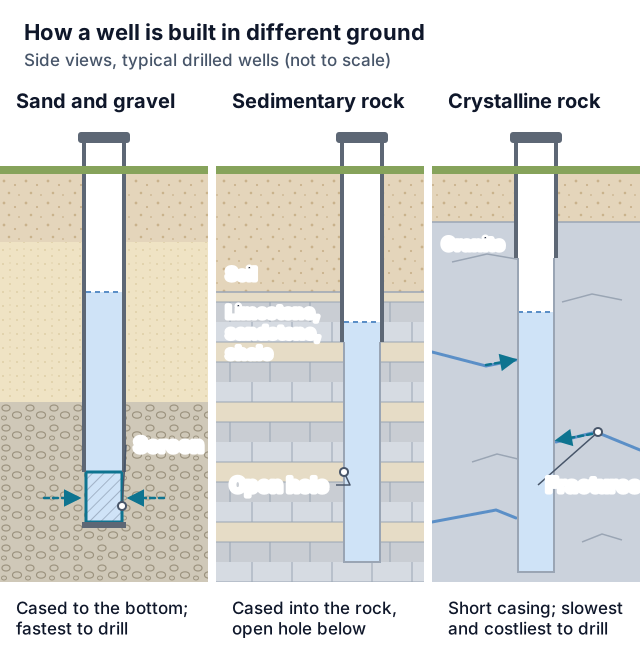
- Casing: Minnesota Rules part 4725.4550 requires a potable water-supply well to be cased at least 15 feet below the established ground surface, and any gravel pack must stop at least 15 feet below it.
- Sale paperwork: when a completed well disclosure certificate comes in, the county recorder collects a $54 fee from the buyer or the person seeking to record the deed (§ 103I.235, subd. 1(h)). Martin County's 2026 fee schedule lists Well Disclosure Certificates at $54.00, effective 7/1/25.
Permits & Local Rules
- Notification: under part 4725.1820, nobody may construct a water-supply well, deepen one through a confining layer, or install or remove casing below the frost line until MDH has received a notification. The property owner, the owner's agent or a licensed well contractor files it (for a drive-point well, a limited drive-point or dug well contractor may), one per well, legible, signed and with the fee. Item D lists what the form must show. It is valid for 18 months from filing. A different contractor or a well finished on a different property needs a new notification, with no new fee. If a drilling attempt fails, § 103I.205, subd. 1(a), requires no new notification unless the information for the successful well has substantially changed.
- Large withdrawals: the DNR's water appropriation permits page requires a preliminary assessment before drilling a well that will withdraw more than 10,000 gallons a day or 1 million gallons a year, and a water use permit for users above those amounts; § 103G.271 sets the permit duty and its exceptions. Where a well will need that permit, § 103I.205, subd. 1(e), lets construction begin only after the information it lists is submitted and the DNR gives preliminary approval.
- Who may drill: § 103I.205, subd. 4, bars anyone from drilling, constructing, repairing or sealing a well without a well contractor's license in possession, apart from the other license types and exemptions it lists. Part 4725.0475 requires a well contractor's license, or the separate limited well/boring license for that activity, to install a well pump or pumping equipment; to install, modify or repair screens, pitless units or adapters and casing from the frost line or pitless unit or adapter to the top of the casing; or to seal wells and borings. Subpart 2 of that part sets five narrow exceptions; read it before relying on one. Section 103I.205, subd. 4(e), also exempts an individual doing labor or services for a licensed contractor on a well at that contractor's direction and under the contractor's personal supervision, provided the person complies with the rest of chapter 103I; the same paragraph's owner exemption is covered in the FAQs.
- Drive-point wells: an individual who installs a drive-point water-supply well on property the individual owns or leases for farming or agricultural purposes or as a place of residence mails MDH's notification form within ten days after completing it, and no fee may be charged. The well must meet parts 4725.2010 to 4725.5650, and this route does not authorize the individual to seal it (§ 103I.205, subd. 1(d); part 4725.1849).
- Pumps and repairs: part 4725.1837 requires no notification or permit to install a pump, pumping equipment, pitless unit, pitless adapter or screen, or to repair an existing well, as long as the repair does not deepen the well through a confining layer or install or remove casing below the frost line.
- Disinfection: a person installing a new well or pump must pump the well until three well volumes are removed or the water is as clear as groundwater conditions allow, then chlorinate the well and pumping equipment to at least 50 parts per million free chlorine in all parts of the well, with the solution touching the well surfaces above the static water level, and leave it at least two hours before pumping all chlorinated water out of the well and the distribution system (part 4725.5550, subp. 2). Under subpart 4, the chlorine must meet ANSI/NSF Standard 60 as determined by a person accredited by ANSI, or be registered by the U.S. EPA under FIFRA section 3(c)(7)(A) as an antimicrobial pesticide for use in potable water; chlorine compounds with additives such as perfumes or algaecides must not be used, and a different biocide may be used if it meets the part's material and use standards and gives biocidal activity equivalent to the required chlorine concentrations and contact times. Under subpart 5, solid chlorine must be dissolved in potable water before it goes into the well or be circulated in the well to contact all well surfaces above the static water level, except that solid chlorine beyond what is needed for the required free chlorine may be added, and a flowing well may be disinfected by placing the solid in the bottom of the well. Subpart 3 sets a separate method for repairing or modifying a well or pump, and subparts 6 and 7 exempt some remedial wells and submerged closed loop heat exchanger pumps.
- First water sample: part 4725.5650 has the builder of a new potable well make sure, within 30 days of completion and before use, that a sample goes to a certified laboratory for total coliform bacteria, nitrate-nitrogen and arsenic, and tell the owner the water must not be used for human consumption until a sample shows no total coliform and the nitrate and arsenic results are reported. The part also sets the laboratory limits, the reporting of results to the owner and MDH, the steps if coliform is found, and when a new pump or repair needs a sample.
- Records: the builder labels the well with its unique well number (§ 103I.205, subd. 7). Section 103I.205, subd. 9, gives the person doing the work 60 days after completing or sealing a well to submit a verified report to MDH, while part 4725.1851 states 30 days for the written construction or sealing record and needs no construction record for a well sealed within 30 days of the start of construction if a sealing record is submitted; the licensee gives the owner or the owner's agent a copy.
- Sealing: § 103I.301 requires the property owner to have a well sealed if it is contaminated or may spread contamination, if an earlier attempt to seal it did not meet chapter 103I, or if its location, construction or upkeep endangers groundwater quality or is a safety or health hazard; a well not in use must be sealed unless the owner holds a maintenance permit. A licensed person authorized to seal that well does the work, after a sealing notification is filed (§ 103I.301, subd. 6; part 4725.1832, valid 18 months). Part 4725.3850 sets the sealing methods. Whoever buries or builds over an unsealed, unused well is responsible for having a licensed or registered contractor seal it (part 4725.3875, subp. 5).
- Maintenance permit: the property owner signs and submits MDH's application, whose contents part 4725.1848 lists, with the $225 annual fee. The permit lasts one year from issue, does not transfer when the property changes hands, does not allow construction or repair that would need a notification or permit, and is not issued for a well that chapter 4725 or § 103I.301 requires to be sealed.
- Isolation distances: part 4725.4450 measures its minimums horizontally from the upper end of the well casing to the closest part of the source or its vertical projection on the ground, and requires a well to be located where surface drainage is best and at the highest practical elevation, and built as far from contamination as practical. The distances apply to a source no longer in use unless all contaminants and visibly contaminated soils are gone. Among the farm-related minimums: 50 feet from a septic tank, an anhydrous ammonia tank, an unused unsealed well, an animal feedlot or an animal or poultry building holding more than one animal unit, and the absorption area of a soil dispersal system or a privy (systems with an average design flow over 10,000 gallons a day, and those serving facilities that handle infectious or pathological wastes such as hospitals or veterinary clinics, take more); 75 feet from a cesspool, seepage pit, leaching pit or dry well; 100 feet from a solid manure storage area without a roof and from an unroofed feedlot holding 300 or more animal units; and 150 feet from an unsafeguarded tank or container holding 25 gallons or more, or 100 pounds or more dry weight, of an agricultural chemical, or an area that fills or cleans application equipment with those amounts. A safeguarded agricultural chemical area is 100 feet, or 50 feet if it also has a permanent watertight roof. A building, feedlot, confinement area or kennel with 0.1 to 1.0 animal unit is 20 feet away. A sensitive well, which part 4725.0100 defines as one with less than 50 feet of watertight casing where the casing does not pass through a confining layer, or several, totaling ten feet or more, needs more. Subpart 2 doubles the subpart 1 distances between a sensitive well and a contamination source directly entering the soil, and among its listed exceptions the feedlot, animal building, soil dispersal absorption area and privy distances rise to 100 feet, the cesspool distance to 150 feet, the manure storage and 300-animal-unit feedlot distances to 200 feet, and the small-animal distance to 40 feet (subpart 2). One animal unit equals one slaughter steer or one horse (part 4725.0100, citing part 7020.0300).
Geology & Water Table Notes
- Geology atlas: the DNR's County Geologic Atlas page, updated September 18, 2026, lists Martin County's Part A geology atlas, which the Minnesota Geological Survey produces, as in progress and its Part B groundwater atlas, which the DNR produces after Part A, as a future start. Until those are published, this page names no aquifer for the county.
- Well logs: the County Well Index, which the Minnesota Geological Survey maintains with MDH, held records for over 599,000 Minnesota wells and borings as of June 2025, built from contractors' drilling logs that MGS geologists later interpret. MDH's Minnesota Well Index serves them by map or text search, and MDH warns that missing information does not guarantee there is no well on a property.
- Arsenic, statewide: MDH says arsenic occurs naturally in rocks and soil across Minnesota, that there is no way to know a well's arsenic level before it is drilled, and that levels can vary between wells even within a small area. It reports arsenic detected in about 40 percent of new wells drilled in Minnesota since 2008 and about 10 percent of the state's private wells above 10 micrograms per liter, and highly recommends action above that level.
- Septic permits: Martin County Planning and Zoning says licensed septic system designers, inspectors and installers must be used when upgrading or replacing a system in the county. Its 2026 fee schedule, effective January 1, 2026, lists a septic permit at $200 for Type 1-3 systems and $400 for Type 4 or 5.
Communities Served
Fairmont · Sherburn · Truman · Welcome · Trimont · Ceylon · Granada · Northrop · Dunnell
Emergency Response Expectations
Part 4725.1838 lets a water-supply well notification be given verbally under emergency conditions, meaning a delay in starting construction poses an immediate and significant danger to health or safety and there is no time for prior notification; its examples include a well failure that will leave livestock or persons without drinking water. During business hours the owner, the owner's agent or a licensed contractor gives the notification details to an authorized MDH representative. After hours or on a nonbusiness day, construction may begin once one of them telephones MDH and leaves those details on its answering service. The written notification and fee must reach the health commissioner within five working days after the emergency notification of the start of construction, and the property owner, the owner's agent or a licensed or registered contractor is responsible for sending them. The emergency notification is void if construction has not started within 72 hours of the verbal report, and every construction and location standard still applies. Item F bars the commissioner from accepting emergency notifications from contractors who violate the emergency notification or permit requirements. This site cannot promise when a contractor will arrive.
Martin County FAQs
Who do I notify before a well is drilled in Martin County?
The Minnesota Department of Health. Martin County is not one of MDH's delegated well programs, so the notification and the $325 fee go to MDH's Well Management Section, and under § 103I.205, subd. 1(c), the county and its cities may not require their own well permit or notification without an MDH delegation.
Is a license needed to put a well on my own farmland?
Minnesota lets an individual build a water-supply well without a license on land the individual owns or leases and uses for farming or agricultural purposes or as the individual's place of abode, provided the rest of chapter 103I is followed (§ 103I.205, subd. 4(e)). That still means the MDH notification and fee before construction, the well code's construction and distance rules, and, under part 4725.1851, a construction record within 30 days after the work is done. A drive-point well instead takes the no-fee notice within ten days described in the permit notes. Sealing a well later takes a licensed person authorized to seal it (§ 103I.301, subd. 1(c)).
What separation does a well need from livestock and manure?
Under part 4725.4450, 50 feet from a feedlot holding more than one animal unit, 100 feet if it is unroofed and holds 300 or more animal units, and 20 feet if it holds 0.1 to 1.0 animal unit; for a sensitive well, 100, 200 and 40 feet. Animal or poultry buildings holding more than one animal unit are 50 feet, or 100 for a sensitive well. Solid manure storage without a roof is 100 feet, or 200 for a sensitive well; liquid manure basins and lagoons have their own distances in the same part, set by their liner and permit status.
What must a seller disclose about wells?
Before signing a sale agreement, § 103I.235 has the seller give the buyer in writing either a statement that the seller knows of no wells, or a disclosure statement with the legal description and county and a map, drawn from available information, showing each well's location as far as practicable, marking each well in use, not in use or sealed. At closing, a well disclosure certificate signed by the seller or someone authorized for the seller carries that information, the buyer's name and mailing address, and each well's quartile, section, township and range. Paragraphs (c), (d), (e) and (i) of the statute set exceptions and alternatives, including a no-known-wells statement on the deed, contract-for-deed sales and an unchanged-status certification, so read them before relying on one; under subdivision 3, the section does not apply to temporary borings or unsuccessful wells that have been sealed by a licensed contractor in compliance with chapter 103I. Unless buyer and seller agree otherwise in writing before closing, a seller who knew or had reason to know of a well and did not disclose it is liable for sealing costs and reasonable attorney fees in an action started within six years after closing.
How often should a Martin County well be tested?
MDH recommends coliform bacteria every year and whenever the water's taste, odor or appearance changes; nitrate every year, and also if you plan to become pregnant or infants will use the water; arsenic at least one time beyond the initial test when the well is first built; and lead and manganese at least once. It recommends an accredited laboratory, or asking your county environmental or public health services whether they offer well testing. If arsenic was detected in a new well, MDH says you may want to retest about six months after construction.
What should I do if my well's nitrate is above 10 mg/L?
MDH's steps are to get drinking water from a safe alternative source such as bottled water, make sure babies under six months old do not drink the well water, not try to boil the nitrate out, have a licensed well contractor inspect the well, and find and remove possible nitrate sources. Home treatment is also an option, but MDH recommends that babies under six months still not drink the water even with treatment, and encourages removing nitrate sources and having the well inspected and repaired before treating.
How deep will a new well in Martin County be?
No agency source found for this review gives a usual depth for Martin County wells, and the county's geologic atlas is still being prepared. A driller can look up logs of nearby wells in the Minnesota Well Index. The well code's floor is 15 feet of casing for a potable well, and a well with less than 50 feet of watertight casing that does not pass through ten feet or more of confining material counts as sensitive and needs larger isolation distances.
Sources
- Minnesota Statutes § 103I.205: Well construction
- Minnesota Statutes § 103I.208: Notification filing fees and permit fees
- Minnesota Statutes § 103I.235: Real property sale; disclosure of location of wells
- Minnesota Statutes § 103I.301: Well sealing requirements
- Minnesota Statutes § 103I.111: Local authority over wells and borings
- Minnesota Statutes § 103G.271: Appropriation and use of waters
- Minnesota Rules part 4725.0100: Definitions
- Minnesota Rules part 4725.0475: Activities requiring licensure or registration
- Minnesota Rules part 4725.1820: Notification for construction of water-supply wells
- Minnesota Rules part 4725.1832: Notification for well sealing
- Minnesota Rules part 4725.1837: Exception to notification and permit requirements
- Minnesota Rules part 4725.1838: Emergency notifications and permits
- Minnesota Rules part 4725.1848: Well maintenance permits
- Minnesota Rules part 4725.1849: Owner or lessee drive-point well notification
- Minnesota Rules part 4725.1851: Well and boring records
- Minnesota Rules part 4725.3850: Sealing well or boring
- Minnesota Rules part 4725.3875: Responsibility for sealing
- Minnesota Rules part 4725.4450: Water-supply well distances from contamination
- Minnesota Rules part 4725.4550: Minimum protective depth
- Minnesota Rules part 4725.5550: Water-supply well disinfection
- Minnesota Rules part 4725.5650: Water quality samples from a new potable well
- MDH: Well Management fees (effective July 1, 2025)
- MDH: Delegated Well Programs
- MDH: Owner's Guide to Wells
- MDH: Arsenic in Well Water
- MDH: Nitrate in Well Water
- MDH: Well Disclosure and Property Transfers
- MDH: Sealing of Wells and Borings
- MDH: Minnesota Well Index
- Minnesota Geological Survey: County Well Index
- Minnesota DNR: County Geologic Atlas series
- Minnesota DNR: Water appropriation permits
- Martin County Planning and Zoning: Septic Systems
- Martin County Planning and Zoning: Feedlots
- Martin County: 2026 fee schedule
- Census Bureau: 2020 places by county, Minnesota
Last reviewed 2026-10-28
Services Available in Martin County
Well Drilling
New residential wells — find local drillers for site evaluation, depth estimates, and written drilling quotes.
Learn more →Water Well Drilling
Household water wells from site evaluation through casing, pump, and water test — written quotes from local drillers.
Learn more →Well Pump Repair
No water at the tap? Request urgent well pump repair — local pros diagnose pressure loss, dead pumps, and pressure tank failures fast.
Learn more →Well Pump Replacement
Pump at end of life or beyond repair? Get quotes for correctly-sized submersible and jet pump replacement from local well pros.
Learn more →Well Inspection & Testing
Buying a home with a well, or overdue for a water test? Local pros for flow tests, equipment inspection, and lab water-quality testing.
Learn more →Well Water Service
Water quality problems, treatment systems, and general well maintenance — connect with local pros for everything between drilling and pump work.
Learn more →Free Tools Before You Call
Ballpark the cost or narrow down the problem before talking to a Martin County provider.
Well Drilling Cost Calculator
Estimate what drilling a well should cost — by depth, geology, and whether you need the pump and pressure tank included.
Use the free tool →No Water From Your Well? Diagnostic Wizard
Suddenly no water in the house? Answer a few questions to find out if it's the breaker, the pressure switch, the tank, the pump — or the well itself.
Use the free tool →Well Pump Size Calculator
Find what size well pump you need — GPM demand, total dynamic head, and a horsepower recommendation from four quick inputs.
Use the free tool →Need help in Martin County, MN?
Send the short form — urgent requests get priority routing.