Well Pump Replacement in Putnam County, IN
Well drilling typically runs $3,000–$16,000 nationally, per our cost guide. Independent local pros serving Greencastle, Cloverdale, Bainbridge and nearby communities. Describe the problem and we'll route your request — free, no obligation.
- Mark no-water pump problems as emergencies on the form
- County pages on local well depths, aquifers, and permits
- Well inspections, water testing, and treatment
- Free to use — no obligation, no markup
Fast response from independent local providers. No obligation.
Typical national cost$3,000 – $16,000Cost guide →Local Help in Putnam County, IN
This page is about replacing and repairing pumps on Putnam County's private wells. In its 2021 Well Owner's Guide, the National Ground Water Association cites recent survey data: a typical household submersible pump ranges between $3,000 and $3,200, and a typical household jet pump from about $1,545 to $1,570. Since one well's performance demands may suit one type better, the guide suggests deciding with a water well system professional or a pump installation specialist. It also says an itemized list of charges gives a clearer picture of cost than a lump sum.
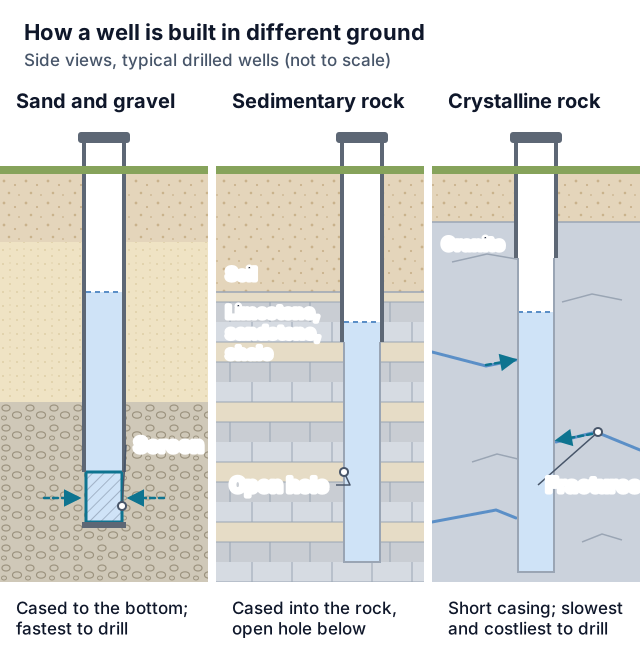
Most wells here are drilled into rock. A May 2010 Indiana DNR Division of Water report on the county's bedrock says approximately 72 percent of all wells in Putnam County are completed in bedrock and identifies four bedrock aquifer systems. Its companion report on glacial deposits puts approximately 28 percent of wells in unconsolidated material, which typically ranges from bedrock exposed at the surface to about 250 feet thick in buried valleys.
This page forwards pump, pressure tank and no-water requests to independent contractors. Cornelia Cove does not employ well crews or pump installers.
Putnam County Service Details
What providers in this area actually see: coverage, common jobs, local pricing factors, and rules worth knowing.
Service Area Notes
- Any Putnam County address can send a request. Going by the Census Bureau's place-by-county list for 2020, checked against the Bureau's current TIGERweb layers, the city of Greencastle, the towns of Bainbridge, Cloverdale, Fillmore, Roachdale and Russellville, and the census-designated places of Heritage Lake and Van Bibber Lake lie within Putnam County.
- Finding the original well log: DNR's Water Rights and Use Section keeps records of more than 400,000 Indiana wells, reachable through its online water well record database; the database offers no owner-name search, while its web viewer offers street address and ZIP code searches. Among the entries 312 IAC 13-2-6 requires in a driller's record are the pump type and pump setting depth, where applicable, plus total depth and static water level; the rule lists the rest.
- Checking a pump installer: DNR's contractor lists show only firms whose drillers and pump installers are licensed for the current year. IC 25-39-3-1(c) requires a licensee installing a water well pump to carry the license and show it to a department representative on request.
Common Jobs in Putnam County
- Replacing submersible pumps in bedrock wells, with the new pump hung to meet the available-drawdown minimums in 312 IAC 13-4-3.5
- Jet pump and offset pump replacement
- Bladder tank and pressure switch diagnosis when a pump short-cycles
- Pitless adapter, well cap and casing extension repairs at the wellhead
- Disinfecting the well and collecting a bacteria sample after the pump goes back in
- Capping wells that sit idle and plugging wells that are abandoned
What Drives Pricing Here
- Which rock the well is drilled into. DNR reports Raccoon Creek Group wells, through most of the western and southwestern county, at 40 to 400 feet with domestic yields of 1 to 50 gallons per minute (gpm), and Borden Group wells, mainly in the north and east, commonly at 35 to 490 feet with domestic yields typically 2 to 60 gpm; both systems have some dry holes. These are system-wide ranges, not a prediction for one lot.
- How deep the pump must hang. 312 IAC 13-4-3.5 sets a floor for available drawdown, unless the department approves otherwise: 50 feet for a well completed in a bedrock aquifer and 20 feet for one completed in an unconsolidated aquifer. Pump depth must also leave room for the pump's own drawdown and for the water level's seasonal rise and fall (312 IAC 13-7-1). Neither section covers monitoring or dewatering wells.
- Low-yield ground. DNR maps the Dissected Till and Residuum / Till Veneer Aquifer System across much of the county, including along Big Walnut Creek. Most wells in it report 5 gpm or less, some borings were dry, and most wells there are finished in the bedrock below. Indiana Department of Health guidance says a well serving a residence should have a stabilized yield of at least 5 gpm, and that if a well yields less than required, the driller should tell the owner so extra storage and suitable pumping equipment can meet peak demand.
Permits & Local Rules
- County health department: the Putnam County Health Department's Environmental page says it enforces state and local rules for on-site sewage disposal, that a permit from its office must be obtained before any construction begins on a septic system, and that it is required before a construction permit can be obtained from the Putnam County Planning and Building Office. Whether the county requires anything for a well or pump job is a question to put to the Environmental Section.
- Licensing: under IC 25-39-3-1, no individual may be a water well driller or a water well pump installer without a license from DNR, and IC 25-39-2-15.5 counts anyone installing or repairing water well pumps as a pump installer. IC 25-39-1.5-3 sets out four exemptions. A person may put in a well for personal use if its inside diameter is 1 1/4 inches or less and its depth 24 feet or less; a plumber who holds an IC 25-28.5 license and has registered with DNR may put in wells within those same two limits; for personal use, anyone may install or repair a water well pump or the pumping equipment; and a person may work under a license holder's direction and personal supervision. Under 312 IAC 13-1-19.3, personal use turns on where the equipment is: a well or pumping equipment serving water supply on property owned by, or in the possession of, the person, or, at a public water supply utility, in a permanent employee's possession. Separately, IC 25-39-4-11 keeps the whole article from applying to wells drilled under or incidental to an IC 14-34 or IC 14-37 activity, wells used solely to supply water for secondary petroleum recovery, plus wells drilled solely to evaluate foundation characteristics, meaning how well earth materials can support bridges, roadways, buildings and other engineered structures.
- License terms: applicants must pass a competency examination prepared and administered by DNR, among the qualifications in IC 25-39-3-3. 312 IAC 13-2-2 puts the fee at $100 for each calendar year, and every license expires on the December 31 that closes its year of issue (IC 25-39-3-1(d)).
- At the wellhead: under 312 IAC 13-3-2, the top of the finished casing or pitless unit sits 1 foot or more above the ground, and earthen material around it is placed so surface water drains away. Inside a designated flood hazard area, one of two further conditions applies: the top clears the regulatory flood elevation by 2 feet or more, or the pitless unit cap or well seal is watertight and vented to 2 feet or more above that elevation. That section does not cover monitoring or dewatering wells. 312 IAC 13-4-3 sets requirements for the pitless unit itself, including a watertight connection to the casing and a self-draining, tamper-resistant cap.
- Well records: within 30 days after a well is completed, the licensee must send DNR a copy of its record on forms the department prescribes or approves (IC 25-39-4-1(b)); 312 IAC 13-2-6 calls for a departmental or division-approved form with an accuracy statement signed by the driller or an authorized representative.
Geology & Water Table Notes
- Blue River and Sanders Groups: DNR maps this mostly limestone system through most of the central county, trending northwest to southeast, with depth to bedrock ranging from outcrop to about 190 feet. Reported yields are typically 1 to 60 gpm with some dry holes, and static water levels range from flowing to 230 feet below the surface.
- Raccoon Creek Group: mostly shale, mudstone and siltstone with minor coal, sandstone and limestone, under up to about 140 feet of unconsolidated deposits in places and exposed at the surface in others. Static levels range from flowing to 195 feet.
- Borden Group: sandstone, siltstone, mudstone and shale, under as much as 200 feet of unconsolidated deposits, though the bedrock is exposed at the surface in some areas. Static levels commonly range from flowing to 110 feet, and DNR rates contamination risk high where the bedrock is shallow.
- Tipton Till Aquifer System: mapped mainly in the north and northeast, with well depths of about 50 to 190 feet, domestic yields typically 10 to 50 gpm and static levels from flowing to about 130 feet; DNR says approximately 60 percent of wells started in it use the bedrock below.
Communities Served
Greencastle · Cloverdale · Bainbridge · Roachdale · Russellville · Fillmore · Heritage Lake · Van Bibber Lake
Emergency Response Expectations
No-water requests are forwarded to independent contractors as urgent, but this site cannot promise how soon one will come. It helps to say whether the pump hums, clicks or stays silent and what the pressure gauge reads. The Indiana Department of Health's well water page lists flooding as a reason a well may need sanitizing.
Putnam County FAQs
Can I replace my own well pump in Putnam County without a license?
Yes, when it is for personal use. IC 25-39-1.5-3 exempts personal-use pump installation and repair, and 312 IAC 13-1-19.3 ties personal use to property you own or possess; work that a license holder directs and personally supervises is exempt too. Other pump installation or repair calls for a DNR license unless one of the other exemptions or exclusions in the permit notes fits.
Do Indiana's well rules cover my pressure tank and house wiring?
Not those parts. DNR's water FAQ says the state well drilling statute and rules do not regulate pipes and electrical connections between the well and the building, or well-related equipment such as pressure tanks inside the building. Indiana Department of Health guidance says offset pumps and pressure tanks should be readily accessible and sets conditions for putting them in a crawl space. It also lists 54 inches, from top of pipe to finished grade, as the minimum burial depth for Putnam County water lines to prevent freezing.
How can I tell whether the tank or the pump is the problem?
Rapid cycling that can damage the motor, NGWA's seasonal inspection article explains, can come from a bladder tank holding too much or too little air. The tank should feel cool where it holds water and warmer where it holds only air, and water left in it after all pressure is drained means the bladder has begun to fail. NGWA lists a pump that cycles on and off frequently among the signs to call a water well systems professional.
Should the well be disinfected and tested after pump work?
Indiana Department of Health guidance says a pump installer must disinfect the well after the pump is installed or repaired, with chlorine dosed to at least 100 mg/l, and that a sample collected in a sterile bottle from a lab certified for bacteriological analysis should show fewer than two coliform organisms per 100 milliliters before drinking use; if not, disinfect and resample. The state health laboratory recommends bacteria and nitrate tests every year, and fluoride, arsenic, lead and copper at least every 5 years or after major maintenance.
Is there karst in Putnam County's limestone?
DNR's report points to very little. It notes that Blue River Group limestones are known for karst features, particularly in southern Indiana, but says only a few wells in Putnam County suggest any minor karst features are present.
What happens to an old well we stop using?
A well is abandoned once its original purpose and use have been discontinued for more than five years, or when disrepair makes using it impractical or a health hazard (IC 25-39-2-2). IC 25-39-4-6(b) gives the landowner one year after a well's abandonment, for wells abandoned after December 31, 1987, to get it plugged by a water well driller. 312 IAC 13-10-2 names a water well driller or pump installer as the one who plugs it, with impervious grouting material and the materials and methods the rule specifies, and the division is to receive a written notice within 30 days once plugging is complete. Wells drilled after December 31, 1987 and left uncased are the driller's to plug, within 72 hours after drilling ends (IC 25-39-4-4). A well that has sat unused more than three months, though not permanently abandoned, needs a watertight cap, welded, threaded or mechanically attached, sealing it at or above ground, and must be kept from becoming a contamination channel (312 IAC 13-10-1). Wells abandoned before 1988, or drilled before 1988 and abandoned before 1994, follow separate capping and closure provisions and must be plugged if they pose a hazard to human health.
Sources
- Indiana DNR: Bedrock Aquifer Systems of Putnam County (May 2010)
- Indiana DNR: Unconsolidated Aquifer Systems of Putnam County (May 2010)
- Indiana Code 2026, IC 25-39: Water well drillers and pump installers
- 312 IAC 13: Water well drillers and water well pump installers (Indiana Administrative Code)
- Indiana DNR: Driller and pump installer licensing
- Indiana DNR: Licensed water well drilling and pump installation contractors
- Indiana DNR: Water well record database
- Indiana DNR: Water availability and use rights FAQ (equipment not regulated)
- Indiana Department of Health: Recommended standards for private water wells
- Indiana Department of Health: Well water quality and testing
- Indiana Department of Health Laboratories: Well water
- Putnam County Health Department: Environmental
- U.S. Census Bureau: 2020 places by county, Indiana
- NGWA: Well Owner's Guide (2021, hosted by University of Maryland Extension)
- NGWA: Seasonal inspection and maintenance recommendations (August 2020)
- NGWA: Well owner maintenance practices
Last reviewed 2026-10-30
Nearby Counties
Services Available in Putnam County
Well Drilling
New residential wells — find local drillers for site evaluation, depth estimates, and written drilling quotes.
Learn more →Water Well Drilling
Household water wells from site evaluation through casing, pump, and water test — written quotes from local drillers.
Learn more →Well Pump Repair
No water at the tap? Request urgent well pump repair — local pros diagnose pressure loss, dead pumps, and pressure tank failures fast.
Learn more →Well Pump Replacement
Pump at end of life or beyond repair? Get quotes for correctly-sized submersible and jet pump replacement from local well pros.
Learn more →Well Inspection & Testing
Buying a home with a well, or overdue for a water test? Local pros for flow tests, equipment inspection, and lab water-quality testing.
Learn more →Well Water Service
Water quality problems, treatment systems, and general well maintenance — connect with local pros for everything between drilling and pump work.
Learn more →Free Tools Before You Call
Ballpark the cost or narrow down the problem before talking to a Putnam County provider.
Well Drilling Cost Calculator
Estimate what drilling a well should cost — by depth, geology, and whether you need the pump and pressure tank included.
Use the free tool →No Water From Your Well? Diagnostic Wizard
Suddenly no water in the house? Answer a few questions to find out if it's the breaker, the pressure switch, the tank, the pump — or the well itself.
Use the free tool →Well Pump Size Calculator
Find what size well pump you need — GPM demand, total dynamic head, and a horsepower recommendation from four quick inputs.
Use the free tool →Need help in Putnam County, IN?
Send the short form — urgent requests get priority routing.