Well Drilling in Limestone County, TX
Well drilling typically runs $3,000–$16,000 nationally, per our cost guide. Independent local pros serving Mexia, Groesbeck, Coolidge and nearby communities. Describe the problem and we'll route your request — free, no obligation.
- Mark no-water pump problems as emergencies on the form
- County pages on local well depths, aquifers, and permits
- Well inspections, water testing, and treatment
- Free to use — no obligation, no markup
Fast response from independent local providers. No obligation.
Typical national cost$3,000 – $16,000Cost guide →Local Help in Limestone County, TX
No groundwater conservation district covers Limestone County on the Texas Commission on Environmental Quality's (TCEQ) statewide district map dated March 2026, and the Texas Water Development Board's (TWDB) 2021 planning summary for Groundwater Management Area 12 lists "Limestone County (no district)". Neither is a ruling on one tract, so confirm with TCEQ or TWDB before drilling near the county line: state law makes the Mid-East Texas GCD's boundaries coextensive with Freestone, Leon and Madison counties unless its territory is modified (Special District Local Laws Code 8866.004) and sets the Southern Trinity GCD's initial boundaries as McLennan County (8821.004), which shares the city of Mart with Limestone.
Without a district in the picture, the state framework remains: Texas Department of Licensing and Regulation (TDLR) licensing, with the exclusions noted below, the siting and construction standards of 16 TAC chapter 76, and the driller's State of Texas Well Report. On top of those, Mexia's utility code and the county's subdivision order set local conditions.
Limestone County Service Details
What providers in this area actually see: coverage, common jobs, local pricing factors, and rules worth knowing.
Service Area Notes
- Census Bureau places with Limestone County territory (2020 place-by-county file): the cities of Groesbeck, Mexia and Mart, the last also listed in McLennan County, and the towns of Coolidge, Kosse, Tehuacana and Thornton.
- Mexia: Code of Ordinances § 13.02.011(8) says that if city water or sewer mains with adequate capacity need less than 200 feet of pipe extension to reach any portion of a property inside city limits, no alternate source such as a well (other than for irrigation) or a septic tank may be built, and the property must connect to city service. Wells and septic tanks existing when the section was adopted are exempt, but only if they perform adequately and meet all permit and health requirements; if they fail, the rule applies. A property with an auxiliary supply such as a private well must install an RP at the meter connection or provide an air gap at the meter; physical separation of the two plumbing systems, documented in a CSI, may serve as the air gap, and periodic CSIs follow.
- Groesbeck and the towns: 16 TAC §76.100(a) requires wells to be completed in compliance with incorporated city ordinances, so ask the city about private wells before drilling inside its limits.
Common Jobs in Limestone County
- New household and livestock wells sited and finished to 16 TAC §76.100
- Pump installation and repair by a TDLR-licensed pump installer
- Plugging abandoned or deteriorated wells under 16 TAC §76.104 and filing the plugging report
- Accredited-lab bacteria tests for coliform
- Iron and dissolved-solids testing before choosing treatment
What Drives Pricing Here
- Which aquifer lies under the tract: TWDB Report 299, prepared by the U.S. Geological Survey in July 1987, describes three belts. The Wilcox Group, the county's major aquifer, crops out in the southeast and thickens to about 1,175 feet in the eastern corner. The Midway Group crops out in a north-northeastward band across the middle of the county. In the west, the Taylor Marl and Navarro Group hold only very small quantities of water, usually of poor quality, and the report noted that most residents on those outcrops got water by pipeline from rural water-supply systems.
- Target sand: the report calls the Simsboro the principal water-producing unit of the Wilcox's three formations (Hooper, Simsboro and Calvert Bluff) and says most wells drilled on the Calvert Bluff outcrop go deep enough to tap the Simsboro below. It puts the Wilcox at about 40 percent sand and 60 percent low-permeability sediment, mostly clay, and says evaluating each test hole, drillers' and geophysical logs included, is necessary to determine a site's maximum water-production capability.
- Midway wells: in the 1987 report, larger-yielding wells in the Tehuacana Member of the Kincaid Formation were confined to the fault and fracture zone at Tehuacana and a down-faulted zone west of Mexia; the Littig Glauconitic and Pisgah members furnished water to domestic wells where they crop out, and the Wills Point Formation yields only small quantities.
Permits & Local Rules
- Licensing: a TDLR license is required before anyone acts, or offers to act, as a driller (Occupations Code 1901.151) or as a pump installer (1902.151). Two groups fall outside those licensing definitions: an owner who drills a water well, or installs or repairs well pumps and equipment, on the owner's own property for the owner's own use; and a helper whose work is directly supervised by a driller or installer and who is not the one primarily responsible for the drilling or the installation. Section 76.30(3) of 16 TAC extends the pump exemption to land the person leases or rents, again for that person's own use, and §76.30 and Occupations Code sections 1901.161 and 1902.161 add a few narrower exemptions.
- Siting (16 TAC §76.100(a)): a well belongs at least 150 feet from concentrated sources of possible contamination, the rule's examples being livestock or poultry yards, cemeteries, pesticide mixing or loading facilities and privies; 100 feet from septic absorption fields, septic spray areas and dry litter poultry facilities; 50 feet from water-tight collection facilities for sewage and liquid waste; and 50 feet from an adjacent property line, so long as the contamination-source distances are also met. The rule also sets exceptions for monitoring, dewatering, piezometer and recovery wells, three situations in which the property-line distance does not apply, a conditional reduced-distance option in §76.100(b) for wells cemented or tremie pressure-filled to at least 100 feet, and sealing requirements for a well that must go in a flood-prone area; ask the driller which of these applies to your site.
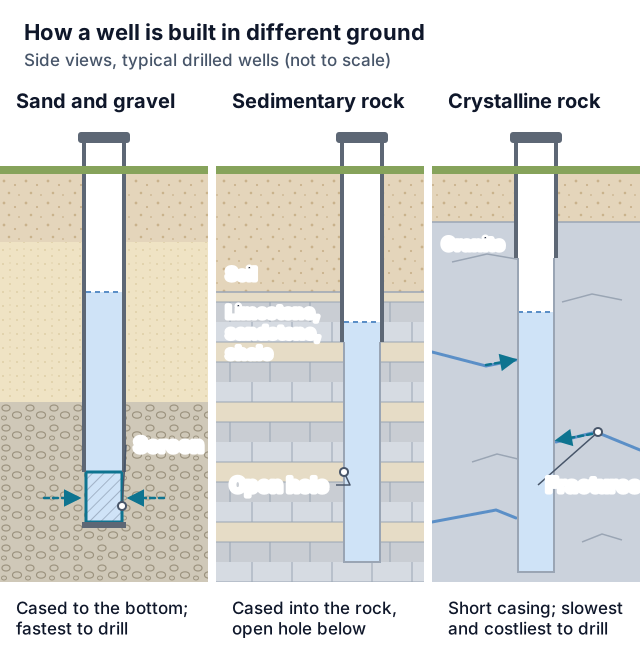
- Construction (16 TAC §76.100(c)-(h)): a well must be completed so that aquifers or zones whose water differs in chemical quality cannot commingle in the casing, borehole annulus or filter pack and cause quality degradation of any aquifer or zone, and the rule sets casing materials, the annular seal, surface completion and disinfection, several with their own exceptions or waivers; ask the driller which zones the well will produce from and how the others will be sealed off.
- Well report (16 TAC §76.70): a 60-day clock starts when the drilling, deepening or alteration work is completed or ceases. Before it runs out, the driller sends a copy of the well log to TDLR electronically, using the agency's Texas Well Report Submission and Retrieval System, gives one to whoever owns the well or had it drilled, and copies the groundwater conservation district where one exists. Latitude and longitude go on every report.
- Subdivisions: the county's subdivision order (linked from the county's home page; adopted and effective December 27, 2010) applies in unincorporated areas, and only to subdivisions creating two or more parts of five acres or less intended for residential purposes; lots that size are presumed residential unless the final plat and all deeds and contracts for deeds restrict them to nonresidential uses. Section 5.2 requires a subdivider proposing individual wells or other non-public systems for residential drinking water to provide a groundwater availability study meeting 30 TAC §§230.1-230.11 that certifies 30-year groundwater quantity and quality for the subdivision's ultimate needs, and test-well water must meet listed community water system standards either untreated or with an identified, commercially available treatment system. The order also sets a plat certification and rules for tracts in a city's extraterritorial jurisdiction.
- Old wells: once a landowner, or anyone else in possession of the well, learns that it is abandoned or deteriorated (both terms are defined in Occupations Code 1901.255(a)), section 1901.255(c) gives them 180 days to get it plugged or capped following the Texas Commission of Licensing and Regulation's standards and procedures. Those standards sit in 16 TAC §76.104. Subsection (d) allows a cap on a well that has not deteriorated, still has casing in good condition, and benefits the landowner; the cover must stop surface pollutants getting in, carry a 400-pound load at minimum, and be constructed so nobody can easily lift it off by hand. The plugging methods in the same rule come with material limits, so work from the rule text. TDLR's abandoned-wells page says landowners may plug a well on their own land following §76.104 or have a licensed driller or pump installer do it; under §76.70(3), the person who plugs files the plugging report with TDLR no later than 30 days after finishing and sends copies to the owner (or whoever the well was plugged for) and to any district.
Geology & Water Table Notes
- Wilcox water (Report 299): dissolved solids ranged from 90 to 1,530 mg/L and hardness from soft to very hard. Iron reached 20,000 micrograms per liter; the report found little link between iron and well depth but said deeper wells generally have less, and drillers reported inspecting cuttings to improve the chance of screening a low-iron zone.
- Lignite: the 1987 report says Wilcox wells often produce a black sediment considered to be lignite, that a well producing from a lignite-bearing zone can pump the suspended lignite with its water, and that wells with this problem usually are abandoned.
- Midway water: dissolved solids in most Littig Glauconitic, Pisgah and Tehuacana wells sampled ran about 350 to 600 mg/L, usually a calcium-bicarbonate water that is hard to very hard. The report said water-quality problems that may result from human activity were limited to a small oilfield area near Mexia.
- Alluvium: stream deposits up to about 40 feet thick overlie small areas along many streams, Lake Limestone covers a considerable area of them, and the 1987 report knew of no producing water wells in them.
- Aquifer name: TWDB's Carrizo-Wilcox Aquifer consists of the Hooper, Simsboro and Calvert Bluff formations of the Wilcox Group and the overlying Carrizo Formation; for Limestone County, its GMA 12 summary lists drawdown targets only for the three Wilcox formations.
Communities Served
Mexia · Groesbeck · Coolidge · Kosse · Thornton · Tehuacana · Mart
Emergency Response Expectations
When the tap runs dry, flag the request as an emergency. Under Occupations Code 1902.001, pump installation includes repairs to an existing pump, so that work needs a TDLR-licensed installer unless an exclusion or exemption above applies.
Limestone County FAQs
Do I need a district permit for a well in Limestone County?
Neither TCEQ's March 2026 map nor TWDB's GMA 12 summary shows a district here, but confirm for your parcel, especially near Freestone or McLennan County. State licensing, construction and reporting rules apply either way, and inside Mexia, check § 13.02.011(8) first.
How do I find out how deep my well will need to go?
It depends on the formation under your tract and the zone the driller plans to screen. Records from neighboring wells help: on TDLR's driller and pump installer page, the Texas Well Reporting System link covers wells drilled after 2002 and the TCEQ Well Reports link covers wells drilled before 2003.
Do I need a licensed driller if the well is on my own land?
Not if you drill it yourself for your own use on land you own: chapters 1901 and 1902 of the Occupations Code exclude that from the driller and installer definitions, as they do installing or repairing a pump at your own place for your own use, and 16 TAC §76.30(3) treats pump work on leased or rented land you use yourself the same way. Ask TDLR which construction and reporting rules then apply to you.
How should I test a new or flooded well?
Follow TCEQ's GI-433 (revised June 2023): it explains sampling for total coliform and E. coli in a sterile container from an accredited lab, testing within 30 hours of collection, and the steps to take if coliform is found. It covers microbial testing only, so ask the lab separately about iron and dissolved solids, the problems Report 299 singled out.
Sources
- TCEQ: Texas Groundwater Conservation Districts map (March 2026)
- TCEQ: Groundwater Conservation Districts
- TWDB: GMA 12 desired future conditions, 2021 joint planning
- TWDB: Groundwater Management Area 12
- TWDB Report 299: Ground-Water Resources of Limestone County, Texas (1987)
- TWDB: Carrizo-Wilcox Aquifer
- Special District Local Laws Code ch. 8866 (Mid-East Texas GCD)
- Special District Local Laws Code ch. 8821 (Southern Trinity GCD)
- Texas Occupations Code ch. 1901
- Texas Occupations Code ch. 1902
- 16 TAC §76.30 (Texas SOS)
- 16 TAC §76.70 (Texas SOS)
- 16 TAC §76.100 (Texas SOS)
- 16 TAC §76.104 (Texas SOS)
- TDLR: Water Well Drillers and Pump Installers
- TDLR: Abandoned or deteriorated water wells
- TCEQ GI-433: How to Sample Your Private Well Water for Microbial Contaminants
- Limestone County: Subdivision Regulations (rev. 12/27/2010)
- City of Mexia Code § 13.02.011 (eCode360)
- Census Bureau: 2020 Texas place-by-county file
- Census Bureau: TIGERweb places service
Last reviewed 2026-10-31
Nearby Counties
Services Available in Limestone County
Well Drilling
New residential wells — find local drillers for site evaluation, depth estimates, and written drilling quotes.
Learn more →Water Well Drilling
Household water wells from site evaluation through casing, pump, and water test — written quotes from local drillers.
Learn more →Well Pump Repair
No water at the tap? Request urgent well pump repair — local pros diagnose pressure loss, dead pumps, and pressure tank failures fast.
Learn more →Well Pump Replacement
Pump at end of life or beyond repair? Get quotes for correctly-sized submersible and jet pump replacement from local well pros.
Learn more →Well Inspection & Testing
Buying a home with a well, or overdue for a water test? Local pros for flow tests, equipment inspection, and lab water-quality testing.
Learn more →Well Water Service
Water quality problems, treatment systems, and general well maintenance — connect with local pros for everything between drilling and pump work.
Learn more →Free Tools Before You Call
Ballpark the cost or narrow down the problem before talking to a Limestone County provider.
Well Drilling Cost Calculator
Estimate what drilling a well should cost — by depth, geology, and whether you need the pump and pressure tank included.
Use the free tool →No Water From Your Well? Diagnostic Wizard
Suddenly no water in the house? Answer a few questions to find out if it's the breaker, the pressure switch, the tank, the pump — or the well itself.
Use the free tool →Well Pump Size Calculator
Find what size well pump you need — GPM demand, total dynamic head, and a horsepower recommendation from four quick inputs.
Use the free tool →Need help in Limestone County, TX?
Send the short form — urgent requests get priority routing.