Well Drilling in Grant County, WI
Well drilling typically runs $3,000–$16,000 nationally, per our cost guide. Independent local pros serving Lancaster, Platteville, Boscobel and nearby communities. Describe the problem and we'll route your request — free, no obligation.
- Mark no-water pump problems as emergencies on the form
- County pages on local well depths, aquifers, and permits
- Well inspections, water testing, and treatment
- Free to use — no obligation, no markup
Fast response from independent local providers. No obligation.
Typical national cost$3,000 – $16,000Cost guide →Local Help in Grant County, WI
In 1968 the Wisconsin Geological and Natural History Survey (WGNHS) released P.G. Olcott's Availability of Ground Water in Grant County, which found that enough water for most uses can generally be had throughout the county, but that its relief puts the water table as much as 350 feet down in upland areas, within 100 feet in the major valleys and 10 to 20 feet down in the Wisconsin and Mississippi river valleys. Treat those figures as a 1968 snapshot rather than a prediction for any particular parcel.
Grant County's code on eCode360, in the Wayback Machine capture of August 14, 2026 (headed "Includes legislation through 11-12-2025"), has chapters on private onsite wastewater systems (225) and floodplain zoning (290) but none on private wells, and we found no county well permit. Wisconsin Statutes chapter 280 and the Department of Natural Resources (DNR) code, Wis. Admin. Code ch. NR 812, set the rules. Because NR 812.10(9) makes drillers get permits from any county authorized under ch. NR 845, ask the county Conservation, Sanitation and Zoning office about local steps first.
Grant County Service Details
What providers in this area actually see: coverage, common jobs, local pricing factors, and rules worth knowing.
Service Area Notes
- Census Bureau 2020 place codes list for Grant County the cities of Boscobel, Cuba City, Fennimore, Lancaster and Platteville; the villages of Bagley, Bloomington, Blue River, Cassville, Dickeyville, Hazel Green, Livingston, Montfort, Mount Hope, Muscoda, Patch Grove, Potosi, Tennyson and Woodman; and the Glen Haven, Kieler and Sandy Hook census-designated places. A TIGERweb query on October 28, 2026 still showed all 19 cities and villages as active.
- Old records: DNR's well records search finds a Well Construction Report showing drillhole and casing depth; without one, DNR says a licensed well professional can inspect the system and measure the well. The 2023 WGNHS report cited below counted about 16,000 private-well construction records in DNR's Well Construction Information System for Grant, Iowa and Lafayette counties together, and notes some wells have no record.
- Where a municipally owned water system serves the property, NR 812.10(9) has the driller verify that the owner holds a well operational permit under the municipality's private well ordinance, and DNR adds that a municipal filling and sealing ordinance may require a permit or the permanent filling and sealing of private wells there.
Common Jobs in Grant County
- New and replacement private wells, with DNR notice and its exceptions as set out under Permits & Local Rules
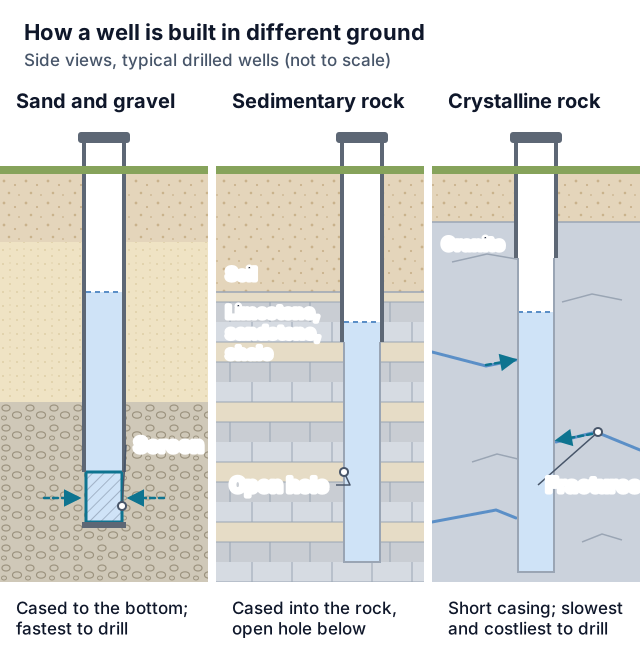
- Bedrock wells cased to NR 812.14 minimums for sandstone, limestone or dolomite
- Pump, pitless adapter and pressure tank work by licensed pump installers
- Property transfer well and pressure system inspections
- Filling and sealing unused or noncomplying wells
- Disinfecting and resampling after a flood or a coliform-positive test
What Drives Pricing Here
- Notice fee: DNR's notification page, read October 28, 2026, lists $50.50 for a Well Construction Notification, not refundable or transferable; buying online through the Quick Sales Catalog or a GoWild account adds a convenience fee.
- Casing minimums: NR 812.14(2) calls for at least 30 feet of casing in a well finished in sandstone; in limestone or dolomite, 40 feet where that rock starts 20 feet or more below ground, or 60 feet where it starts shallower. Bedrock wells must be at least 6 inches in diameter. The 2023 WGNHS report says carbonate bedrock is within 50 feet of the surface in much of its study area.
- Near a quarry: Table A keeps wells 500 feet from one, but NR 812.12(4) lets a well go closer when casing and upper enlarged drillhole depths are measured from the permitted quarry bottom, each goes 20 feet past the bedrock minimum, and the annulus is grouted with neat cement. No setback variance is needed where the quarry floor is or will be higher than the ground at the well, or the quarry is no longer used and permanently filled with water.
- Calculator caveat: for its sedimentary-rock option (limestone, sandstone, shale) this site's estimator prices drilling and casing at $35 to $55 per foot of whatever depth you type, and it also carries a $200 to $500 line labeled as a well permit that varies by county, plus optional pump and pressure tank lines; its per-foot rates and pump and tank costs come from national HomeGuide, Angi and HomeAdvisor pages. No published Grant County depth is offered here to enter, so ask drillers to quote from logs of nearby wells.
- Pump setting: the 2023 report notes that water in deep wells finished in the lower aquifer can stand far below the level in shallower upper-aquifer wells. Ask a licensed pump installer how your measured water level affects the pump and the price.
Permits & Local Rules
- Notification: DNR says the property owner must notify DNR before any new private well that is not high capacity is built, drilled or driven point alike; high capacity wells, reconstruction of existing wells and wells on Native American property are excepted, and wells needing written DNR approval follow that approval's notice terms. Owner or constructor may buy the number, but the constructor must hold a receipt copy showing it before starting.
- Who may drill: NR 812.10(1) requires a licensed water well driller except for an individual drilling on real estate they own or lease, employees of a licensed driller or registered drilling business, and people building driven point or nonpotable wells, all of whom must still meet the rest of the subchapter. Under Wis. Stat. 280.15(3r), an individual who is not a licensed driller or a registered drilling rig operator may drill only under the supervision of a licensed driller or registered drilling rig operator who is on the site. That does not apply to an individual drilling on real estate the individual owns or leases (280.15(4)), or to an individual drilling a public well for a local governmental unit who applies for drilling rig operator registration no later than 14 days after beginning that drilling.
- Who may install pumps: NR 812.27(1) requires an NR 146 license for pump installing on a potable well. NR 146.03(2)(c) exempts a competent sanitary engineer preparing plans and specifications for, or supervising the installation of, water systems that a licensed installer or registered pump installing business installs, where the engineer prepared those plans and specifications; a waterworks superintendent doing the same for water systems the superintendent is responsible for; employees of a licensed installer or registered pump installing business; people installing pumps in nonpotable wells; and a qualified welder installing a welded pitless adapter or pitless unit under contract with a licensed installer or registered business; NR 146.03(2)(e) lets a licensed driller, or a registered drilling business's employee, set a temporary test pump to check capacity or water quality, or install or replace a well cap or seal. No owner exemption appears.
- Reports: NR 812.10(11) gives the driller or well constructor 30 days after finishing a well, a reconstruction, a dry or unsuccessful drillhole not immediately filled and sealed, a driven point or certain other jobs to file the Well Construction Report with DNR (electronically since January 1, 2023) and the owner, and a replacement-well report must list any well removed from service on the property. A report DNR returns must be corrected and resubmitted within 15 days. DNR wants the notification number under the signature line; owners who build their own well ask DNR for the form.
- Samples: after a new well, the driller or well constructor collects coliform and nitrate samples before the well goes into service and within 30 days of completion, gives the owner lab reports within 10 days of receiving them, and alerts the owner as soon as practicable, within 48 hours of the lab's notice, to a coliform-positive or over-standard result (NR 812.46). A pump installer entering an existing well for pump work samples for coliform, nitrate and arsenic unless the same licensee took nitrate and arsenic samples there after pump work in the past 6 months, when coliform alone is needed. A coliform-positive new well brings the driller back to diagnose and try to correct it, starting within 10 days of being told or before service begins, whichever is later (NR 812.10(12)).
- Setbacks for wells being built or reconstructed (NR 812.08 Table A, amended effective March 1, 2026; property lines never waive them; dewatering wells approved under NR 812.09(4)(a) are exempt, and DNR may require more for wells needing plan approval) include 25 feet to a septic tank or holding tank; 50 feet to a soil absorption unit or mound under 12,000 gallons a day (200 for school wells, none once the unit is abandoned under SPS 383.33); 50 feet to a pit privy, an animal barn or barn pen measured to the building's nearest outside edge, an animal shelter or an animal yard, while a pet shelter or kennel housing no more than 5 pets needs 8 feet; 150 feet to a temporary manure stack; and 250 feet to earthen, excavated or non-liquid-tight manure storage. Sources named neither in NR 812.08 nor in the table need 8 feet, and a footnote warns farm manure distances in NRCS standards and chs. NR 151 and 243 can differ.
- Floodplains: NR 812.08(3) lets a well be built, reconstructed or replaced in a floodfringe, or reconstructed or replaced in a floodway, if its top is at least 2 feet above the regional flood elevation from the local floodplain zoning ordinance; a new well in a floodway also needs NR 116.12(1)(f) and the local ordinance to allow it.
- Grout: in bedrock wells NR 812.14(7) calls for neat cement or bentonite-cement, placed by an NR 812.20 pressure method, once the upper enlarged drillhole reaches 5 feet or more into rock, lists other materials for shallower holes, and leaves flowing and potable high capacity wells to their own sections. No well may be open to both unconsolidated deposits and bedrock.
- Bentonite chips: where fractures, voids or caverns keep grout from flowing at the surface, NR 812.14(8) lets the driller or well constructor seal the annular space with chips, but only if the upper enlarged drillhole is at least 4 inches larger than the casing's nominal diameter and reaches any such opening found more than 20 feet down; a hole deeper than 60 feet holds no drilling mud or cuttings, and one 60 feet or shallower holds none heavier than 9 pounds per gallon; chips below the water table are screened and poured so they do not bridge, and chips above it are hydrated with water meeting NR 812.11(14). Chips may seal to the surface unless an NR 812.09 approval, a special well casing depth area or an NR 812.43 variance requires cement grout, in which case only the minimum needed to resume NR 812.20 grouting may be used. The well construction report notes the bags or volume used, the depth placed and the reason.
- DNR approval first: NR 812.09(4) requires prior DNR approval for, among other things, any NR 812.43 variance, wells in special well casing depth areas where the designation list says so, pits, dug wells and springs used for drinking water. Requests go in writing, except that when a situation needs an immediate response DNR may grant a verbal approval followed by written confirmation (NR 812.09(1)). The driller, well constructor, pump installer or contractor gets a copy of the approval before any work and keeps it on site, though after a verbal approval the driller, pump installer or contractor may start before the written confirmation arrives if they follow the approval's conditions (NR 812.09(5)). The owner or authorized agent notifies DNR at least one working day before construction under an approval starts, in the manner the approval specifies; an approval is void if the work has not begun within 2 years of its date, and modified plans need written approval before construction (NR 812.09(4g), (4r), (7)).
Geology & Water Table Notes
- Aquifers: WGNHS Open-File Report 2023-02, Assessing Private Well Contamination in Grant, Iowa, and Lafayette Counties, describes an upper aquifer of fractured Sinnipee Group dolomite and limestone (the Galena, Decorah and Platteville Formations) and a lower aquifer of the St. Peter Sandstone, Prairie du Chien Group, Trempealeau Group and Cambrian sandstones, separated by the Glenwood Shale, with sand and gravel a third aquifer in valley bottoms. It says the Sinnipee is the top bedrock across most of the area and that, since the rock filters little, the soil over it is essential for removing contaminants.
- Olcott's 1968 report named the upper Cambrian group of formations, in which the Mt. Simon and Galesville sandstones were the most productive units, as the county's principal aquifer, noted the St. Peter and Galena-Platteville often sit above the water table in the uplands, and said wells at Platteville and Lancaster passed through about 1,700 feet of sedimentary rock before reaching crystalline rock.
- Sampling results for Grant County in the 2023 report (Table A3): of 122 wells sampled in November 2018, 38% were positive for total coliform, 7% for E. coli and 12% had nitrate-nitrogen above 10 mg/L, 43% showing coliform or high nitrate; of 250 sampled in April 2019, the shares were 14%, 1%, 13% and 25%.
- Of 52 Grant County wells tested for fecal sources, chosen at random from wells positive for coliform or high in nitrate, 25 showed a human wastewater marker, 11 a cattle or ruminant marker and 4 a pig marker (Table A4). Across the three counties, microbes were generally more common after rain and where bedrock is shallow, and both microbes and nitrate in older, shallower wells; the report calls these probabilities, not certainties.
Communities Served
Lancaster · Platteville · Boscobel · Fennimore · Cuba City · Dickeyville · Hazel Green · Potosi · Cassville · Bloomington · Muscoda · Montfort
Emergency Response Expectations
If floodwater covered the casing, or the water's taste, color or sediment changed, DNR says to stop drinking it or cooking with it, use a known safe source, and boil the well water for one minute only if no convenient safe source exists. It says disinfecting the well and plumbing is best done by a licensed driller or pump installer, though owners may follow DNR's procedure, and calls for a certified-lab coliform test before reuse. Requests sent here go to independent contractors, and response times are theirs to set.
Grant County FAQs
Does Grant County issue its own well permit?
We found no well chapter in the county code and no county well permit. DNR's $50.50 notification number is still needed before a new private well, except for high capacity wells and wells on Native American property, and a well that needs written DNR approval follows the notice terms in that approval; check with Conservation, Sanitation and Zoning for anything local.
Can a Grant County landowner drill their own well?
Yes, without a driller license, if you own or lease the real estate (Wis. Stat. 280.15(4)), but the well must meet NR 812, DNR's notification rule and its exceptions still apply, and you ask DNR for the Well Construction Report form. Neither the pump installer exemptions nor the filling and sealing rules include an owner exception.
What testing schedule does Wisconsin recommend for private wells?
DNR recommends bacteria yearly and when taste, color or smell changes; nitrate yearly and before use by someone who is or may become pregnant; and arsenic every five years for most users, yearly after an earlier arsenic detection or in Outagamie, Winnebago or Brown counties. The Grant County Health Department's 2025 annual report says it gave free test kits that year to pregnant moms and to households with a child under 1.
What if nitrate tests at 10 mg/L or more?
DHS says anyone who is or may become pregnant should switch at once to other water for drinking and for foods that absorb a lot of water, babies should get other water for drinking and formula, and bathing, toothbrushing and dishwashing are fine. Retest; if still high, everyone should use other water for drinking and those foods, and DHS names a certified treatment device or a new well as long-term fixes.
Who may inspect a well when a property sells?
DNR says state law does not require a well inspection or water test for a sale. Anyone paid to inspect wells and pressure systems in contemplation of a transfer must be a licensed driller authorized for well drilling or a licensed pump installer (Wis. Stat. 280.30(3), NR 146.11(2)), except employees of a county that has adopted a Level 3 delegation program under ch. NR 845, inspecting as part of their county duties under NR 812 subchapter VI and on DNR form 3300-221 (NR 146.11(7)). The inspector may not delegate sampling: coliform, nitrate and arsenic for each potable well, coliform for each nonpotable well (NR 812.46(6)). Under NR 146.11(3), collecting a sample needs no license only if that is the only work done, the certified laboratory reports results on a laboratory form, and neither the collector nor the lab offers statements or opinions on the well or pressure system's location, compliance, condition, capacity or performance, or on wells that must be filled and sealed.
Who may fill and seal an unused well?
A licensed driller authorized by DNR for well drilling or a licensed pump installer; someone under such a licensee's supervision or employed by a licensed driller, licensed pump installer or registered well drilling or pump installing business; or a water system operator certified under Wis. Stat. 281.17(3), or someone under that operator's supervision, but only for a well within the service area of the local governmental water system for which the operator works (Wis. Stat. 280.30(2), NR 812.26(3)). The supervising licensee or certified operator need not be present, and anyone exempt from licensing must still meet the rest of NR 812.26. The owner must arrange it once a well has gone unused for more than 90 days (more than 3 consecutive years for a seasonal or high capacity irrigation well), or in the other cases NR 812.26(4)(a) lists, and whoever does the work files the report with DNR electronically within 30 days.
Sources
- Wisconsin Statutes ch. 280: Well Drilling, Heat Exchange Drilling, and Pump Installing (published October 1, 2026)
- Wis. Admin. Code ch. NR 812: Well Construction and Pump Installation (Register February 2026 No. 842)
- Wis. Admin. Code ch. NR 146: driller and pump installer licensing
- Wisconsin DNR: Well and heat exchange notification
- Wisconsin DNR: Information for private well owners
- Wisconsin DNR: Test your private well water annually
- Wisconsin DNR: Well filling and sealing
- Wisconsin DNR: Buying or selling property with a private well
- Wisconsin DNR: Private wells inundated by flooding
- Wisconsin DHS: Drinking Water: Nitrate and Nitrite
- WGNHS Open-File Report 2023-02: Assessing Private Well Contamination in Grant, Iowa, and Lafayette Counties
- WGNHS Open-File Report 68-5 (Olcott): Availability of Ground Water in Grant County
- Grant County Health Department: 2025 Annual Report
- Grant County: Conservation, Sanitation, and Zoning
- Grant County code on eCode360
- Census Bureau 2020 place-by-county codes for Wisconsin
Last reviewed 2026-10-29
Nearby Counties
Services Available in Grant County
Well Drilling
New residential wells — find local drillers for site evaluation, depth estimates, and written drilling quotes.
Learn more →Water Well Drilling
Household water wells from site evaluation through casing, pump, and water test — written quotes from local drillers.
Learn more →Well Pump Repair
No water at the tap? Request urgent well pump repair — local pros diagnose pressure loss, dead pumps, and pressure tank failures fast.
Learn more →Well Pump Replacement
Pump at end of life or beyond repair? Get quotes for correctly-sized submersible and jet pump replacement from local well pros.
Learn more →Well Inspection & Testing
Buying a home with a well, or overdue for a water test? Local pros for flow tests, equipment inspection, and lab water-quality testing.
Learn more →Well Water Service
Water quality problems, treatment systems, and general well maintenance — connect with local pros for everything between drilling and pump work.
Learn more →Free Tools Before You Call
Ballpark the cost or narrow down the problem before talking to a Grant County provider.
Well Drilling Cost Calculator
Estimate what drilling a well should cost — by depth, geology, and whether you need the pump and pressure tank included.
Use the free tool →No Water From Your Well? Diagnostic Wizard
Suddenly no water in the house? Answer a few questions to find out if it's the breaker, the pressure switch, the tank, the pump — or the well itself.
Use the free tool →Well Pump Size Calculator
Find what size well pump you need — GPM demand, total dynamic head, and a horsepower recommendation from four quick inputs.
Use the free tool →Need help in Grant County, WI?
Send the short form — urgent requests get priority routing.