Well Drilling in Seneca County, NY
Well drilling typically runs $3,000–$16,000 nationally, per our cost guide. Independent local pros serving Seneca Falls, Waterloo, Romulus and nearby communities. Describe the problem and we'll route your request — free, no obligation.
- Mark no-water pump problems as emergencies on the form
- County pages on local well depths, aquifers, and permits
- Well inspections, water testing, and treatment
- Free to use — no obligation, no markup
Fast response from independent local providers. No obligation.
Typical national cost$3,000 – $16,000Cost guide →Local Help in Seneca County, NY
For a private well in Seneca County, the local office to ask is the Seneca County Health Department (SCHD) in Waterloo. Its Environmental Health staff enforce most of the New York State Sanitary Code, including protection of public drinking water supplies, and the department lists private wells among the topics on which it gives technical advice. Its handout for well owners adds that SCHD can supply a list of registered drillers and explain how to abandon an unused well properly.
State law sets the core rules. Under Environmental Conservation Law §15-1525, a business that drills water wells anywhere in New York needs a DEC (Department of Environmental Conservation) registration certificate first, and every well has to be drilled to the Health Commissioner's rules adopted under Public Health Law §206(18), published as Appendix 5-B of 10 NYCRR. We are a referral service only: Seneca County requests go to independent contractors, and we do not drill wells or service pumps.
Seneca County Service Details
What providers in this area actually see: coverage, common jobs, local pricing factors, and rules worth knowing.
Service Area Notes
- We take requests from the whole county. Census TIGERweb's current county-subdivision layer shows ten towns (Covert, Fayette, Junius, Lodi, Ovid, Romulus, Seneca Falls, Tyre, Varick and Waterloo) plus a piece of the City of Geneva. Interlaken, Lodi, Ovid and Waterloo are incorporated villages; the Census place list carries Seneca Falls and Romulus as census-designated places rather than villages.
- Find out first whether a water district reaches the lot. In the 2024 water quality reports SCHD posts, the Village of Waterloo draws from Seneca Lake, and the reports for Fayette Water Districts 1, 2, 5 and 6, the Romulus Water District, Seneca Lake Water District #1 in Varick and the Seneca County Water District say their water comes from Waterloo, directly or through another district; the Seneca Falls Water District takes Cayuga Lake water. NYSDOH tells private well users to take steps to connect to a public water system if they have the opportunity.
- To vet a contractor, search DEC's online Water Well Contractor Search Tool or ask SCHD for its list. Depths and yields of neighboring wells may show up in the completion-report records DEC publishes through DECinfo Locator, data DEC says it has not verified in most cases.
Common Jobs in Seneca County
- Drilling new wells for homes beyond a water district; the driller notifies DEC before starting and files a completion report at the end
- Replacing dug wells, which SCHD's handout says the department does not recommend as potable water supplies
- Shock disinfection of a new well (the handout notes drillers often do this at installation), followed by total coliform and E. coli tests once no chlorine is left in the water
- Pump, pitless adapter and drop-pipe work inside the casing, overseen on site by someone who meets the state's pump-exam requirement (see the permit notes below)
- Extending casing and upgrading caps on wells in flood-prone spots, work NYSDOH's flood-recovery booklet says a registered well driller should perform
- Decommissioning unused wells found on a property, which SCHD says should be properly abandoned to protect the groundwater source
What Drives Pricing Here
- Depth: we know of no published county-wide depth figure. DEC's consumer guide is plain that no standard depth exists; it names local geology, natural water quality, health standards, yield and storage needs, drilling equipment capabilities and cost as the factors. The NYS Geological Survey's Drift Thickness of Seneca County map (Map & Chart 169) shows the thickness of drift over bedrock, derived from a bedrock surface built on 999 bedrock control points, 936 of them water wells; a contractor can read it alongside nearby well logs.
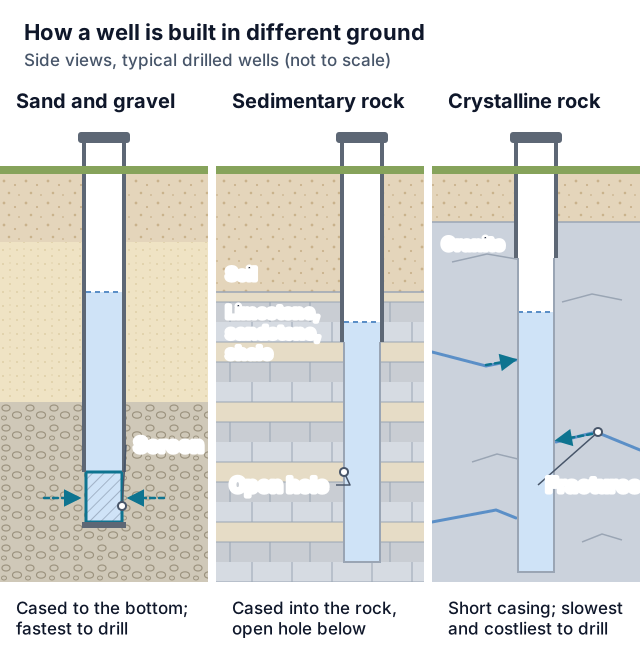
- Casing: the state minimum in Appendix 5-B, section 5-B.3(b)(4), runs from 1 foot above to 19 feet below finished grade, with two exceptions. Table 2 can demand a longer total length in some geology, and when a shallow aquifer is the only workable source and the well must stay under 19 feet deep, the Department or the local health department may allow casing under 20 feet if extra safeguards are added, for example bigger setbacks under Table 1, Note 1. SCHD's handout asks for more as guidance: casing should go at least 50 feet below the ground surface, stand at least 1 foot above it, and reach at least 2 feet above the 100-year flood elevation. Ask SCHD how it applies the 50-foot figure before you compare bids.
- Grouting: if rock is closer than 19 feet to the surface, section 5-B.3(b)(16) requires drilling an oversized hole and sealing the casing with grout down to 19 feet or 5 feet into competent rock, whichever goes deeper. For wells finished in rock, Table 2 turns on what lies above it. Beneath 19 feet or more of clay, hardpan, till, shale or similar material, the casing is seated firmly in the creviced or fractured rock and the annulus is grouted, with hole sizes and placement methods given in the table and its notes; beneath 19 feet or more of caving sand or gravel, the casing is still seated in rock but no grout is required.
- Yield test: section 5-B.4 requires every new or redeveloped well to be yield-tested before use. The standard version should include at least 4 hours of steady drawdown while pumping at a constant rate, then watching recovery until the level recovers to 90 percent of the starting level or 24 hours have passed, whichever comes first. Subdivision (c) permits a modified standard test, or another test meeting the section's performance requirements, when the local health department judges hydrogeologic information adequate and conditions uniform; when the test is directed and certified by an experienced hydrogeologist or a licensed professional engineer; when planned use is below 500 gallons a day, using pumping, bailing or air-lift methods; or, for a flowing artesian well whose flow at least equals the desired use rate, by measuring that flow directly.
- Our calculator: we have no Seneca County price survey. The site's cost calculator multiplies depth by a per-foot rate and adds lines for the pump, pressure tank and permit, using national figures from Angi, HomeGuide and HomeAdvisor, and its permit line is only a placeholder; SCHD's environmental health fee schedule updated January 1, 2026 lists no private well permit fee. Get written per-foot quotes from contractors.
Permits & Local Rules
- DEC registration: the yearly fee in §15-1525 is $10, DEC says each certificate stays in effect through March 31 of the next year, and the registrant's number has to appear on its well drilling machinery. The certificate also tells its holder that the business falls under General Business Law article 36-A, which DEC's consumer guide explains as a written-contract requirement for home improvement work and materials costing more than $500. Public corporations, political subdivisions and government agencies are exempt, the guide says. On owner-drilled wells, the guide cites the State Building Code as requiring that every well be drilled by a registered contractor, and NYSDOH quotes Residential Code P2602.1.1, under which private wells must be installed by a DEC-registered driller and meet Appendix 5-B.
- On-site supervisors: since January 1, 2003, whoever is in charge on site during drilling must have scored 70 percent or higher on NGWA's two-part certification exam or on an equivalent exam the commissioner offers or approves, and must produce proof if an enforcement officer demands it. For pump repairs or installations that open the casing, the person supervising on site needs a 70 percent or better result on an NGWA- or Water Systems Council-developed exam, or on an equivalent the commissioner offers or approves, with the same duty to show proof. According to DEC's guide, pitless adapters and pumps inside wells are covered, while piping, pumps and treatment gear outside the well are not.
- Paperwork: before the rig starts, the registered driller files a preliminary notice with DEC. Once the well is done, the driller files a completion report giving the log, the well's size and depth, the capacity of any pump attached or planned, and other information DEC's rules call for, and gives the owner a copy. DEC's registration packet asks that the report go to DEC and the owner within 30 days after construction is completed, and the consumer guide says DEC charges nothing for it. Under section 5-B.4(a)(5), a new well's tested yield goes on the report, and the test data go to the owner and, on request, to state or local agencies with jurisdiction.
- Local permits: DEC's guide says its own permits apply only to Long Island wells producing more than 45 gallons per minute and geothermal wells deeper than 500 feet, and that some counties require a local permit. NYSDOH notes that code enforcement officials check a well's location and construction before they issue a building permit or certificate of occupancy, and SCHD's handout warns new-home builders and owners that no certificate of occupancy will be given until the water tests negative for total coliform. Ask SCHD and your town's code office what they require before drilling.
- Where the well goes: section 5-B.2 asks for a site with adequate access for inspection, maintenance, repair, renovation, treatment and testing, out of reach of seasonal flooding or surface water contamination (or built so floodwater cannot enter), and upgradient of known or potential contamination unless property lines, topography, structures and access require otherwise. The ground around the casing must slope surface water away, and concrete may not be used for that grading. The Table 1 distances must be kept. Under section 5-B.1(a)(2), new and replacement wells may deviate from Appendix 5-B only at the discretion of the Department or the local health department, through a waiver under Part 75, a variance under Subpart 5-2, a written approval issued before December 1, 2005, or a written approval a local health department grants under a local sanitary code.
- Farm setbacks in Table 1: land spreading or subsurface injection of liquid or solid manure, and storage areas for manure piles, each need 200 feet. Barnyards, silos, barn gutters and animal pens need 100 feet, rising to 200 feet when they sit in coarse gravel or upgrade of the well and directly in its drainage path; small pet shelters or kennels housing three or fewer adult pets do not count as animal pens. Fertilizer or pesticide mixing and clean-up areas need 150 feet. The manure-spreading distance may drop to 100 feet based on on-site evaluations of agricultural properties under Agricultural Environmental Management or comprehensive nutrient management plan programs by a certified nutrient management planner or soil and water conservation district official. A well may also sit 100 feet from temporary manure piles or staging areas (30 days or less) controlled to preclude contamination of surface water or groundwater, or from other managed piles controlled under regulation so they cannot contaminate either.
- Septic and other setbacks in Table 1: a watertight effluent line to the distribution box, a septic tank or an aerobic unit, 50 feet; an absorption field or bed, non-watertight septic parts, or an intermittent sand filter lacking a watertight liner, 100 feet; a seepage pit following a septic tank, 150 feet; a cesspool, or a wastewater absorption system in coarse gravel or the well's direct drainage path, 200 feet; streams, lakes, watercourses, drainage ditches and wetlands, 25 feet. The absorption fields, seepage pits, non-watertight parts and unlined sand filters also move out to 200 feet if they lie in coarse gravel, or upgrade of the well and directly in its drainage path. The table also covers privies, cemeteries, chemical and petroleum storage, landfills and sewers, and puts 100 feet between a well and any known source it does not otherwise list. Each Table 1 distance increases by 50 percent where aquifer water enters the well less than 50 feet below grade; if that is not achievable, the largest possible increase is required, plus whatever additional measures are needed to prevent contamination. SCHD's handout gives its own short list (any building 10 feet, property lines 15 feet, septic tank 50 feet, sewage system 100 feet, stream, lake or wetland 50 feet); where Table 1 sets a larger distance for a particular source, such as a seepage pit, the state figure is the floor.
- Old and unused wells: section 5-B.6 points to Appendix 5-A for capping, abandonment and decommissioning. On its program page, DEC says every well must be kept up or properly decommissioned by a well driller registered in New York, and asks that its Water Well Abandonment and Decommissioning Report be sent to DEC. NYSDOH's Fact Sheet #4 allows that a homeowner may decommission a well but strongly recommends hiring a DEC-registered driller, says to check requirements with the local health department first, and says the pump, drop pipe and electrical controls have to be pulled from the casing before abandonment.
Geology & Water Table Notes
- Between two lakes: the NYS Geological Survey's Bedrock Topography of Seneca County map (Map & Chart 168, revised edition 168.1) describes a county that extends from the Erie-Ontario Lowlands to the Allegheny Plateau and sits along Cayuga and Seneca lakes. The survey compiled surface and subsurface bedrock data into one database and separated bedrock from the unconsolidated sediment above it; it says the result reveals Paleozoic bedrock erosional profiles and evidence of past glaciation.
- Salt and gypsum shale in the north: USGS Scientific Investigations Report 2021-5086 (2022) studied an area that takes in the northern parts of Ontario and Seneca counties. It reports that the Camillus and Vernon Shales under the middle and southern parts of that area hold beds of gypsum and salt; where those beds have dissolved, domestic wells can get fairly high yields, but the dissolved mineral content makes the water unsatisfactory for drinking in most places. Hydrogen sulfide, salt and iron show up in varying amounts, and wells deeper than 100 feet generally intersect salt layers that yield high-chloride brine and gypsum layers that cause high noncarbonate hardness. Citing a 1951 study, it says most bedrock wells producing satisfactory drinking water penetrate less than 30 feet of bedrock.
- Karst: USGS built geospatial datasets for karst-prone areas in Seneca and Wayne counties to help resource managers protect groundwater. Its companion methods report (SIR 2021-5094) says karst between Albany and Buffalo occurs in carbonate and evaporite bedrock of Silurian and Devonian age, that karst aquifers are especially susceptible to the unintended introduction of industrial and agricultural contaminants, and that focused recharge potential is greatest where bedrock is at the land surface or closed depressions exist. NYSDOH counts wells in creviced rock such as limestone among the hardest to decommission and points drillers to AWWA Standard A100.
- Village wells as a guide: Interlaken's 2024 water report says its supply is a single drilled well 25 feet deep that draws from fractured bedrock beneath a lower-permeability layer. Ovid's report says the village uses Seneca Lake water but keeps two drilled wells on East Seneca Street that have served only as an emergency backup for the last 11 years; the state's source water assessment rated those wells medium-high in susceptibility to protozoa, enteric viruses and enteric bacteria, mainly because of the close proximity of low-intensity residential land use in the wells' recharge area.
- Testing near fields: SCHD's handout says to test for pesticides and herbicides if a well is close to an area used for agriculture, and for volatile organic chemicals if oil, petroleum or solvents are stored nearby or there has been a spill. NYSDOH's testing fact sheet, drawing on EPA guidance, lists nitrate, pesticides, arsenic and coliform bacteria for wells near intensive agriculture, and hydrogen sulfide, pH and metals when water has an objectionable taste or smell.
Communities Served
Seneca Falls · Waterloo · Romulus · Fayette · Varick · Ovid · Lodi · Interlaken · Covert · Junius · Tyre
Emergency Response Expectations
If floodwater covered your well or spring, even for a short time, SCHD says to treat it as contaminated, not drink from it, and contact its Environmental Health office for directions on disinfecting and testing. NYSDOH's flood booklet, which SCHD posts, says not to turn the pump on until the well has been assessed and repaired as needed, and recommends hiring a water well contractor to disinfect a point well or one served by a jet pump. For suspected gasoline, heating oil or chemical contamination, NYSDOH says to contact the health department and DEC's Spill Hotline, and warns that neither boiling nor disinfecting removes oil and other chemicals. We forward urgent no-water requests, but no response time is guaranteed.
Seneca County FAQs
Does Seneca County require a permit to drill a well?
Ask SCHD and your town's code enforcement office before work starts. NYSDOH's guidance for code officials says some counties may have their own approval requirement for new and replacement wells and tells readers to contact the local health department. DEC's guide limits DEC permits to Long Island wells producing more than 45 gallons per minute and geothermal wells deeper than 500 feet, adding that a local permit is needed in some counties. NYSDOH also says code enforcement officials review a home well's location and construction before issuing building permits and certificates of occupancy.
What should a new well in Seneca County be tested for?
SCHD's handout says the water must be tested for total coliform and E. coli after shock disinfection, once no chlorine remains, and recommends a fuller panel: coliform, chloride, lead, nitrate, nitrite, iron, manganese, sodium, pH, hardness and turbidity. NYSDOH's list for new wells adds arsenic, sulfate and alkalinity and recommends added tests for constituents that appear regionally, such as radon, radium, uranium, methane, barium and fluoride. NYSDOH says samples should go to a lab certified under its Environmental Laboratory Approval Program (ELAP).
How often should I retest a well I already have?
SCHD says to test for coliform bacteria and nitrate every year, and more often if the taste, smell, color or clarity of the water changes. It strongly suggests testing when neighbors find a particular contaminant or there is unexplained illness in the household, and says the water should always be tested when someone in the home is pregnant or there are small children. NYSDOH adds testing for other contaminants every 3 to 5 years.
Where can I pick up sample bottles?
SCHD's public water supplies page lists the Waterloo Water Treatment Plant, the Waterloo Town Offices, the Seneca County Health Department, Community Science Lab and Romulus Town Hall as places to pick up bottles for water testing.
Can I keep using an old dug well?
SCHD does not recommend dug wells as potable water supplies. NYSDOH's guidance for code officials says dug wells built with stone or brick shoring, and single-pipe driven point wells under suction, do not comply with Appendix 5-B and should be avoided, and that dug wells, well points, springs and shore wells may need local health department approval.
Sources
- Seneca County Health Department: Environmental Health
- Seneca County Health Department: Public Water Supplies (flooded wells, sample bottles, 2024 water reports)
- Seneca County Health Department: Private Wells handout
- Seneca County Health Department: Environmental Health Fee Schedule (updated January 1, 2026)
- Village of Interlaken: 2024 Annual Water Quality Report
- Village of Ovid: 2024 Annual Water Quality Report
- NYSDOH: Restoring and Testing Your Private Well After a Flood (posted by SCHD)
- NYS Environmental Conservation Law §15-1525: water well driller registration
- NYSDEC: Water Well Contractor Program
- NYSDEC: Water Well Consumer Protection Guide
- NYSDEC: Water Well Contractor Program registration packet
- NYSDOH: 10 NYCRR Part 5, Subpart 5-1, Appendix 5-B, Standards for Water Wells
- NYSDOH: Private Wells
- NYSDOH Fact Sheet #3: Recommended Residential Water Quality Testing
- NYSDOH Fact Sheet #4: Decommissioning Abandoned Wells
- NYSDOH Fact Sheet #6: Guidance for Code Enforcement Officials
- NYS Geological Survey: Bedrock Topography of Seneca County, Map & Chart 168.1
- NYS Geological Survey: Drift Thickness of Seneca County, Map & Chart 169
- USGS SIR 2021-5086: Hydrogeology of aquifers within the Fairport-Lyons channel system and adjacent areas in Wayne, Ontario, and Seneca Counties (2022)
- USGS SIR 2021-5094: Methods for an assessment of karst aquifer systems between Albany and Buffalo, New York
- USGS data release: Geospatial datasets to assess karst aquifer systems in Seneca and Wayne counties, New York
- U.S. Census Bureau TIGERweb: county subdivisions of Seneca County, NY (current layer)
- U.S. Census Bureau: 2020 places by county, New York
Last reviewed 2026-10-29
Services Available in Seneca County
Well Drilling
New residential wells — find local drillers for site evaluation, depth estimates, and written drilling quotes.
Learn more →Water Well Drilling
Household water wells from site evaluation through casing, pump, and water test — written quotes from local drillers.
Learn more →Well Pump Repair
No water at the tap? Request urgent well pump repair — local pros diagnose pressure loss, dead pumps, and pressure tank failures fast.
Learn more →Well Pump Replacement
Pump at end of life or beyond repair? Get quotes for correctly-sized submersible and jet pump replacement from local well pros.
Learn more →Well Inspection & Testing
Buying a home with a well, or overdue for a water test? Local pros for flow tests, equipment inspection, and lab water-quality testing.
Learn more →Well Water Service
Water quality problems, treatment systems, and general well maintenance — connect with local pros for everything between drilling and pump work.
Learn more →Free Tools Before You Call
Ballpark the cost or narrow down the problem before talking to a Seneca County provider.
Well Drilling Cost Calculator
Estimate what drilling a well should cost — by depth, geology, and whether you need the pump and pressure tank included.
Use the free tool →No Water From Your Well? Diagnostic Wizard
Suddenly no water in the house? Answer a few questions to find out if it's the breaker, the pressure switch, the tank, the pump — or the well itself.
Use the free tool →Well Pump Size Calculator
Find what size well pump you need — GPM demand, total dynamic head, and a horsepower recommendation from four quick inputs.
Use the free tool →Need help in Seneca County, NY?
Send the short form — urgent requests get priority routing.