Well Drilling in Grand Traverse County, MI
Well drilling typically runs $3,000–$16,000 nationally, per our cost guide. Independent local pros serving Traverse City, Kingsley, Fife Lake and nearby communities. Describe the problem and we'll route your request — free, no obligation.
- Mark no-water pump problems as emergencies on the form
- County pages on local well depths, aquifers, and permits
- Well inspections, water testing, and treatment
- Free to use — no obligation, no markup
Fast response from independent local providers. No obligation.
Typical national cost$3,000 – $16,000Cost guide →Local Help in Grand Traverse County, MI
A U.S. Geological Survey review of each Michigan county's groundwater, Open-File Report 2007-1236, used the February 2005 Wellogic database to estimate that approximately 97 percent of Grand Traverse County's wells were finished in glacial deposits and 0 percent in bedrock units, while 3 percent had too little information to sort. Bedrock lies under the glacial deposits, the report says, but is not currently used for water supply.
Well construction permits here come from the Environmental Health Division of the Grand Traverse County Health Department (GTCHD), which describes its job as evaluating proposed well locations and permitting wells for private homes and small businesses. Applications may be submitted through EPIC GT, the county's online permitting system. Once the permit is issued, the applicant gives it to a registered well driller of the applicant's choosing, and GTCHD says registered drillers must follow the regulatory codes of both the State of Michigan and Grand Traverse County. This site only forwards requests to independent contractors; it does no drilling, pump work or water testing of its own.
Grand Traverse County Service Details
What providers in this area actually see: coverage, common jobs, local pricing factors, and rules worth knowing.
Service Area Notes
- Community names: the Census Bureau's 2020 place-by-county file lists Traverse City city (which the file also lists under Leelanau County), the villages of Fife Lake and Kingsley, and the Chums Corner, Grawn and Interlochen census-designated places under Grand Traverse County. Its 2020 county subdivision file lists Traverse City with Acme, Blair, East Bay, Fife Lake, Garfield (a charter township), Grant, Green Lake, Long Lake, Mayfield, Paradise, Peninsula, Union and Whitewater townships, and the Census Bureau's current TIGERweb layers carry the same names.
- Looking up an existing well: GTCHD's well page links to EGLE's Wellogic database of construction records for wells drilled in Michigan since 2000, and its Environmental Health page says archived well and septic records are now available online. EGLE describes Wellogic as holding over a million records that anyone can view and search by 22 fields without an account, which is needed only for submitting or modifying data.
- Checking a contractor: EGLE's Source Water Unit registers water well drilling contractors, dewatering contractors, limited well drilling contractors, pump installers and well drilling rigs every year. Its registration page says all registrations expire April 30 by law, renewal applications must be in by March 1, and a contractor that fails to renew by May 1 cannot do any well drilling or pump installation until the registration is renewed.
Common Jobs in Grand Traverse County
- New private and Type III public wells, permitted through EPIC GT
- Wells for Type II noncommunity supplies, which GTCHD describes as providing water for drinking or domestic purposes to 25 or more people on 60 or more days a year, or having 15 or more service connections; these also need a well permit before construction
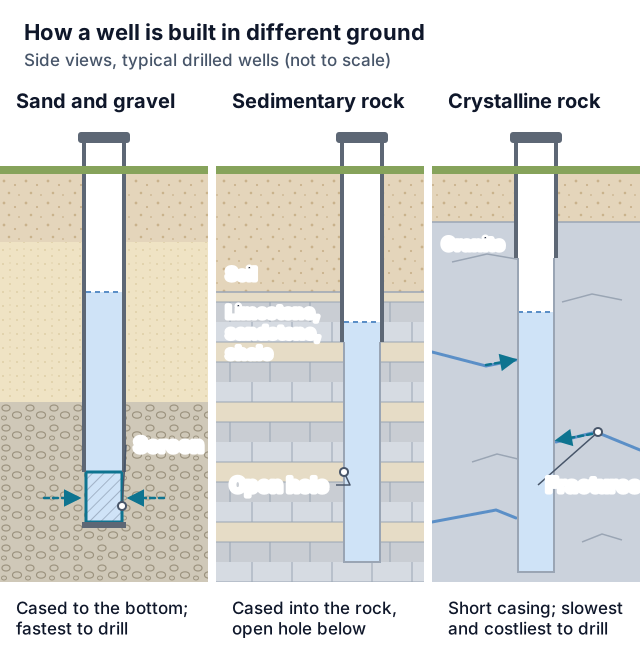
- Screened wells in sand and gravel, developed and pumped to waste at a rate at least equal to the permanent pump's until the water is as clear as is reasonably possible for local groundwater conditions (R 325.1639)
- Extensive changes to an older well, such as replacing the entire casing, removing a casing or changing aquifers, which must meet the current rules unless a deviation is issued (R 325.1611(1))
- Pump, controls, drop pipe and pressure tank replacements, which R 325.1611(2) counts among minor repairs that do not force the rest of the system to be upgraded
- Well and septic status reviews, which GTCHD says many local permitting agencies require for projects such as remodels or garages and outbuildings with plumbing
- Water supply evaluations by GTCHD-certified evaluators before a covered home near surface water is sold or transferred
- Plugging abandoned wells, including any well abandoned at the time municipal water is installed, as R 325.1662(3) requires
What Drives Pricing Here
- Permit fees: GTCHD's 2026 Environmental Health fee schedule charges $240 for a private or Type III well, $600 for a Type II well and $180 for a Type II conversion. Its after-the-fact fee is double the permit fee. Renewing a permit costs 50 percent of the original permit fee for an additional 2 years under the renewal policy the schedule refers to, and a permit amendment is $100 when administrative only or $150 when it includes additional fieldwork.
- Other county charges on that schedule: $40 for a well/septic status form, $160 for water sample collection including coliform and nitrate, and $200 for a preliminary site review that may cover well, septic and/or soil erosion review, half of which may be applied to a permit application within 1 year.
- Ballpark math: this site's drilling cost calculator has no Grand Traverse data. You type in a depth and pick a geology, and it multiplies that depth by a per-foot band set for the geology you chose, then adds a flat permit allowance plus pump and pressure tank allowances unless you switch those off. None of those bands or allowances is specific to this county, so its output is only a rough figure, not a quote from anyone working here.
- Depth: we found no published county-wide median or typical well depth. The USGS county summary says that where outwash and coarse-grained lake deposits are at the surface, groundwater is unconfined and wells are often shallow, less than 100 feet deep, while lower glacial units are confined or semi-confined by till and clay layers; it gives the glacial deposits a thickness of 0 to 900 feet. Logs of nearby wells can be searched in Wellogic.
- Casing: R 325.1632(3) sets the minimum casing length at 25 feet below ground and the minimum stickup at 12 inches above it. If a well has under 26 feet of casing, nobody may use it unless the health officer approves it in writing under R 325.1613, a rule that lists the specific cases where shallower casing can be allowed. Section 3.320 of the county's Environmental Health Regulations also bars installing a well less than 25 feet deep without the health officer's written approval, and R 325.1632a(2) bars using a driven well point as a water supply well without it.
- Grouted length: R 325.1634a(1) covers wells drilled by rotary, auger or another drilling method in which the permanent casing goes into an oversized borehole. Those wells get neat cement or bentonite grout, placed as R 325.1633a directs, along the whole length of the casing; where a screen is installed, grouting runs up to the surface from a point 10 feet or less above the top of the screen. The only way to grout less is a health officer's deviation under R 325.1613(2)(f), and that subdivision is limited to wells deeper than 100 feet that do not pass through a confining layer; under R 325.1613(3), every deviation is issued in writing with its reasons stated.
Permits & Local Rules
- Permit before work: Section 3.40 of the Environmental Health Regulations for Grand Traverse County Health Department says that on and after December 31, 1989 no person, or that person's agent or contractor, may build a habitable building or dwelling or any private, semipublic or certain other water supply defined in the code, or install a new water supply or alter an existing one, until approval and a permit from a health officer have been obtained. The applicant and the health officer both sign the permit, one copy goes to the applicant to be posted at the construction site, and the health officer makes whatever site inspections the health officer considers necessary. Building, installing or altering a water supply without the permit and approval counts as a code violation.
- Applying: GTCHD's well page points applicants to EPIC GT. Its paper Septic and/or Well Permit Application, dated March 2022, has to come with an accurate site plan showing the structures, driveway, road names and direction, and existing and/or proposed well and septic locations, and an agent may sign for a permit only with a written authorization statement from the landowner. The form also asks whether an old well will be kept in use, which it says needs health department approval, and the signer authorizes GTCHD to evaluate the property and run any tests needed and agrees to follow the county's Environmental Health Regulations and applicable Michigan law.
- Registration: under MCL 333.12704(1), nobody may take up well drilling or pump installing as a business without first getting a certificate of registration, renewed every year, in the well drilling contractor or pump installer category. The annual fee is $40 for well drilling contractors and $25 for pump installers, with $10 more per year for each additional drilling machine; well drilling contractors may also do pump installer work without paying the pump installer fee (MCL 333.12704(3)). Pump installers, by contrast, are limited to pump installation and may not drill (R 325.1608). A certificate cannot be transferred and expires on April 30; renewing after July 1 costs an extra 50 percent of the basic registration fee on top of the regular fee (MCL 333.12705(2)). At the county level, Section 3.380 of the Environmental Health Regulations says anyone in the business of constructing, installing or servicing potable water supplies or well equipment in Grand Traverse County must register with the Health Department in accordance with Part 127.
- Firms, plumbers and public bodies: when the registrant is a firm, partnership or corporation, it must designate at least 1 partner, officer or responsible full-time employee to take the examination for it (MCL 333.12705(3)). Pump installer work is also open to a master plumber licensed under the state plumbing act, who needs no pump installer registration for it (MCL 333.12703(3)). Counties, cities, villages, townships and other governmental units that drill wells or install pumps still have to register, but they owe no registration fee when the work is done by their own regular employees, with equipment they own, on wells or pumps the unit will use (MCL 333.12704(4)).
- Owner-built wells: MCL 333.12703(2) leaves room for a person to build a well or put in a pump on land the person owns or leases. The exemption holds only if the well is meant solely for the single-family house the person permanently lives in, or solely for farm use on the person's own farm, and no part of its output is intended for the public or for any home but the person's own. Even then, the person has to file the drilling record called for in MCL 333.12707 and follow the rules and construction code issued under MCL 333.12714. Under R 325.1667, a well drilled by someone who is neither the property owner nor a registered well drilling contractor must be abandoned and plugged as the rules direct. Section 3.40 of the county code, summarized above, applies to any person who installs a new water supply.
- State isolation distances (R 325.1622): where hydrogeologic data exist they must be used in choosing the site, the well must sit upgradient of any potential or known contamination source where that is possible, and it goes at the greatest practical distance from such sources. The rule's floors are 800 feet from the active work area of a landfill or from septage waste spread on the land surface; 300 feet from oil and gas wells, from petroleum product processing or storage facilities, from municipal wastewater effluent or digested sludge applied to land or injected below the surface, and from regulated storage tank systems holding 1,100 gallons or more that lack secondary containment; 150 feet from a storage or preparation area for fertilizers, agricultural chemicals or other chemicals with the potential to contaminate soil or groundwater; and 50 feet from a cesspool, seepage pit, septic tank, dry well, subsurface disposal field, grease trap, sewage pump chamber, pressurized sewer, outhouse, animal or poultry yard, any other wastewater handling or disposal unit or site of liquid wastes draining into the soil, and any buried sewer not built to the 10-foot standard below. Fifty feet also applies to regulated tank systems of 1,100 gallons or more that do have secondary containment, and to tanks smaller than 1,100 gallons holding motor or heating fuel kept for noncommercial purposes or for consumptive use where it is stored. The 10-foot floor applies to surface water bodies such as lakes, ponds, rivers and streams; to a sump, pit or unfilled space below ground, other than a crawl space; and to a buried gravity-flow sewer made of service-weight or heavier ductile-iron pipe or schedule 40 PVC plastic, either with watertight joints, or of other pipe and joints the director has approved in writing.
- Changing those distances: a health officer may raise or lower any of these minimums for a single well, but only by issuing a deviation under R 325.1613, whose conditions control (R 325.1622(2)); ask GTCHD whether a lot qualifies. A well that serves a public water supply is isolated under the requirements of R 325.10101 et seq. (R 325.1622(3)), and on land the well owner owns, keeping the distances is the owner's responsibility (R 325.1622(4)). The county code adds its own siting rule: Section 2.431 puts septic tanks at least 50 feet from any potable water supply, well, spring or unprotected suction line and 75 feet from Type II and Type III wells, and Section 2.450 gives subsurface disposal systems the same location requirements.
- Well and pump records: within 60 days after finishing a well, the well drilling contractor delivers its record, 1 copy to the owner and 2 to the department or local health department, and keeps a copy itself (MCL 333.12707; R 325.1675(1)). The record gives the well's depth and location, the owner's name, the amount of casing, static water levels, each geologic material penetrated with its thickness, and anything else the rules require; for a drive point well that removes no earth, it is enough to list the owner's name, the location and depth, the static water level, and the casing and screen data. The department supplies a standard form, though a contractor may use its own form once the department approves it, and within 30 days of receipt, 1 copy goes from the receiving agency to the Department of Natural Resources. The log must carry a registered well drilling contractor's signature (R 325.1675(4)). During drilling, the contractor notes material types and thicknesses on a record kept at the site and open to inspection, and if the contractor does not keep that record or does not submit the log within 60 days of the well's completion date, geophysical logging may be ordered by the department or health officer to check which materials were penetrated and how thick they are (R 325.1675(2), (5)). When a pump goes on a new well, R 325.1676 sets a 60-day deadline for a pump installation record: the owner gets 1 copy, the health officer gets 2 and, within 30 days of receipt, sends 1 on to the Department of Natural Resources, and the contractor or installer keeps 1. The form gives the pump's manufacturer, model number, type, capacity in gallons per minute and motor horsepower plus the drop pipe length, and is signed by a registered well drilling contractor or registered pump installer. Section 3.390 of the county code also requires anyone building or servicing a new potable water supply in the county to give the Health Department, within 60 days of completion, whatever location, construction and geologic information the health officer requires, and says those records may be examined by any person.
- Disinfection and the first sample: once a well has been pumped to waste, R 325.1661 has whichever well drilling contractor or pump installer worked on the system chlorinate the part it worked on, choosing one of the chlorine strengths and minimum contact times in the rule's Table 5. After the chlorine is flushed, and before service begins for a system that is new, repaired or reconditioned, at least 1 sample drawn at the sampling faucet has to come back free of coliform organisms. Collecting it is the owner's job or that of a representative the owner designates, and the contractor or installer must let the owner know.
- Plugging an abandoned well: either the well owner or a registered well drilling contractor may plug an abandoned well or dry hole, except that a registered contractor is required whenever the property has a well supplying the public or a home that is not the owner's (R 325.1662(1)). If possible, the pump, drop pipe, packer, other equipment, debris and obstructions come out of the well first (R 325.1662(2)). R 325.1663 sets the allowed plugging materials, which differ for overburden, bedrock sections, lost circulation zones, flowing wells and wells discharging gases; R 325.1664 governs placement of each material; and R 325.1665 covers large dug and crock wells. Any other material or method needs a health officer's prior approval and must plug the hole so it cannot become a pathway for contaminants or for subterranean gases to escape (R 325.1664(c)).
- After plugging: the person who did the plugging has 60 days to file 2 copies of a report with the department or local health department giving the well's depth, diameter and location, the owner's name, the plugging procedure, and the type and amount of plugging material (R 325.1675(3)). Plugging details for a well being replaced may be recorded on the log submitted for the replacement well, whether that well is already built or still planned, and one log form may cover several abandoned wells or dry holes sharing one parcel if they have similar geologic materials and plugging methods. Responsibility for plugging rests with the well owner unless a written contract with a registered contractor provides otherwise, but a registered contractor whom a health officer or the department finds to have improperly located or constructed a well bears responsibility for plugging it (R 325.1669). A temporarily abandoned well remains subject to the construction and isolation distance rules, must have no connection to any water distribution piping, and needs a secure cap on its casing top that keeps out surface water and foreign materials and prevents access (R 325.1670).
- Sales near surface water: the county's Regulation for the Evaluation of Onsite Water and Sewage Disposal Systems at Time of Property Transfer, adopted May 21, 2025 and effective January 1, 2026, bars selling, transferring or conveying a premises with an onsite water supply and/or sewage disposal system without an evaluation and Health Department approval if it has a dwelling within 300 feet of surface water, measured from the closest part of the dwelling to the surface water or the high-water mark if available. An evaluation is needed if certification has not been completed within the 36 months before the transfer date. The regulation exempts transfers from a spouse; ownership changes made only to exclude a spouse; transfers subject to a life lease or life estate, until it expires; transfers to effect foreclosure or forfeiture of real property; transfers by redemption from a tax sale; transfers creating or ending joint ownership when at least one person is an original owner or that owner's spouse; transfers to establish or release a security interest; premises built within the 36 months before the transfer; premises that will be demolished and not occupied after the transfer; new homes that have not been occupied; and premises whose onsite water and/or sewage system was installed and approved by the Health Department within the past 36 months under a Health Department permit.
- What the sale evaluation checks: the owner has the system evaluated by a Health Department certified evaluator. The water supply is evaluated for its proximity to contamination sources, substantial compliance with Michigan construction standards, and compliance with bacteria and nitrate standards at a minimum, plus other water quality standards the Health Department considers necessary in areas with known water quality concerns; samples are taken from a source connected to the home's drinking water system following Michigan's Water Well Disinfection Manual and analyzed at an EGLE-certified laboratory. The regulation also lists plugging all abandoned wells on the premises, under applicable state and local laws and rules, among the owner's responsibilities. Fees are paid when evaluation reports are filed and before the transfer, and certified evaluators set their own fees.
- If a system fails the sale evaluation: after written notice of non-compliance, the owner, buyer or authorized agent submits a proposed corrective action plan within 30 days or a timeframe the Health Department sets, and, on or before the closing or transfer date, places a surety, performance bond or cash equal to 1.5 times the estimated cost of the contract in escrow. No corrective action may be taken without the proper Health Department permit, and the Health Department reviews the plan and amends it as needed to meet federal, state and local law. Before closing, the owner or agent shows the prospective buyer documentation that the Health Department approved the plan. Where the entity operating a public sanitary sewer or public community water supply determines one is available, the owner applies to the municipality for a permit to connect; where none is available, the owner applies to the Health Department for a permit for the changes in the approved plan. Corrective work must be finished within 180 days after the Health Department approves the plan unless weather prohibits it. If a system presents an immediate health hazard, the owner or other responsible party must, in cooperation with the Health Department, take measures that immediately reduce or eliminate its impact until the full plan can be carried out.
Geology & Water Table Notes
- Landforms: the USGS summary, citing earlier studies, says sand and gravel outwash covers the surface in most of the county, with the Mancelona Outwash Plain between two parts of the Port Huron Moraine: the Inner Port Huron Moraine in the northeast and the Outer Port Huron Moraine in the south, plus the Manistee Moraine in the northwest. It describes the Port Huron Moraine's surface deposits as mainly glaciofluvial sand and gravel, with thin till layers separated by sand and silt possible below and thick clay and gravel at its base. Till plains with drumlins lie in the northeast and on Old Mission Peninsula, and lake deposits made up of sand, gravel and clay, depending on location, occur in the north-central county and on Old Mission Peninsula.
- Groundwater flow: according to the same report, a major groundwater divide near Bass Lake in the northwest runs north to south for about 10 miles and then east toward Fife Lake. North and east of it, groundwater flows to the Boardman River or Grand Traverse Bay; south and east of it, groundwater flows into neighboring counties. The Manistee, Betsie-Platte, Boardman-Charlevoix and Lake Michigan watersheds drain the county, which is bounded on the north by the East and West arms of Grand Traverse Bay.
- East Bay Township: citing a 1985 study of the township and the U.S. Coast Guard Air Station, the report describes a permeable sand and gravel unit 29 to 188 feet thick, with 15 to 20 feet of fine- to medium-grained sand on top and coarser sand and gravel below, resting on a relatively impermeable clay unit estimated at 100 to 200 feet thick. These are area-wide descriptions, not a forecast for any single lot.
- Water quality: the report says nitrate equaled or exceeded the U.S. EPA maximum contaminant level of 10 ppm in 1.6 percent of the groundwater sampled in the county, cites a 1990 study for a mean nitrate concentration below EPA drinking water regulations, and cites the 1985 study for organic chemicals in groundwater in some areas of the county. The report was published in 2007 from older studies and does not describe any well today; the state nitrate fact sheet says testing is the only way to know whether nitrate or nitrite is in your water.
- Routine testing: state fact sheets that GTCHD links from its well page say the Michigan Department of Health and Human Services (MDHHS) recommends testing a well every year for coliform bacteria, including E. coli, and for nitrate and nitrite. The nitrate sheet gives maximum contaminant levels of 10 milligrams per liter for nitrate and 1.0 milligrams per liter for nitrite; above those, it says to talk with the local health department, use another source such as bottled water for drinking, cooking and preparing infant formula until the problem is fixed, and warns that boiling does not remove nitrate or nitrite and increases the amount left in the water. Its other listed steps are installing a reverse osmosis, ion exchange or distillation filtration system, which needs regular maintenance and testing to work correctly, or drilling a new well. GTCHD also posts a list of local water testing labs.
Communities Served
Traverse City · Kingsley · Fife Lake · Interlochen · Grawn · Chums Corner · Acme Township · Blair Township · East Bay Township · Garfield Charter Township · Long Lake Township · Peninsula Township · Whitewater Township
Emergency Response Expectations
We found no emergency exception to the permit requirement in Section 3.40 of the county's Environmental Health Regulations, so contact GTCHD Environmental Health before a replacement well or alteration begins. This site hands requests on to independent contractors and cannot control how quickly any of them replies.
Grand Traverse County FAQs
What does a well permit cost in Grand Traverse County?
GTCHD's 2026 fee schedule lists $240 for a private or Type III well, $600 for a Type II well and $180 for a Type II conversion. Its after-the-fact fee is double the permit fee.
Can I drill my own well in Grand Traverse County?
Only within the limits of MCL 333.12703(2): the land must be yours by ownership or lease, the well must be intended solely for your own single-family permanent residence or solely for farming on your farm, and none of the water may be intended for public use or another residence. The drilling record under MCL 333.12707 still has to be filed and the state rules and construction code still apply, and Section 3.40 of the county code requires a health officer's permit before any person installs a new water supply. R 325.1667 requires plugging of a well drilled by anyone who is neither the property owner nor a registered well drilling contractor.
Does selling a house near a lake or river require a well evaluation?
Since January 1, 2026, yes, if the property has a well and/or septic system and a dwelling within 300 feet of surface water, unless a certification was completed within the 36 months before the transfer or the transfer falls under one of the regulation's listed exemptions. A GTCHD-certified evaluator does the evaluation, and the Health Department must approve it before the transfer. GTCHD's Time of Transfer page links a parcel map viewer and a step-by-step guide for checking a home's mapped classification.
What distance does Michigan require between a well and a septic tank?
Under R 325.1622, at least 50 feet separates a well from a septic tank or a subsurface disposal field. GTCHD's Environmental Health Regulations likewise keep septic tanks and subsurface disposal systems 50 feet or more from any well, and 75 feet from Type II and Type III wells. A health officer may change a state minimum for one well only by a deviation issued under R 325.1613.
Who collects the first water sample from a new well?
The owner, or a representative the owner designates. R 325.1661 makes the driller or pump installer tell the owner about this duty, and no coliform organisms may be present in the sampling-faucet sample before the system goes into service. GTCHD's 2026 schedule lists $160 for water sample collection including coliform and nitrate.
How deep are wells in Grand Traverse County?
There is no published county-wide figure we can cite. The USGS county summary says wells are often shallow, under 100 feet, where outwash and coarse-grained lake deposits lie at the surface, and that glacial deposits range from 0 to 900 feet thick. Records for nearby wells can be searched in EGLE's Wellogic database.
Sources
- Grand Traverse County Health Department: Drinking Water & Wells
- Grand Traverse County Health Department: Environmental Health 2026 fee schedule
- Environmental Health Regulations for Grand Traverse County Health Department
- Grand Traverse County Environmental Health: Septic and/or well permit application (March 2022)
- Grand Traverse County Health Department: Type II public water supply
- Grand Traverse County: EPIC-GT self service portal
- Grand Traverse County Health Department: Environmental Health
- Grand Traverse County Health Department: Time of Transfer evaluations
- Grand Traverse County Regulation for the Evaluation of Onsite Water and Sewage Disposal Systems at Time of Property Transfer
- Grand Traverse County Health Department: Time of Transfer regulation quick facts
- Michigan well owner fact sheet: Coliform bacteria in drinking water (posted by GTCHD)
- Michigan well owner fact sheet: Nitrate and nitrite in drinking water (EGLE site)
- Michigan Legislature: Public Health Code Part 127, MCL 333.12701 to 333.12715
- Michigan Administrative Code R 325.1601 to R 325.1781: Groundwater Quality Control
- EGLE: Water well contractor registration
- EGLE: Wellogic
- USGS Open-File Report 2007-1236: Summary of Hydrogeologic Conditions by County for the State of Michigan (Apple and Reeves)
- U.S. Census Bureau: 2020 places by county, Michigan
- U.S. Census Bureau: 2020 county subdivisions, Michigan
Last reviewed 2026-10-29
Nearby Counties
Services Available in Grand Traverse County
Well Drilling
New residential wells — find local drillers for site evaluation, depth estimates, and written drilling quotes.
Learn more →Water Well Drilling
Household water wells from site evaluation through casing, pump, and water test — written quotes from local drillers.
Learn more →Well Pump Repair
No water at the tap? Request urgent well pump repair — local pros diagnose pressure loss, dead pumps, and pressure tank failures fast.
Learn more →Well Pump Replacement
Pump at end of life or beyond repair? Get quotes for correctly-sized submersible and jet pump replacement from local well pros.
Learn more →Well Inspection & Testing
Buying a home with a well, or overdue for a water test? Local pros for flow tests, equipment inspection, and lab water-quality testing.
Learn more →Well Water Service
Water quality problems, treatment systems, and general well maintenance — connect with local pros for everything between drilling and pump work.
Learn more →Free Tools Before You Call
Ballpark the cost or narrow down the problem before talking to a Grand Traverse County provider.
Well Drilling Cost Calculator
Estimate what drilling a well should cost — by depth, geology, and whether you need the pump and pressure tank included.
Use the free tool →No Water From Your Well? Diagnostic Wizard
Suddenly no water in the house? Answer a few questions to find out if it's the breaker, the pressure switch, the tank, the pump — or the well itself.
Use the free tool →Well Pump Size Calculator
Find what size well pump you need — GPM demand, total dynamic head, and a horsepower recommendation from four quick inputs.
Use the free tool →Need help in Grand Traverse County, MI?
Send the short form — urgent requests get priority routing.