Well Drilling in Rockingham County, NH
Well drilling typically runs $3,000–$16,000 nationally, per our cost guide. Independent local pros serving Londonderry, Derry, Salem and nearby communities. Describe the problem and we'll route your request — free, no obligation.
- Mark no-water pump problems as emergencies on the form
- County pages on local well depths, aquifers, and permits
- Well inspections, water testing, and treatment
- Free to use — no obligation, no markup
Fast response from independent local providers. No obligation.
Typical national cost$3,000 – $16,000Cost guide →Local Help in Rockingham County, NH
NHDES's private-well page estimates that nearly half of the state's residents draw their water from a private well, and the state health department's data portal says about 46% of New Hampshire homes are supplied by private wells, which it calls unregulated, adding that private well users are responsible for testing their water and treating any contaminants. Along the coast, a USGS assessment of the Seacoast region (Scientific Investigations Report 2008-5222, by Thomas J. Mack) found that rising groundwater use there came from domestic and supply wells nearly all finished in the fractured-bedrock aquifer, and that by 2003-04 the region's stratified-drift aquifers were essentially fully utilized.
At the state level, three sources apply. RSA 482-B created the New Hampshire Water Well Board to license water well contractors and pump installers and to collect a record of each well; the Board's administrative rules, We 100-1000, which NHDES says were last revised on March 1, 2017, hold the construction, pump, sealing and reporting standards; and NHDES publishes testing advice that the state does not make mandatory for private domestic supplies. Any request made here is handed to an independent contractor; this site neither drills nor services pumps.
Rockingham County Service Details
What providers in this area actually see: coverage, common jobs, local pricing factors, and rules worth knowing.
Service Area Notes
- Town names on this page follow the Census Bureau's county subdivision list for Rockingham County, which matches its current TIGERweb layer: Portsmouth is listed as a city, while Derry, Londonderry, Salem, Windham, Exeter and every other community in the Communities Served list below are listed as towns.
- Looking up an existing well: NHDES says the state well inventory began in 1984 alongside RSA 482-B, now holds more than 135,000 records, and can be searched on NHDES OneStop; wells installed before 1984 are not in it. Because a record's mapped location may not pin down a well on a lot, the agency advises homeowners to review their site plan through a Subsurface Systems Bureau file review to find the approved well location.
- Checking a rig: RSA 482-B:6 has a water well contractor post the license number, in letters no less than 2 inches tall, conspicuously on each side of every rig or other machine used to build wells, and a pump installer do likewise on each side of every pump service truck, directly beside a Board-furnished seal that shows the year the license was issued or renewed and reads Licensed New Hampshire Water Well Contractor or Licensed New Hampshire Pump Installer. NHDES's construction FAQ points to a OneStop query that finds licensed well and pump contractors by company name, geographic area or license type.
Common Jobs in Rockingham County
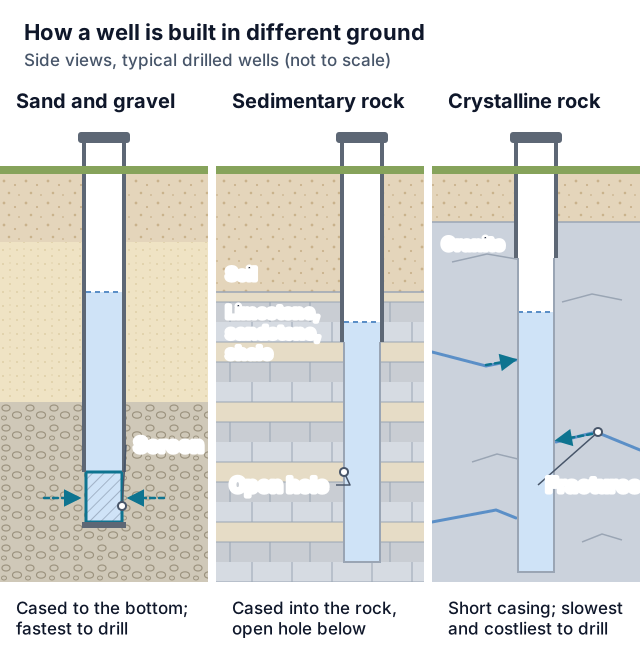
- New drilled bedrock wells cased into competent rock under We 602.22
- Replacing a shallow dug well in till at an older home
- Hydrofracturing a bedrock well to try to raise its yield (We 602.34)
- Pump, pitless adapter and pressure tank installation or repair (We 700)
- Raising a buried casing above ground with a casing extension when a pump or well that ends below ground is repaired, replaced or maintained and does not meet the We 602.35 buried-casing requirements (We 603.03)
- Sealing an abandoned or replaced well (We 604)
- Chlorinating a well after a pump is installed or reinstalled
- Water testing before a home purchase, following NHDES guidance
What Drives Pricing Here
- Depth and yield: this page does not give a typical depth for the county. The depths and yields contractors have reported for nearby wells since 1984 are in NHDES's Well Completion Report query. USGS Professional Paper 1660 (Moore and others, 2002), a statewide study of reported bedrock-well data that also gathered geologic, fracture and lineament data for the Pinardville and Windham quadrangles, found well depth positively related to total yield, and found sites underlain by foliated plutons, sites on steep slopes, sites at high elevations and sites on hilltops negatively related to yield.
- Rock type: the Seacoast assessment cites that 2002 study's finding that wells in the Rye Complex and the Kittery and Eliot Formations have a greater probability of a high yield than wells in other New Hampshire bedrock types, and it reports very high bedrock-well yields (more than 40 gallons per minute) in some parts of the Seacoast.
- Casing in rock: We 602.22 requires a bedrock well to have at least 20 feet of casing, installed at least 10 feet into competent bedrock, standing at least 8 inches above ground (higher in flood-prone areas, and 18 inches for a public water system well) under a cover sealed with an o-ring, gasket or other seal. Under We 602.21, steel casing has a wall at least 0.23 inches thick, and plastic casing is Schedule 40 or better and National Sanitation Foundation approved.
- Seating the casing: We 602.22 calls for a drive shoe on steel casing and a Jaswell-type seal tip, shale packer or equal on plastic casing, with exceptions in We 602.22(c)(5) to (7) for some cable tool work and for steel casing set in a hole cased to bedrock with larger temporary casing; a seal tip or packer may not be used to fix a failed drive-shoe seal or an inadequately cased new well. The space outside the casing is filled with cement grout, bentonite, or ledge drillings or cuttings, except that on a known active hazardous waste remediation site, a petroleum spill remediation site or a site with an unlined solid waste landfill, as identified in the department's remediation and initial response spill sites database, it must be filled with cement grout, bentonite grout or a cement-bentonite grout mixture.
- Grouting where required: when a rule calls for a grouted casing (We 602.14, 602.16, 602.22 and 602.25), We 602.05 limits the material to neat cement, cement-sand grout, cement-bentonite grout with no more than 5 percent bentonite, or high-solids bentonite grout, and sets how it is placed in bedrock and gravel wells; the section does not apply to dug wells or to driven and drive-and-wash wells.
- Hydrofracturing: NHDES's FAQ calls it an optional development technique that injects water at high pressure and flow to flush out or expand fractures. We 602.34 sets conditions on the source and treatment of the injection water, on packer depth and on measuring yield afterward, and bars the use of dry ice and explosives.
- The site's estimate: the cost tool on this site prices each foot of the depth you type in at a rate band for the ground type selected, then tacks on an all-purpose permit allowance and, in its default setting, pump and pressure-tank lines. Those rates come from national pricing published by Angi, HomeGuide and HomeAdvisor, which makes the total a national ballpark, not a Rockingham County bid. The state's $100 fee for each well completion report (We 303.02(j)) and its license fees are in the FAQ below.
Permits & Local Rules
- Licenses: under RSA 482-B:5, anyone going into the business of constructing wells or installing pumps must first obtain the proper annual water well contractor or pump installer license; licenses are not transferable and expire June 30 each year. We 302.01 requires a water well contractor license to construct water supply wells, observation wells, open or closed loop geothermal wells, construction dewatering wells deeper than 20 feet, or to do technical drilling, and, subject to the We 302.02 exemptions, a pump installer license to install new or replacement pumps (including for pumping tests) and to maintain or repair existing pump systems. Under We 303.01 a contractor license names the types of construction allowed (drilled, washed, dug or monitoring wells), and a pump installer license covers domestic pumps up to 3 horsepower, commercial, industrial and municipal pumps of any horsepower, or both. We 302.03 issues these licenses to a corporation or other business entity together with a named qualified individual as defined in We 302.07, and an employee of a licensed water well contractor or pump installer is not required to be licensed.
- Exemptions: We 302.02 allows a licensed plumber engaged in plumbing as defined in RSA 153:27, XIV, or a licensed electrician performing electrical installations as defined in RSA 319-C:2, III, to maintain and repair existing pump systems, and lets a New Hampshire licensed water distribution system operator, professional engineer or professional geologist set a temporary pump to test a new well, provided a licensed pump installer does the final installation; it also exempts wells 20 feet deep or less built to temporarily dewater construction sites, pump installations for that temporary dewatering, and exploratory excavations analyzing foundation conditions for a structure. RSA 482-B:17 exempts an owner or owner's agent doing pump installation repairs or replacement on property the owner owns, and a person whose regularly employed maintenance worker replaces and maintains pump installations on that person's property, as long as the work conforms to the Board's rules.
- Building your own well: RSA 482-B:12 leaves a person free to build a well on the person's own or leased property when the well will serve only noncommercial farming purposes, or when its water is meant neither for public use nor for anyone living in a residence other than the person's own permanent residence. That person must still submit the RSA 482-B:10 well record and comply with any applicable rules, and We 801.03(h) accepts a completion report signed by the owner of such a well.
- Siting near a septic system: We 602.07 places a well at least 75 feet from the effluent disposal area or tank of a septic system with a design flow of up to 750 gallons per day, with the tank distance reducible to 50 feet if the soil line is SDR 26 or equivalent and the tank is sealed and grouted; other systems follow Table 1008-4 in Env-Wq 1008.06(b), reprinted in Appendix C of the rules, and We 602.08 sets where the protective well radius may lie (on the lot, on a recorded easement, on certain land precluded from development, or within property-line setbacks to septic systems). NHDES's FAQ puts it more simply: a 75-foot protective radius for wells serving homes with up to 5 bedrooms, applying to property boundaries and to the septic tank and leachfield. Where a septic system is proposed or built, We 602.12 has the contractor review the state-approved septic plan and drill at the well location it shows; if that spot cannot be used, the contractor works out an alternate location with the owner or the owner's agent under RSA 485-A:30-b and We 602.06 through We 602.15, and on a lot requiring a critical well location the contractor must also consult the permitted septic designer and may not drill elsewhere until NHDES issues an approved amended plan.
- Other distances: except as We 602.14 provides for bedrock wells, We 602.09 keeps a well at least 50 feet from a state highway right-of-way, surface water, or a sewer or any part of one; at least 75 feet from a livestock pen, automotive salvage yard, solid waste disposal site, fertilizer, manure or salt storage pile or other source of contamination, or a public road surface; and at least 100 feet from a livestock pen for a dug well. Under We 602.11, gasoline underground storage tank systems must be at least 250 feet from a non-public water supply well (500 feet from a public one), and tank systems for other regulated substances at least 75 feet (400 feet from a public one). We 602.10 keeps dug wells out of areas prone to flooding or standing water.
- Closer than standard: when site conditions prevent meeting these distances, We 602.13 through We 602.17 set out how an alternate location is chosen, when the owner must sign the Board's Setback Reduction Form before construction and the contractor files it with the completion report, the extra casing and grouting a bedrock well then needs, which lots may have a reduced septic setback at all, and the NHDES inspection and written confirmation that no practicable alternative exists, both required before any well is started less than 25 feet from an effluent disposal area. Read those sections with your contractor, or ask the NHDES Water Well Program, before settling on such a site.
- Chlorination and testing the yield: anyone who completes a new well, installs a new pump in a well, or reinstalls an existing pump must chlorinate the well to at least 50 parts per million for at least 4 hours (We 602.03 and We 702.02), and the chlorinated water may not be discharged into any surface water of the state (We 602.04 and We 702.03). Under We 602.33 the final yield of every new well is measured after development and written on the completion report, for at least 15 minutes when the well yields more than 5 gallons per minute, or, for 5 gallons per minute or less, for at least 30 minutes after the hole is dewatered and until the flow has stabilized.
- Buried casings: We 602.35 lets a contractor end a casing below ground only where an above-ground casing would pose a hazard (the rule treats driveways and parking lots as potentially hazardous, lawns and yards as not), after explaining to the owner the advantages of an above-ground casing and the added requirements and costs of a buried one, and only if the owner then asks for it. The section goes on to set well-pit, sealing, venting and location-reference requirements, and does not apply to dug wells.
- Well completion report: under RSA 482-B:10 and We 801.03, the contractor files the report with the Board no later than 90 days after completion, by mail, in person or electronically through NHDES OneStop, and We 801.01 lists everything it must contain and requires the licensed contractor's signature. A new or replacement well counts as complete when it meets the statutory definition of a well and the contractor has removed all construction equipment from the site. Missing the 90 days is a violation subject to an administrative fine; a late report not tied to an impending disciplinary action must come with the licensee's signed written explanation; and a report that is unsigned, signed by the wrong person or missing required information is returned and does not satisfy RSA 482-B:10. We 303.02(j) sets a $100 fee for every report. A report is also due for each well decommissioned (We 602.02).
- Old and unused wells: the owner maintains a well under We 603.05. An inactive well is either sealed under We 604 or kept to the We 603.01 standards, and one whose casing ends below ground must otherwise get a casing extension (We 603.02). A well that is inactive, not maintained and not sealed is abandoned (We 604.03), and We 604.02(b) allows sealing only by a licensed New Hampshire water well contractor. All pumping equipment, piping, wire and any debris seen in the well come out first (We 604.04), and We 604.05 sets separate sealing methods and materials for dug wells, drilled bedrock wells, drilled wells in unconsolidated material, small-diameter wells other than drilled wells, and contaminated wells. Wells built before August 17, 1983 need not meet the other rules, but any such well abandoned from now on must meet We 604 (We 104.02).
Geology & Water Table Notes
- Three water-bearing units: the USGS Seacoast report describes groundwater there in glacial till, stratified drift and bedrock. Till, an unsorted mix of clay, silt, sand, gravel and cobbles left directly under glacial ice, is generally about 20 feet thick or less; stratified deposits are sorted, layered sand, gravel, silt and clay of glacial or marine origin; and crystalline metasedimentary or intrusive bedrock lies beneath and is exposed in places.
- Bedrock: the report names the Rye Complex (commonly coarse-grained gneiss, quartzite and schist), the Kittery Formation (mainly phyllite and schist) and the Eliot Formation (mainly slate, phyllite and schist) as the dominant rock types, with lesser Breakfast Hill granite, Exeter Diorite and the Newburyport Complex, a quartz diorite. Structures including the Rye anticline, the Great Bay syncline and the Portsmouth Fault give a northeast-southwest regional trend. The rock has little primary porosity, so water is stored and moves in fractures, and NHDES's arsenic fact sheet notes that because New Hampshire's bedrock is highly fractured, even wells a short distance apart can have very different water quality.
- Sand and gravel: the report says most areas of the Seacoast have saturated thicknesses under 40 feet. The report names as exceptions the aquifer under the Pease Tradeport (the former Pease Air Force Base) in Newington, described from a 1964 study as a deposit about 4 miles long, 0.25 to 1 mile wide and up to 70 feet thick, an aquifer at Great Brook Meadows in Kensington, and thinner aquifers in Hampton. An extensive but thinner aquifer, generally less than 40 feet thick, runs from western Rye to southern Portsmouth and northern Greenland, and one up to about 40 feet thick lies beneath central North Hampton.
- Older dug wells: the report says wells dug in till before the mid-1900s were typically about 20 feet deep, and that shallow till wells, still found at many older Seacoast homes, generally do not meet current domestic needs, particularly in dry periods. During the 2001-2002 drought across the northeastern United States, many Seacoast communities imposed water-use restrictions.
- Artesian wells: NHDES's FAQ notes that bedrock wells are commonly called artesian, but only about 2% of them are true artesian wells, where the water level from a confined aquifer stands above the ground surface.
- Water quality data: NHDES's 2021 arsenic fact sheet gives New Hampshire private wells about a 25% probability of naturally occurring arsenic above 5 micrograms per liter, notes that arsenic has no color, taste or odor, and recommends a follow-up arsenic-III test before choosing treatment when a result is above 5 ppb. In 2022 NHDES described a Private Well Water Quality Dashboard, built by the state's Environmental Public Health Tracking Program with the Public Health Laboratory and NHDES from tests of more than 23,000 wells from 2006 to 2020, that shows statistics for 14 common contaminants in and around a chosen town or county.
Communities Served
Londonderry · Derry · Salem · Windham · Chester · Candia · Raymond · Epping · Nottingham · Kingston · Hampstead · Atkinson · Sandown · Exeter · Stratham · North Hampton
Emergency Response Expectations
An urgent no-water request can be forwarded from this site, but contractor response times are not something it controls. RSA 482-B:15 limits well and pump maintenance and repair work to a licensed water well contractor, pump installer, plumber or electrician (with We 302.02 covering a plumber only when engaged in plumbing and an electrician only when performing electrical installations), subject to the owner and maintenance-employee exceptions in RSA 482-B:17; We 302.03(b) also does not require an employee of a licensed water well contractor or pump installer to be licensed. When a pump is installed or reinstalled, other than temporarily for sampling or for testing or developing yield (We 701.02), We 702.02 calls for chlorinating the well to at least 50 parts per million for at least 4 hours.
Rockingham County FAQs
Does a well driller in New Hampshire need a state license?
Yes. RSA 482-B:5 requires an annual water well contractor or pump installer license before engaging in the business of building wells or installing pumps, and the Water Well Board issues both. Under We 302.03(b), an employee of a licensed water well contractor or pump installer does not need a license of their own. For building a well yourself, RSA 482-B:12 covers your own or leased property when the well is only for noncommercial farming, or when the water is not meant for the public or for anyone's residence other than your own permanent one; you still file the well record and follow the applicable rules. The Board may also grant an exemption for undue hardship under RSA 482-B:13.
What fees does the state set?
We 303.02 sets $100 for every well completion report. It also sets yearly license fees of $225 for a rotary drilling contractor, $150 for cable tool, wash-well or percussion equipment, $100 for dug-well equipment, $225 for technical drilling and $100 for a pump installer, with a contractor who owns several equipment types paying the highest applicable fee, plus a $25 application fee and a $10 exam fee per category. Under RSA 482-B:5, a license renewed after July 31 also carries a $20 late fee.
What distance does the state require between a new well and a septic system?
For a septic system with a design flow of up to 750 gallons per day, We 602.07 sets 75 feet from the tank and the effluent disposal area, and the tank distance may drop to 50 feet if the soil line is SDR 26 or equivalent and the tank is sealed and grouted. If the lot has a state-approved septic plan, the contractor builds the well where that plan shows it, subject to the alternate-location steps in We 602.12.
What water tests does NHDES recommend, and how often?
NHDES's April 2026 guidance lists arsenic, total coliform and E. coli bacteria, chloride, copper and lead (stagnant and flushed samples), fluoride, hardness, iron, manganese, nitrate, nitrite, pH, radon, sodium, uranium and four PFAS (PFHxS, PFNA, PFOA and PFOS). New Hampshire does not require testing of private domestic wells, but the guidance says well users should test for bacteria, nitrate and nitrite every year and the rest every 3 to 5 years; if a first PFAS test finds none and the budget does not allow retesting every 3 to 5 years, waiting longer is acceptable, especially if nearby land uses do not change. Home buyers should test before purchase if the seller has not provided a recent test, and treated water should be tested after a system is installed and every 3 to 5 years after that. NHDES lists accredited labs and its Be Well Informed tool interprets results.
Will NHDES test my well for PFAS?
NHDES's PFAS page recommends that all private well owners test for PFAS, at a minimum for the four compounds with state maximum contaminant levels. It has been testing the private wells most susceptible to PFAS contamination and takes requests, but a request does not guarantee sampling, since each location is checked against NHDES records for eligibility and priority, and NHDES does not resample. Its PFAS Sampling Dashboard shows whether your well was already sampled.
How much water should a new house well supply?
NHDES's FAQ says the state has no mandated minimum flow rate for private domestic wells. The Water Well Board recommends, for indoor domestic use, 600 gallons delivered to the home by the water system within a 2-hour period at least once a day.
Can I fill in an old well on my land myself?
Not under the Board's rules: We 604.02(b) says a well may be sealed only by a licensed New Hampshire water well contractor. Having an abandoned well sealed is the owner's responsibility, except that the contractor must seal a failed borehole, or a well abandoned within 12 months of construction because it was built improperly (We 604.06). After installing a replacement well, the contractor must tell the owner what We 603 and We 604 require for the old one.
Where can I find the record of my existing well?
Search the state well inventory on NHDES OneStop, which NHDES says holds well records reported since 1984. Wells installed before 1984 are not inventoried, and a mapped record may not be exact enough to locate the well on a lot.
Sources
- NH RSA Chapter 482-B: New Hampshire Water Well Board (full chapter)
- N.H. Admin. Rules We 100-1000: Water Well Board rules (official text)
- NHDES: Water Well Board
- NHDES: Water well construction FAQs
- NHDES: Water well inventory
- NHDES: Private wells
- NHDES: Water Testing Guidance for Private Well Users (April 2026)
- NHDES fact sheet DWGB-3-2: Arsenic in New Hampshire Well Water (2021)
- NHDES PFAS Response: Private wells
- NHDES: Be Well Informed guide
- NHDES blog: Private well water, using data to increase well testing and treatment (Aug. 2022)
- NH DHHS WISDOM: Drinking water
- USGS SIR 2008-5222: Assessment of Ground-Water Resources in the Seacoast Region of New Hampshire (Mack, 2009)
- USGS Professional Paper 1660: Factors related to well yield in the fractured-bedrock aquifer of New Hampshire (2002)
- Census Bureau: 2020 county subdivision codes, New Hampshire
- Census TIGERweb: current county subdivisions, Rockingham County NH
Last reviewed 2026-10-27
Services Available in Rockingham County
Well Drilling
New residential wells — find local drillers for site evaluation, depth estimates, and written drilling quotes.
Learn more →Water Well Drilling
Household water wells from site evaluation through casing, pump, and water test — written quotes from local drillers.
Learn more →Well Pump Repair
No water at the tap? Request urgent well pump repair — local pros diagnose pressure loss, dead pumps, and pressure tank failures fast.
Learn more →Well Pump Replacement
Pump at end of life or beyond repair? Get quotes for correctly-sized submersible and jet pump replacement from local well pros.
Learn more →Well Inspection & Testing
Buying a home with a well, or overdue for a water test? Local pros for flow tests, equipment inspection, and lab water-quality testing.
Learn more →Well Water Service
Water quality problems, treatment systems, and general well maintenance — connect with local pros for everything between drilling and pump work.
Learn more →Free Tools Before You Call
Ballpark the cost or narrow down the problem before talking to a Rockingham County provider.
Well Drilling Cost Calculator
Estimate what drilling a well should cost — by depth, geology, and whether you need the pump and pressure tank included.
Use the free tool →No Water From Your Well? Diagnostic Wizard
Suddenly no water in the house? Answer a few questions to find out if it's the breaker, the pressure switch, the tank, the pump — or the well itself.
Use the free tool →Well Pump Size Calculator
Find what size well pump you need — GPM demand, total dynamic head, and a horsepower recommendation from four quick inputs.
Use the free tool →Need help in Rockingham County, NH?
Send the short form — urgent requests get priority routing.