Well Drilling in Ingham County, MI
Well drilling typically runs $3,000–$16,000 nationally, per our cost guide. Independent local pros serving Mason, Williamston, Leslie and nearby communities. Describe the problem and we'll route your request — free, no obligation.
- Mark no-water pump problems as emergencies on the form
- County pages on local well depths, aquifers, and permits
- Well inspections, water testing, and treatment
- Free to use — no obligation, no markup
Fast response from independent local providers. No obligation.
Typical national cost$3,000 – $16,000Cost guide →Local Help in Ingham County, MI
Well permits in Ingham County come from the Ingham County Health Department's Environmental Health office. Its Permits & Licensing page lists a well permit to construct or alter a private residential, Type II or Type III well, and links an online Well & Septic Application. That page also posts the county's permit and point-of-sale charges, but the table carries no effective date, so this page repeats none of the dollar amounts; check the live table before you budget.
A home sale brings its own well check. According to the county's point-of-sale brochure (revised October 2023), the Board of Commissioners adopted a regulation on April 25, 2006 for inspecting residential on-site water and sewage disposal systems when property is transferred, and it requires the septic system and/or well to be inspected and evaluated before a residential home changes hands, apart from the exemptions listed under permits below.
Ingham County Service Details
What providers in this area actually see: coverage, common jobs, local pricing factors, and rules worth knowing.
Service Area Notes
- Census Bureau 2020 place codes put these places in Ingham County: the cities of East Lansing, Lansing, Leslie, Mason and Williamston; the villages of Dansville, Stockbridge and Webberville; and the Edgemont Park, Haslett, Holt and Okemos census-designated places. Lansing city is also listed under Clinton and Eaton counties, and East Lansing city under Clinton County. Each of these names is still present in the Bureau's current TIGERweb place layers.
- The 2020 county subdivision file lists Delhi, Lansing and Meridian as charter townships and Alaiedon, Aurelius, Bunker Hill, Ingham, Leroy, Leslie, Locke, Onondaga, Stockbridge, Vevay, Wheatfield, White Oak and Williamstown as townships.
- Public systems draw on both aquifers. Using 2005 data, USGS Scientific Investigations Report 2009-5244 lists Lansing, Mason and Williamston among communities that combine wells in the glacial deposits with wells in the Saginaw aquifer, and East Lansing, Leslie and Webberville among those taking water from the Saginaw aquifer. Those are community supplies, not a guide to any private lot.
- For logs of nearby wells, try Wellogic. According to EGLE, the system has taken electronic well, pump and plugging filings from Michigan contractors since 2000, now holds over a million records that the public can view through 22 search fields, and can be searched without an account.
Common Jobs in Ingham County
- New and replacement private wells under an Ingham County Health Department well permit
- Replacement wells called for by a point-of-sale evaluation, which may be bid and escrowed at closing
- Type II and Type III wells, which the county's well permit also covers
- Pump, control, drop pipe and pressure tank replacement, a minor repair under R 325.1611(2)(e)
- Plugging a well taken out of service when municipal water reaches the house
- Coliform, nitrate and arsenic sampling after construction, repairs or ahead of a sale
What Drives Pricing Here
- County charges: the Health Department's fee table has separate lines for a well permit, a combined well and septic permit, a point-of-sale application, a county well evaluation and a township evaluation (described as a municipal required evaluation of well and/or septic). Use the amounts on that page at the time you apply. The brochure says private certified inspectors set their own fees and that every point-of-sale inspection, whether done privately or by the county, also carries an administrative fee.
- Escrow at sale: the brochure says the county allows funds to be held in escrow if installation cannot occur before closing, and that when a replacement well is required, without approved water samples the county will require a bid and an escrow agreement for a new well. Ingham County requires 150% of the total of the bids to be placed in escrow at closing, the repairs to be completed within 180 days of closing, and no escrowed funds to be released without the Health Department's written authorization; the bids and escrow agreement go to the county for review, and any required permit has to be issued before the county completes its conformance-with-escrow letter.
- Drift thickness: SIR 2009-5244 reports glacial deposits in Ingham County from less than 10 feet to more than 300 feet thick, so depth to bedrock varies widely across the county. The report also notes that in buried-outwash areas, the most extensive of which include the northern part of Ingham County, most wells are completed in bedrock aquifers because better-quality water is available at depth.
- About this site's calculator: it multiplies the depth you type by a per-foot band set by the geology you choose, then adds a standard permit allowance and, unless you switch them off, a pump and pressure tank. It has no Ingham County inputs and this page publishes no local depth to enter, so treat its output as a rough national figure and ask each driller for a written per-foot price that names the casing and grouting.
Permits & Local Rules
- Registration: MCL 333.12704(1) requires a state certificate of registration (well drilling contractor or pump installer, renewed every year) before anyone starts a well drilling or pump installing business. Drillers can take on pump installation without the separate pump installer fee (MCL 333.12704(3)); R 325.1608 authorizes a registered driller to do both kinds of work and forbids a registered pump installer to drill. A master plumber licensed under the 1929 plumbing act may do a pump installer's work with no pump installer registration (MCL 333.12703(3)). Any governmental unit, such as a county, city, village or township, that drills wells or installs pumps must register as well, and pays no registration fees only when its own regular employees do the work, with equipment the unit owns, for wells or pumps intended for the unit's own use (MCL 333.12704(4)).
- Renewal: certificates cannot be transferred and expire April 30 each year, and renewing after July 1 means paying the regular fee plus a surcharge equal to half the basic registration fee (MCL 333.12705(2)). EGLE's registration page says renewal applications must be submitted by March 1 and that a contractor who has not renewed by May 1 is barred from all well drilling and pump installation work until renewal. EGLE links a directory of registered contractors from its water well construction page.
- Owner-built wells: MCL 333.12703(2) lets someone who owns or leases property construct a well or set a pump there themselves, provided the well is intended for one of two uses only, either a single-family house the person lives in as a permanent residence, or farming purposes on the person's own farm, and none of its water is meant for public use or for any residence besides the person's. That owner is still bound to submit the MCL 333.12707 drilling record and to comply with the rules and construction code. R 325.1667 requires plugging of a well 'drilled by a person other than the property owner or by a person other than a well drilling contractor who is registered.' Ask Environmental Health about the county well permit before starting.
- County permit: the Health Department's well permit is for constructing or altering a private residential, Type II or Type III well, and applications are taken through its online Well & Septic Application. For a replacement well needed at a sale, the brochure says the application goes to the area sanitarian, who contacts the applicant or owner to set up a site visit and write the well permit. If you are unsure whether a job needs a permit, ask Environmental Health through the county's Well and Septic page.
- Older systems: R 325.1611(1) says extensive changes or repairs to a water supply system built before the effective date of the amended rules must comply with them unless a deviation is issued under R 325.1613; extensive changes include replacing the entire casing, removing a casing from the ground or changing aquifers. Minor repairs need no upgrade; R 325.1611(2) gives as examples putting in a liner pipe; replacing a pump, its controls, the pump drop pipe or the pressure tank; replacing a telescoped well screen; changing the screen's elevation; deepening a bedrock well or plugging one back; and treating the well with chemicals or disinfecting it.
- Setbacks, longer distances: R 325.1622(1) requires a well that furnishes water for any beneficial use to be located at least 800 feet from land surface application of septage waste or from the active work area of any landfill; at least 300 feet from oil or gas wells, from facilities that process or store petroleum products, from land application or subsurface injection of effluent or digested sludge from a municipal wastewater treatment facility, and from regulated underground or abovegrade storage tank systems of not less than 1,100 gallons that lack secondary containment; and at least 150 feet from any place used to prepare or store fertilizer, agricultural chemicals or other chemicals that might contaminate the soil or groundwater. Those are floors: the rule also says to use hydrogeologic data in siting when available, to put the well upgradient of known or potential contamination where possible, and to keep it the maximum practical distance away.
- Setbacks, shorter distances: R 325.1622(1)(g) allows as little as 10 feet to three things: a lake, pond, river, stream or other surface water body; a sump, pit or unfilled space below the ground surface (crawl spaces are not counted); and a buried gravity-flow sewer laid with watertight joints in either schedule 40 PVC or ductile iron of service weight or heavier, or in another pipe and joint type the director approves in writing. Subdivision (d) puts 50 feet between a well and a septic tank, subsurface disposal field, dry well, cesspool, seepage pit, grease trap, outhouse, animal or poultry yard, sewage pump chamber, pressurized sewer, any buried sewer that does not meet the 10-foot construction, and any other unit or site that handles or disposes of wastewater or lets liquid wastes drain into the soil. Subdivisions (e) and (f) apply the same 50 feet to regulated storage tank systems of at least 1,100 gallons equipped with secondary containment, and to tank systems under 1,100 gallons that store fuel (motor or heating) for noncommercial purposes or for consumptive use on the premises. Under R 325.1622(2) the health officer can raise or lower any of these distances for an individual well by deviation under R 325.1613; R 325.1622(3) sends public water supply wells to the isolation rules in R 325.10101 et seq.; and R 325.1622(4) makes the owner responsible for keeping the distances on property the owner owns. R 325.1624(1) adds a 3-foot minimum between a well and any building, pump room or projection of one, unless a deviation is issued.
- Casing: steel permanent casing needs an inside diameter of at least 2 inches, except a driven well point, whose steel casing may be as small as 1 1/4 inches and which may not be used as a water supply well without the health officer's written approval; PVC permanent casing needs at least 5 inches unless it is liner pipe, and goes only into an oversized borehole without driving (R 325.1632(1)-(2), R 325.1632a). R 325.1632(3) sets the casing's reach at 25 feet or more below the ground surface and its top at 12 inches or more above it, and two written health-officer approvals change that. Where the ground is paved and not subject to flooding, the casing top may stop as low as 2 inches above the ground surface, provided every connection and opening on it is watertight and either threaded or welded, and the casing is vented acceptably (R 325.1632(6)). Putting a well into use when its casing is shorter than 26 feet takes written approval under R 325.1613, whose subrule (2)(d)-(e) permits casing shallower than 25 feet only for a well that will not supply habitable structures or human consumption, is clearly and permanently identified as unsuitable for drinking or body contact and is separated from any potable system on the premises, or where potable water of suitable quantity is not believed to exist at a reasonable depth beyond 25 feet and either the distance to a contamination source is increased or a confining layer lies above the aquifer the shallow well will use.
- Grouting: R 325.1634a(1) applies where rotary, auger or other drilling sets the permanent casing in an oversized borehole. Neat cement or bentonite grout must fill the annulus for the full casing length; with a screen, grouting starts no more than 10 feet above the screen's top and runs to the surface. A shorter grouted length is possible only through a health officer deviation under R 325.1613(2)(f), which requires a well deeper than 100 feet that penetrates no confining layer (R 325.1634a(2)), and every deviation is written and states its reasons (R 325.1613(3)). Grout goes in via the permanent casing or a grout pipe, bottom-up, in one uninterrupted operation (R 325.1633a(2)). R 325.1633a(5) covers jobs that use temporary casing: as it comes out, the annulus around the permanent casing must be grouted, either with neat cement or bentonite grout pumped in, or with bentonite chips, bentonite pellets or granular bentonite poured in, and the granular form is not allowed where that annulus holds water or drilling fluid. Driven-casing wells are grouted under R 325.1635 instead. If drilling meets bedrock within the top 25 feet, R 325.1637(1) calls for an oversized borehole and at least 25 feet of neat-cement grout around the permanent casing.
- Disinfection and first sample: after thorough pumping to waste, the well and pumping equipment get chlorine at a Table 5 strength and contact time from R 325.1661 (10 hours at 100 ppm, 4 hours at 250 ppm, 2 hours at 500 ppm, or 1 hour at 1,000 ppm), and whichever driller or pump installer did the work chlorinates the portion they worked on. No new, repaired or reconditioned system may be placed in service until every trace of chlorine has been flushed and at least one sample drawn at the sampling faucet shows no coliform organisms. Collecting that sample falls to the owner or the owner's designated representative, and the contractor who did the work has to tell the owner so (R 325.1661(1)-(3)).
- Well records: a well log is due no later than 60 days after a well is completed; the owner receives 1 copy and the health officer 2, and it names the owner and gives the well's location and depth, the geologic materials passed through with their thicknesses, static water levels, the amount of casing and any further items the rules require (MCL 333.12707; R 325.1675(1)). The forms are the department's standard ones, or a contractor's own if the department approves them, and a registered well drilling contractor signs the log (R 325.1675(4)). During drilling, the contractor notes materials on an at-the-site record open to inspection, and R 325.1675(5) lets the department or health officer require geophysical logging of the well when the log has not been submitted within 60 days of completion or the on-site record was not maintained. Pump installations on new wells need their own record, signed by a registered driller or pump installer and due on the same 60-day schedule (R 325.1676).
- Plugging: R 325.1662(1) allows the well owner to seal an abandoned well or dry hole, as can a registered well drilling contractor, but reserves the job to a registered contractor when any well on that property serves the public or a household other than the owner's. Pumps, drop pipe, packers, debris and other obstructions come out first where possible, and R 325.1662(3) extends the plugging duty to a well that goes out of use once municipal water is installed. R 325.1663 sets which materials may be used for wells ending in overburden, sections in bedrock, lost-circulation zones, flowing wells and wells giving off gas, and R 325.1664 sets how each is placed; read both before starting. Within 60 days, whoever did the plugging sends the department or local health department 2 copies of a report naming the owner and giving the well's location, depth and diameter, the procedure, the material and how much of it went in; that information may instead be entered on the log of a replacement well, and multiple wells or dry holes within one parcel can be reported together on one form when their geology and plugging methods are similar (R 325.1675(3)). Plugging is the owner's responsibility except as a written contract with a registered driller provides, and if the department or a health officer finds that a registered contractor put a well in the wrong place or built it improperly, that contractor bears the plugging (R 325.1669). EGLE notes that local health departments check plugging in the field and by reviewing the plugging records contractors and owners submit.
- Point-of-sale process: the brochure says homeowners or their agents hire a county-certified private inspector or the Health Department. Inspection reports are filed with the Health Department and describe the condition of the well and/or septic system, with a summary of findings, water samples and the septic tank maintenance report. Within five business days of receiving the completed report, the county issues a written notice either authorizing the transfer (conformance) or citing non-compliance (non-conformance), and owners or applicants send proof of corrections, such as invoices, receipts or pictures, by email, fax or mail to the sanitarian who signed the non-conformance letter. A conformance letter is valid for 12 months.
- Point-of-sale exemptions, as the brochure lists them: new well and septic systems installed and given final approval within the last 2 years; removing a name from the title or changing names because of a divorce; property with municipal or public water and sewer systems; and land contract properties, which need no inspection until the title transfers, though the county encourages doing it early.
Geology & Water Table Notes
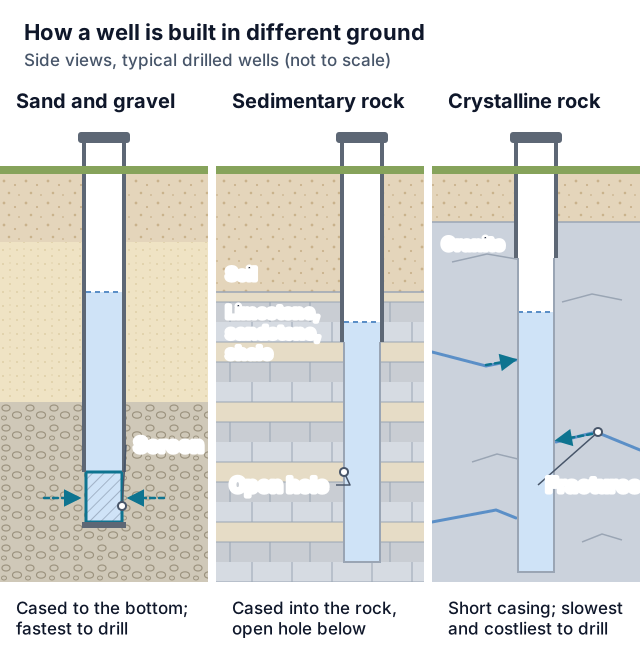
- Two aquifer types: SIR 2009-5244 (USGS, 2009) treats Clinton, Eaton and Ingham counties as one Tri-County region, where glacial deposits form the uppermost aquifer and the aquifers in them are made up mainly of coarse alluvial and outwash material. Below lies the Saginaw aquifer, held in sandstone beds of two Pennsylvanian units, the Grand River and Saginaw Formations, and the report says most of the region's communities rely on it.
- Thin rock to the east: Pennsylvanian rocks, the region's uppermost bedrock, are absent in the extreme eastern part of Ingham County, and the report says groundwater flow across the eastern part of the county is minimal because the Saginaw Formation sandstone there is very thin or absent. In Eaton and Ingham counties, erosion removed most of the Grand River Formation, leaving a few large remnants.
- Eskers and till: long sand-and-gravel ridges called eskers occur in Ingham and Eaton counties, and the report says esker deposits supply municipal wells in Williamston and once did in Mason. Till covers much of the region and generally is not a source of water to wells, though locally it may hold thin sand and gravel beds that yield water.
- Water character: citing a 1973 study, the report says nearly all wells tapping the Grand River and Saginaw Formations yield water fit for household needs, generally hard or very hard and containing iron, with soft water from the Saginaw Formation in some localities.
- Testing schedule: MDHHS says testing a private residential well is the owner's responsibility and recommends coliform bacteria and E. coli, nitrate and nitrite every year, arsenic and lead every 3 to 5 years, and PFAS at least once. It also suggests testing when a household member is pregnant, an infant or young child lives in the home, flooding has happened near the well, the well was repaired, or the water's taste, color or smell changes. EGLE recommends that homeowners have well water tested for arsenic, and if a result exceeds 0.010 mg/L it recommends not using the water for drinking or cooking.
Communities Served
Mason · Williamston · Leslie · Stockbridge · Webberville · Dansville · Holt · Okemos · Haslett · Meridian Charter Township · Vevay Township · Wheatfield Township
Emergency Response Expectations
If the pump, controls, drop pipe or pressure tank fails, R 325.1611(2)(e) treats replacing them as a minor repair that does not require upgrading the whole well to current rules. Afterward the contractor chlorinates the part of the system worked on, and the repaired system should not go back into service until a sample from the sampling faucet shows no coliform organisms (R 325.1661). This site passes requests along but does not set or promise any contractor's response time.
Ingham County FAQs
Who issues well permits in Ingham County, and what do they cost?
The Ingham County Health Department's Environmental Health office, through its online Well & Septic Application. Its Permits & Licensing page lists the current well permit and combined well and septic permit charges, but the table shows no effective date, so check it there rather than relying on a figure copied elsewhere.
Does my well have to be inspected before I sell?
Yes, unless one of the brochure's exemptions (listed in the permit notes above) applies: the county's point-of-sale regulation calls for the well and/or septic system to be inspected and evaluated before a residential home changes hands, by a county-certified private inspector or the Health Department. Start at listing, because the county does not control private inspectors' schedules.
Can the sale close before a replacement well is drilled?
Yes, if Environmental Health receives and approves a corrective action plan or a permit to replace the system, proof of a contract with a contractor to finish the work, and an escrow agreement with the title company covering 1.5 times the cost of the required repairs. Repairs must then be completed within 180 days of closing.
Can a homeowner build their own well in Ingham County?
Only within MCL 333.12703(2): you own or lease the land, the well serves only your own single-family home, used as your permanent residence, or only farming on your farm, and the water is not for the public or anyone else's residence. You still owe the state the MCL 333.12707 drilling record, must meet the construction code, and should confirm the county permit with Environmental Health first.
Will a new well here be in sand and gravel or in sandstone?
It depends on the site. USGS reports glacial deposits from under 10 feet to over 300 feet thick in the county, with the Saginaw sandstone very thin or absent in the east; logs for nearby wells in EGLE's Wellogic show what drillers actually found.
Who can plug the old well after we hook up to city water?
R 325.1662(3) says a well that goes out of use when municipal water is installed is plugged under the state rules. Either you or a registered driller may plug it, unless any well on the property supplies water to the public or to another household; then a registered contractor has to. Whoever plugs it files the report within 60 days.
Sources
- Ingham County Health Department: Permits & Licensing (well, septic and point-of-sale fees)
- Ingham County Health Department: Well and Septic
- Ingham County Environmental Health: A Guide to Transferring Property (point-of-sale brochure, revised 10/2023)
- Michigan Legislature: Public Health Code Part 127, MCL 333.12701 to 333.12715 (PDF)
- Michigan Administrative Code: R 325.1601 to R 325.1781, groundwater quality control (well construction code)
- EGLE: Water well construction program
- EGLE: Water well contractor registration
- EGLE: Wellogic water well records
- EGLE: Abandoned water wells
- EGLE: Arsenic in well water
- MDHHS: Test your drinking water
- USGS SIR 2009-5244: Groundwater flow in Clinton, Eaton and Ingham counties, Michigan
- U.S. Census Bureau: 2020 place-by-county codes, Michigan
- U.S. Census Bureau: 2020 county subdivision codes, Michigan
Last reviewed 2026-10-29
Services Available in Ingham County
Well Drilling
New residential wells — find local drillers for site evaluation, depth estimates, and written drilling quotes.
Learn more →Water Well Drilling
Household water wells from site evaluation through casing, pump, and water test — written quotes from local drillers.
Learn more →Well Pump Repair
No water at the tap? Request urgent well pump repair — local pros diagnose pressure loss, dead pumps, and pressure tank failures fast.
Learn more →Well Pump Replacement
Pump at end of life or beyond repair? Get quotes for correctly-sized submersible and jet pump replacement from local well pros.
Learn more →Well Inspection & Testing
Buying a home with a well, or overdue for a water test? Local pros for flow tests, equipment inspection, and lab water-quality testing.
Learn more →Well Water Service
Water quality problems, treatment systems, and general well maintenance — connect with local pros for everything between drilling and pump work.
Learn more →Free Tools Before You Call
Ballpark the cost or narrow down the problem before talking to an Ingham County provider.
Well Drilling Cost Calculator
Estimate what drilling a well should cost — by depth, geology, and whether you need the pump and pressure tank included.
Use the free tool →No Water From Your Well? Diagnostic Wizard
Suddenly no water in the house? Answer a few questions to find out if it's the breaker, the pressure switch, the tank, the pump — or the well itself.
Use the free tool →Well Pump Size Calculator
Find what size well pump you need — GPM demand, total dynamic head, and a horsepower recommendation from four quick inputs.
Use the free tool →Need help in Ingham County, MI?
Send the short form — urgent requests get priority routing.