Well Drilling in Hampshire County, MA
Well drilling typically runs $3,000–$16,000 nationally, per our cost guide. Independent local pros serving Belchertown, Granby, Pelham and nearby communities. Describe the problem and we'll route your request — free, no obligation.
- Mark no-water pump problems as emergencies on the form
- County pages on local well depths, aquifers, and permits
- Well inspections, water testing, and treatment
- Free to use — no obligation, no markup
Fast response from independent local providers. No obligation.
Typical national cost$3,000 – $16,000Cost guide →Local Help in Hampshire County, MA
No county office handles wells here. Massachusetts General Laws chapter 34B, section 1 abolished Hampshire County's government as of January 1, 1999, and, among other duties, transferred the operation and management of its jail, house of correction and registry of deeds to the Commonwealth effective September 1, 1998. Any local well permit comes from the Board of Health of the city or town where the well will be drilled: MassDEP's private well FAQ says that under M.G.L. c. 111, § 122 local boards have primary jurisdiction over private wells and may adopt a regulation setting siting, construction, water quality and quantity criteria.
The state certifies drillers and collects a Well Completion Report for each well under 310 CMR 46.00, and MassDEP's Private Well Guidelines (updated May 2024) offer construction standards, while stating they are no substitute for existing regulations and statutes. We pass Hampshire County requests to independent drilling and pump contractors; we do not drill wells ourselves.
Hampshire County Service Details
What providers in this area actually see: coverage, common jobs, local pricing factors, and rules worth knowing.
Service Area Notes
- Requests are accepted from every city and town the Census Bureau's current TIGERweb layer places in Hampshire County: Amherst, Belchertown, Chesterfield, Cummington, Easthampton, Goshen, Granby, Hadley, Hatfield, Huntington, Middlefield, Northampton, Pelham, Plainfield, South Hadley, Southampton, Ware, Westhampton, Williamsburg and Worthington.
- Ask your own Board of Health for its current well regulation, application and fee before booking a driller. Pelham's paperwork shows how specific this gets: its Board of Health fee schedule, approved May 9, 2024, lists $80 for a private well permit, and its application form asks for three copies of a complete set of plans.
- Replacing or deepening a well? Get its Well Completion Report first. MassDEP's FAQ says drillers send copies to the local Board of Health and to MassDEP's Well Driller Program, and that either office should be able to provide one, with construction details and geologic descriptions.
Common Jobs in Hampshire County
- New drilled wells, with the pumping test and water sample a Board of Health may require before it approves the supply
- Replacing dug wells and springs, which MassDEP's guidelines do not recommend for drinking water because they are more susceptible to contamination than drilled wells
- Submersible pump installation and replacement, and pressure tank work
- Yield enhancement (hydrofracturing) and deepening of low-yield bedrock wells
- Water sampling for home sales, rentals and new-well approvals
- Decommissioning abandoned wells, test holes and dry borings
What Drives Pricing Here
- Depth is the biggest unknown. The USGS report Yields of Bedrock Wells in Massachusetts (Water-Resources Investigations Report 93-4115, 1994) analyzed reported data from 4,218 bedrock wells statewide and found a median depth of 170 feet and a median reported yield of 7 gallons per minute. It also found median depth rising from 128 feet for 1950–60 to 250 feet for 1980–90. Those are statewide figures, not a Hampshire County measurement.
- How the site calculator prices it: with geology unknown, the well drilling cost calculator multiplies depth by $25–$65 per foot, then adds $200–$500 for a permit, $900–$2,500 for a pump and $400–$1,500 for a pressure tank. At the 170-foot USGS statewide median it returns $5,750–$15,550. That is a rough estimate, not a quote from any Hampshire County driller. The permit line is a placeholder; Pelham's 2024 schedule charges $80.
- Yield and storage: MassDEP's guidelines suggest a minimum yield of 5 gallons per minute for most small single-family homes and list higher peak flow rates for larger homes. When a well cannot meet peak demand, the guidelines describe cutting peak use or adding storage in the borehole, a pressure tank or a larger storage tank, and note that a 6-inch well holds about 147 gallons per 100 feet of water depth.
- Hydrofracturing limits: the guidelines set packers no less than 40 feet from the bottom of the casing and at least 60 feet below ground surface, call for potable water as the only fluid, require disinfecting the well afterward, and rule out dry ice or dynamite for yield enhancement or development in bedrock wells.
Permits & Local Rules
- Building permits: M.G.L. c. 40, § 54, as quoted in MassDEP's guidelines, provides that "no building permit shall be issued for the construction of a building which would necessitate the use of water therein, unless a supply of water is available"; the guidelines add that the supply may be a public water system or a private well.
- Who may drill: under 310 CMR 46.02(1), no person may engage in the business of well drilling in Massachusetts without a MassDEP certificate or a registration under the predecessor rule, 313 CMR 3.00. The requirement does not cover wells used temporarily to dewater excavations, stabilize hillsides or earth embankments, sample soil gases, or sample groundwater when the installation tool stays in the ground less than 48 hours. MassDEP's guidelines add that anyone in the business who constructs, repairs or alters a private well must be certified when the work is done, and that sealing an abandoned well also takes a valid certification.
- Spotting a certified rig: 310 CMR 46.03(1) requires a MassDEP rig permit decal on every drilling rig used in the business, and on both sides of each rig the words "Massachusetts Certified Well Driller" (or "Massachusetts Certified Monitoring Well Driller," as the certificate specifies) in letters at least two inches high, plus the certification number. Any advertising must give the certified driller's name and certification number.
- Well Completion Report: under 310 CMR 46.03(3), the certified driller who supervised the work signs and submits the report on a MassDEP form within 30 days of well completion, with a copy to the municipal Board of Health. The minimum contents are listed in 46.03(3) itself. MassDEP's Well Driller Forms page directs general, monitoring, geothermal closed-loop and decommissioned well reports to its eDEP system, with paper forms only for those who cannot use eDEP.
- Wetlands, septic systems and heat pumps: MassDEP's guidelines say construction or alteration of land within 100 feet of a wetland or within a river's or stream's 100-year floodplain needs an application to the local Conservation Commission for a Determination of Applicability under M.G.L. c. 131, § 40 and 310 CMR 10.00. They summarize Title 5 (310 CMR 15.00) as requiring 50 feet between a potable well and a septic tank, and 100 feet between the well and a leaching field, with separate distances for privies and building sewers; no variance below the 100-foot leaching-field and privy minimums is allowed without MassDEP's prior written approval. A well that also serves a ground-source heat pump needs a Board of Health well permit, must meet the drinking-water quality requirements, and, unless the property is only used for one single-family residential unit, needs a MassDEP Underground Injection Control permit.
- Pelham's permit (Board of Health regulation adopted February 16, 2023): a Massachusetts certified well driller must get the permit before construction starts. The application lists the owner's name and address; the driller's name and proof of valid certification; a plan at a specified scale, signed by a registered surveyor or engineer, locating the well relative to existing or proposed above- or below-ground structures; prior and current land uses within 200 feet that are potential contamination sources, including existing and proposed structures, subsurface sewage disposal systems, subsurface fuel storage tanks, public and private ways, utility rights-of-way and any other potential source of pollution; and the current fee. The permit stays on site during work, expires one year after issuance unless revoked for cause or extended, and may be extended once for six months if a written explanation reaches the Board before it expires.
- Pelham's Water Supply Certificate must be issued before an occupancy permit for an existing structure, or before a building permit for new construction the well will serve. The owner submits the well construction permit, the Well Completion Report, a Pumping Test Report and a Water Quality Report, and the Board issues the certificate, denies it with reasons, or issues it with conditions such as treatment or more testing.
- Pelham's testing rules: once a new well is built and disinfected, and before it is used for drinking, a baseline sample goes to a Massachusetts or EPA certified laboratory for the parameters section VIII lists, with a gross alpha screen and radon added for bedrock wells and radium and uranium analysis when gross alpha reaches 5 pCi/L or more. The owner of every drinking-water well, rented property included, must test at a Massachusetts certified laboratory at least yearly for total coliform, E. coli, nitrate, nitrite, pH, conductivity, sodium and iron, and the regulation says all other required parameters should be tested at least every ten years; the Board may require more.
- Pelham setbacks: a well may be permitted as a potable source only if it is at least 10 feet from the property line, 25 feet from a public or private roadway, 15 feet from a right of way, 50 feet from a building sewer line or septic tank, 100 feet from a leaching field or drywell, 100 feet from a stable, barnyard or manure storage, 250 feet from an underground fuel storage or pesticide tank, and 25 feet from any surface water, wetlands included. The Board may set further setbacks as written permit conditions. Section XV lets the Board vary any provision of the regulation when enforcement would be a manifest injustice and the applicant shows an equivalent degree of protection; no work may be done under a variance until 30 days after it issues unless the Board certifies in writing that an emergency exists.
- Pelham's quantity and construction rules: after the pumping test, the water level must recover to within 85 percent of the pre-pumped static level within 24 hours, and a storage tank is required when the well's one-hour output plus borehole storage cannot meet the peak demand the regulation's bedroom-and-bathroom table sets. Bedrock wells are grouted from the ground surface, or from the bottom of a pitless adapter if present, to 15 feet into competent bedrock with neat cement, sand cement or bentonite grout, and casing that ends above grade must stand at least 12 inches above the ground, or 2 feet above the highest recorded flood in a floodplain.
- Pelham's pump and repair rules: electrical connections between the well and the pump controls, and all piping between the well and the storage or pressure tank, including installing the pump and its appurtenances in the well or house, must be done by a pump installer or certified well driller, and the connection to the house distribution system must meet the local plumbing code. Section IX(9) assigns disinfection to the driller and the pump installer and sets the chlorine strength, contact time and follow-up lab sample.
- Pelham's decommissioning rules: section X of the regulation lists when an owner must decommission a well, allows only certified well drillers to plug abandoned wells, test holes and borings, and sets the grout types, bottom-up placement and concrete surface seal the work must use.
Geology & Water Table Notes
- Bedrock at the surface: USGS's State Geologic Map Compilation page for Hampshire County shows the New Haven Arkose, red, pink and gray arkose interbedded with siltstone and sandstone and assigned to the Newark Supergroup, at the surface over 18 percent of the county's area. It shows a Goshen Formation unit of micaceous quartzite and schist over 17 percent, the Waits River Formation's schist and calcareous granofels or quartzose marble over 8 percent, and the hornblende quartz monzodiorite gneiss of the Belchertown Complex's outer zone over 5 percent.
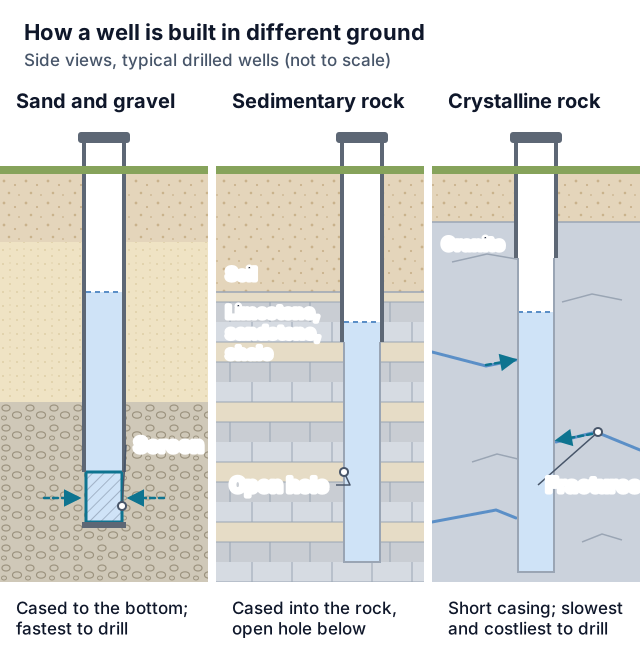
- Valley sandstone: the USGS Ground Water Atlas chapter for New England (HA 730-M) says Newark Supergroup sandstones form a significant aquifer in the Connecticut River Valley of Connecticut and Massachusetts, with water moving mainly through joints, fractures and bedding planes. Across 688 wells in that sandstone aquifer it reports yields from 0.5 to 578 gallons per minute, averaging 34, and depths from 40 to 973 feet, averaging 203; yields from the interbedded basalt flows are generally smaller.
- Crystalline rock: the same atlas says nearly all water in crystalline rock moves through fractures or joints, which are most common near land surface and shrink with depth, so wells are commonly not drilled past 300 to 600 feet, though exceptions show deep water-yielding fractures exist. Statewide, USGS WRIR 93-4115 found yield in Connecticut Valley sedimentary rocks increasing significantly at depths greater than 400 feet.
- Valley fill: USGS WRIR 84-4106 (1986) found a 25-square-mile stretch of the Connecticut River valley lowlands in Amherst, Hadley and Sunderland mostly underlain by fine-grained lacustrine (lake) deposits. Nine test wells 100 to 303 feet deep went completely through the unconsolidated fill, seismic surveys put the bedrock surface 138 to 476 feet below land surface, and the areas judged most favorable for future groundwater exploration lay mainly between the Connecticut River and the Holyoke Range.
- Water quality by aquifer: MassDEP's guidelines say Connecticut River valley sedimentary bedrock wells are commonly 100 to 250 feet deep and often yield water relatively high in sulfate, sodium and fluoride, harder and higher in dissolved solids at depth and bitter where sulfate or dissolved solids are high.
- Radon and arsenic: the guidelines recommend that Boards of Health require radon testing throughout Massachusetts and suggest checking indoor air if well water exceeds 4,000 pCi/L. Their table of towns a 2011 USGS study rated high or medium probability for arsenic or uranium in bedrock wells covers only central Massachusetts, and the guidelines note that towns outside that study may also have elevated levels.
Communities Served
Belchertown · Granby · Pelham · Amherst · Hadley · Williamsburg · Chesterfield · Goshen · Cummington · Huntington · Westhampton · Ware
Emergency Response Expectations
When a well stops delivering water, the cause may be the pump, its controls or the well. In Pelham only certified well drillers may physically alter or repair a well, and a sample from a repaired well must be tested for total coliform bacteria, and any other parameters the Board deems appropriate, before the well goes back into use. MassDEP also recommends a bacterial test after any well repair or pump or plumbing modification, taken only after disinfection and substantial flushing. We pass urgent requests along but cannot promise a response time.
Hampshire County FAQs
Does Hampshire County issue well permits?
No. M.G.L. c. 34B, § 1 abolished the county government as of January 1, 1999. Local well permits come from the Board of Health in the city or town where the well will be drilled; in Pelham, for example, the certified well driller obtains the permit.
Does Massachusetts require me to test my well water?
Not at the state level. MassDEP's testing guide says there is no state requirement, though a mortgage lender or local Board of Health may require it. MassDEP recommends testing for coliform bacteria and nitrate/nitrite initially and at least yearly, its other listed contaminants initially and at least every ten years, or as the local Board of Health requires, and using a state certified laboratory.
Do I have to test my well before selling a house in Pelham?
Yes. Pelham's regulation requires every private drinking water well on the property to be tested at a Massachusetts certified laboratory no more than one year before the transfer, with results to the Board of Health before the transfer. The owner must also give any buyer or broker copies of all available results; if there is no buyer when the water is tested, the buyer gets them before the property goes under agreement.
Sources
- M.G.L. c. 34B, § 1: transfer date for abolished counties
- MassDEP: 310 CMR 46.00, Certification of Well Drillers and Filing of Well Completion Reports
- MassDEP: Private Well Guidelines (updated May 2024)
- MassDEP: FAQs, private wells
- MassDEP: Well Driller Forms (eDEP filing)
- MassDEP: Find a certified well driller
- MassDEP: Protect Your Family, water quality testing for private wells
- MassDEP: Private drinking water testing and MassDEP-certified laboratories
- Town of Pelham Board of Health: Private Well Regulations (adopted February 16, 2023)
- Town of Pelham Board of Health: fee schedule (approved May 9, 2024)
- Town of Pelham: private well construction permit application
- USGS WRIR 93-4115: Yields of bedrock wells in Massachusetts (1994)
- USGS WRIR 84-4106: ground-water exploration, central Connecticut Valley lowlands, Massachusetts (1986)
- USGS Ground Water Atlas HA 730-M: sandstone aquifers
- USGS Ground Water Atlas HA 730-M: crystalline-rock aquifers
- USGS State Geologic Map Compilation: geologic units in Hampshire County, MA
- U.S. Census Bureau TIGERweb: county subdivisions of Hampshire County, MA (current layer)
Last reviewed 2026-10-26
Services Available in Hampshire County
Well Drilling
New residential wells — find local drillers for site evaluation, depth estimates, and written drilling quotes.
Learn more →Water Well Drilling
Household water wells from site evaluation through casing, pump, and water test — written quotes from local drillers.
Learn more →Well Pump Repair
No water at the tap? Request urgent well pump repair — local pros diagnose pressure loss, dead pumps, and pressure tank failures fast.
Learn more →Well Pump Replacement
Pump at end of life or beyond repair? Get quotes for correctly-sized submersible and jet pump replacement from local well pros.
Learn more →Well Inspection & Testing
Buying a home with a well, or overdue for a water test? Local pros for flow tests, equipment inspection, and lab water-quality testing.
Learn more →Well Water Service
Water quality problems, treatment systems, and general well maintenance — connect with local pros for everything between drilling and pump work.
Learn more →Free Tools Before You Call
Ballpark the cost or narrow down the problem before talking to a Hampshire County provider.
Well Drilling Cost Calculator
Estimate what drilling a well should cost — by depth, geology, and whether you need the pump and pressure tank included.
Use the free tool →No Water From Your Well? Diagnostic Wizard
Suddenly no water in the house? Answer a few questions to find out if it's the breaker, the pressure switch, the tank, the pump — or the well itself.
Use the free tool →Well Pump Size Calculator
Find what size well pump you need — GPM demand, total dynamic head, and a horsepower recommendation from four quick inputs.
Use the free tool →Need help in Hampshire County, MA?
Send the short form — urgent requests get priority routing.