Well Drilling in Chippewa County, MI
Well drilling typically runs $3,000–$16,000 nationally, per our cost guide. Independent local pros serving Sault Ste. Marie, De Tour Village, Brimley and nearby communities. Describe the problem and we'll route your request — free, no obligation.
- Mark no-water pump problems as emergencies on the form
- County pages on local well depths, aquifers, and permits
- Well inspections, water testing, and treatment
- Free to use — no obligation, no markup
Fast response from independent local providers. No obligation.
Typical national cost$3,000 – $16,000Cost guide →Local Help in Chippewa County, MI
Michigan Geological Survey Progress Report 17, a 1958 reconnaissance of Chippewa County groundwater prepared cooperatively with the U.S. Geological Survey, found that most wells in the county tapped glacial-drift aquifers, which it called the most accessible source, and expected bedrock aquifers to yield adequate supplies where drift aquifers were missing or too weak. It also recorded that a potable groundwater supply had been hard to obtain in places within the Sault Ste. Marie-Sugar Island area.
Three sets of rules govern a well here. Part 127 of Michigan's Public Health Code (MCL 333.12701 to 333.12715) covers contractor registration and well records; EGLE's Water Well Construction and Pump Installation Code, beginning at R 325.1601, sets construction, disinfection and plugging standards; and the Chippewa County Health Department issues well permits under the Upper Peninsula Environmental Health Code, approved by the county Board of Commissioners on October 15, 2020 and effective January 1, 2021. Requests sent through this site go to independent contractors; the site itself does not drill wells or install pumps.
Chippewa County Service Details
What providers in this area actually see: coverage, common jobs, local pricing factors, and rules worth knowing.
Service Area Notes
- The Census Bureau's 2020 place list, which matches its current TIGERweb place layers, shows Sault Ste. Marie city, De Tour Village village and the Brimley and Kincheloe census-designated places in Chippewa County. Its county subdivision list divides the county into Sault Ste. Marie city and townships, including Kinross charter township and Bay Mills, Bruce, Dafter, Detour, Drummond, Pickford, Rudyard, Soo, Sugar Island, Superior, Trout Lake and Whitefish townships.
- City or village water nearby: Section 5-4 of the county code says an available public water supply does not prevent a private well permit unless other regulations prohibit it, and that the department contacts the municipal water supplier before issuing the permit.
- Tracing an existing well: EGLE says contractors have filed well, pump and plugging records electronically in Wellogic since 2000, that it holds over a million records, and that searching needs no account. An MDHHS checklist on the county's site adds that wells installed before 2000 may turn up among EGLE's scanned well records, and that the local health department can help when no record is found.
- Spotting a registered rig: MCL 333.12706 has each well drilling contractor display its registration number, including the county code number for the business location, in figures at least 2 inches high on both sides of the drilling machine, with an EGLE seal showing the year of issue or renewal and the words "Michigan registered water well drilling contractor" beside it. EGLE's registration page says every registration expires April 30, that contractors who have not renewed by May 1 cannot drill or install pumps until they do, and links a directory of registered contractors.
Common Jobs in Chippewa County
- New private wells built under a Chippewa County Health Department construction permit
- Replacement wells, where the county application asks why the old well is being replaced, who will abandon it and how
- Type II (noncommunity) and Type III public supply wells for uses such as the restaurants, campgrounds, schools and churches named on EGLE application form EQP2024
- Pump replacement, which needs no county permit under Section 5-3.3 but does call for a water well and pump record under Section 5-5
- Flow control for flowing artesian wells
- Plugging abandoned wells and dry holes, including hand-dug and crock wells
- Chlorinating a new or repaired system and collecting the coliform sample before use
What Drives Pricing Here
- Depth: Progress Report 17 said most wells in the county were drilled to less than 200 feet, while some went several hundred feet before reaching an adequate supply. It described the drift as up to 400 feet thick where buried bedrock valleys were filled with glacial sediment, and thin and discontinuous next to the Niagara escarpment and other bedrock highs. These are 1958 countywide observations, not a forecast for a particular lot; Wellogic holds the logs drillers filed for nearby wells.
- The site's estimate: our drilling cost tool takes the depth you type in, prices each foot within a range tied to the geology type you choose, then adds a generic permit line and, by default, a pump and a pressure tank. Its rates come from national cost pages at Angi, HomeGuide and HomeAdvisor, so the total is a rough national figure rather than a Chippewa County bid. The county's own permit fee is given in the FAQ below.
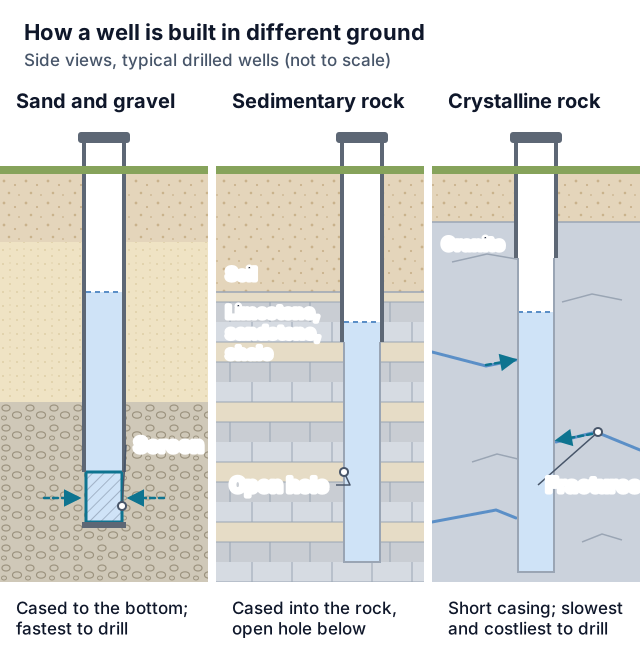
- Casing: R 325.1632 requires steel casing of at least 2 inches inside diameter, or PVC casing of at least 5 inches (unless installed as liner pipe) placed in an oversized borehole without driving. Casing must reach at least 25 feet below the ground and end at least 12 inches above it; in a paved area the health officer may approve in writing a termination of 2 inches or more when the subrule's flooding, watertight-connection and venting conditions are met. A well with less than 26 feet of casing may not be used without the health officer's written approval under R 325.1613. Driven well points need at least 1 1/4-inch steel casing and the health officer's written approval to serve as a water supply (R 325.1632a).
- Grout: R 325.1633a has neat cement or bentonite grout placed through the permanent casing or a grout pipe from the bottom of the annular space to the surface in one uninterrupted operation, in a borehole at least 2 inches larger than the casing's nominal size (except as R 325.1635 provides), or at least 2 7/8 inches larger when the grout pipe runs outside the casing. Where temporary casing is pulled, the space between it and the permanent casing is grouted during removal, either by pumping neat cement or bentonite grout or by pouring bentonite chips, bentonite pellets or granular bentonite; granular bentonite may not be poured into a space that holds drilling fluid or water. Neat cement of the listed types must set at least 24 hours, or 48 hours if bentonite is added, before drilling resumes. Wells with driven casing follow the separate grouting options in R 325.1635.
- Shallow bedrock: where bedrock is met within 25 feet of the surface, R 325.1637 calls for an oversized borehole with the casing grouted in neat cement to at least 25 feet, while Section 5-12 of the county code is stricter and requires the entire casing length grouted with neat cement or concrete grout.
- Artesian flow: Progress Report 17 found water in many aquifers across extensive areas of the county under enough pressure to make wells flow. R 325.1638 requires such wells to be grouted to protect the artesian aquifer, prevent erosion of overlying materials and confine the flow within the casing, and to have discharge control (valved pipe connections, watertight pump connections, a receiving tank set at the altitude of the artesian head, a flowing well pitless adapter, a packer, or another method the health officer approves) unless a deviation is issued under R 325.1613.
- Other permits: the county application warns that other permits may be required, such as an EGLE wetlands permit or a soil erosion and sedimentation control permit from the Chippewa, Luce, Mackinac Conservation District, and says a copy of the well permit is emailed to the Chippewa County Building Department and that district.
Permits & Local Rules
- Registration: MCL 333.12704 requires a person to obtain an annual certificate of registration as a well drilling contractor or pump installer before engaging in the business of well drilling or pump installing, and a registered well drilling contractor may do any pump installer's work. Under R 325.1608 a registered pump installer may install pumps but may not drill. MCL 333.12703(3) lets a licensed master plumber do the work of a pump installer without a pump installer registration.
- Building your own: MCL 333.12703(2) does not prevent a person from constructing a well or installing a pump on property the person owns or leases when the well is intended only for a single-family house that is that person's permanent residence, or only for farming purposes on that person's farm, and the water is not intended for use by the public or in any residence other than the person's own. That person must still submit the drilling record required by MCL 333.12707 and follow the construction code. The county's handout So You Want To Drill Your Own Well lists its conditions (own or lease the property, the property is your permanent residence, the well serves only a single-family house and no other residence, and the water is not used by the public) and requires a written plan showing exactly how the well will be built, reviewed before the construction permit is issued; the permit must be issued first.
- When a permit is needed: Section 5-3.2 of the county code bars anyone from beginning construction of a well or water supply, or making an extensive change to one, without first obtaining a water supply construction permit. Section 5-3.3 exempts minor repairs (replacing a telescoped well screen, changing a screen elevation, deepening or plugging back a bedrock well, installing a liner pipe, replacing a pump, pump controls, drop pipe or pressure tank, or chemical treatment or disinfection), wells under the Mineral Well Act, and work for which the owner, agent, driller or pump installer must get a permit directly from EGLE under the Safe Drinking Water Act. Section 5-11 covers emergency work when the department is closed.
- Permit terms: an application is made by the property owner or an authorized representative, and the department will not act on an incomplete one. A permit is valid for 24 months from issuance unless declared void, may be extended once for 24 months if the request comes within a 30-day grace period after expiration, and cannot be transferred. The department may require an on-site evaluation before issuing it and inspections during construction, may attach special construction conditions, and may require a separate permit for each well on the premises. The driller must keep a valid permit on site during construction except under the emergency section.
- What to send: the county's application requires the 11-digit property tax ID and, for new construction, a 911 address from the Equalization Department before you apply. Its site plan must show property dimensions, all structures with dimensions, roads and driveways, surface water, existing or proposed septic systems and wells (including a neighbor's within 75 feet of your property), easements and utilities, and above- and below-ground fuel storage tanks, with the distances between them.
- Small lots and subdivisions: under Section 5-15, a well proposed on a parcel under one acre created after March 31, 1997, a lot in a subdivision or site condominium, or a parcel created beyond the allowed exempt splits under the Land Division Act must meet R 560.401 to R 560.428 before a permit is issued.
- Distances from contamination: R 325.1622 requires a well to be located where possible upgradient of contamination sources and the maximum practical distance from them, and sets minimums including 800 feet from a landfill's active work area or land-applied septage, 300 feet from oil and gas wells, 150 feet from fertilizer or chemical storage or preparation areas, 50 feet from a septic tank, subsurface disposal field, seepage pit, cesspool, animal or poultry yard or outhouse, 50 feet from a fuel tank under 1,100 gallons storing motor or heating fuel for noncommercial purposes or consumptive use on the premises, and 10 feet from a lake, pond, river or stream. The health officer may raise or lower these for a particular well under R 325.1613, and the owner must keep the distances on the owner's own property. The county's handout for owner-built wells lists 100 feet from any pit privy or outhouse, so confirm that distance with the department.
- Buildings and floods: a well must be at least 3 feet from a building, pump room or any projection unless a deviation is issued, and the owner must keep access for a drilling machine (R 325.1624). A well may not be placed where it floods unless protected as the health officer prescribes in writing, and the owner must grade the ground so surface water drains away from the casing (R 325.1625).
- Disinfection and sampling: after pumping to waste, R 325.1661 has the well and pumping equipment chlorinated at one of four concentration and contact-time pairs in its Table 5 (100 ppm for 10 hours, 250 ppm for 4 hours, 500 ppm for 2 hours or 1,000 ppm for 1 hour), with the contractor or pump installer responsible for the part of the system it worked on. Once the chlorine is flushed out, one or more samples from the sampling faucet must show no coliform organisms before the system goes into service; the owner collects the sample or arranges for a designated representative to do so, and the contractor must tell the owner about that duty.
- Records: under MCL 333.12707 and R 325.1675, within 60 days of completing a well the contractor gives the owner one copy and the department or local health department two copies of a well log showing the owner's name, location, depth, geologic materials and thicknesses penetrated, amount of casing, static water levels and any other information the rules require; a drive point well with no earth removed needs only the owner's name, location, depth, casing, static water level and screen data. The contractor keeps a geologic record at the site for inspection during construction, and the log is signed by a registered well drilling contractor. If the log is not filed within 60 days or the site record is not kept, the department or health officer may require geophysical logging of the well (R 325.1675(5)). R 325.1676 adds a signed pump installation record within 60 days of installing a pump on a new well, and county code Section 5-5 lists further events, including a pump replacement, a new pitless adapter or a deepened well, that also call for a water well and pump record.
- Final approval: under Section 5-9.2 the department does not approve a water supply until it complies with the code, other applicable codes and the permit; the water well and pump record (with any associated abandoned well plugging record) has been submitted, reviewed and approved; and the department has reviewed the required water sample results and found the quality meets safe drinking water standards for the parameters tested.
- Plugging: R 325.1662 lets an abandoned well or dry hole be plugged by a registered well drilling contractor or by the well owner, but requires a registered contractor where the property has a well serving the public or a residence other than the owner's (county code Section 5-16 repeats this). The county's private well permit application goes further for replacements: it states that the old well must be abandoned by a registered well driller. Before plugging, the pump, drop pipe, packer and any other equipment, debris or obstructions are removed if possible (R 325.1662). The approved plugging materials and placement methods for wells in overburden, bedrock sections, lost circulation zones, flowing or gas-discharging wells, and large dug or crock wells are set out in R 325.1663 to R 325.1665; EGLE's abandoned water wells page links its plugging rules and manual, and local health departments enforce plugging through field inspections and review of plugging records. Within 60 days, whoever plugged the well sends EGLE or the local health department two copies of a report giving the owner's name, well location, depth and diameter, plugging procedure, material and amount used; where a replacement well will be or has been built, the information may instead go on the replacement well's log, and several abandoned wells or dry holes on a single parcel may be reported on one well log form if their geologic materials and plugging methods are similar (R 325.1675(3)).
- Not ready to plug: a temporarily abandoned well must meet the construction and isolation distance rules, be disconnected from the water distribution piping, and have the casing top securely capped against surface water, foreign material and access (R 325.1670). Under county code Section 5-16, a well replaced under a permit must be plugged unless it stays active for a beneficial use or is placed in temporarily abandoned status.
Geology & Water Table Notes
- Bedrock: Progress Report 17 describes Paleozoic sedimentary rocks over Precambrian metamorphic and igneous rocks, all mantled by glacial and glacial-lake sediments, with the rock layers dipping about 40 feet per mile southward toward the center of the Michigan basin.
- Sandstone aquifers: the report calls the sandstones of Late Cambrian and Early Ordovician age (including the Munising formation) one of the principal aquifers of the Northern Peninsula; most wells using them were in the northeastern part of the county, and several deep wells drilled for oil in the Pickford and Rudyard areas produced large flows of fresh water from them. Several wells in the Sault Ste. Marie area produced saline water from the red sandstone of Cambrian age.
- Limestone and dolomite: Middle Ordovician limestone and dolomite, including the Trenton and Black River limestones, form a cuesta across the northern part of the county, masked by glacial deposits in all but a few places, and give small to moderate supplies where solution has opened fractures under the drift, but remain relatively impermeable where Late Ordovician shale covers them; that shale, about 250 feet thick, yields no water to wells in the county. Middle Silurian limestone and dolomite of the Niagara cuesta along the southern part of the county feed many springs, and solution openings are the main source for wells drilled into it.
- Drift: outwash sand and gravel is the most permeable part of the drift and yields moderate to large supplies. Moraines in the western half of the county and in the Kinross area are largely sand and gravel, while much of the eastern moraine material is clayey till and a poor source. Glacial Lake Algonquin left clay, silt and fine sand over much of the county, more than 300 feet thick in places; drillers call the silt and fine sand quicksand, and most flowing wells are in low areas where lake clays confine the aquifers.
- Water quality: the report measured hardness of 50 to 150 ppm in glacial-drift samples and 170 to 365 ppm in fresh bedrock water, iron from near 0 to 12 ppm in drift samples, and some sulfur water. It described mineralized water (more than 1,000 ppm dissolved minerals) in places, and warned that a deep uncased well or unplugged test hole may provide a path for mineralized water to flow to the surface or into overlying freshwater aquifers.
Communities Served
Sault Ste. Marie · De Tour Village · Brimley · Kincheloe · Kinross Charter Township · Rudyard Township · Pickford Township · Drummond Township · Whitefish Township · Sugar Island Township
Emergency Response Expectations
Section 5-11 of the county code says that when a lack of water causes undue hardship and the department is closed, a well driller or property owner may start repair work or construction of a new well or water supply without prior notification or permit, must contact the department on the next working day to obtain a permit, and remains responsible for complying with every other provision of the code. This site can pass an urgent request along, but how fast a contractor responds is outside its control.
Chippewa County FAQs
Is a county permit required before a well is drilled in Chippewa County?
Yes for a new well or water supply, or an extensive change to one (Section 5-3.2 of the Upper Peninsula Environmental Health Code). Section 5-3.3 exempts listed minor repairs, such as replacing a pump, pump controls, drop pipe or pressure tank, along with Mineral Well Act wells and work permitted directly by EGLE, and Section 5-11 lets a well driller or property owner start repair work or a new well or water supply without prior notification or permit when a lack of water causes undue hardship and the department is closed; the driller or owner must contact the department on the next working day to obtain a permit and still has to comply with the rest of the code.
What does the county charge for a well permit?
The Environmental Health fee schedule effective February 28, 2022, posted on the department's site and checked October 27, 2026, lists $318 for a private well permit, $447 for a Type II well permit, $290 for a Type II sanitary survey once every five years, and $347 for a Type III well permit. The same schedule lists $71 for staff to collect a water sample, not including the analysis fee.
Can I drill my own well?
Only within MCL 333.12703(2): on property you own or lease, for a single-family house that is your permanent residence or for farming on your own farm, with the water not intended for public use or for any other residence. You must still file the drilling record and follow the construction code, and the county reviews a written construction plan before it issues the permit you need first.
How close can a home well be to a septic system or a lake?
R 325.1622 sets minimums of 50 feet to a septic tank or subsurface disposal field and 10 feet to a lake, pond, river or stream, and the health officer can change these for a specific well. EGLE's isolation table lists larger distances for public supply wells, for example 75 feet from a septic tank, drainfield or surface water for Type IIb and III wells and 200 feet for Type I and IIa wells.
What applies to a well for a campground or other business?
The department issues Type II and Type III permits using EGLE's public water supply application (EQP2024). That form says that after construction the water well and pump record must be submitted and approved, the local health department notified for a final inspection, and the applicable sampling completed, and that local health department approval is required before the well is placed in service.
Who tests private well water here?
The county's Environmental Health Division has bacteria sample bottles at its office and recommends sampling for bacteria, noting that well owners are responsible for testing. EGLE's Drinking Water Laboratory tests private residential wells, including for arsenic and lead, and says its fees increased October 1, 2026. An MDHHS fact sheet posted by the county recommends a coliform test (which includes E. coli) every year, and also when taste, color or odor changes suddenly, the water turns cloudy after rain or flooding near the wellhead, people drinking it have an upset stomach, vomiting, fever or diarrhea, or a septic system or barnyard is within 50 feet of the well.
Who can plug an old well on my land?
Under R 325.1662, the owner or a registered well drilling contractor, but only a registered contractor where the property has a well serving the public or a residence other than the owner's. For a replacement under a county permit, the county's application calls for a registered well driller.
When does a well need EGLE water withdrawal approval?
EGLE's Water Withdrawal Assessment Tool page says the tool is required for new or increased large quantity withdrawals, defined there as 100,000 gallons or more per day averaged over 30 days for a shared water system, and that landowners planning a new or increased withdrawal using one or more pumps capable of at least 70 gallons per minute must get EGLE approval before operating. Ask EGLE whether a planned pump falls under that process.
Sources
- Michigan Legislature: Public Health Code Part 127, MCL 333.12701 to 333.12715
- Michigan Administrative Code R 325.1601 to R 325.1781: Groundwater Quality Control (well construction code)
- EGLE: Water well construction program
- EGLE: Minimum well isolation distances
- EGLE: Water well contractor registration
- EGLE: Wellogic water well records
- EGLE: Abandoned water wells
- EGLE: Drinking Water Laboratory
- EGLE: Water Withdrawal Assessment Tool
- Michigan Geological Survey Progress Report 17: Reconnaissance of the Ground-Water Resources of Chippewa County (Vanlier and Deutsch, 1958)
- USGS Michigan District: Progress Report 17 citation
- Chippewa County Health Department: Well and Water Services
- Chippewa County Health Department: Environmental Health fee schedule, effective February 28, 2022
- Chippewa County Health Department: Septic system and water well permit application
- Chippewa County Health Department: So You Want To Drill Your Own Well
- Upper Peninsula Environmental Health Code, Chippewa County (effective January 1, 2021)
- EGLE form EQP2024: Application to install or alter a public water supply system (county Type II and III packet)
- MDHHS: Coliform Bacteria in Drinking Water for Well Owners (posted by the county)
- MDHHS: MiWell Maintenance Checklist (posted by the county)
- U.S. Census Bureau: 2020 places by county, Michigan
- U.S. Census Bureau: 2020 county subdivisions, Michigan
Last reviewed 2026-10-27
Nearby Counties
Services Available in Chippewa County
Well Drilling
New residential wells — find local drillers for site evaluation, depth estimates, and written drilling quotes.
Learn more →Water Well Drilling
Household water wells from site evaluation through casing, pump, and water test — written quotes from local drillers.
Learn more →Well Pump Repair
No water at the tap? Request urgent well pump repair — local pros diagnose pressure loss, dead pumps, and pressure tank failures fast.
Learn more →Well Pump Replacement
Pump at end of life or beyond repair? Get quotes for correctly-sized submersible and jet pump replacement from local well pros.
Learn more →Well Inspection & Testing
Buying a home with a well, or overdue for a water test? Local pros for flow tests, equipment inspection, and lab water-quality testing.
Learn more →Well Water Service
Water quality problems, treatment systems, and general well maintenance — connect with local pros for everything between drilling and pump work.
Learn more →Free Tools Before You Call
Ballpark the cost or narrow down the problem before talking to a Chippewa County provider.
Well Drilling Cost Calculator
Estimate what drilling a well should cost — by depth, geology, and whether you need the pump and pressure tank included.
Use the free tool →No Water From Your Well? Diagnostic Wizard
Suddenly no water in the house? Answer a few questions to find out if it's the breaker, the pressure switch, the tank, the pump — or the well itself.
Use the free tool →Well Pump Size Calculator
Find what size well pump you need — GPM demand, total dynamic head, and a horsepower recommendation from four quick inputs.
Use the free tool →Need help in Chippewa County, MI?
Send the short form — urgent requests get priority routing.