Well Drilling in Jones County, MS
Well drilling typically runs $3,000–$16,000 nationally, per our cost guide. Independent local pros serving Laurel, Ellisville, Sandersville and nearby communities. Describe the problem and we'll route your request — free, no obligation.
- Mark no-water pump problems as emergencies on the form
- County pages on local well depths, aquifers, and permits
- Well inspections, water testing, and treatment
- Free to use — no obligation, no markup
Fast response from independent local providers. No obligation.
Typical national cost$3,000 – $16,000Cost guide →Local Help in Jones County, MS
Jones County lies in the Southern Pine Hills district of the Gulf Coastal Plain, according to Ground-Water Resources of Jones County, Mississippi, a U.S. Geological Survey report (Water-Resources Investigations Report 85-4342) published in 1987 in cooperation with the City of Laurel. It found the Catahoula Sandstone beneath most of the county's surface, with the county's largest groundwater withdrawals coming from Catahoula aquifers in the Miocene aquifer system.
The Mississippi Department of Environmental Quality's Office of Land and Water Resources licenses drillers and pump installers, sets construction and plugging standards, and keeps records on drilled and plugged wells. The Mississippi State Department of Health (MSDH) tests private wells for bacteria and sets how far septic tanks and disposal fields must stay from a well. We route Jones County requests to independent licensed contractors.
Jones County Service Details
What providers in this area actually see: coverage, common jobs, local pricing factors, and rules worth knowing.
Service Area Notes
- Requests are welcome from anywhere in the county. The Census Bureau's place-by-county reference file for Mississippi lists the cities of Laurel and Ellisville, the towns of Sandersville and Soso, and the census-designated places of Eastabuchie, Moselle, Ovett and Sharon in Jones County.
- Check the license before the rig arrives. MDEQ Rule 2.8 has drilling rigs, water trucks and service vehicles used on wells or pump installations display the licensee's name and "MS Lic." with the license number on both sides, and MDEQ posts a list of licensed well contractors, drillers and pump installers.
- Buying a place with a well? Ask the seller for its State Well Report; under Rule 2.9, the contractor who files it with MDEQ keeps a copy and provides one to the well's owner.
Common Jobs in Jones County
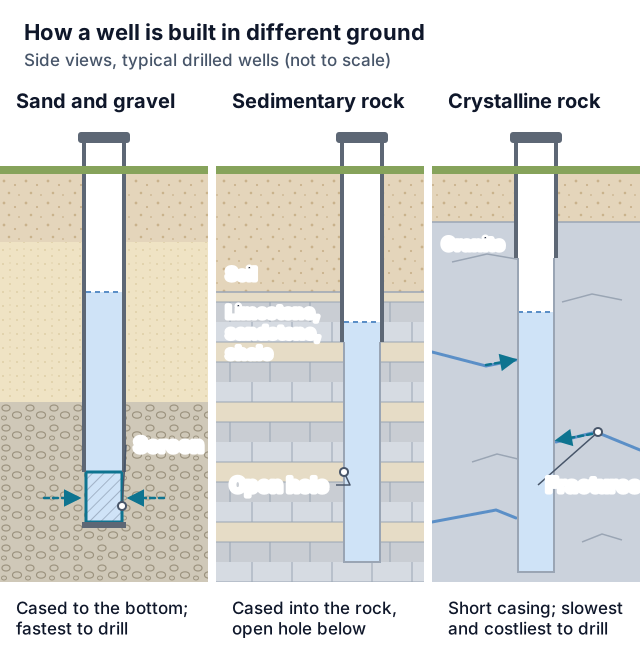
- New household wells finished in Catahoula Sandstone sand beds or, in the county's northeast, in the Glendon Formation
- Replacement wells, with the old well plugged under MDEQ's decommissioning rule
- Pump and pressure tank installation and service by MDEQ-licensed pump installers
- Plugging abandoned or unused wells
- Disinfecting a well after flooding or a positive bacteria result
- Wells for poultry houses and livestock, which may need an MDEQ water use permit
What Drives Pricing Here
- Depth to a usable sand: USGS found the principal Catahoula aquifers in the Laurel area at depths of about 200 and 400 feet, several public and industrial wells drawing on Eocene strata deeper than 900 feet, and some small supplies in the north coming from wells less than 200 feet deep in Oligocene sediments. Assuming the beds share the Glendon Formation's southwesterly dip of about 40 feet per mile, the report puts a given aquifer about 100 feet deeper for each 2½ miles southwestward at the same ground altitude.
- Hit-or-miss sand: the report says the Catahoula Sandstone commonly holds as much as 50 percent clay and that the odds of a large-capacity well at a particular site cannot be accurately predicted; test drilling for one Laurel-area municipal well field took 19 test holes for seven successful well sites.
- Grout depth: Rule 2.12 grouts the annular space to the surface from at least 10 feet down, and from at least 50 feet down for wells within 100 feet of a potential pollution source such as sewers, septic tanks, landfills, and waste and raw material piles, each subject to exceptions the rule lists.
- Saltwater zones: USGS reported local contamination of Jones County freshwater aquifers from past earthen pits and improper waste injection, and wrote that saltwater contamination can be expected in wells drilled in or near oil fields. Rule 2.12 requires metal casing and Halliburton-method grouting for any well drilled through or into an aquifer above 250 mg/L chloride or 1,000 mg/L dissolved solids.
- Water treatment: in the 1987 report, iron topped 0.30 mg/L in 33 percent of the analyses of water from Catahoula and Vicksburg wells, and pH generally ran below 7.0 in those aquifers. MSDH points mineral and chemical testing to private laboratories.
- Our cost calculator multiplies the depth you enter by a per-foot rate range for the geology you pick, with rates based on national Angi, HomeGuide and HomeAdvisor cost pages, so treat its output as a rough third-party-based figure, not a Jones County quote.
Permits & Local Rules
- Withdrawal permit: under MDEQ Rule 1.4 (11 Miss. Admin. Code Pt. 7, Ch. 1), groundwater withdrawals need a permit unless the well is used for domestic purposes and provides potable water to only one household, has a surface casing diameter less than six inches (still subject to the rule's prohibited uses and reporting requirements), or is a relief well protecting a structure such as a dam or levee. A well that is part of a public water system must comply with MSDH regulations regardless.
- Farm wells: that chapter's definition of domestic use covers watering noncommercial farm livestock and poultry, while Rule 1.4.B puts water for commercial cattle, hogs and other animal operations in its industrial/commercial priority category, so ask MDEQ about a permit for a commercial poultry or livestock well.
- Licensing: Rule 2.2 (Pt. 7, Ch. 2) requires an MDEQ license before anyone engages in a business that drills water wells or boreholes that may penetrate water-bearing strata, or installs pumps or other equipment in water wells. Licenses go only to individuals; a company is deemed licensed only through a licensed principal or key employee.
- Owner exemption: Rule 2.2.B lets a person who owns or leases property, or holds another property interest allowing a well and the use of the water under it, drill a well there without a license, provided the well will be used only to supply water for domestic use to a single family dwelling that is the owner's or lessee's permanent residence and/or to water livestock on the owner's or lessee's farm, and the owner or lessee complies with the regulation's construction standards and applicable MSDH regulations. The paragraph's crop-irrigation clause is marked in effect until July 1, 2011 under Miss. Code Ann. § 51-5-1, so confirm it with MDEQ.
- Supervision: Rule 2.2.C requires a licensed water well contractor, or an employee the licensee has certified under Rule 2.2.D, on site personally supervising all critical stages of drilling and completing a potable water well, such as setting and grouting the casing and installing the pump. If you plan to drill under the owner exemption, ask MDEQ how this applies first.
- Construction and first sample: Rule 2.12 makes the licensee responsible for its standards, which bar any potable water well within 100 feet of any potential source of pollution and require a check valve in the discharge line. After drilling, a potable well is disinfected with at least 50 mg/L free chlorine for at least 24 hours, then pumped until a chlorine-free sample is collected; that sample must also be free of coliform bacteria, and is collected and analyzed under MSDH requirements.
- State Well Report: if the contractor completes the well immediately after drilling, the whole report goes to MDEQ within 30 days after completion. Otherwise the driller's log is due within 30 days after drilling is completed and the completion section within 30 days after the well is completed; if someone else completes the well, the owner must give that licensee a copy of the report form carrying the driller's log.
- MSDH Notice of Intent: under Rule 1.5.3 of MSDH's on-site wastewater regulations (15 Miss. Admin. Code Pt. 18, Subpt. 77), before a mobile, modular or permanently constructed residence is built or placed where it may require a single residential on-site wastewater system and either a new water meter or a new private well, the applicant files a Notice of Intent with a legal description, a plot plan (plat) and the fee.
- Septic distances: in those regulations, Rule 5.1.3 sets a septic tank at least 50 feet from potable water supplies and all private wells. For aggregate systems, Rule 5.4.4 keeps the effluent disposal field at least 100 feet from any public, private or individual potable water source, at a lower elevation or in a landscape position that keeps surface runoff from flowing toward the well site. Other disposal methods have their own location rules.
- Plugging: Rule 2.14 assigns wells and boreholes 25 feet deep or more that penetrate a water-bearing stratum to an MDEQ-licensed water well contractor, but MDEQ may authorize plugging by someone else, or an alternate method, if the results meet the intent of the regulations; it considers only detailed written requests and gives any approval in writing. Water wells less than 25 feet deep may be plugged by someone other than a licensed contractor. The same procedures and reporting requirements apply whoever does the work, and the person or contractor who plugs a well files MDEQ's decommissioning form within 30 days after plugging. The rule also sets when MDEQ may treat a well as abandoned, the plugging deadlines, grout materials and written MDEQ approval to keep a properly cased and sealed well, under a locking cover, as a monitoring or observation well instead, so read it or ask MDEQ before an old well is sealed.
Geology & Water Table Notes
- Stacked Catahoula sands: USGS calls the principal aquifers tapped by Laurel-area public and industrial wells the middle Catahoula aquifer (the "200-foot sand") and the lower Catahoula aquifer (the "400-foot sand"). An upper Catahoula aquifer crops out at and south of Laurel and forms a third aquifer to the south; the report's highest-yielding wells, about 1,600 gallons per minute each, were screened in it in the southwestern part of the county.
- Edges of the county: the Glendon Formation of the Vicksburg Group, locally called "honeycomb rock," supplies low-yielding wells (less than 50 gallons per minute) in northeastern Jones County, while the water-bearing Hattiesburg Formation overlies the Catahoula in the south.
- Falling heads at Laurel: the 1987 USGS report found that water levels in key observation wells in the lower Catahoula aquifer at Laurel had dropped from about 150 feet above sea level in 1945 to about 80 feet above sea level in 1985, and it described groundwater in the county as moving from all directions into a cone of depression caused by long-term pumping for public and industrial supplies in the Laurel area. Those are the report's findings, not current measurements.
- Floodplains: USGS notes that the alluvial plains of the Leaf River and its larger tributaries (Tallahala Creek, Tallahoma Creek and the Bogue Homa) are subject to flooding. Rule 2.12 ends casing at least 12 inches above natural ground or, where practicable, above the 100-year flood elevation, and where flood levels routinely exceed a reasonable extended-casing height, the well is fully sealed with a Braden casing head or approved equivalent.
Communities Served
Laurel · Ellisville · Sandersville · Soso · Eastabuchie · Moselle · Ovett · Sharon
Emergency Response Expectations
When a Jones County well stops delivering water, flag the request as urgent; arrival depends on which independent licensed contractors have a crew free. If floodwater reached the wellhead, MSDH's private well disinfection page sets out its procedure.
Jones County FAQs
Does a home well in Jones County need an MDEQ withdrawal permit?
Not if it is used for domestic purposes and provides potable water to only one household. An exempt well is still built to MDEQ's construction standards, and MSDH's Notice of Intent applies when a new residence may need both an on-site wastewater system and a new private well.
Can I drill a well on my own land without a license?
Only within Rule 2.2.B: on property you own, lease or otherwise hold a qualifying interest in, a well supplying domestic water to a single family dwelling that is your permanent residence and/or watering livestock on your farm, built to MDEQ's construction standards and applicable MSDH regulations. Ask MDEQ's Office of Land and Water Resources how the on-site supervision rule applies before starting.
Who tests private well water for bacteria?
MSDH, on request, through its private well water sampling application or request form. It tests for bacteriological contamination only and lists private labs in its Drinking Water Lab Certification Program for other testing.
Floodwater got into my well. What now?
MSDH's printable guide on flooding of a private water well recommends its chlorine disinfection procedure, followed by a bacteriological sample that a county environmentalist can help collect. If two attempts do not clear the contamination, MSDH says to contact a licensed water well contractor.
Sources
- MDEQ: 11 Miss. Admin. Code Pt. 7, Ch. 1 (groundwater use)
- MDEQ: 11 Miss. Admin. Code Pt. 7, Ch. 2 (water well contractors)
- 11 Miss. Code R. 7-1.4 (Cornell LII)
- 11 Miss. Code R. 7-2.14 (Cornell LII)
- MDEQ: Water well drillers
- MDEQ: Licensed drillers list
- MSDH: Private well water testing
- MSDH: Private well disinfection
- MSDH: Flooding of your private water well
- Secretary of State: MSDH on-site wastewater regulations
- USGS WRI 85-4342: Jones County ground-water resources
- Census Bureau: Mississippi places by county
Last reviewed 2026-10-26
Nearby Counties
Services Available in Jones County
Well Drilling
New residential wells — find local drillers for site evaluation, depth estimates, and written drilling quotes.
Learn more →Water Well Drilling
Household water wells from site evaluation through casing, pump, and water test — written quotes from local drillers.
Learn more →Well Pump Repair
No water at the tap? Request urgent well pump repair — local pros diagnose pressure loss, dead pumps, and pressure tank failures fast.
Learn more →Well Pump Replacement
Pump at end of life or beyond repair? Get quotes for correctly-sized submersible and jet pump replacement from local well pros.
Learn more →Well Inspection & Testing
Buying a home with a well, or overdue for a water test? Local pros for flow tests, equipment inspection, and lab water-quality testing.
Learn more →Well Water Service
Water quality problems, treatment systems, and general well maintenance — connect with local pros for everything between drilling and pump work.
Learn more →Free Tools Before You Call
Ballpark the cost or narrow down the problem before talking to a Jones County provider.
Well Drilling Cost Calculator
Estimate what drilling a well should cost — by depth, geology, and whether you need the pump and pressure tank included.
Use the free tool →No Water From Your Well? Diagnostic Wizard
Suddenly no water in the house? Answer a few questions to find out if it's the breaker, the pressure switch, the tank, the pump — or the well itself.
Use the free tool →Well Pump Size Calculator
Find what size well pump you need — GPM demand, total dynamic head, and a horsepower recommendation from four quick inputs.
Use the free tool →Need help in Jones County, MS?
Send the short form — urgent requests get priority routing.