Well Drilling in LaGrange County, IN
Well drilling typically runs $3,000–$16,000 nationally, per our cost guide. Independent local pros serving Lagrange, Shipshewana, Topeka and nearby communities. Describe the problem and we'll route your request — free, no obligation.
- Mark no-water pump problems as emergencies on the form
- County pages on local well depths, aquifers, and permits
- Well inspections, water testing, and treatment
- Free to use — no obligation, no markup
Fast response from independent local providers. No obligation.
Typical national cost$3,000 – $16,000Cost guide →Local Help in LaGrange County, IN
Indiana DNR's Division of Water places LaGrange County in the northeastern part of the state, entirely inside the St. Joseph River Basin, with the Pigeon River, the Fawn River and the Little Elkhart River as its major drainage systems. The division's aquifer summary for the county names unconsolidated glacial sand and gravel as the principal source of ground water and says the underlying shale bedrock is generally not used as an aquifer.
The LaGrange County Health Department states that the county has no water well ordinance and that a residential water well permit is not required, and that drillers follow Indiana Department of Health and Indiana DNR rules. On the DNR side those are the licensing statute IC 25-39 and the Natural Resources Commission's rule 312 IAC 13, which covers drilling, casing, grouting, disinfection, pump installation and the plugging of old wells. This site does no drilling; it forwards requests to independent contractors.
LaGrange County Service Details
What providers in this area actually see: coverage, common jobs, local pricing factors, and rules worth knowing.
Service Area Notes
- Requests are taken from anywhere in the county. The Census Bureau lists four incorporated towns with LaGrange County territory (Lagrange, as the Bureau spells it, plus Shipshewana, Topeka and Wolcottville, which also extends into Noble County) and one census-designated place, Howe.
- Researching an existing well: the Division of Water's Water Rights and Use Section holds records for more than 400,000 Indiana water wells, about 138,000 of them field verified. Its online database cannot be searched by owner name, but the water well records viewer offers a street address and ZIP code search. Under IC 25-39-4-10, the department keeps a well record confidential for one year when the well owner or the licensee applies in writing.
- Checking a contractor: DNR lists drilling and pump service contractors whose drillers and pump installers hold a license for the current year, says it does not recommend particular contractors, and asks people to contact the Division of Water to confirm an individual's license status. IC 25-39-3-1 requires a licensee who is operating drilling equipment or installing a pump to carry the license and present it when a department representative asks.
Common Jobs in LaGrange County
- New household wells drilled, cased and grouted to 312 IAC 13
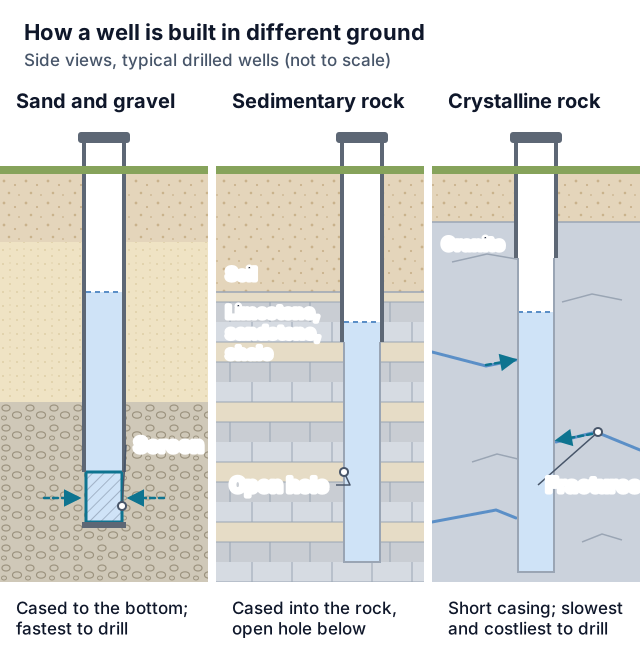
- Screened wells in glacial sand and gravel; 312 IAC 13-4-2 requires a well screen on wells drilled in an unconsolidated formation, other than monitoring and dewatering wells
- Yield tests: a well that will get a pump is developed and test pumped at capacity for at least one hour, with yield and drawdown recorded (312 IAC 13-7-1)
- Disinfecting a new well with chlorine at 100 parts per million or more under 312 IAC 13-9
- Pump installation and repair, which IC 25-39 reserves for licensed water well pump installers apart from its personal-use and supervised-worker exceptions
- Capping wells left unused for more than three months, and plugging abandoned ones
What Drives Pricing Here
- Which sand and gravel layer the well reaches: DNR's county summary describes the Natural Lakes and Moraines Aquifer System as having near-surface sand and gravel 10 to 50 feet thick, typically within 100 feet of the ground, over deeper lenses at 100 feet or more, and says most wells in that system are completed at depths shallower than those deeper aquifers. In the Kendallville Aquifer System the depth to a productive aquifer is usually at least 90 feet and can exceed 200 feet where the clays are thick. These are system-wide descriptions drawn from a 1987 basin study, not a forecast for any one parcel.
- On the site calculator: your depth is multiplied by a per-foot band that varies with the chosen geology, then pump, pressure-tank and generic permit amounts are added; those amounts come from national cost pages published by Angi, HomeGuide and HomeAdvisor. The total is a ballpark, not a quote for a LaGrange County job, and because the county health department says no residential well permit is required, confirm with the driller whether any permit or fee is part of the price.
- Casing and grout: 312 IAC 13-6-1 (rotary and augered wells) and 13-6-3 (cable tool and jetted wells), neither of which covers monitoring, dewatering or public water supply wells, call for casing at least 2 inches in inside diameter set at least 25 feet below the surface (for rotary and augered wells, unless the division approves otherwise). For new wells other than public water supply wells, 312 IAC 13-5-1 has the annulus grouted within 24 hours after the casing is installed or before the drilling equipment leaves the site, whichever comes first, and the well record must state the type, depth and thickness of the grout and how it was installed (312 IAC 13-2-6).
- Pump setting: unless the department approves otherwise, 312 IAC 13-4-3.5 requires the pumping apparatus to provide at least 20 feet of available drawdown in a well completed in an unconsolidated aquifer and at least 50 feet in a bedrock aquifer, and 312 IAC 13-7-1 has the pump set deep enough to allow for the drawdown it causes and for seasonal water-level changes.
Permits & Local Rules
- County role: the LaGrange County Health Department's septic information page says LaGrange County does not have water well ordinances and a residential water well permit is not required, but that well drillers need to follow the Indiana Department of Health and Indiana DNR regulations on well separation and potential contamination sources. For a commercial well, the department says the Indiana Department of Environmental Management should be contacted to get any permit required by state law.
- Who needs a license: IC 25-39-3-1 says an individual may not be a water well driller (someone who operates well drilling or driving equipment or drills or drives wells) or a water well pump installer (someone who installs or repairs water well pumps) without a DNR license. IC 25-39-1.5-3 says chapters 3 and 4 of the statute do not apply to a person installing a well that is for personal use and no more than 1 1/4 inches inside diameter and 24 feet deep; to a plumber licensed under IC 25-28.5 who has registered with DNR and installs wells within that same size and depth limit; to a person who installs or repairs a water well pump or pumping equipment for personal use; or to a person working under the direction and personal supervision of a license holder. 312 IAC 13-1-19.3 defines personal use as water supply use of a well or pumping equipment located on property the person owns or possesses, or, for a public water supply utility, possessed by one of its permanent employees. IC 25-39-4-11 also leaves out wells drilled under or incidental to an activity under IC 14-34 (surface coal mining and reclamation) or IC 14-37 (oil and gas), wells drilled solely to supply water for secondary recovery of petroleum, and wells drilled solely to evaluate the foundation characteristics of earth materials for bridges, roadways, buildings or other engineered structures.
- Getting a license: under IC 25-39-3-3 an applicant must be at least 18, furnish evidence from three references (two of them water well drillers, water well pump installers or licensed plumbing contractors familiar with the applicant's work experience and professional competency) and pass DNR's competency examination. The license fee is $100 per calendar year (312 IAC 13-2-2), and every license expires December 31 of the year it was issued for (IC 25-39-3-1).
- Well placement: under 312 IAC 13-3-2, which does not cover monitoring or dewatering wells, a well sits as far as practicable from any high capacity well and any known contamination source, with earth placed to drain surface water away, and the finished casing or pitless unit ends at least 1 foot above ground level. In a designated flood hazard area it must either be at least 2 feet above the regulatory flood elevation or carry a watertight pitless unit cap or well seal vented to at least 2 feet above that elevation. 312 IAC 13-3-3 keeps the well's center line at least 5 feet from any building projection, and 312 IAC 13-4-4 requires the division to approve a well pit design before construction.
- Septic separation: Table I of 410 IAC 6-8.3-57, Indiana's residential on-site sewage rule, puts septic tanks and other treatment units, dosing tanks, lift stations and soil absorption systems at least 50 feet from a private water supply or private geothermal well and at least 100 feet from a commercial water supply or commercial geothermal well. Those distances double for soil absorption systems built where a horizon within 34 inches of the surface has a soil loading rate above 0.75 gallons per day per square foot under the rule's Table IV, unless system design overcomes that hazard, and the distance to a private well abandoned under 312 IAC 13-10-2(e) may be cut to 10 feet.
- Septic work on the same lot: the LaGrange County Health Department's procedure says a site plan drawing is required to issue a septic permit, and the well location is one of several items that drawing must show; the Residential Septic Permit Procedures on the health department's septic information page list everything the plan needs. The fee schedule adopted by Ordinance No. 2023-10-16 on October 16, 2023 lists $75 residential and $150 commercial for septic inspection services and septic construction permits, the latter good for one year; the septic information page adds that a permit could be renewed if the system has not been installed within one year of issue.
- Well records: for every well drilled, IC 25-39-4-1 has the licensee record the location, the depth and diameter, the date the contractor completed it, the character and thickness of materials or formations drilled, the static water level and performance data, and any other information required by rule, then send a copy to the department on forms it prescribes or approves within 30 days after completion. 312 IAC 13-2-6 lists the further items the record must carry.
Geology & Water Table Notes
- Howe Outwash Aquifer System: DNR maps it across the northern third of the county, with near-surface outwash sand and gravel 15 to 135 feet thick over an altered till plain, and rates ground-water availability as good to excellent at 100 to 1,000 gallons per minute, with the surficial deposits highly susceptible to contamination. Around Pigeon Lake, North and South Twin Lakes and Still Lake west of Howe, clay layers 25 to 180 feet thick lie under the surface sand and gravel and availability drops to 5 to 100 gallons per minute.
- Topeka Aquifer System: its northern occurrence begins just south of Topeka and runs into Noble County, with up to 126 feet of near-surface sand and gravel over till. DNR says most existing wells there use the more continuous deeper sand and gravel layer rather than the near-surface deposits.
- Other mapped systems: DNR rates the Natural Lakes and Moraines system at 25 to 800 gallons per minute, the Kendallville system (sand and gravel lenses usually 5 to 30 feet thick in thick clay) at 25 to 600, the Nappanee system at 50 to 600, and the St. Joseph Aquifer System at 100 to 1,500 gallons per minute and highly susceptible to contamination.
- Bedrock: the one bedrock aquifer system DNR identifies is the Devonian and Mississippian Coldwater, Ellsworth and Antrim Shales, which it calls an aquitard and an extremely limited resource. It puts the overlying unconsolidated sediments at about 100 to over 400 feet thick and reports that only two water wells in the county reportedly draw from the shale.
- Water levels: a 2012 DNR potentiometric surface map contoured about 4,400 static water levels from well records, with contours from about 970 feet above mean sea level in the southeast to about 810 feet in the northwest corner. DNR cautions that the levels reflect conditions when each well was completed and that the map is no substitute for a site-specific study.
- Water quality: the Indiana Department of Health notes that glacial deposits of arsenic and naturally occurring methane exist throughout Indiana, that bacteria and nitrates are typically found in human and animal waste and released from failing septic systems and large herds of animals, and that private well water is unregulated by both IDEM and the EPA, leaving owners responsible for its safety.
Communities Served
Lagrange · Shipshewana · Topeka · Wolcottville · Howe
Emergency Response Expectations
We forward urgent requests but cannot say how quickly an independent contractor will respond. The Indiana Department of Health notes that a well may need sanitizing after a flood. When a test comes back positive for contamination, it says bottled or filtered water can serve as a short-term solution, that in some cases boiling water and sanitizing the well may solve the problem, and that long-term options include treatment and sanitation, switching to municipal water or building a new well.
LaGrange County FAQs
Does LaGrange County require a permit to drill a household well?
The county health department says there is no water well ordinance and no residential water well permit, but drillers still follow state rules, chiefly IC 25-39 and 312 IAC 13. For a commercial well it refers owners to the Indiana Department of Environmental Management.
Can I put in my own well or pump?
Only within the exceptions in IC 25-39-1.5-3: a personal-use well no larger than 1 1/4 inches inside diameter and no deeper than 24 feet, pump or pumping equipment work for your own personal use, or work done under the direction and personal supervision of a license holder. A plumber licensed under IC 25-28.5 who has registered with DNR may also install wells within that size limit. Outside those exceptions, and the special-purpose wells IC 25-39-4-11 removes from the statute, the work needs a DNR-licensed driller or pump installer.
How deep are wells in LaGrange County?
DNR's aquifer summary gives ranges by aquifer system rather than one county figure, for example near-surface sand and gravel within about 100 feet in the Natural Lakes and Moraines system, and a productive aquifer usually at least 90 feet down in the Kendallville system. Records of nearby wells are in DNR's water well record database.
What septic setback applies to a new well in LaGrange County?
Under 410 IAC 6-8.3-57, at least 50 feet from the septic tank, other treatment units, dosing tank, lift station and soil absorption system for a private well, and 100 feet for a commercial well. The distances double for soil absorption systems where the rule's soil loading condition applies, unless system design overcomes that hazard.
Where can LaGrange County well owners get water tested?
The county health department offers free sample bottles during business hours; samples are taken only on Tuesday morning and brought back before noon, and a certified lab picks them up and mails the results. Its water testing page lists $25 for bacteria, $27 for nitrate and $10 for courier service to the Hoosier Microbiology Laboratory, matching the total coliform, nitrate and courier prices on the lab's sheet effective February 1, 2022. The Indiana Department of Health laboratory recommends testing every year for bacteria and nitrate, and at least every five years, or whenever major maintenance is done, for fluoride, arsenic, lead and copper; its page, checked October 27, 2026, lists $10 each for bacteria, nitrate and fluoride and $20 for arsenic, lead and copper, not including shipping.
What has to happen to an old well on my land?
312 IAC 13-10-1 calls for a watertight cap that is welded, threaded or mechanically attached, at or above ground, on any well that has gone more than three months without use and has not been permanently abandoned; IC 25-39-4-6(c) allows a welded or threaded cap or sealing under the commission's rules. For a well abandoned after December 31, 1987, IC 25-39-4-6(b) requires the landowner to have it plugged by a water well driller within one year after it is abandoned, and 312 IAC 13-10-2 states that a water well driller or water well pump installer plugs it with impervious grouting material. A shorter deadline covers a well drilled after December 31, 1987 that is not equipped with casing: IC 25-39-4-4 and 312 IAC 13-10-2(d) require a water well driller to plug it within 72 hours after completion. Wells abandoned before 1988, and wells drilled before 1988 and abandoned before 1994, have separate capping and closure options in that rule, with plugging also required when such a well poses a hazard to human health, and the division must be notified in writing within 30 days after plugging is completed.
When does a farm or business have to register its wells with DNR?
When its water withdrawal facilities, in the aggregate, can withdraw more than 100,000 gallons of ground water, surface water or both in one day, the IC 14-25-7-15 threshold, apart from the statute's exclusions for some landfill and off-stream impoundment facilities, which still fall under the registration requirement of IC 14-25-15-1 if they are located in the Great Lakes basin as that law defines it. Registration with the Natural Resources Commission is due within three months after the facility is completed, a verified report of water withdrawn is due within three months after the end of each year, and DNR may waive that information for a temporary facility under commission rules.
Sources
- Indiana Code 2026, IC 25-39: water well drillers and pump installers
- Indiana Code 2026, IC 14-25-7-15: significant water withdrawal facility registration
- 312 IAC 13: Water well drillers and water well pump installers
- 410 IAC 6-8.3-57: Separation distances for residential on-site sewage systems
- Indiana DNR: Well driller and pump installer licensing
- Indiana DNR: Licensed water well drilling contractors
- Indiana DNR: Water well record database
- Indiana DNR: Significant water withdrawal facility registration
- Indiana DNR: Unconsolidated aquifer systems of LaGrange County
- Indiana DNR: Bedrock aquifer systems of LaGrange County
- Indiana DNR: Potentiometric surface map of LaGrange County (2012)
- Indiana Department of Health: Well water quality and testing
- Indiana Department of Health Laboratories: Well water
- LaGrange County Health Department: Septic information
- LaGrange County Health Department: Water testing
- LaGrange County Ordinance No. 2023-10-16: Health department fee schedule
- Hoosier Microbiology Laboratory prices effective February 1, 2022
- U.S. Census Bureau: 2020 places by county, Indiana
Last reviewed 2026-10-27
Services Available in LaGrange County
Well Drilling
New residential wells — find local drillers for site evaluation, depth estimates, and written drilling quotes.
Learn more →Water Well Drilling
Household water wells from site evaluation through casing, pump, and water test — written quotes from local drillers.
Learn more →Well Pump Repair
No water at the tap? Request urgent well pump repair — local pros diagnose pressure loss, dead pumps, and pressure tank failures fast.
Learn more →Well Pump Replacement
Pump at end of life or beyond repair? Get quotes for correctly-sized submersible and jet pump replacement from local well pros.
Learn more →Well Inspection & Testing
Buying a home with a well, or overdue for a water test? Local pros for flow tests, equipment inspection, and lab water-quality testing.
Learn more →Well Water Service
Water quality problems, treatment systems, and general well maintenance — connect with local pros for everything between drilling and pump work.
Learn more →Free Tools Before You Call
Ballpark the cost or narrow down the problem before talking to a LaGrange County provider.
Well Drilling Cost Calculator
Estimate what drilling a well should cost — by depth, geology, and whether you need the pump and pressure tank included.
Use the free tool →No Water From Your Well? Diagnostic Wizard
Suddenly no water in the house? Answer a few questions to find out if it's the breaker, the pressure switch, the tank, the pump — or the well itself.
Use the free tool →Well Pump Size Calculator
Find what size well pump you need — GPM demand, total dynamic head, and a horsepower recommendation from four quick inputs.
Use the free tool →Need help in LaGrange County, IN?
Send the short form — urgent requests get priority routing.