Well Pump Replacement in Hendricks County, IN
Well drilling typically runs $3,000–$16,000 nationally, per our cost guide. Independent local pros serving Danville, Brownsburg, Avon and nearby communities. Describe the problem and we'll route your request — free, no obligation.
- Mark no-water pump problems as emergencies on the form
- County pages on local well depths, aquifers, and permits
- Well inspections, water testing, and treatment
- Free to use — no obligation, no markup
Fast response from independent local providers. No obligation.
Typical national cost$3,000 – $16,000Cost guide →Local Help in Hendricks County, IN
Hendricks County Ground Water Well Ordinance 2016-37, adopted in December 2016, makes it unlawful for any person to install a well or well pump, or to perform a well repair, in Hendricks County without a valid permit from the Health Officer. The Health Department's permit application has its own Replacement Pump line, and the ordinance counts as a well repair any work on a well, pump or accessory lines when the pitless adapter is removed or separated. Public water supply wells and dewatering wells are outside the ordinance.
On equipment, recent survey data cited in the National Ground Water Association's 2021 Well Owner's Guide prices the submersible pump in a typical home at $3,000 to $3,200 and the jet pump in a typical home at roughly $1,545 to $1,570. The guide adds that its figures only give a general indication, are not exact for any locale, and can change over time and from place to place.
This site forwards pump and no-water requests to independent contractors; Cornelia Cove LLC itself does not drill wells, set pumps or pull county permits.
Hendricks County Service Details
What providers in this area actually see: coverage, common jobs, local pricing factors, and rules worth knowing.
Service Area Notes
- The 2020 Census lists these incorporated towns in Hendricks County: Amo, Avon, Brownsburg, Clayton, Coatesville, Danville, Jamestown (which also has territory in Boone County), Lizton, North Salem, Pittsboro, Plainfield and Stilesville. Section X of Ordinance 2016-37 says the ordinance applies to the entirety of Hendricks County.
- The county's 2025 Comprehensive Plan names Cartersburg and Hazelwood as unincorporated communities to evaluate for utility service. It says several unincorporated communities lack municipal sewer, water and stormwater infrastructure, with on-site well and septic systems on individual lots, and that homes in these areas tend to be much older than the county average, while reporting no known issues at present.
Common Jobs in Hendricks County
- Replacement pump installation under a Health Officer permit
- Well repairs that separate the pitless adapter, fitted with a pitless adapter afterward, with the casing extended to 1 ft above ground
- Diagnosing a failed pressure switch, pressure tank or check valve
- Pump and storage choices for a low-yield well
- Chlorinating the well after pump work and taking a follow-up coliform sample
- Abandonment or GPS location of a well before a structure is demolished
What Drives Pricing Here
- Permit fee. The Health Department's Onsite Sewage System & Groundwater Well Permit Application, marked Revised 11/2024 and the version its well page links today, lists New Well and Pump $45.00, Replacement Pump $20.00 and Well Repair $20.00.
- Well depth and aquifer. DNR reports well depths of about 25 to 270 ft in the Tipton Till Aquifer System, typically about 30 to 140 ft in the Tipton Till Aquifer Subsystem, 25 to 135 ft in the White River and Tributaries Outwash Aquifer System, and approximately 30 to 500 ft in the Borden Group Aquifer System.
- Pump setting. 312 IAC 13-4-3.5 sets a minimum of 20 ft of available drawdown (static water level to pump setting) for a well finished in an unconsolidated aquifer and 50 ft for a bedrock well, unless the department approves otherwise; monitoring and dewatering wells are exempt.
- Method: the submersible and jet pump numbers on this page are NGWA's national survey figures as printed; no local price survey or depth adjustment has been applied to them.
Permits & Local Rules
- Licensing. Indiana bars any individual from working as a water well driller or water well pump installer without a DNR license (IC 25-39-3-1), and a pump installer is anyone who installs or repairs water well pumps (IC 25-39-2-15.5). IC 25-39-1.5-3 takes four situations outside IC 25-39-3 (licensing) and IC 25-39-4 (regulation of water well drilling): someone putting in a well for personal use that is no wider than 1 1/4 inches inside diameter and no more than 24 ft deep; a plumber with an IC 25-28.5 license who has registered with DNR, when installing wells within those diameter and depth limits; personal-use installation or repair of a water well pump or pumping equipment; and anyone working under a licensee's direction and personal supervision.
- DNR issues one license card showing driller, pump installer or both; under IC 25-39-3-1 a licensee who is setting a pump must have the license on hand for inspection whenever a department representative asks, and each license lapses on December 31 of the year it was issued for. 312 IAC 13-2-2 sets the application fee at $100 for a calendar year.
- County permit. Section III requires the owner or agent to obtain a written permit signed by the Health Officer before construction of a well, or of a geothermal heat pump system that uses a well, a well repair or a pump installation begins, and no one may work on the project until the permit is obtained. The application is made on a form provided by the Health Officer, supplemented by any plans, specifications or other information the Health Officer deems necessary, and the permit is void if the installation is not completed within one year.
- Emergencies. Section III requires the applicant to notify the Health Department of the pending installation before an emergency well installation begins, then submit the signed application within 24 hours of the first regular scheduled workday after the emergency installation starts, describing the situation that made the emergency installation necessary. The 11/2024 application applies these steps to a well or pump permit applicant.
- Repair standard. Section V says that whenever an existing well is repaired, it must be fitted with a pitless adaptor and its casing extended to 1 ft above ground level; inside a designated flood hazard area the well must reach at least 2 ft above the regulatory flood elevation or carry a well seal (see the written-waiver clause under separation distances). The statewide rule, 312 IAC 13-3-2, likewise requires the finished casing or pitless unit to extend at least 1 ft above ground, with earthen material placed to drain surface water away; in a designated flood hazard area it must sit 2 ft above the regulatory flood or have a watertight pitless unit cap or well seal vented 2 ft above that level (monitoring and dewatering wells excluded).
- Separation distances. Section V sets minimum distances from contamination sources. For private wells and open-loop geothermal systems serving a residence, and wells used for irrigation or livestock, they include 50 ft from septic tanks and absorption fields, 100 ft from sewage pits and dry wells and 25 ft from streams, lakes and ponds; a second table with larger distances covers wells and open-loop systems serving anything other than a residence of not more than two dwelling units. A clause after these tables lets the Health Officer or the Health Board waive the requirements set forth above by written documentation when this is not considered to endanger public health and does not conflict with other state requirements.
- Reports and inspection. Within 30 days of well drilling, Section V makes the property owner and the well driller responsible for giving the Health Department the well drilling logs, bacteriological water sample results, water pump technical specifications, and other reports the Health Department or another county, state or federal agency requests. 312 IAC 13-2-6 separately gives the driller 30 days after a well is completed to submit its record, on a form the department issues or the division approves, carrying a signed statement from the driller or an authorized representative that it is accurate. Under Section VI the driller and owner must tell the Health Department when the well and appurtenances are available for inspection.
- Unused and abandoned wells. Under 312 IAC 13-10-1, a well that has sat unused for over three months without being permanently abandoned must be closed at or above ground with a watertight cap that is welded, threaded or mechanically attached, and maintained so it does not become a source or channel of ground water contamination. IC 25-39-4-6 gives the owner of the land one year after abandonment to get a well abandoned after 1987 plugged by a water well driller, while the rule's plugging subsection, 312 IAC 13-10-2(c), names a driller or pump installer. 312 IAC 13-10-2 also sets the plugging materials and methods, a duty for a driller to plug an uncased well drilled after 1987 within 72 hours after completion, written notice to the division within 30 days after plugging is completed, and separate terms for older wells.
- Demolition. Before a structure served by a well is demolished, Section V requires the well to be either properly abandoned under 312 IAC 13 or other applicable regulations, with written verification sent to the Local Health Officer before demolition begins, or located by global positioning system for later abandonment, with written notice and the well location sent to the Local Health Officer before demolition begins. The department's demolition abandonment application states that abandonment logs are required within 30 days after plugging is complete.
- Penalties. Under Section VIII, a person who keeps violating the ordinance, IC 14-25, IC 25-39, 312 IAC 12 or 312 IAC 13 past the time limit in the Health Officer's written order is cited in court; on conviction the fine is no more than $2,500 plus attorney's fees and court costs, each day may be deemed a separate offense, and civil penalties, including injunctive relief, may also apply.
Geology & Water Table Notes
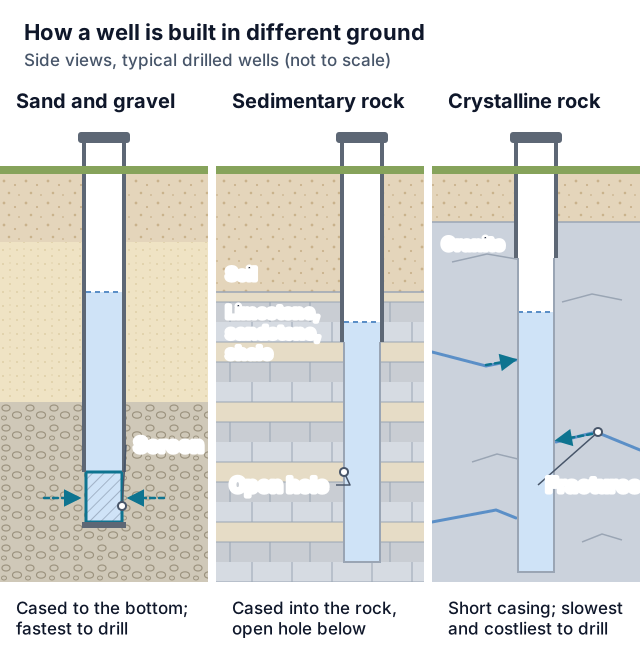
- DNR's 2010 Unconsolidated Aquifer Systems of Hendricks County maps six systems, and approximately 64 percent of the county's wells are completed in unconsolidated deposits, which typically range from bedrock exposed at the surface to about 275 ft thick in buried valleys.
- Much of west-central and southern Hendricks County is mapped as Till Veneer, which DNR calls the most limited unconsolidated system: most wells there are completed in the underlying bedrock, most reported capacities are 5 gpm or less, and some wells are reported dry. In the north and center DNR maps mainly the Tipton Till Aquifer System, where domestic yields are typically 10 to 50 gpm; its subsystem in the west-central and south generally yields 5 to 10 gpm.
- DNR's 2010 bedrock text says the Borden Group, mostly sandstone, siltstone, mudstone and shale, outcrops or subcrops in nearly the entire county. It is often described as an aquitard with typically quite limited yields; domestic Borden wells range from 2 to 100 gpm, with some dry holes reported. Approximately 36 percent of the county's wells are completed in bedrock.
- At the commissioners' June 23, 2026 meeting, Dr. Henry Loope of the Indiana Geological and Water Survey presented on water resources and a county research project that, according to the minutes, should be completed in two years; the minutes also record that he considers the county relatively water limited. His slides describe till-dominated surficial geology, a bedrock valley across the northern third of the county and shallow Borden Group bedrock in the southern half.
Communities Served
Danville · Brownsburg · Avon · Plainfield · Pittsboro · Lizton · North Salem · Stilesville · Amo · Clayton · Coatesville · Cartersburg
Emergency Response Expectations
No arrival time is promised for a Hendricks County no-water request; it goes to independent contractors as they are available. An emergency well or pump installation still needs notice to the Health Department before it begins and a signed application, describing the emergency, within 24 hours of the first regular scheduled workday after it starts.
Hendricks County FAQs
What does it cost to replace a well pump in Hendricks County?
Begin with NGWA's national pump figures quoted above and add the $20.00 replacement pump permit from the county's 11/2024 application; repairs that trigger the pitless and casing standard add work.
Is a county permit required for a replacement pump?
Yes, because Ordinance 2016-37 makes installing a well pump in Hendricks County without a valid Health Officer permit unlawful; Section III places the duty to get that permit on the owner or agent before work begins.
Can I replace my own pump?
Pump work for personal use falls outside IC 25-39-3 and IC 25-39-4 (IC 25-39-1.5-3). 312 IAC 13-1-19.3 treats water supply use as personal when the equipment sits on property the person owns or possesses, or is possessed by a permanent employee of a public water supply utility. That exemption is from the state statute; the county permit rule covers any person who installs a well pump.
Should I test the water after the pump is replaced?
The state health department's Recommended Standards put disinfection on the pump installer after any pump installation or repair, and say a sample taken in a sterile bottle from a certified lab should contain fewer than two coliform organisms per 100 ml before the water goes into drinking use. The IDEM sheet the county links says chlorine must be gone before a coliform sample and calls a retest about 30 days after disinfection important. IDOH's lab page says well water should be tested for bacteria and nitrate every year, and the Health Department recommends certified laboratories for well water testing, pointing to the Department of Health's list of certified labs.
My well can't keep up with demand. What do the state sources say?
The Indiana Department of Health's standards say a residential well should reach a stabilized yield of at least 5 gpm; below that, the driller should let the owner know so additional storage and suitable pumping equipment can cover peak demand.
Sources
- Hendricks County Ground Water Well Ordinance No. 2016-37 (adopted December 2016)
- Hendricks County Health Department: Onsite Sewage System & Groundwater Well Permit Application (Revised 11/2024)
- Hendricks County Health Department: Groundwater Well Protection
- Hendricks County Health Department: Application for Well Abandonment Due to Demolition
- IDEM: Well Disinfection (linked from the county's well page)
- Hendricks County 2025 Comprehensive Plan
- Indiana Geological and Water Survey presentation, June 23, 2026 Commissioners' Meeting
- Hendricks County Commissioners: Minutes of the June 23, 2026 meeting
- Indiana DNR: Unconsolidated Aquifer Systems of Hendricks County (Schmidt, June 2010)
- Indiana DNR: Bedrock Aquifer Systems of Hendricks County (Schmidt, June 2010)
- Indiana Code 2026, Title 25, Article 39 (IC 25-39)
- Indiana Administrative Code 312 IAC 13 (2026 edition)
- Indiana DNR: Well driller and pump installer licensing and continuing education
- Indiana Department of Health: Recommended standards for private water wells (guidance)
- Indiana Department of Health Laboratories: Drinking water laboratory certification
- Indiana Department of Health Laboratories: Well water testing
- U.S. Census Bureau: Indiana places by county (2020)
- NGWA: Well Owner's Guide (2021), page 8
Last reviewed 2026-10-31
Services Available in Hendricks County
Well Drilling
New residential wells — find local drillers for site evaluation, depth estimates, and written drilling quotes.
Learn more →Water Well Drilling
Household water wells from site evaluation through casing, pump, and water test — written quotes from local drillers.
Learn more →Well Pump Repair
No water at the tap? Request urgent well pump repair — local pros diagnose pressure loss, dead pumps, and pressure tank failures fast.
Learn more →Well Pump Replacement
Pump at end of life or beyond repair? Get quotes for correctly-sized submersible and jet pump replacement from local well pros.
Learn more →Well Inspection & Testing
Buying a home with a well, or overdue for a water test? Local pros for flow tests, equipment inspection, and lab water-quality testing.
Learn more →Well Water Service
Water quality problems, treatment systems, and general well maintenance — connect with local pros for everything between drilling and pump work.
Learn more →Free Tools Before You Call
Ballpark the cost or narrow down the problem before talking to a Hendricks County provider.
Well Drilling Cost Calculator
Estimate what drilling a well should cost — by depth, geology, and whether you need the pump and pressure tank included.
Use the free tool →No Water From Your Well? Diagnostic Wizard
Suddenly no water in the house? Answer a few questions to find out if it's the breaker, the pressure switch, the tank, the pump — or the well itself.
Use the free tool →Well Pump Size Calculator
Find what size well pump you need — GPM demand, total dynamic head, and a horsepower recommendation from four quick inputs.
Use the free tool →Need help in Hendricks County, IN?
Send the short form — urgent requests get priority routing.