Well Drilling in Benton County, WA
Well drilling typically runs $3,000–$16,000 nationally, per our cost guide. Independent local pros serving Kennewick, Richland, West Richland and nearby communities. Describe the problem and we'll route your request — free, no obligation.
- Mark no-water pump problems as emergencies on the form
- County pages on local well depths, aquifers, and permits
- Well inspections, water testing, and treatment
- Free to use — no obligation, no markup
Fast response from independent local providers. No obligation.
Typical national cost$3,000 – $16,000Cost guide →Local Help in Benton County, WA
Drilling a well in Benton County is a state matter first. The Benton-Franklin Health District (BFHD) says the drilling of new wells is regulated by the Washington Department of Ecology and that no approval from the district is needed to drill a residential single-family well. Ecology's construction standards are in chapter 173-160 WAC and its licensing rules in chapter 173-162 WAC.
The county steps in at the building permit. Its Adequate Water Supply Determination Form requires each applicant for a building that needs potable water to show an adequate supply, by an Ecology water right permit, a Benton County Mitigation Certificate, a letter from an approved water purveyor or another form sufficient to verify it. For a well inside the Rural Water Supply Program's Mitigation Area, the form's statements for new and existing wells both cite a valid mitigation certificate. This site forwards requests to independent, licensed well contractors and does no drilling itself.
Benton County Service Details
What providers in this area actually see: coverage, common jobs, local pricing factors, and rules worth knowing.
Service Area Notes
- Requests are taken countywide. A 2020 Census Bureau list of places by county shows six in Benton County: the cities of Kennewick, Richland, West Richland, Prosser and Benton City, and the Finley census-designated place.
- Ecology's water-availability focus sheets name Benton County in three watersheds: WRIA 31 (Rock-Glade), WRIA 37 (Lower Yakima, with Benton City, Richland and West Richland among its cities) and WRIA 40 (Alkali-Squilchuck). The county's Mitigation Area is a portion of WRIA 37 shown on its official map, so check your parcel before booking a rig; Ecology's wells page likewise says to check with your local permitting agency before a notice of intent is filed.
- Other Northwest pages on this site cover Pend Oreille County, WA and Umatilla County, OR.
Common Jobs in Benton County
- New permit-exempt household wells, with Ecology's notice of intent filed at least 72 hours ahead
- Wells for new homes in the Mitigation Area; where the county makes a mitigation certificate a building-permit condition, the owner also buys a meter for the residential well
- Pump replacement, general maintenance, cleaning and sanitation, which WAC 173-160-111 excludes from well alteration
- Deepening or hydrofracturing, which that definition counts as well alteration
- Coliform bacteria and nitrate sampling
- Decommissioning abandoned or unusable wells
What Drives Pricing Here
- State fees: RCW 18.104.055 and WAC 173-160-151 (last amended effective January 19, 2009) charge $200 for one water well (other than a dewatering well) with a top casing diameter under 12 inches, $300 at 12 inches or more, and $50 to decommission a water well, paid with the notice of intent. Each unusable well needs its own decommissioning notice and fee; the rule's subsection (5) sets the conditions for a replacement attempt without a second construction notice or fee.
- Mitigation Area costs: the county's program page lists one-time certificate fees, the meter and its installation, Auditor recording fees, any notary fees, and an Annual Program Fee of $180 a year billed each January ($90 for the first year if the meter is bought after June 30).
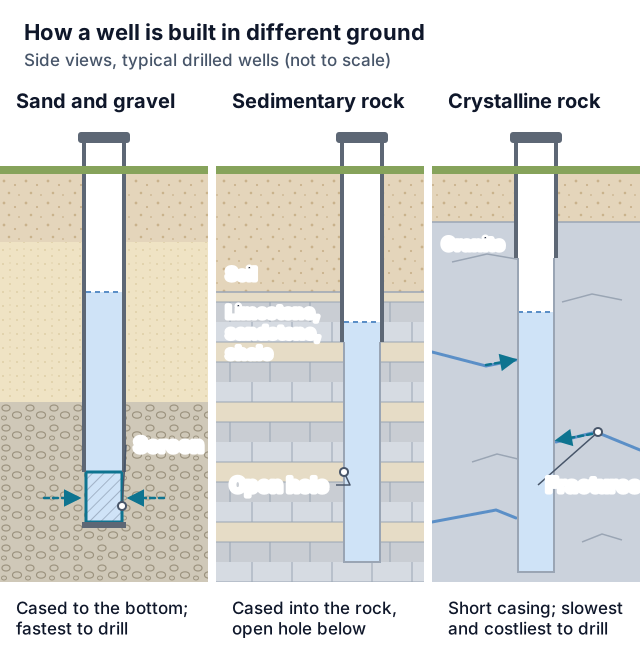
- Depth: the USGS Ground Water Atlas says wells in the Columbia Plateau's Miocene basalt aquifers commonly need to go several hundred feet deeper than the top of the saturated zone to get a desired yield. We found no USGS or Ecology publication that prints a Benton County median depth, so ask for nearby well reports.
- The site calculator multiplies your depth by $25–$65 a foot when geology is unknown and adds placeholder amounts of $900–$2,500 for the pump, $400–$1,500 for a pressure tank and $200–$500 labeled as a permit. It is a rough estimate, not a quote.
Permits & Local Rules
- Who may drill: RCW 18.104.030 bars contracting to build a well or acting as a well operator without a license, except as RCW 18.104.180 allows. That section exempts (1) an individual who personally builds a well on land the individual owns, leases or is buying under contract, for that individual's farm or single-family residential use only, no more than one well every two years, while still meeting all other requirements, including construction standards, fees and the notice; (2) workers under the direction, supervision and control of a licensed operator present on site (WAC 173-162-050 excludes trainees and requires direct supervision); and (3) persons licensed under chapter 18.08 or 18.43 RCW acting within those licenses, which ORIA, the Governor's Office for Regulatory Innovation and Assistance, describes as engineers, architects and land surveyors registered in Washington who meet state construction and decommissioning rules and are on site during that work. ORIA says the owner exemption does not extend to decommissioning.
- Notice of intent: under WAC 173-160-151, the property owner, owner's agent or water well operator notifies Ecology on its form at least 72 hours before construction or decommissioning; the rule lists the required contents, including the water right permit or certificate when one is required. Ecology says the notice is not a permit or approval to use water. In an emergency, a public health emergency or exceptional instances, Ecology may allow verbal notice to the appropriate regional office, with the written notice and fee due within 24 hours.
- Water rights: RCW 90.44.050 exempts stock-watering, a lawn or noncommercial garden of one-half acre or less, single or group domestic use up to 5,000 gallons a day and industrial use up to 5,000 gallons a day from the permit requirement, and anyone withdrawing 5,000 gallons a day or less may still apply for one. Ecology says one exempt use of each type is allowed per project and the 5,000-gallon limit applies to every day of use, not as an average. Other wells need an Ecology permit before drilling (WAC 173-160-121).
- Mitigation Area: the county program requires new subdivisions, short plats and residential building permits for a dwelling unit in the area to take part. Customers required to buy a mitigation certificate as a condition of a building permit must also buy a meter for the residential well and agree to take part in metering. Package A (200 gallons a day on average, indoor use only) is limited to parcels with outdoor irrigation access; parcels without it may choose B (300 gallons a day on average for indoor use and up to 1,500 square feet of outdoor irrigation) or C (400 gallons a day on average, indoor use and up to 3,000 square feet), and a parcel holding only a recorded Package B certificate may apply for a supplemental 100 gallons a day on an annual average. The county's form says an application for a certificate is not proof of supply.
- Siting, WAC 173-160-171: not where water ponds or in a floodway (except as chapter 86.16 RCW provides), and protected from a 100-year flood. For wells other than public supply wells: 5 feet from buildings, and not in garages, barns, storage buildings or dwellings; 50 feet from septic tanks, holding tanks, pump chambers, distribution boxes and sewer lines other than building drains; 100 feet from drainfields, health-authority-approved proposed drainfields, reserve areas and other contamination sources; and 1,000 feet from solid waste landfills, unless a variance is granted on documentation that the well will not further degrade the environment or cause a public health risk. BFHD calls it essential for owners relying on a septic system to consult it before drilling, since every drainfield must be 100 feet from any well.
- Construction and records: WAC 173-160-231 requires a surface seal of at least 18 feet (shorter for driven, jetted, dewatering and some dug wells), and WAC 173-160-291 sets casing at least 6 inches above ground (on sites subject to flooding, 2 feet higher than the estimated 100-year flood) and bans pit completion. Whoever builds or decommissions the well files a report with Ecology within 30 days after completion or after the drilling equipment leaves the site (WAC 173-160-141); filed reports are searchable in Ecology's Well Report Viewer.
- Decommissioning, WAC 173-160-381: required for wells that are unusable or abandoned, permanently out of use, in such disrepair that continued use is impractical, or an environmental, safety or public health hazard. A cased well's casing is either perforated, pressure sealed and filled, or withdrawn as the hole is filled; uncased, dug and flowing artesian wells have separate methods. Ecology says owners must hire a licensed driller.
- Shared wells: BFHD treats any system as public unless it serves only one single-family residence or four or fewer service connections on one farm, and WAC 173-160-171 requires Department of Health or local health jurisdiction site approval before a public supply well is built.
Geology & Water Table Notes
- Surface geology: the USGS State Geologic Map Compilation shows loessial silt at the surface over 50 percent of the county, younger glacial drift (outwash) over 17 percent, glaciolacustrine sand and silt over 12 percent, Middle Miocene basalt flows over 9 percent and alluvium over 4 percent.
- Aquifers: USGS report SIR 2009-5152 says about half of Benton County lies in the Yakima River basin, where the Grande Ronde, Wanapum and Saddle Mountains Basalts form the major, productive volcanic-rock part of the aquifer system, and maps Ringold Formation, Hanford Formation and pre-Missoula Flood gravel subunits in the eastern Benton basin.
- Horse Heaven Hills: USGS report WRI 94-4068 found those three basalt units supply irrigation and domestic water there, that most of its study area is directly underlain by the Saddle Mountains formation, that 10 to 40 feet of loess covers the basalt over most of it, and that interflow zones are the more permeable zones.
- Nitrate: BFHD calls nitrate a commonly occurring contaminant in Columbia Basin groundwater, with shallow wells, dug wells without watertight casings, and wells with damaged or leaking casing or fittings among the most vulnerable. Its Alternative Water Program offers free nitrate testing to eligible private-well and Group B residents.
- Testing: DOH recommends yearly coliform and nitrate tests, says owners may want to retest in six months if nitrate is 5 mg/L or higher, and suggests testing for arsenic at least twice while you own the well. BFHD adds disinfecting the well after work or repairs.
Communities Served
Kennewick · Richland · West Richland · Prosser · Benton City · Finley
Emergency Response Expectations
WAC 173-160-151(3) says Ecology may allow verbal notification to the appropriate regional office in an emergency, which can include a failing well, with the notice of intent and fee submitted within 24 hours. This site can forward an urgent request, but it cannot say when a contractor will arrive.
Benton County FAQs
Do I need a county or health district permit to drill?
BFHD says no district approval is needed to drill a residential single-family well. Ecology needs the notice of intent and fee at least 72 hours ahead, and that notice is not a permit. A building-permit applicant for a building that needs potable water must give the county evidence of an adequate water supply.
May an owner drill a well here without a license?
Only within RCW 18.104.180(1): land you own, lease or are buying under contract, your farm or single-family residential use, one well every two years, with all other requirements, including the construction standards, fee and notice, still applying. The exemption does not cover decommissioning.
Who can seal an old well, and what is the state fee?
Ecology says a licensed well driller, after a notice filed at least 72 hours ahead. WAC 173-160-151 sets the fee for decommissioning a water well at $50.
Sources
- RCW 18.104: Water well construction
- WAC 173-160: Well construction standards
- WAC 173-162: Operator licensing
- RCW 90.44.050: Groundwater permits and exemptions
- Ecology: Wells
- Ecology: Abandoned wells
- Ecology: Groundwater permit exemption
- Ecology focus sheet 19-11-090: permit-exempt uses
- Ecology focus sheet 20-11-031: WRIA 31
- Ecology focus sheet 20-11-037: WRIA 37
- Ecology focus sheet 20-11-040: WRIA 40
- Ecology: Well Report Viewer
- ORIA: Well operator license
- BFHD: Private wells
- BFHD: Public water systems
- BFHD: Groundwater
- BFHD: Alternative Water Program
- Benton County: Adequate Water Supply Determination Form
- Benton County: Rural Water Supply Program
- DOH: Testing your water
- USGS SIR 2009-5152
- USGS WRI 94-4068
- USGS Ground Water Atlas HA 730-H
- USGS geologic units, Benton County
- Census 2020 places by county, WA
Last reviewed 2026-10-27
Nearby Counties
Services Available in Benton County
Well Drilling
New residential wells — find local drillers for site evaluation, depth estimates, and written drilling quotes.
Learn more →Water Well Drilling
Household water wells from site evaluation through casing, pump, and water test — written quotes from local drillers.
Learn more →Well Pump Repair
No water at the tap? Request urgent well pump repair — local pros diagnose pressure loss, dead pumps, and pressure tank failures fast.
Learn more →Well Pump Replacement
Pump at end of life or beyond repair? Get quotes for correctly-sized submersible and jet pump replacement from local well pros.
Learn more →Well Inspection & Testing
Buying a home with a well, or overdue for a water test? Local pros for flow tests, equipment inspection, and lab water-quality testing.
Learn more →Well Water Service
Water quality problems, treatment systems, and general well maintenance — connect with local pros for everything between drilling and pump work.
Learn more →Free Tools Before You Call
Ballpark the cost or narrow down the problem before talking to a Benton County provider.
Well Drilling Cost Calculator
Estimate what drilling a well should cost — by depth, geology, and whether you need the pump and pressure tank included.
Use the free tool →No Water From Your Well? Diagnostic Wizard
Suddenly no water in the house? Answer a few questions to find out if it's the breaker, the pressure switch, the tank, the pump — or the well itself.
Use the free tool →Well Pump Size Calculator
Find what size well pump you need — GPM demand, total dynamic head, and a horsepower recommendation from four quick inputs.
Use the free tool →Need help in Benton County, WA?
Send the short form — urgent requests get priority routing.