Well Drilling in Huerfano County, CO
Well drilling typically runs $3,000–$16,000 nationally, per our cost guide. Independent local pros serving Walsenburg, La Veta, Gardner and nearby communities. Describe the problem and we'll route your request — free, no obligation.
- Mark no-water pump problems as emergencies on the form
- County pages on local well depths, aquifers, and permits
- Well inspections, water testing, and treatment
- Free to use — no obligation, no markup
Fast response from independent local providers. No obligation.
Typical national cost$3,000 – $16,000Cost guide →Local Help in Huerfano County, CO
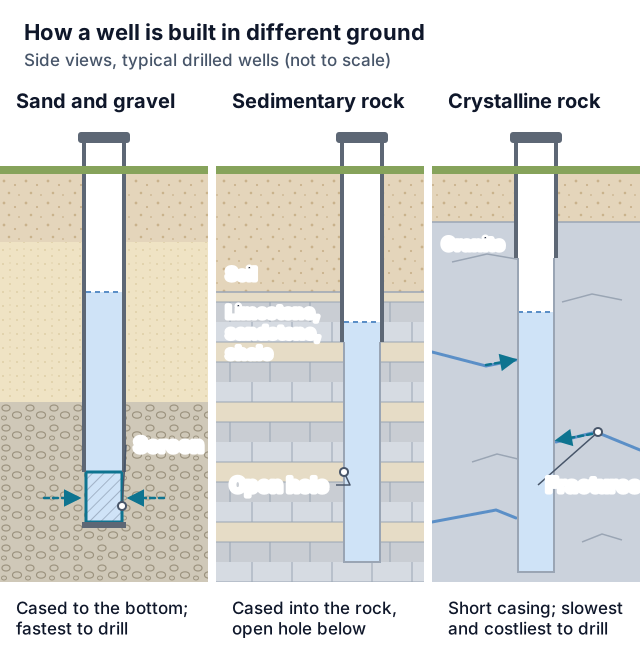
The U.S. Geological Survey's county study, Water-Supply Paper 1805 (1966, prepared with the Colorado Water Conservation Board), puts the western part of Huerfano County in the Southern Rocky Mountains and the rest in the Great Plains, with annual precipitation from about 14 to nearly 30 inches. It sorts the county's groundwater into two aquifer types: relatively thin alluvial deposits in the valleys and beneath pediments, and older consolidated bedrock such as sandstone and limestone, where water in most formations is under artesian pressure.
Wells here are permitted by the State of Colorado. Rule 6.2.1 of the Water Well Construction Rules (2 CCR 402-2, current version effective January 1, 2026) says no well may be constructed, repaired, replaced or modified unless it is associated with a valid well permit issued by the State Engineer, who directs the Division of Water Resources (DWR). Rule 6.3 sets a separate notice of intent for dewatering wells, monitoring and observation holes, and test holes that will penetrate a confining unit between aquifers. The Colorado Geological Survey places the Raton Basin and Huerfano Park within Water Division 2. This site is a referral service: it forwards Huerfano County requests to independently operating contractors and performs no well or pump work itself.
Huerfano County Service Details
What providers in this area actually see: coverage, common jobs, local pricing factors, and rules worth knowing.
Service Area Notes
- Any address in Huerfano County can be submitted. Colorado's 2020 place-by-county file from the Census Bureau lists the city of Walsenburg, the town of La Veta and the Gardner census-designated place in Huerfano County, and its current TIGERweb layers (January 1, 2026 vintage) add the Cuchara census-designated place, whose internal point falls inside the county.
- Looking up an existing well: DWR's Well Permit Search and map viewer cover all registered well permits, and DWR says a permit file holds the well's allowable uses, the original application and any available well construction and pump installation records. DWR's Beginner's Guide to Well Permits (updated October 2025) notes that a well built on or after May 8, 1972 should have such a file, while a residential or livestock well put to use before that date might not have a permit.
- Finding a contractor: DWR's well construction page links the State Board of Examiners' licensed contractor lists, and the Beginner's Guide says the Board publishes a quarterly list of licensed well contractors who can help owners plug a well properly.
Common Jobs in Huerfano County
- New household or livestock wells, applied for on DWR's Residential Water Well Permit Application, Form GWS-44
- Replacement wells, which carry over the original well's allowed uses and are applied for on Form GWS-44 or GWS-45, depending on the use of the original well
- Wells in valley alluvium or in bedrock such as sandstone and limestone, the two aquifer types the USGS county study describes
- Pump work: Rule 17.1.3 calls for a pump installation report every time a new pump goes into a well and for any change in the pump depth setting
- Cisterns tied into a well supply, which Rule 17.1.8 has the pump installation contractor or private pump installer document as installed and disinfected
- Post-construction well inspection reports for wells built on or after May 8, 1972 that have no construction report on file, signed by a licensed contractor or authorized individual (Rule 17.1.9)
- Plugging and abandoning wells that are no longer used, followed by a Well Abandonment Report to the State Engineer
What Drives Pricing Here
- Depth in Huerfano Park: the Colorado Geological Survey's Groundwater Atlas counts 136 water wells of record in Huerfano Park as of February 2001 and reports that about 70 percent were less than 100 feet deep and 90 percent were less than 325 feet deep, with water levels from near the surface to about 70 feet below it.
- Depth in the Raton Basin: the same atlas says that in Huerfano County water can generally be found in the Cuchara-Poison Canyon aquifer at depths of less than 200 feet in its outcrop areas, but that near the Spanish Peaks the aquifer may be dry to a depth of several hundred feet as a result of dissection by igneous intrusive rocks. For the Colorado part of the basin (Las Animas and Huerfano counties), where it counts almost 1,370 permitted water wells of record as of February 2001, it reports that the majority of permitted wells are less than 150 feet deep, 90 percent were completed at less than 450 feet, and the mean depth in its data set is 188 feet. These are basin-wide figures, not a forecast for any one lot.
- Yield and storage: the atlas puts about one-third of Huerfano Park wells below 5 gallons per minute and 90 percent below 20 gallons per minute, and says 85 percent of water supply wells of record in the Raton Basin reported less than 16 gallons per minute. DWR's guide says a low-yield well may still meet its purpose when used with properly sized storage tanks, water stored in the well itself and controlled pumping, gives 75 gallons per person per day for in-house use as a rule of thumb, and suggests that buyers consider a pump test by a qualified party such as a Colorado licensed pump installer or water well driller.
- Water quality: the 1966 USGS study found almost all alluvial water in the county hard, and most of it highly to very highly mineralized, some above 5,000 ppm dissolved solids. Rule 10.1.2 requires anyone authorized to construct wells to become familiar, before starting, with the area's potential aquifers, confining units, anticipated water quality problems and known contaminated water-bearing zones, and where necessary to advise the owner of possible poor water quality and plan how to resolve it before construction begins.
- Casing: Rules 10.4.2 and 10.4.3 call for watertight steel casing and joints from at least 1 foot above to at least 19 feet below ground level, whether or not the well has a separate surface casing string, with the annulus grouted under Rule 10.5 and the rules for that aquifer type. Rule 10.4.10 covers an outer casing cut off near the ground, and gallery wells and infiltration galleries need a Board variance under Rule 10.4.13.
- State fees versus our calculator: DWR's fee schedule (effective August 6, 2025) lists $100 for a new well permit application and $60 to replace a permitted exempt domestic, stock water or household well. Our calculator's estimate is depth times a per-foot rate tied to the geology option selected, plus a generic $200 to $500 permit allowance and pump and pressure-tank amounts drawn from national figures published by Angi, HomeGuide and HomeAdvisor; treat it as a planning number, not a quote or DWR's fee.
Permits & Local Rules
- Exempt wells, C.R.S. 37-92-602(1)(b): wells producing no more than 15 gallons per minute, used for ordinary household purposes, fire protection, watering poultry, domestic animals and livestock on farms and ranches, and irrigating not over one acre of home gardens and lawns, but not used for more than three single-family dwellings. Since July 1, 2006, subsection (3)(a)(II) allows such wells to be built only after a permit is issued.
- What a parcel can get: DWR's guide says household-use-only permits cover ordinary uses inside one single-family dwelling, with no outside watering or livestock, and are generally available for parcels created before June 1, 1972 or by a county exemption from subdivision rules; in most cases a parcel can have only one exempt well, and the in-house limit may apply to a new well on a parcel under 35 acres that is not in a court-approved augmentation plan. The broader domestic uses (up to three single-family dwellings, one acre or less of lawn and garden, domestic animals and livestock) may be available if the parcel is 35 acres or larger, is not in a court-approved augmentation plan or a subdivision created after June 1, 1972, and the well will be the only exempt well on a 35-acre or larger portion; or if the well is inside a Designated Groundwater Basin or the Denver Basin; or if it is not in an over-appropriated stream system, and the guide notes that most Colorado stream systems are over-appropriated, with only a few limited western-slope areas not considered so. DWR says no permit is guaranteed until its review is complete.
- Presumption of no injury, C.R.S. 37-92-602(3)(b)(II)(A): it applies to a (1)(b) well that will be the only well on a residential site and used solely inside a single-family dwelling with no irrigation, or the only well on a tract of 35 acres or more, or the only well on a cluster development lot serving one single-family residence where the development's withdrawals do not exceed one acre-foot a year for each 35 acres and the well is used solely for (1)(b) purposes; in each case the return flow must go back to the same stream system in which the well is located, and evidence showing material injury can rebut the presumption. Except as (3)(b)(IV) provides for an existing presumption well after its land is divided, under (3)(b)(III), for wells in a subdivision approved on or after June 1, 1972 whose water supply plan the State Engineer has not recommended for approval, the cumulative effect of all such wells is considered.
- Applying: DWR takes applications through its eForms dashboard or by email and does not process a form until the fee is paid. The person signing must be the applicant, an officer of an applicant company or agency, their attorney, or an agent authorized by a signed letter from the applicant or attorney. DWR says review of a complete application may take up to 49 days.
- Permit life: exempt and small-capacity permits are issued for two years, and the well must be drilled before the expiration date, with evidence of construction provided to DWR. An extension of one year at a time can be requested on Form GWS-64 with good cause, but only before the permit expires; after that a new permit is needed. Once the well was built on time, the pump can be installed and the well used at any time. If the work was done but forms were not filed in time, the guide points to State Engineer Guideline 2017-1 on reinstating expired permits.
- Who may drill or install pumps: C.R.S. 37-91-105(1), as amended by HB25-1165, requires an individual to obtain a Board license before engaging in the business of contracting for well construction, ground heat exchanger installation or pumping equipment installation, and to register each rig the individual or an employee operates or leases. Under 37-91-106 no license is required of an individual directly employed by or under the supervision of a licensed well construction, ground heat exchanger or pump installation contractor; of private drillers and private pump installers, who must still meet the construction standards of 37-91-110 and the Board's rules; or of a professional engineer, professional geologist or professional hydrologist, or anyone directly employed by or under the supervision of one, when sampling, measuring or test-pumping for scientific, engineering or regulatory purposes. Both private categories cover only work on a well entirely for the owner's own use: Rule 5.2.43 limits private drillers, and Rule 5.2.45 limits private pump installers, to well owners or their direct employees using the owner's own equipment (not rented, leased or hired) on land the owner owns (not rents or leases). Rules 6.1.1 and 6.1.2 require the private driller or private pump installer assessment before that work starts.
- On the job: Rule 6.2.2 makes the private driller, private pump installer or licensed contractor responsible for confirming a valid permit exists before and during the work. Under the official text of Rule 6.2.2.1, a copy of the permit must be available and posted at the well site at all times while a contractor works on a new well or performs work that requires a new well permit under Rule 6.2.1.2; DWR's well construction page words this more broadly, as any work that requires a well permit under Rule 6.2.1. If the permit's conditions call for it, the contractor gives the State Engineer advance notice before constructing the well, first installing the pump or installing a cistern connected to the well supply; DWR's well construction page asks for that notice by 11:59 pm the day before. All permitted work must be finished before the permit expires. Rule 6.2.1.2 calls for a new permit before changing a permitted well's production or grout interval, installing certain dewatering systems or installing pumping equipment that allows a sustained rate above the permitted rate, while Rule 6.2.1.3 lets casing or pumping equipment be pulled for repair or replacement without a new permit if the perforated interval is not altered and the production rate stays within the permit. For repairs, if a permit cannot be verified within 30 days of the work, Rule 6.2.2.2 has the individual notify the State Engineer on its form unless the work already calls for a construction, pump installation or other report.
- Siting, Rule 10.2.2: a well may not be closer than 100 feet to the nearest existing source of contaminants or 50 feet to a septic tank, exterior sewer line or other above- or below-ground vessel containing contaminants (excluded are properly maintained vessels for permitted chemigation products, properly maintained vessels mounted on vehicles, and properly maintained vessels mounted or carried on equipment used to build wells or install pumping equipment), measured at the time of construction. A well that cannot meet that spacing needs a variance request, prepared by a water well construction contractor or authorized individual from hydrogeologic information and meeting the Figure 4a or 4b minimums to the greatest extent possible, and written Board approval before construction. Rule 10.2.1 applies any stricter federal, state, county, municipal or local distance, and when a well being replaced sits less than 100 feet from a contaminant source, Rule 10.2.3 bars the replacement from being closer to that source and keeps the base of its grout seal at least 100 feet (Figure 4a) or 50 feet (Figure 4b) from the source's perimeter unless a variance is granted.
- Reports, Rule 17: the Well Construction and Yield Estimate Report, the pump installation report and the Well Abandonment Report, each with the contents Rule 17.1 lists, go to the State Engineer within 60 days after the work is completed or within 7 days after the permit or other authorization expires, whichever is sooner. They are signed by the contractor or authorized individual responsible, or by the private driller or private pump installer who did the work, and contractors must give the well owner a copy.
- Plugging, Rule 16.1: the well owner is ultimately responsible for having an unused well properly plugged, sealed and abandoned, the contractor or authorized individual must tell the owner of these requirements in writing, and pumping equipment comes out first. Licensed water well construction contractors may plug any type of well or hole; licensed pump installation contractors only wells that do not need casing removed where it penetrates more than one aquifer or casing ripped or perforated opposite confining units; authorized individuals only monitoring and observation wells and holes, dewatering wells, piezometer holes and test holes that do not penetrate a confining unit; private drillers and private pump installers only wells they own that need no casing removal (apart from cutting the top off below ground), ripping or perforating, and only after consulting a licensed water well construction contractor or Board staff. Backfill must be clean, inert and free of contaminants, and if casing is cut off below ground, Rule 16.1.4 requires either grout in the top 5 feet of the remaining casing, or a watertight cover permanently attached with the excavation filled with material no more permeable than the surrounding soil and compacted. The fill and grout methods for each aquifer type are set out in the rest of Rule 16.
- Buying a property: DWR's guide says that for residential sales on or after January 1, 2009 involving an existing well not yet registered with DWR, the buyer must complete a registration, with the forms, supporting documents and fees due within 60 days of closing; the seller may do it instead. Form GWS-12 covers residential and livestock wells built and put to use before May 8, 1972 and used for the same purposes since. Wells built on or after that date, or whose use changed or expanded after it, go on Form GWS-44, with a Post-Construction Well Inspection Report (GWS-68) or a construction report signed by a licensed water well contractor for the newer wells, or a Statement for Wells Constructed Prior to May 8, 1972 (GWS-81) signed by the owner for older ones.
- Septic work on the same lot: the Las Animas-Huerfano Counties District Health Department permits on-site wastewater treatment systems in both counties, requires the permit application and fee to be submitted and approved before installation begins (a permit may also be required to repair, replace or alter a system), and its application asks for a measured plot plan showing the property dimensions and size, existing and proposed buildings, the proposed septic tank, treatment area and alternate area, water supply lines, all existing or proposed wells on and within 150 feet of the property, and streams, lakes, ditches and drainage areas on or within 50 feet.
Geology & Water Table Notes
- Raton Basin: the Colorado Geological Survey describes a north-northwest trending structural basin in Las Animas and Huerfano counties that runs from near the Huerfano River valley south into New Mexico. It groups the Raton, Vermejo and Trinidad formations as the Raton-Vermejo-Trinidad Aquifer, the basin's deepest, and the sandstones and siltstones of the Cuchara and Poison Canyon formations as the Cuchara-Poison Canyon Aquifer, whose water generally meets the 500 mg/L secondary standard for total dissolved solids around the basin edges and becomes less potable toward the center.
- Huerfano Park: the atlas places the Wet Mountain Valley and Huerfano Park in parts of Fremont, Custer and northwestern Huerfano counties, calls Huerfano Park a very complex structural basin on the east side of the Sangre de Cristo Mountains, and says its streams generally flow south toward the Huerfano River, a tributary of the Arkansas. It reports that most groundwater withdrawals in the two basins come from basin-fill deposits, including units of the Dry Union, Farisita, Huerfano, Cuchara and Poison Canyon formations.
- Rock at the surface: the USGS state geologic map compilation lists the Poison Canyon Formation and undivided Pierre Shale at 12 percent each of the county's surface, the Niobrara Formation at 11 percent and the Cuchara Formation at 10 percent, and notes that its Huerfano Formation unit includes the Farisita Conglomerate in northwestern Huerfano County.
- Valley alluvium: the 1966 USGS study found alluvium up to about 50 feet thick in Huerfano Valley and probably no more than 30 feet in the valleys of the Cucharas River and Bear, Santa Clara, Muddy and Apache creeks, and said the alluvium of smaller valleys yields enough water for domestic and stock use only in a few places.
- Bedrock aquifers: the same study names the Entrada Sandstone, the Cheyenne Sandstone Member of the Purgatoire Formation, the Dakota Sandstone, the Greenhorn Limestone, a limestone-sandstone aquifer, the Trinidad Sandstone, the Vermejo and Raton formations, and the Poison Canyon and Cuchara formations as able to supply domestic and stock water, adding that other formations may yield small supplies locally. It read the near absence of water in many interstream coal mines as a sign of comparatively little movement along the strike of the coal-bearing rocks, suggested the many igneous dikes radiating from the Spanish Peaks and Dike Mountain may impede it, and noted that some dikes may transmit water readily.
Communities Served
Walsenburg · La Veta · Gardner · Cuchara · Huerfano Park
Emergency Response Expectations
When an existing well that supplies drinking water to one or more occupied dwellings or to livestock has to be replaced, DWR's emergency procedures (October 2022) let the replacement permit be prioritized, with residential and livestock approvals possible as soon as the next business day; the same procedures cover a driller on site who finds the well would be more than 200 feet from the permitted location or must be completed in a different aquifer, and the new permit must be approved before the contractor moves or drills into the other aquifer. A licensed well construction contractor must be named on the application, which is marked as an emergency and sent with the fee and the date the contractor expects to be on site, and an unregistered exempt well put to use before May 8, 1972 also needs a registration application. DWR's table sends Division 2 (Arkansas River Basin) applications to its Denver office. Rule 19 lets emergency replacement wells begin only after the State Engineer approves, and DWR says construction may not begin until the licensed contractor has received the permit.
Huerfano County FAQs
Who issues well permits in Huerfano County?
The State Engineer, through the Colorado Division of Water Resources; Rule 6.2.1 requires a valid permit from that office before a well is constructed, repaired, replaced or modified, with Rule 6.3's notice of intent covering certain test, monitoring and dewatering holes instead. The Las Animas-Huerfano Counties District Health Department handles septic system permits, and Rule 6.6 says work must also meet any stricter federal, tribal, state, county, municipal or local requirement.
What does a residential well permit application cost?
DWR's fee schedule lists $100 for a new well permit application and $60 to replace a permitted exempt domestic, stock water or household well. Fees are non-refundable and subject to change, and DWR's payment table shows a $100 application costing $103.02 by card or $101.00 by eCheck.
Can I drill or plug my own well?
An owner can work as a private driller only on a well entirely for the owner's own use: the owner or a direct employee using the owner's own equipment (not rented, leased or hired) on land the owner owns (not rents or leases), after completing the private driller assessment, with a valid permit and under the Board's construction rules. Rule 5.2.45 sets the same limits for an owner installing a pump as a private pump installer, who completes the private pump installer assessment first. The private driller signs and files the construction report for that work. Owners may plug only their own wells that need no casing removal (other than cutting the top off below ground), ripping or perforating, after consulting a licensed water well construction contractor or Board staff.
How deep are wells in Huerfano County?
As of February 2001, the Colorado Geological Survey counted about 70 percent of Huerfano Park wells under 100 feet deep, and said water in the county's Cuchara-Poison Canyon aquifer can generally be found at less than 200 feet in outcrop areas, while near the Spanish Peaks the aquifer may be dry to several hundred feet. DWR's Well Permit Search pulls up permit files for nearby wells, which can include their construction records.
Where do Huerfano County residents send well water for testing?
The Las Animas-Huerfano Counties District Health Department provides testing kits to residents on private wells, springs and cisterns. It says samples must go directly to the Pueblo Department of Public Health and Environment Laboratory, which treats samples more than 30 hours old as unsuitable and takes deliveries Monday through Wednesday, and the department lists that lab's fees as $25 for potability and $27 for enumerated testing, subject to change. CDPHE's State Public Health Laboratory has temporarily suspended water chemistry testing but still offers bacterial tests, including total coliform and E. coli, and CDPHE links a list of accredited labs.
What should a Huerfano County well be tested for?
CDPHE recommends total coliform bacteria, total dissolved solids, nitrates/nitrites and pH every year; arsenic, copper, fluoride, hardness, iron, lead, manganese and uranium every 3 to 5 years; and a longer panel, including PFAS and a volatile organic compounds screen, for a new well or one with no known testing. It also lists reasons for an extra test: a pregnancy or a child joining the household, unexplained stomach illness among people drinking the water, contamination found in a neighboring well, a change in the water's taste, odor, color or clarity, a chemical or fuel spill in or near the well, replacement or repair of any part of the well system, and a flood, fire or other natural disaster near the well.
What happens to the old well when I drill a replacement?
Under C.R.S. 37-92-602(3)(c), an application to relocate a well of the kinds listed in (1)(b) to (1)(e) must state the intent to abandon the existing one, and when the new well will not substantially change the water use, the permit is issued and the old well must be abandoned within 91 days after the new one is completed. Absent a showing by a preponderance of the evidence, the statute presumes no substantial change when the old well was built under a State Engineer permit and the new one is within 200 feet, in the same aquifer, for the same historical use, and at the same or lower annual volume and gallons-per-minute rate.
Sources
- Colorado DWR: Well Permitting
- Colorado DWR: Form Submittal, Payment Options and Fee Schedule (November 19, 2025)
- Colorado DWR: Beginner's Guide to Well Permits (updated October 2025)
- Colorado DWR: Procedures for Emergency Approval of Well Permits (October 2022)
- Colorado DWR: Well Construction and Inspection
- Code of Colorado Regulations: 2 CCR 402-2, Water Well Construction Rules (effective January 1, 2026)
- Colorado General Assembly: Colorado Revised Statutes 2024, Title 37 (37-91 and 37-92-602)
- Colorado General Assembly: HB25-1165 session law (amending 37-91-105 and 37-91-106)
- CDPHE: Private well water and your health
- CDPHE: Water testing services, State Public Health Laboratory
- CDPHE: Find your local public health agency
- Las Animas-Huerfano Counties District Health Department: Drinking Water Testing
- Las Animas-Huerfano Counties District Health Department: OWTS permits and installation
- Las Animas-Huerfano Counties District Health Department: OWTS permit application
- Colorado Geological Survey: ON-010 Colorado Groundwater Atlas (Raton Basin; Wet Mountain/Huerfano Park)
- USGS Water-Supply Paper 1805: Ground water in Huerfano County, Colorado (1966)
- USGS mineral resources data: State Geologic Map Compilation units mapped in Huerfano County, CO
- U.S. Census Bureau: 2020 place-by-county list, Colorado
- U.S. Census Bureau TIGERweb (current): Cuchara CDP
- U.S. Census Bureau TIGERweb (current): county containing the Cuchara CDP internal point
Last reviewed 2026-10-28
Nearby Counties
Services Available in Huerfano County
Well Drilling
New residential wells — find local drillers for site evaluation, depth estimates, and written drilling quotes.
Learn more →Water Well Drilling
Household water wells from site evaluation through casing, pump, and water test — written quotes from local drillers.
Learn more →Well Pump Repair
No water at the tap? Request urgent well pump repair — local pros diagnose pressure loss, dead pumps, and pressure tank failures fast.
Learn more →Well Pump Replacement
Pump at end of life or beyond repair? Get quotes for correctly-sized submersible and jet pump replacement from local well pros.
Learn more →Well Inspection & Testing
Buying a home with a well, or overdue for a water test? Local pros for flow tests, equipment inspection, and lab water-quality testing.
Learn more →Well Water Service
Water quality problems, treatment systems, and general well maintenance — connect with local pros for everything between drilling and pump work.
Learn more →Free Tools Before You Call
Ballpark the cost or narrow down the problem before talking to a Huerfano County provider.
Well Drilling Cost Calculator
Estimate what drilling a well should cost — by depth, geology, and whether you need the pump and pressure tank included.
Use the free tool →No Water From Your Well? Diagnostic Wizard
Suddenly no water in the house? Answer a few questions to find out if it's the breaker, the pressure switch, the tank, the pump — or the well itself.
Use the free tool →Well Pump Size Calculator
Find what size well pump you need — GPM demand, total dynamic head, and a horsepower recommendation from four quick inputs.
Use the free tool →Need help in Huerfano County, CO?
Send the short form — urgent requests get priority routing.